As revenue-depleted hometown newspapers shrink and shut down, a roughly decade-long rollout of nonprofit news organizations has yielded cash and innovations aimed at filling gaps in local coverage and tangibly supporting local reporters.
Those efforts range from the Knight Foundation-launched News Match project to ProPublica’s Local Reporting Network to a local news-focused collaboration among the Institute for Nonprofit News, Independent Online News Publishers and News Revenue Hub that, among other gifts, received $1 million from Facebook.
“It’s helped me report on things in a way I never could have done otherwise,” said Benjamin “Benji” Hardy, a Little Rock-based freelancer, of being an Arkansas Nonprofit News Network grantee. “It’s allowed me the sort of sustained, blow-by-blow coverage I want to do. It’s allowed me two things: depth and volume.”
His network-funded reporting, as examples, delivered news articles about thousands of Arkansans unwittingly being dropped from Obamacare rolls and the state’s troubled juvenile justice system. That work was published on the nonprofit’s new site but also by, among others, the Arkansas Times, a for-profit alternative print and online publication established after the family-owned Arkansas Democrat bought the Gannett-owned Arkansas Gazette in 1991, forming a single publication and laying off dozens of employees.
In addition to getting published by the Arkansas Times, journalism underwritten by the Arkansas Nonprofit News Network, itself a grantee of, among others Knight’s News Match and the John Logan Family Foundation, gets picked up by 20 of the state’s largest newspapers, TV stations and National Public Radio affiliates.
Cross-posting and -airing work by journalists from nonprofit news operations is a hallmark of that sphere, said Emily Ramshaw, editor-in-chief of the public policy-, politics- and government-focused Texas Tribune, an inventive and financially stable digital-first, nonprofit newsrooms.
“On any given day, across Texas, you will see Texas Tribune articles all across the front pages of other publications … ” Ramshaw said. “We are like a free Associated Press of Texas Capitol coverage. The importance of that has only made us more committed to our mission.”
The Tribune’s model includes its Texas Tribune Speakers Bureau, Texas Tribune Events, Texas Tribune Festival, other ticketed affairs and paid sponsored content, feting its audience to thought-leaders, researchers, scholars, disrupters and others across a span of political parties, think tanks, academic institutions and grassroots groups.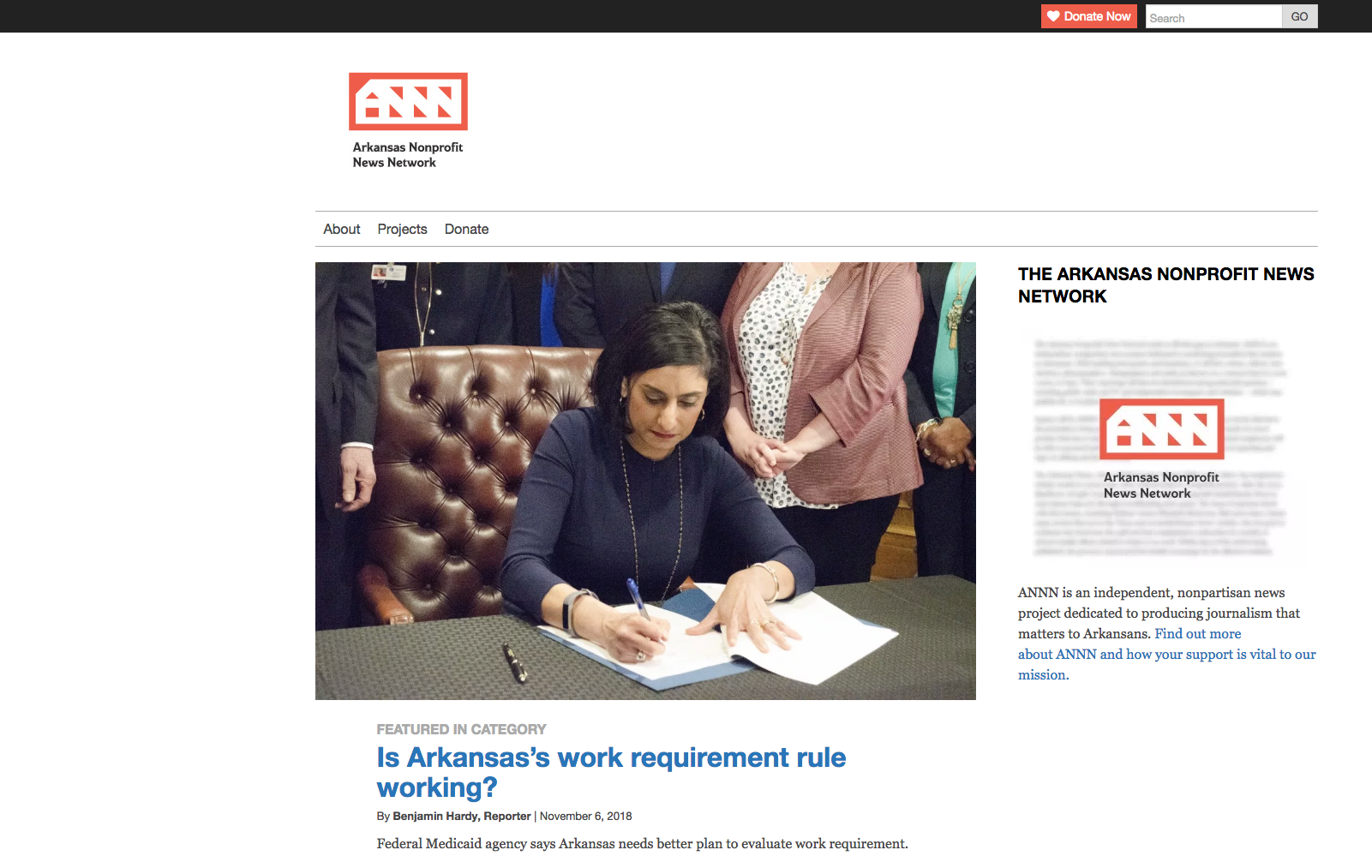
Arkansas Nonprofit News Network
Those combined efforts yielded, according to the Tribune, a monthly average of 1.4 million unique visitors — inside and outside of Texas — and 4.5 million page-views in 2017. Its audience skews young, with the 25-to-34 and 35-to-44 age groups each comprising 23 percent and the 65-plus set 9 percent of that audience. The youngest subgroup, 18- to 24-year-olds, comprised 13 percent in 2017.
Alex Samuel, 23, started out as a reporting fellow at the Tribune, which crowd-funded the salary paying her to come aboard full-time. In addition to reporting, she’s in charge of social media engagement, including on the Tribune’s Facebook page.
“Every day, I make sure we have fresh content in the group, whether that’s posting news stories or asking questions to the group for their feedback,” she said.
“For the month of November, our discussion topic is infrastructure. So, this week, I posted, ‘Hello, we’re back again after Veterans Day. We’re going to talk about … highways, ride-hailing, public transit, et cetera. Here are some discussion questions to get the group going and here are 10 stories from outside places that touch on infrastructure.’ I ask them to join me in adding to that list of stories.”
Such back-and-forth between journalists and news consumers seems especially critical in these times, said Amanda Quraishi, whom Texas Tribune EIC Ramshaw calls a “super fan,” donating to and raising money on behalf of that news outlet.
“That there is a source for professional, ethically produced journalism we can tap to get the valuable information we need when as we engage about how politics and government affect our lives, the way we educate our kids — so many things — is amazing,” said Quraishi, social media director for the Texas Association of School Boards.
“The Tribune,” she added, “is constantly adapting to this new landscape. This whole idea of producing digital media, without a pay wall, making it available for other news organization to share and reprint seems almost counter intuitive and way ahead of what [others] have done.”
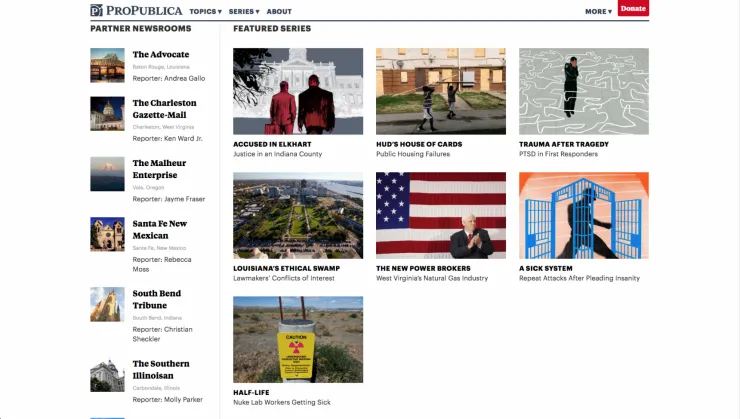
Ensuring that local news gets covered, especially the hard issues, is what drives ProPublica’s Local News Network of investigative journalism fellows from across the country, said Charles Ornstein, who traded a high-profile gig as a national health care reporter to direct those fellows, who are paid a year’s salary and health benefits commensurate with what full-time ProPublica staffers get.
“We also provide [fellows with] what I consider is Pro Publica’s special sauce: research support and social support and community engagement, people who can help local reporters analyze data and build tools that let the community interact with them,” Ornstein said. “Rather than just telling a story in words, with Pro Publica’s help, those reporters are taking data and letting people look up their doctor or school. Instead of just reading the story you’re able to tell your own story.”
Rattling off a shortlist of current fellows and their projects, he pinpointed New Mexico journalist Rebecca Moss’s coverage of Los Alamos National Laboratory’s failure to protect its workers from deadly exposure to radiation.
“We commissioned an artist to illustrate the piece and linked her with RaCon,” Ornstein said, referring to the latter’s software analyzing radiation exposure. “What we are able to do was raise her ambition and the paper's ambition for what they could do. We have additional plans for the work. What she put together was an amazingly rich narrative that her paper devoted eight pages to.”
Across the nonprofit news spectrum, the quality of the journalism has varied greatly, said former print and broadcast journalist Karen Rundlet, director of the Knight Foundation’s journalism program.
Still, what particularly excites Knight, she said, are the ways in which some nonprofits are breaking conventions. Take, for example, Chicago’s City Bureau.
“They have a project called The Documenters” training everyday people to collect and cull information, Rundlet said. “They’ve got citizens who are interested in being part of the newsgathering process and going to meetings and becoming a documenter.
She continued: “Here’s the thing, there are fewer local reporters anymore. Most people who aren’t journalists don’t have the opportunity to meet a journalist anymore because there are so many fewer journalists. So, what’s going on, around collaboration, is different and unique … In Philadelphia and Charlotte, Solutions Journalism Network is bringing organizations together. The players may be, like, a university, the legacy newspaper, the digital start-up that only works on digital planning issues, the black-owned radio station, a documentary filmmaker … ”
It’s an approach shaped by region and locale but, perhaps, even more so, by access to finances, said the Arkansas Nonprofit News Network’s founder, chief executive and chief fundraiser Lindsey Millar, also Arkansas Times editor-in-chief.
“The nonprofit news media that have been most successful — and this is my broad brush — usually started with large money from venture capital folks with big successes in other industries. Pro Publica, Texas Tribune and The Marshall Project, Mississippi Today and Smart City in Memphis all had big money,” Millar said.
“I hope that continues. I hope it means that people with means get excited about journalism and public interest and investigative journalism. But it’s always dicey when you have one or two big funders that you’re relying on. And I’m not sure how all of this is going to shake out.”