The survival of local journalism is finally getting the public attention it deserves. But the question now is: Will it make a difference?
I certainly hope so. Despite ominous signs with downsizing continuing at local newspapers and now even at some of the digital upstarts that were supposed to harken a new future for the craft, there are sprouts of optimism. City Bureau, Resolve Philadelphia and Outlier Media have all been pegged as promising approaches for delivering local news.
When I talk about the crisis in local news, I am not talking about the major national newspapers, such as The Washington Post and The New York Times, or even networks like ABC, CNN or Fox. They have done quite well in rough and tumble Trump world. Is that sustainable? We’ll have to wait and see.
But local journalism is where accountability journalism matters most. It is focused on how dollars are spent and how priorities are set on the local level. It is often that base level reporting that becomes the seed corn for bigger national stories with datelines from the heartland and the tiniest suburbs.
Even if you are agnostic about platform, you have to be worried about local journalism’s very survival. That’s why I am rooting for those local startups that with the right support can combine with what we have left to keep journalism alive. And I am just about willing to consider any viable solution that doesn’t change the core mission of the craft.
There was a glimmer of hope before the fade
I left the business in 2016 because I concluded hedge funds and investment banks that dominated ownership of local newspapers were not committed to the mission of serving the public interest. But I freely admit that between 2009 through 2014, I was feeling pretty optimistic that newsrooms might make it across the digital divide because of efficiency and creativity.
The editors had become better managers. With no deadwood to move around any longer, they focused on getting the most out of all who remained, aware that any departure might go dark during these tighter times. We were more selective about what we covered and our story recognition was sharper. We jettisoned low-level rote reporting in favor of higher impact news. And we were taking advantage of digital tools to multi-task and become better storytellers — packaging compelling reporting, writing, video and photography that was growing audience.
We were creating all kinds of apps, and were blogging, tweeting, Facebooking … you name it. If the top business leadership had been as committed to building the business as the newsroom editors were committed to building the audience, I really think we’d be in better shape today.
I am encouraged by Google and now Facebook each committing $300 million to help support local journalism, to make subscribing easier through their platforms and combatting fake news. I’d probably be even happier if they each doubled down on that financial commitment and threw in even more technology help.
Nothing wrong with trying everything
I’m encouraged by what we are seeing from philanthropy. The Knight Foundation continues to step up with huge investments. They have been joined by the likes of Pierre Omidyar’s Democracy Fund, John D. and Catherine T. MacArthur Foundation, The Lenfest Institute and ProPublica. More recently, the Gates Family Foundation and Bonfils-Stanton Foundation helped Colorado Public Radio finance a takeover of digital startup, Denverite, which was about to go under.
But I’m also intrigued by the BBC model that works in the United Kingdom and the Corporation for Public Broadcasting that supports public radio and television in the United States. I completely understand in the age of Trump and his incessant attacks on the media that this is not a great time to be advocating for any government involvement in the news.
Still, is there something to be explored, especially with Canada already having approved nearly $600 million in government subsidies to help struggling local newspapers? Then New Jersey — of all places — is looking to use $5 million in government funds to support communities bereft of local news. The details remain to be worked out, but the imperative to buttress local news is clear.
We all need reality checks
Feeling a bit out over my skis when it comes to government subsidies, I reached out to three respected contemporaries who I served with on the Pulitzer Prize Board to get their views on the state of local journalism and their thoughts about the future.
Ann Marie Lipinski, the curator of the Nieman Foundation and former editor of the Chicago Tribune, sees this as a pivotal moment. “I do think you're seeing the signs of a public that is starting to understand the costs of disappearing journalism. That was not true even three years ago,” she said. “It feels like we are finally crawling our way out of the ‘information wants to be free’ era and into a realistic understanding of what it takes for journalism to not only thrive, but to exist.”
Retired longtime executive editor of the Associated Press, Kathleen Carroll, is worried that local news operations are so diminished that the climb back may be too steep. “I feel the advertising model, the business model and the people who are in a position to have an impact on local news are just under threat in a really terrible way,” she said. “There are a lot of communities that are having trouble supporting even the most basic local journalism. And I say this with the humility of a former local journalist and with respect, but I feel like a lot of news organizations are not in a position to do the kind of work that will make a difference.”
I agree the talent drain has been severe and many of the reporters who remain are young and overburdened. Between 2008 and 2017, the Pew Research Center reported that roughly 32,000 newspaper journalist jobs have disappeared and news deserts are increasing.There is little doubt the local journalism watchdog is slowly being put to sleep.
Added Carroll: “You can't pay somebody $40,000 a year and expect them to tweet and cover 12 things and then for them to have a brain cell left to say, you know, we are going to look back at five years’ worth of budgets to find out where is all the money going for schools, why are staircases rotting and why are the town fathers spending this much money on this kind of curbing.”
There is no telling how many stories are being missed, but we know the public is learning about important misbehavior late. Case in point: the water crisis in Flint, Michigan. The public only learned about contaminated drinking water in the city after a lot of damage had been done, despite government knowledge of the problem. With properly resourced local news operations, communities have a real chance to learn what’s being done to them in real time and not after the fact. That’s what is at stake.
Jim Amoss, the former editor of the Times-Picayune in New Orleans for 25 years before retiring in 2015, believes despite challenges, local news is successfully evolving. “We really have to make a distinction between traditional print-based journalism and just pure local journalism as it's evolving,” he said. “I'm on the whole pretty optimistic about it. I don't think I'm kidding myself. I know how much news staffs have shrunk.
“But I think what's happened to news organizations has had a silver lining. It's forced innovation, it’s forced news organizations to make value judgments and to weed out things that aren't absolutely essential and to focus on what the mission is. To my mind, that's a good exercise and it has to be a continuing exercise and it cannot stop. I think the future belongs to the people who engage in that exercise and who just understand their communities and innovate relentlessly.”
We have to find a financial model that works
The question is what a funding mechanism for local news might look like in the future. Lipinksi thinks philanthropy has an important role to play. She recalled that it took time for people to accept that foundations and donors were going to have to play a role in funding museums, orchestras and the ballet.
“Are we at a point where we can accept that about journalism, where we say this is a value to society, it's a necessity to a democracy and we're going to have to put more of a burden on the philanthropic community to maintain the health of the industry? I think that's the question that a lot of philanthropists are taking to heart. It's not just the Knight Foundations of the world now. You have organizations and individuals saying, ‘I’m going to shift my priorities to include journalism.’ I think that's been a healthy contribution.”
Lipinksi, Carroll and Amoss have far more reservations than I do about exploring public subsidies for local news. I’m thinking we might explore something similar to the system we have for political campaigns, where the public can designate a contribution from their state income tax return. It could even be a broader public assessment. A lot of safeguards need to be erected, I know, but just because it is hard does not mean it can’t be done.
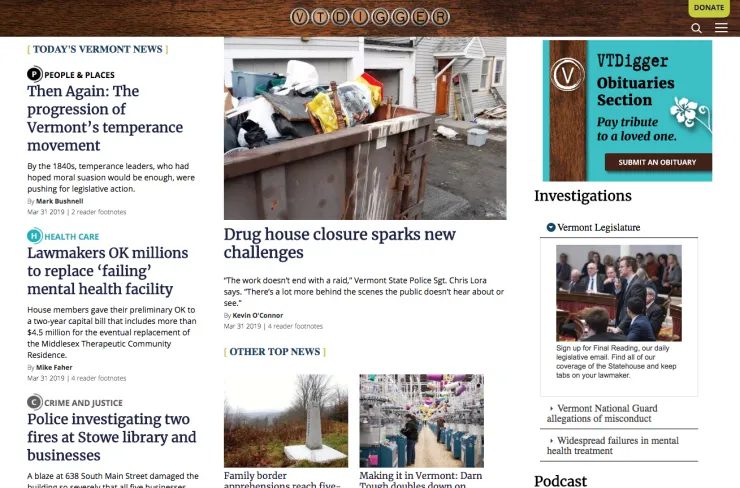
Carroll argues that when government entities have their hands on the purse strings, they have a tendency to pull them tighter, as we’ve seen with funding for public radio and television. She prefers industry players keep trying to stand up a digital-subscription model. “I have a lot of faith in finding your audience and appealing to their interest in the topics that you can cover and see if you can make a go of it that way.” She is particularly impressed with VTDigger, a statewide non-profit website that, since 2009, has reported on Vermont politics, business and consumer affairs. And it’s growing.
Adds Amoss: “I think it's a very slippery slope to the control of content and censorship, and ultimately perhaps the death of a free press. But I do think that there are ways that with a combination of advertisers and foundations doing more than they're doing now and consumers paying more than they are now, that you can stitch together a viable future.”
Every day that passes by another local newspaper inches closer to death. I just hope we have given the public enough to fight for and to fight about. The very survival of local news is at stake.