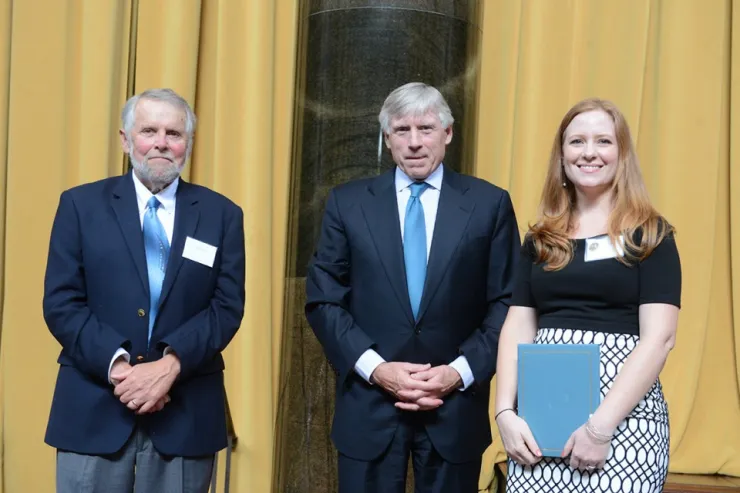
Lisa Falkenberg, 2015 Pulitzer Prize winner in Commentary, spoke to Pulitzer.org about her decision as vice president and editor of opinion at the Houston Chronicle to participate in the Boston Globe-led effort to support the First Amendment in the response to the White House's assault on the press.
Why launch this effort now?
LISA FALKENBERG: President Trump is certainly not the first president to excoriate the press. Nixon compiled a list of press enemies and had them audited. His Justice Department sued the Times over the Pentagon Papers. President Obama said the right things about respecting the press’ role, but his administration was famously opaque and his Justice Department prosecuted leakers and seized journalists’ phone records. At one point, ASNE had to fight to get Obama to allow access to photojournalists, rather than handing out official photos that amounted to visual press releases.
So, why are newspapers nationwide writing their own editorials now about Trump’s treatment of the news media? Because Trump’s undermining of the press isn’t just taking place the back rooms of bureaucracy. It’s front and center in press conferences, at rallies, on Twitter. And it’s incessant. The Anti-Defamation League’s "Pyramid of Hate" is an illustration that shows how mere bias can progress to harsh words and bullying, and ultimately, to violence, if a society comes to accept it as normal.
Certainly, the risk to the safety of journalists is a concern. In other countries where regimes are hostile to the press, attacks on individual journalists are commonplace. But more insidious is the undermining of the messenger’s credibility.
In our democratic republic, the most important messenger — a free and independent professional press, protected by the First Amendment — is essential in keeping the public informed so people can hold elected leaders and other power brokers accountable. If the public loses all trust in that messenger, truthful messages will be discarded, fact becomes subjective, and people may come to believe that the best version of the truth can be found in an official government press release.
If people stop trusting the press, they lose their check on government, and they lose power.
What do you collectively hope to achieve?
LF: It’s important to note that independent newspapers are not "colluding" here on content. If we are in cahoots, it’s because of our shared support of the First Amendment, our duty to inform the public, and our desire as journalists to do our jobs without fear for our safety.
Each newspaper is writing its own editorial. In Houston, our goal is not to antagonize the president or his supporters. It is not to pretend that President Trump is the only U.S. president to ever to ridicule or stymie the press. He’s not. It is to ask readers to balance the president’s incessant rhetoric with an acknowledgement of the necessary role of journalists in keeping our democratic republic afloat. It can’t survive without professional journalists asking the hard questions no powerful person wants to answer.
Here in Houston, we’re asking our readers to remember that politics makes up only a fraction of our coverage. Our journalists are not enemies of the people. Every day, we fight true enemies of the average American: corruption, government waste, and failed policies that actually affect people’s lives — from an illegal state policy that deprived thousands of Texas children of special education services to breakdowns in leadership and infrastructure that worsened the flooding and devastation after Hurricane Harvey.
The calling of many journalists is to expose problems with the ultimate goal of fixing them. Our criticism isn’t gratuitous, or personal or flippant. It is thoughtful, constructive and vital. The collective nature of this effort allows newspapers to spread that message wider than any one of our organizations could do alone.
Is it a one-off or the start of something bigger?
LF: Honestly, there is nothing novel about the point of this editorial. We have spotlighted before the press’ essential role in ensuring open, accountable government and we will likely do so again.