Editor's Note, 9/7/17: With the Deferred Action for Childhood Arrivals (DACA) policy's future in question, revisit Jonathan Freedman's prize-winning editorials on immigration in California.
Twenty-eight years after Jonathan Freedman won the 1987 Pulitzer Prize for Editorial Writing, an interviewer asked him how the winning work came to be.
Freedman answered:
“I was 30 years old, unemployed, freelancing in Haight-Ashbury. I went down to San Diego for a job interview at the Tribune. The editor took me to the cafeteria. ‘Jonathan, on my way to work, I saw these poor migrant workers hiding in the bushes in the rain. I’ve worked for this newspaper for 30 years. Every day we report murders and terrible things on the border. But we’ve never gone into depth on the issues underlying illegal immigration. If we did that, we could win a Pulitzer Prize.’
“I needed a job. The idea of a Pulitzer Prize was beyond my imagination. I got hired and trained as an editorial writer. Six months later, I said, ‘Mr. Bennett, do you remember what you said about the border?’ ‘Yeah, but we have no time,’ he said. ‘Write me a proposal.’ So I wrote, ‘The border between Mexico and the United States is where water flowing from the Colorado River stops, and a river of humanity flows northward from Mexico to United States.’
“ ‘Bull! You don’t know anything about the border. Tomorrow, you’re going to the border.’
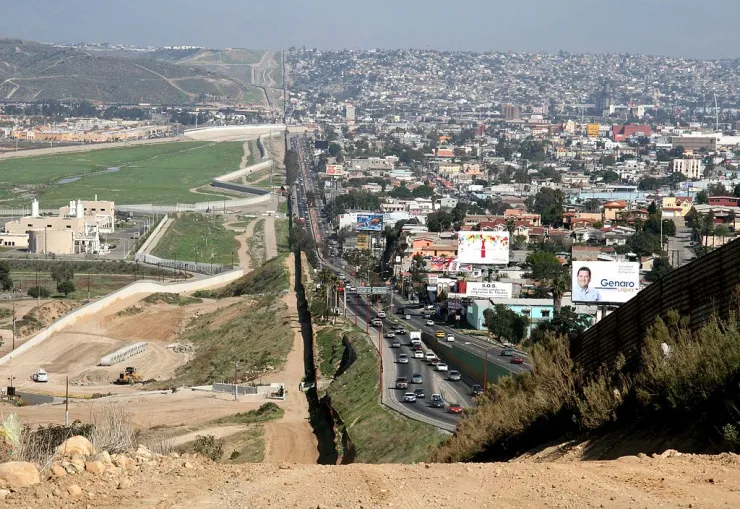
“So, the next day, I went to the border outpost at the extreme southwest corner of the United States and Mexico. I saw a hole in the chain-link fence. It was the size of a crouching man. Then I interviewed the border patrol agents. They told me how they’d get alerted when someone trips a wire. They’d chase them; they’d arrest them; they’d deport them. And the next day, they’d be back. I saw a holding tank for people who had been caught trying to cross the border. It was dark and dingy and someone had written on the wall mojado power, ‘wetback power.’
“So I came back and I wrote an editorial. There’s a hole in the fence between Mexico and the United States. Each year, thousands of people cross the border illegally. Their first act is to violate law. They’re hunted like animals.
“That began a series of editorials exploring illegal immigration from different points of view. Every week, I would go to a new place. I would go into Mexico, follow the people across the border, go to the strawberry fields. I asked the same questions: ‘What can we do to protect our borders? What can we do to help the people living here illegally? They’re providing food, harvesting crops, doing all kinds of jobs. But they have no rights.
“I wrote a series of editorials that began in 1981 and continued for six years. Our purpose was to convince Congress to pass a just and compassionate law. My editorials from the border were read in the halls of Congress. They were instrumental in the passage of the Immigration Reform and Control Act of 1986. The law granted legalization to over two million people.
“I was awarded a Pulitzer Prize in Distinguished Editorial Writing in 1987. But the law did not solve all the problems of immigration.”
Here is Freedman’s editorial of April 3, 1986, from the prize-winning package.
Easter sunrise on the border ends in trauma
By JONATHAN FREEDMAN
The night before Easter, three companeros crawled through a hole in the chain-link fence — into America. The border where they crossed is a no-man’s land. But in the spring, yellow flowers bloom waist-high beside the torn fence.
The companeros stopped to rest. Tomorrow was Domingo Santo, the holy day when the crucified Jesus rose from his tomb.
They laid a blanket under the flowers near a dirt track. They lay down and nestled together.
In the darkness, the fence was silhouetted against the garish lights of the Zona Norte, the red-light district of Tijuana. Pieces of clothing caught in the fence fluttered in the wind. As the moon crossed the heavens, it was possible, perhaps, to imagine the fence was a cross. And the clothing was the body of the Senor, crying out, “Porque me olvidaste?”
But that was on Good Friday. This was Domingo Santo — the resurrection. Today was the promise of rebirth, a new life in this land of work, America.
Before he slept, one companero closed his eyes and put his hands to his forehead.
“I prayed for my little mother and my brothers,” he said later, lying in a hospital room. “I prayed for myself. I was afraid of bandidos who assault us.”
As he prayed, he thought of his mother and father and eight brothers back in Guanajuato. Their home was roofed with tin, and the floor was dirt. His father, a cobbler, earned 6,000 pesos ($12) a week: “Not enough to pay for the light and water and for schooling. There were times when we went hungry. I”m the oldest brother, so I came here to work.”
It was the second time. Last year, he dug ditches to build a road in Encinitas. He worked for an American. “His name was hard to pronounce. But he paid me $250 a week.”
He slept in a van during the rains in Encinitas. He was better off than many illegal aliens in the North County, who shivered in ravines and in spider holes.
“I wanted to go back to work for the man in Encinitas,” he said.
But after the long journey from Guanajuato, he fell asleep in the flowers. In the darkness came others from Mexico and Central America and other parts of the world, countless as the chain links in the fence. The Border Patrol driving Ramchargers chased them along the fence, down paths between the flowers, catching some and letting others escape to El Norte.
Sometime in the early morning, when sunrise services were going on in San Diego, one of the Ramchargers turned down the dirt path near the fence.
“I woke up screaming,” the 20-year-old remembered, his eyes filling with tears in the hospital room, where he had no family or friends. “The migra ran over us with the van. My companero was crying.”
The Border Patrol agent called for help. A Life Flight helicopter landed and carried the aliens to the trauma hospital.
One was released with minor injuries. The second suffered bruises on his legs and was released in a wheelchair, to be taken back to the border to be held for deportation. Two floors below the room where the second told his story, the third companero lay unconscious in the trauma unit. He was surrounded by tubes. Doctors said he had a chance of recovering. But he had lost his spleen.
As the second youth was rolled away to the Border Patrol sedan in his tire-marked jeans and dirty sweatshirt, he asked: “Where is my money? Where are my shoes? How am I going to work?”
Far away from the border, it is cherry blossom time in Washington. There, the House of Representatives is taking up immigration-law reform once again.
Immigration law, like the fence on the border, is riddled with holes. And each loophole in the law is defended by a lobbyist, paid to keep that loophole open. Business interests want to keep the aliens coming through the fence, to work for cheap wages. Organized labor wants to stop the illegal aliens, but it does not want to provide an organized program of guest workers.
Those claiming to speak for the illegal aliens represent Hispanic-Americans, who have their own suffering and fears of discrimination. Nativists, who want to stir up opposition to all immigration, exaggerate the danger of the illegal-alien “invasion” of America.
As the factions in the House Judiciary Committee fight over the remnants of previous immigration reform bills, the harsh reality on the border is as hidden as the three companeros sleeping under the flowers.
The courts must determine whether the Border Patrol agent who ran over the aliens was negligent.
But the truck that drove over their bodies was driven by us, the American people. We make the immigration laws, and we hire the aliens who must cross the border like hunted animals to build our roads, harvest our crops, clean our hotels and serve dinner to the politicians banqueting in Washington.
Congress, remove our guilt. Halt the crucifixion of illegal aliens on the border.
Sources: “An interview and novel excerpt by Pulitzer Prize-winning journalist and author Jonathan Freedman,” Oct. 17, 2014, /Pulitzer Prize Editorials: America’s Best Writing, 1917-2003 (Third Edition), William David Sloan, Laird B. Anderson (eds.), Iowa State Press, 2003, pp. 222-24.