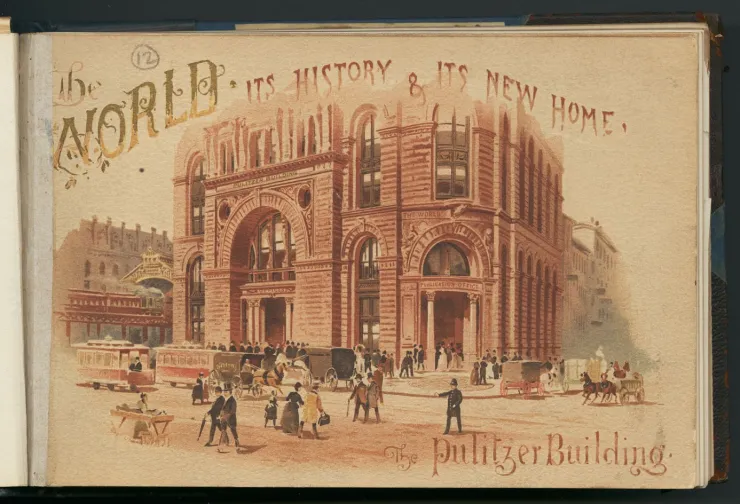
Joseph Pulitzer cared little for the Evening or Sunday editions of the World, beyond expecting them to prosper, which both did amazingly, reserving his interest and affection for the six-day morning issue, which he regarded as his paper. The others were mere commercial enterprises, but the Morning World contained his soul — and that of the establishment. He lavished money on it, leaving the evening edition to get along with a slender force, though one of much talent.
The World was managed by its managers and edited by its editors. He suggested freely, but ordered little. Final judgment was always with the office. He once advised the business manager that he could do anything on behalf of the paper except hunt for the North Pole, or back the invention of a flying machine, both ideas seeming chimerical to him. Within less than a decade after this adjuration the Pole was located and the machine that flew became an accomplished fact. He lived to see both. Indeed, it was the World’s award of $10,000 to Glenn Curtiss for flying from Albany to New York that enabled that aviator and inventor to establish the great business which grew about his name.
He was always interesting, seldom companionable, taking all he could from the minds of others, but rarely giving much back, his method being to dispute and to reap the benefits of an aroused defense.
He disliked greed in any form. When his younger brother Albert, fresh from Europe, came to St. Louis in 1867, ice cream was a discovery for the youth, and he developed an inordinate fondness for the delicacy to the great wrath of the elder, whose reproof led to the beginning of an unfriendliness that ended in total estrangement for the last twenty years of Albert’s life. Joseph had in him much of the lofty and spiritual. Albert was earthy. No two natures could have been more widely apart.While he was interested in heredity, like Junot, he knew he was his own ancestor. “Men are made by environment, not birth,” was his final conclusion.
Discussing some passing matter, a secretary used the phrase “your friends.” “My friends,” interrupted Mr. Pulitzer ironically. “I have no friends. The fellows in the office will not let me have any.” This was in a great measure true. But the “fellows in the office” did not have any either, and he knew it and delighted in the singleness of their devotion to the World. There was no list of “sacred cows” in the place, nor any Index Expurgatorius. The facts had to warrant the story. That was the only rule.
With no apparent religious predilections, Mr. Pulitzer was catholic in his respect for those of others. Mrs. Pulitzer and the family were Episcopalians and he greatly admired Dr. W.S. Rainsford, when pastor of St. George’s in New York, which was first attended. Later, when his residence was removed to 55th Street, St. Thomas Church became the affiliation, and he transferred his regards to Dr. E.M. Stires.
He rarely, if ever, went to church at all. There was a small Episcopal chapel at Jekyll Island [an island in Georgia frequented by aristocrats], and one Sunday morning, a visitor was surprised to see Dr. G.W. Hosmer enter its portals just as the service began and retire after a brief sojourn. Knowing the doctor’s anti-clerical views, he asked Alfred Butes if the old boy had repented. “No,” he replied. “Each Sunday morning, Dr. Hosmer goes to chapel and remains until the offertory is taken up, when he places a new $5 bill on the plate and decorously retires. Mr. Pulitzer has then attended church.”
His table was graced with the best vintages, the finest Moselles, burgundies and champagnes and Jonnisberger from Metternich’s famous Schloss. Yet he drank little, rarely more than a single glass. Indeed, he abhorred excess and doubted the ability of men to carry large cargoes of liquids. He was belittling the stories of drinking bouts one evening at Chatwold when Arthur H. Billing remarked that in England it was quite common for a gentleman to consume a quart of champagne without visible inconvenience. “Impossible!” said Mr. Pulitzer.
Mr. Billing modestly suggested that he could accomplish the feat himself if supplied with the bottle. “Good,” said Mr. Pulitzer, “we will test it now. Mark [the butler], bring a quart of Mumm and place it before Mr. Billing. Seitz, you shall umpire and see that he drinks it to the last drop. Make sure that there is no shirking!”
The chilly quart came in. Mr. Billing drank it over the course of fifteen minutes. He was quite undisturbed by the feat and Mr. Pulitzer much discomfited. He avoided champagne himself, because the gases went quickly to his head and so he thought it would serve Billing.
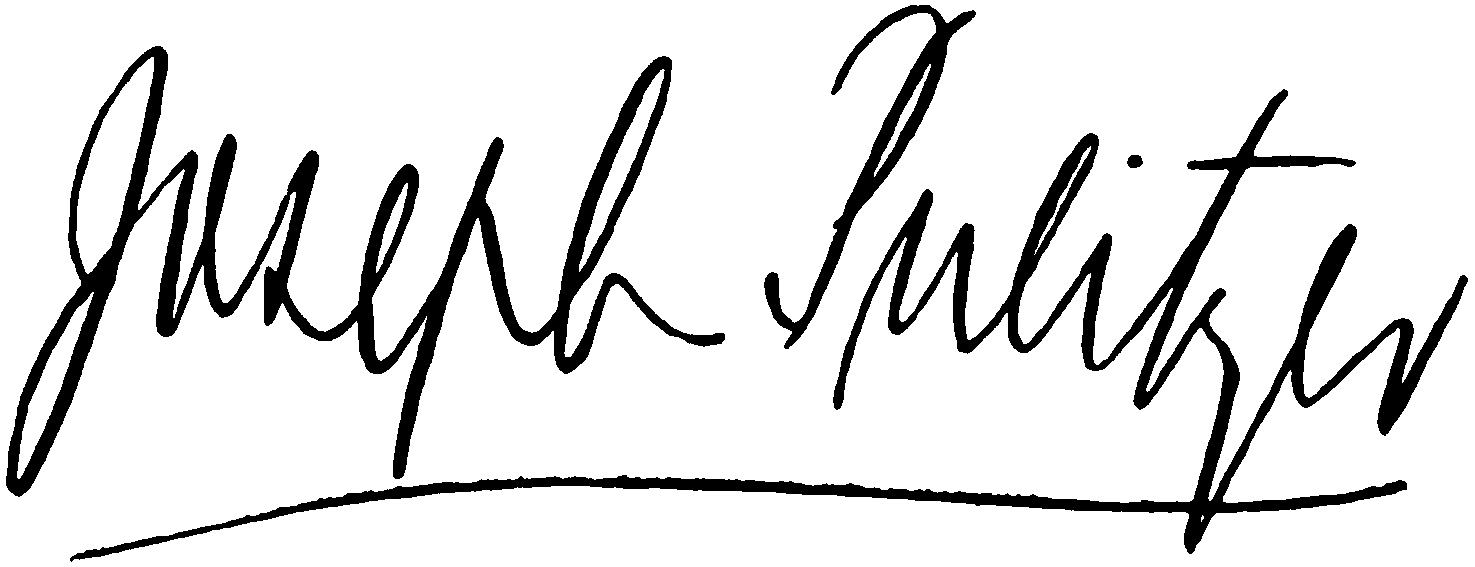
Pulitzer's signature.
His handwriting was large, Gothic and aggressive. Its characters became exaggerated with failing sight until but a few words adorned the page. He wrote his signature as he wrote his life, big and bold.
“Forever unsatisfied” described his temperament in more ways than his use of the words in expressing his idea of the paper’s public duties. He was forever unsatisfied, not so much with the results as with the thought that if a further effort had been made, a sterner command, or greater encouragement given, as the case might be, more could have been accomplished. His intense desire for the superlative often left him with not even a good comparative to pay for all the tumult raised.
Curiously, he was most pestiferous in his urgings and drivings when all was going at its best. In times of trouble he rested his lash. Men were left unhampered in their responsibilities, seldom chided when they failed if there was evidence that they had tried to succeed, and richly rewarded if they triumphed.
As Mr. Pulitzer was troubled with touches of asthma, the Liberty was often set in motion for no other object than to create a breeze which would pour fresh air into his gasping nostrils. “Find a breeze” was the most frequent sailing order. He was a reckless navigator, defying harbor rules and often taking great risks from storm and tide. Odd as it may seem, he knew nothing of the latter phenomenon and had to be argued with when told it was a factor to be reckoned with when the Liberty strayed outside of the Herculean Straits [Straits of Gibraltar].
Five roundtrips he drove the noble vessel across the Atlantic, to the despair of his entourage. The idle cruising in the Mediterranean in touch with shore and many joyous ports was great fun, but the long days on the dull Atlantic were appalling to all but J.P.
“Always der cold gray sky, always der cold gray sky,” moaned Dr. Friedrich Mann, his German reader and pianist.
Incidentally he never carried any cash about him, and made much of having a process server hand him a $2 fee on the street in front of his house one morning, as the first he had really received with his own hands for many years.
When some new delight came his way, he liked to pass it on to those he wished to reward or encourage. Coming from the mild and humid central Mississippi Valley, he found the New York winter chilly and took to a fur-lined overcoat for protection. This was before the days of heated streetcars or comfortable subways, and the heavy garment gave him great content. Soon the men of mark on the World were garbed in fur with the compliments of the owner.
When his eyes grew troublesome, he secured needed shade from the flexible brim of a Panama hat. Presto! All the favorites were likewise bedecked. He had great regard for the tall silk hat and always wore one out on occasions that seemed important. He usually closed all arguments with a bet when the talk grew too strenuous, and the wager took the form of a hat, frequently five hats.
His speeches during the Greeley campaign [in 1872] were all made in German, his familiar tongue. When he came to stump for Tilden [1876], he employed English. This was not an easy task, for he thought in German and had to translate it as he talked. To facilitate clearness of expression he laboriously wrote out his addresses in English and committed them to memory as formed on paper. When he spoke in later years, after coming to New York, he had acquired the habit of thinking in English, and when asked to make an address in German during the Nicoll campaign found it very difficult to comply. [De Lancey Nicoll was a New York City district attorney who, in private practice, had successfully defended the World in a libel suit.] In his after years of retirement he took up German again and used it faultlessly, cultivating the language, through skilled readers, from the best books in German literature.
He liked William C. Whitney [a conservative Democratic political reformer a prominent Manhattan aristocrat], and would occasionally visit him on Sundays, talking politics and economics, in which both were deeply versed. He always asked about Miss Dorothy Whitney [later a social activist and philanthropist], who was one of his last memories before his eyes grew dim.
“You know,” he once said, “before I lost my eyes I used to walk around and talk politics with Whitney. He was so very interesting. This young lady, then a little girl, would climb upon my knees and pull my whiskers. So she stays in my memory as among the last of those whom I could see. I shall always be interested in her.”
Mr. Pulitzer read omnivorously. He was always buying books. One of his great griefs over the fire that destroyed his 55th Street mansion was the total loss of his library. He was not a “collector” in any sense but loved his volumes for what they contained. Naturally, for one who read so much by proxy he was impatient of the prolix. For another thing, books are made from books, and much that came to his ears he had heard before. The most successful readers, like Dr. G.W. Hosmer and Harold S. Pollard, learned to edit new books in the light of what had already been read, and succeeded by tactful omission in overcoming impatience with the authors and themselves.
Of Colonel Harvey [George Brinton McClellan Harvey, a Pulitzer protégé and, later, a publishing entrepreneur] he once said, “I knew he wouldn’t do as a managing editor, when I learned he refused to allow the elevator to stop to let anyone on or off while he was in it.”
Beyond this penchant for monopoly in levitation, Mr. Pulitzer admired the colonel and was his firm friend all through the years. He was a frequent visitor, his touch with public characters and interest in affairs giving his host a contact of the sort he desired with men and things from which he was personally barred by indisposition. In July, 1907, the colonel was being battered more or less by the World’s editors, the page being in charge of Frank I. Cobb and Horatio W. Seymour. Mr. Pulitzer wired from Bar Harbor:
Tell Cobb, Seymour, etc. to treat Harvey more gently, even when he is wrong. Able, brainy fellow and one of my boys. A little joke now and then all right, but don’t handle him too severely. I like him.
He had this oriental idea of democracy, that talent was the sole password to position. Inherited wealth and a place in society he ignored. He liked men who would make their own way and brushed aside the cultivated drones who barred their path.
He loved horses and rode with the grace and freedom of one to the saddle born. Always in good weather, at home or abroad, an afternoon ride was the rule. As he became blinder, the speed dropped to a trot, but his seat was secure and his mastery of his steed perfect. Good horses were plentiful before the automobile drove them out of use. At one time the Chatwold stables contained twenty-six animals. He was slow in taking to the auto, but once converted “took” to it amazingly. Indeed, he liked speed. To be in motion was his incessant delight. For this reason he made long and seemingly purposeless journeys. Life soon became dreary when he settled down for a time. The thought of moving cheered him up and in motion he was serenely amiable.
The considerable fortune left by Mr. Pulitzer was enhanced by the outcome of wise investments in American securities listed on the New York Stock Exchange. They were not made primarily with this intent but to protect the World. When the paper began piling up money, with his customary caution, he looked ahead for lean years. He wished to be securely beyond the need of borrowing from banks, feeling that this might lead to his getting into the hands of the moneyed interests. So he picked out what appeared to be the soundest securities. The paper rarely needed his aid and the investments grew with the years and the increasing prosperity of the country. When his property was listed, but one worthless item was found, a twenty-share certificate in some long-forgotten effort to build a railroad in Missouri. Every other item had held, or increased its value. Some had repaid him more than 300 percent.
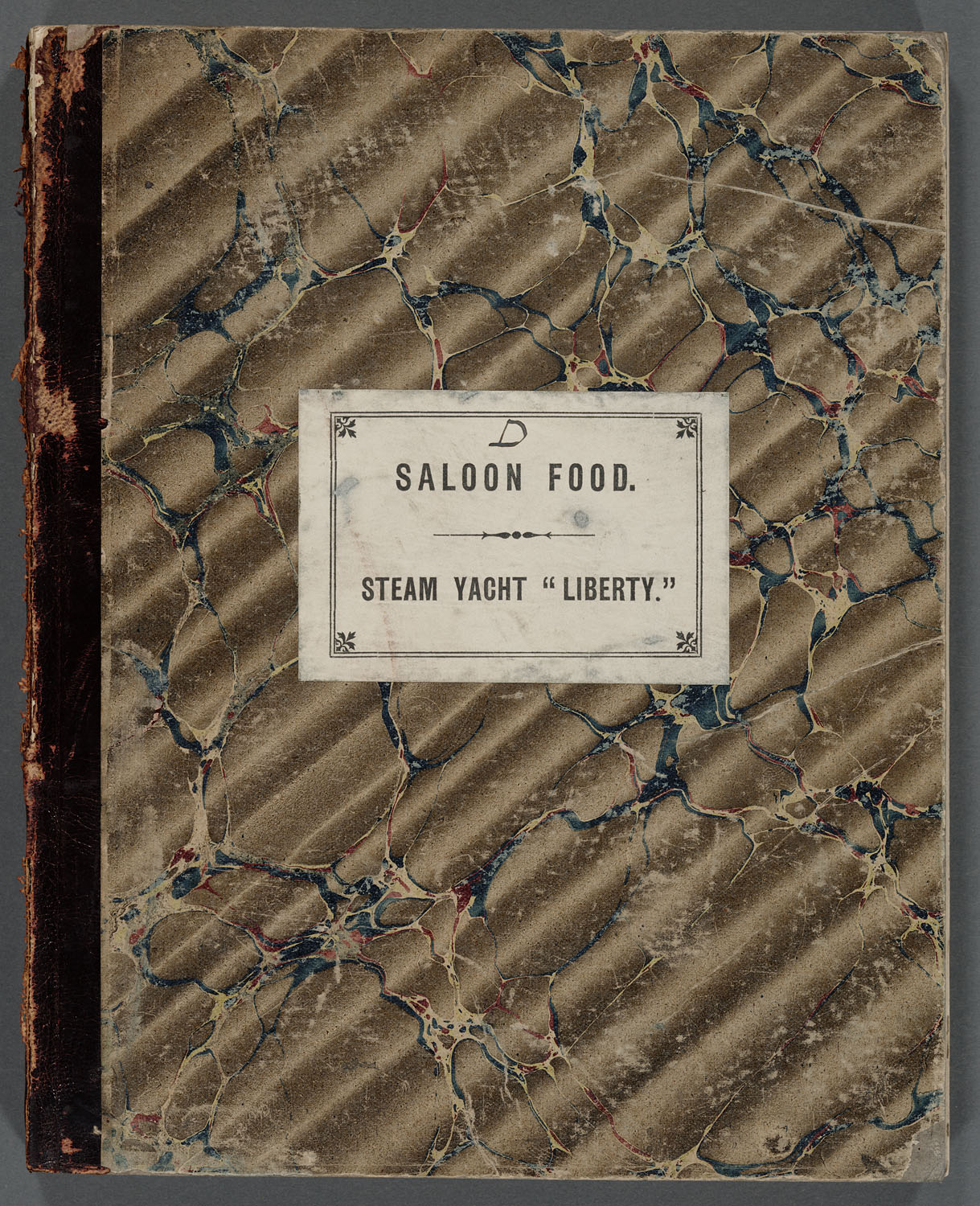
The Saloon ledger from the Liberty.
His personal expenditures were enormous. The Liberty was always in commission. Her operating cost, with repairs, ran close to $200,000 a year. He maintained costly residences at Bar Harbor, Jekyll Island, Georgia, and in New York, to which was added the finest villa to be had at Cap Martin. Probably the bill totaled $350,000 a year, but it barely dented the great income from newspapers and investments. There was always a large annual surplus.
He cared little about the outlay on the Liberty though port charges and like annoyances vexed him. He was fond of quoting J. Pierpont Morgan the elder, whose Corsair ranked with the Liberty, who, when asked by a friend who contemplated buying a yacht if he found it expensive, replied: “If it is of any consequence to you, keep out of it.”
He loved New York. Driving once past the magnificent Columbia College Library building, the gift of Seth Low, he exclaimed: “What a wonderful city New York is, and what a more wonderful city it is destined to be. I wish I could come back and see it a hundred years from now.”
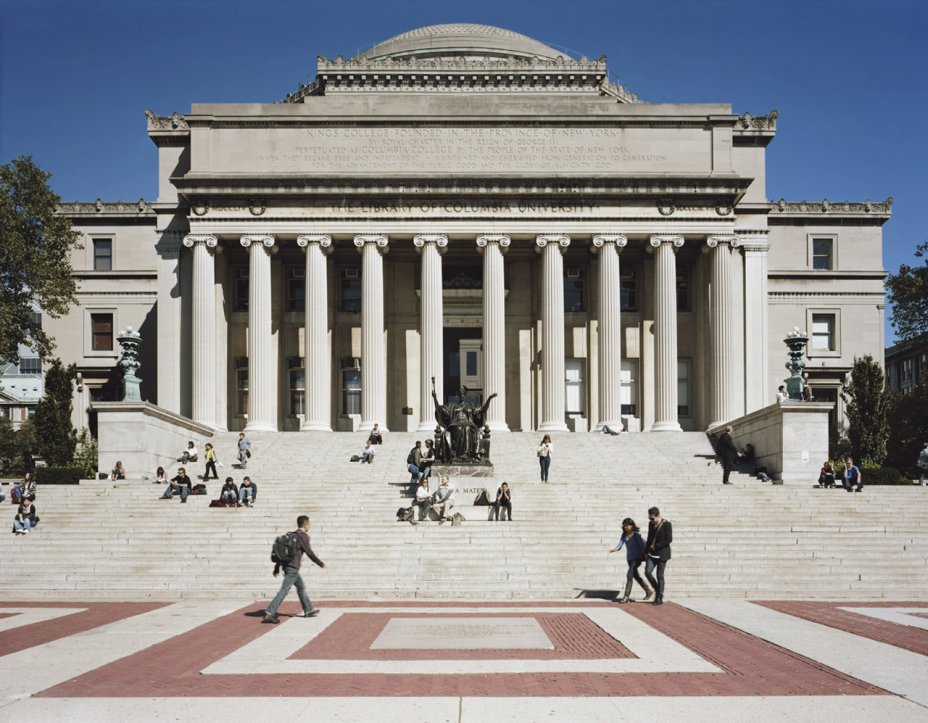
Low Library at Columbia University.
He was singularly delicate about being fully clad, and could not bear to have any part of his person exposed to the gaze of another. From his earliest days he slept alone, save for when he shared a bed with Professor Davidson, remarking in after years that this unwonted intimacy showed how much he thought of his learned friend. [Thomas Davidson (1840-1900), a Scottish-American philosopher, was teaching high school in St. Louis in 1865 when he befriended the young Pulitzer.]
His sensitiveness in this particular developed in an amusing way at Cap Martin in the spring of 1910, when after much negotiation, the great Rodin was commissioned to execute a bust. A room for studio purposes was cleared on the top floor of the Villa Cynthia and quarters were assigned to the sculptor and his wife. As Mr. Pulitzer always objected to the arrangement of details directly between principals, there was much backward and forward discussion via secretaries. Rodin insisted that Mr. Pulitzer in posing should lay bare his shoulders in order that he might correctly visualize the poise of the head. To this Mr. Pulitzer objected strenuously. Rodin was obdurate but it was not until he threatened to throw up the commission and return to Paris that his subject surrendered, and then under conditions that none but his immediate attendants should be admitted to the studio.
This was agreed to and the work went on, the model proving very petulant and unruly and refusing to talk to Rodin, who naturally wished to relax his sitter and get some glimpse of his mentality. The contract was for a bronze and marble bust. The bronze is a mere head with no attempt to indicate the shoulders. The marble goes further – and here Rodin has his revenge, for he laid a bit of ruching across the chest, playfully suggestive of the upper works of a chemise.
Personally Mr. Pulitzer was singularly shy. He did not like to be pointed out publicly, or to be made a center of interest. Once at Bar Harbor, I had told Mrs. Pulitzer a merry tale about him, the joke of which was on the other fellow. She repeated it to J.P. “What’s this story you have been telling Mrs. Pulitzer?” he queried at luncheon. I replied that it was a good one. He was silent for a moment, then said gently, “Don’t tell stories about me. Keep them until I am dead.”