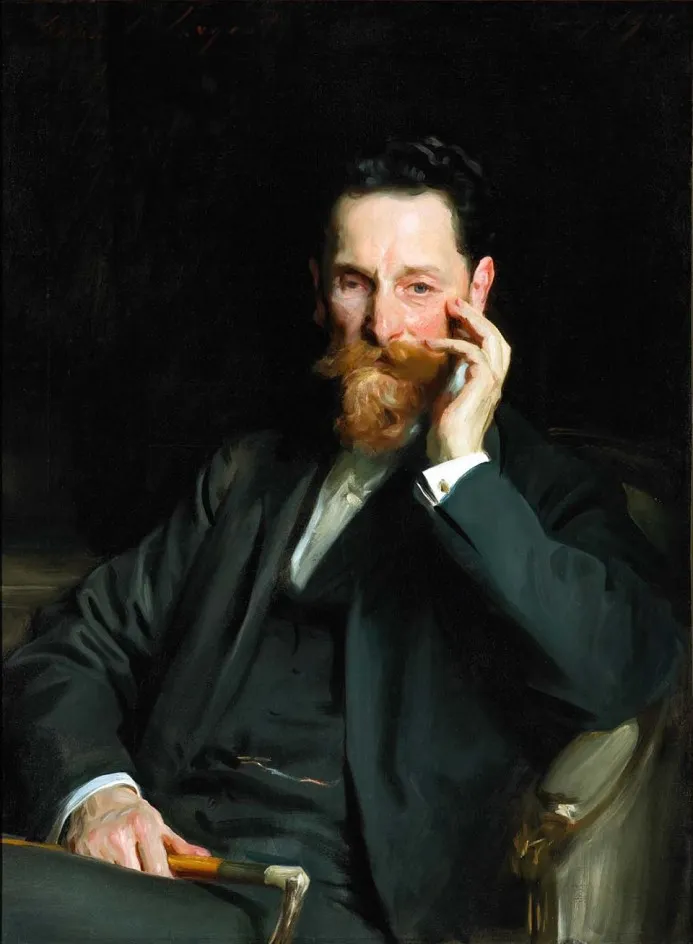
On May 18, 1905, John Singer Sargent wrote to thank Joseph Pulitzer for the check. The artist had recently finished a portrait of Kate Davis Pulitzer, Joseph’s wife of 27 years. The check was for a thousand guineas, a little over $5,000 at the time, or $138,000 in 2016 dollars. Sargent closed by saying he looked forward to seeing Joseph Pulitzer at noon on June 26.
For Pulitzer, traveling from New York to London to sit for Sargent required setting a small army of helpers in motion. Pulitzer was blind, noise-averse, rich and demanding, and he hated the smell of perfume. He favored the White Star Lines for Atlantic crossings because its crew placed a vast woven-rope rug on the deck above his cabin to muffle footsteps. This allowed Pulitzer to sleep.
One duty of James Tuohy, the New York World’s London Bureau chief, was to ensure that Pulitzer’s horse, which had been shipped to London beforehand, was acclimated to the city when Pulitzer arrived. Tuohy also prepared Pulitzer’s London house, overseeing the installation of thick glass in the windows to block sound from outside.
Pulitzer traveled with a personal assistant — a combination secretary, companion, caretaker and private reader. He kept several of these on call. Qualifications for the job were precise. The men had to be single and prepared to travel at a moment’s notice. They had to be tall so that the 6-foot-2 Pulitzer did not have to stoop to speak with them. Above all, they needed to be good readers with pleasing voices.
As it happened, Tuohy had recommended the secretary who traveled to London with Pulitzer for his sitting for Sargent. This was Norman G. Thwaites, the 32-year-old son of a British parson. When Pulitzer first met Thwaites in 1902, he felt his head and face, then had Thwaites take his arm and walk him in the garden. There they talked about books and the theater for some time. Pulitzer liked his voice, intellect and demeanor.
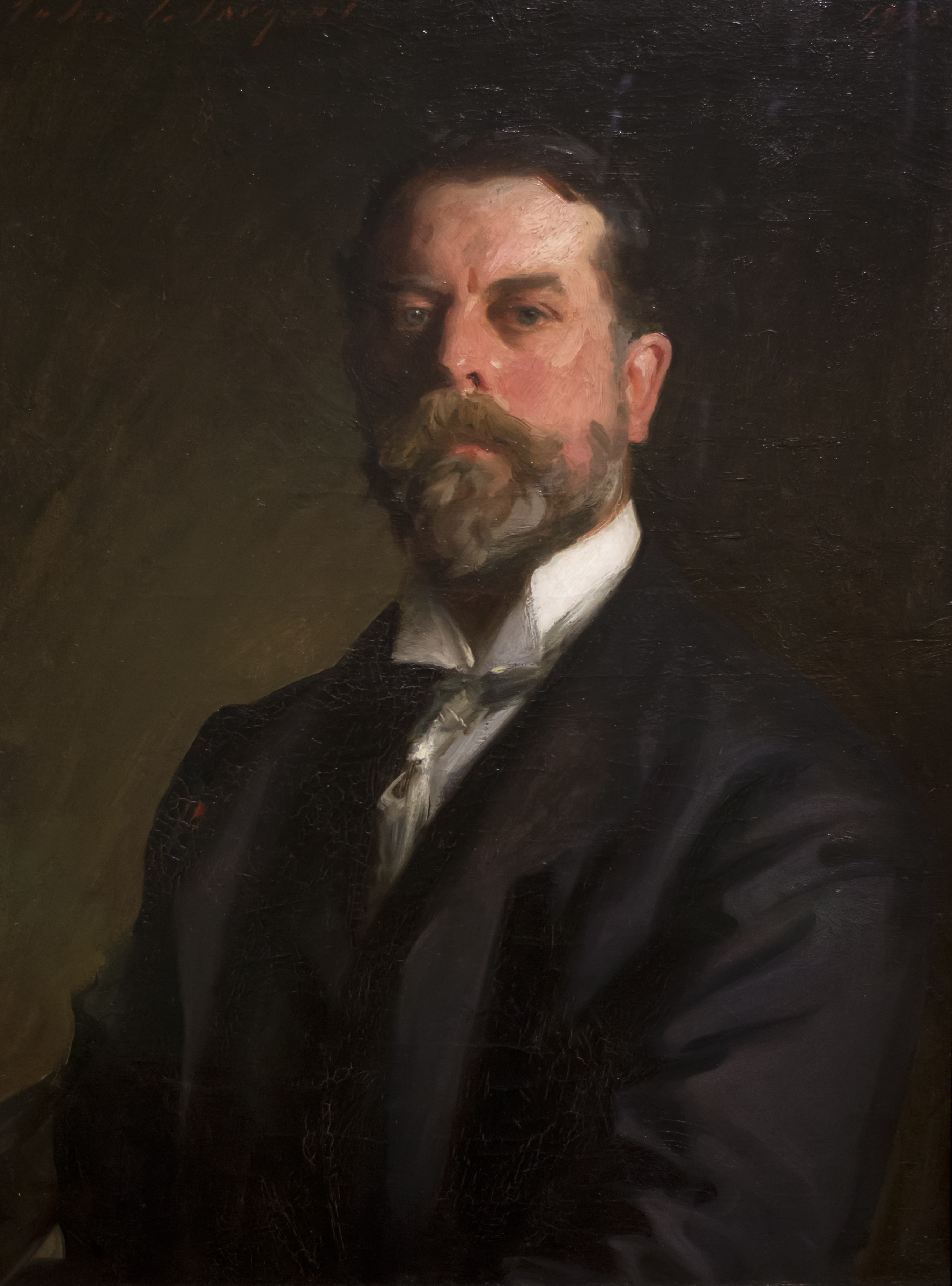
Self-portrait by Sargent
John Singer Sargent was 49 years old, nine years younger than Pulitzer. He was a portraitist of renown but not always happy with this fate. To Ralph Curtis, a friend and fellow artist, he once wrote: “No more paughtraits. ... I abhor and abjure them and hope never to do another especially of the Upper Classes.”
Sargent’s artistic ambition exceeded portraiture, and wanderlust fed this ambition. After painting Pulitzer’s portrait, he planned to go to Italy. In the fall it would be on to Palestine and Syria. In these places, in both oil and watercolor, he could paint landscapes, street scenes and anything else he wished.
During the first decade of the 20th century Sargent painted 145 formal portraits, hitting his peak with 29 in 1901 and his nadir with three in 1910. Kate and Joseph Pulitzer were two of his 17 subjects in 1905, a year in which he started or completed many more non-portraits than that.
Perhaps his ambivalence toward upper-class portraits accounted for both the punctuality he demanded of his subjects and the efficiency with which he worked.
Kate Pulitzer, who had sat for him in May, warned her husband to be on time for his sittings.
Once Joseph Pulitzer reached London, he contacted Charles Chapin, the editor of the New York Evening World, who had been traveling with his wife and was about to head home. Pulitzer ordered him to cancel the trip and come for lunch. Chapin obliged.
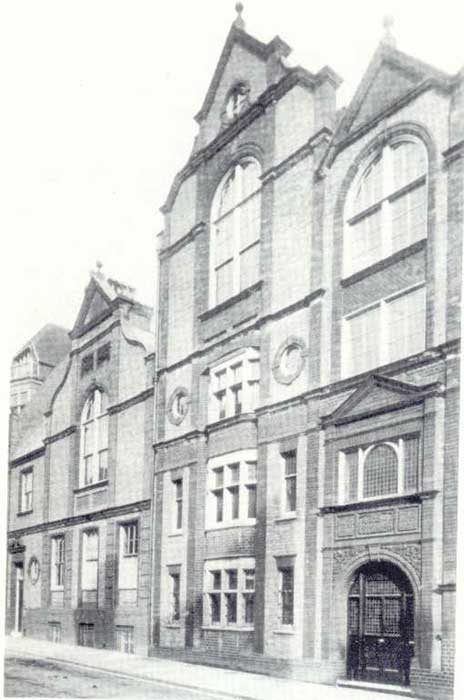
Sargent's Tite Street studio
The next morning Pulitzer and Norman Thwaites rode around Hyde Park in a carriage before going to Sargent’s studio at 31-33 Tite Street in Chelsea. They would follow this schedule for the four or five days it took to make the painting. Pulitzer had ordered a smallish canvas — 38½ by 28 inches — as opposed to Sargent’s full-length portrait of Kate Pulitzer, which was 58 by 38½.
There was little small talk between artist and subject that first day. As Thwaites described the scene, Pulitzer asked Sargent how he would proceed, and Sargent gave him what must have been a stock answer to a question he heard all the time. As recorded by Thwaites, it went like this:
“I paint what I see. Sometimes it makes a good portrait; so much the better for the sitter. Sometimes it does not; so much the worse for both of us. But I don’t dig beneath the surface for things that don’t appear before my eyes.”As he spoke, he began a charcoal outline of Pulitzer on his grayish canvas. From that point, Thwaites observed, he “worked at a great pace, advancing upon his canvas and retiring much in the manner of a boxer sparring for an opening.”
This is consistent with other descriptions of Singer’s methods, including the account of Julie Heyneman, a student of Sargent’s during the 1890s. She wrote that he began with a few strokes of charcoal that put the subject’s head in place on the canvas, wiped this sketch until its lines were faint, and began to paint. He outlined the head, suggested the hair and matched the tone of the clothing. Then his brushwork accelerated. His hand was sure.
Sargent liked to set his easel right before his subject. Then when he stepped back, as described by Thwaites, he could behold not only his painting in progress but his subject just behind it.
A painting session lasted about two hours and could be exhausting for the sitter. It cannot have been easy for Pulitzer. He smoked cigars, but he hated cigarette smoke and sometimes struggled to breathe. “None of us dared smoke around him,” said Thwaites. Sargent was a chain smoker, and the air in his studio thickened as the session wore on.
On the third day, Chapin, the Evening World editor, joined Pulitzer for lunch. He had followed the boss’s suggestions in seeing the sights of London. With portraiture on his mind, Pulitzer had recommended the National Portrait Gallery. Chapin’s visit there had made him a surrogate for Pulitzer. After listening to Chapin’s detailed report of the pictures he had liked, Pulitzer said: “What I wouldn’t give to see what you saw.”
Thwaites thought the portrait was nearly done. In his view, Sargent’s Pulitzer looked like a good-natured older man. But as they entered the studio on the fourth day, a man who followed them in hectored Pulitzer to meet with him. “Tell him to go away,” Pulitzer snarled.
“A look of fury and impatience entirely changed the face of the subject,” Thwaites wrote, “and Sargent contemplated the scene with keep interest, while making a dab or two on the canvas.”
To Thwaites, these late flourishes captured Pulitzer’s dual nature: “Hide, with a sheet of paper, one-half the face and you have a benevolent middle-aged gentleman. Observe, now, the other half, and you have the malevolent, sinister and cruel expression of Mephisto. Unconsciously, the painter had presented what he saw.”
Whether Sargent’s gesture was unconscious is open to question, but Thwaites’s assessment of the portrait seems accurate. Another man who knew Pulitzer well, Don Carlos Seitz, business manager of the New York World, saw the portrait that way, too. According to Seitz, when Pulitzer was warned that Sargent was adept at exposing the hidden weaknesses of his subjects, he said: “I want to be remembered just as I really am, with all my strain and suffering there.”
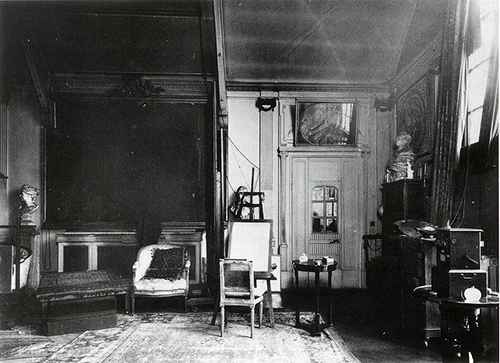
The interior of Sargent's studio
Seitz had worked for Pulitzer for 18 years. In his synopsis of the Sargent portrait of his boss, he wrote:
“The painting presents the blind man, seated, holding a riding crop in one hand and resting the other lightly against his cheek — a favorite attitude. The pain and invalidism of years show on his face, blended with high intellect, energy of character and fierceness of temper. It is Joseph Pulitzer, as Time and Trouble moulded him.”
[I am especially indebted for this account to two books by James McGrath Morris — "Pulitzer: A Life in Politics, Print and Power" (Harper, 2010) and "The Rose Man of Sing Sing: A True Tale of Life, Murder, and Redemption in the Age of Yellow Journalism" (Fordham University Press, 2003). Other sources include Don C. Seitz’s "Joseph Pulitzer: His Life and Letters" (Simon and Schuster Inc., 1924), Karen Corsano and Daniel Williman’s "John Singer Sargent and His Muse: Painting Love and Loss" (Rowman & Littlefield, 2014) and many excellent websites on Sargent, his work and his technique.]