To the extent he has come down to us in literary history, Don Carlos Seitz is mainly known as the man who fired Stephen Crane as a war correspondent for Joseph Pulitzer’s New York World.
Seitz began a 25-year tenure as business manager of the paper in 1898. That year, in the July 16 World, an un-bylined story said that officers of a New York regiment had been guilty of cowardice under fire in Cuba. The rival New York Journal accused the World of slander. In response, Seitz orchestrated Crane’s firing. The World’s loss proved to be the Journal’s gain. The Journal hired Crane, who had in fact not written the offending dispatch, and sent him to resume his coverage of the Spanish-American War.
Don Carlos Seitz was a literary dynamo, churning out magazine articles and books while handling his paper’s business affairs. Born in Ohio in 1862, he had lived in Norway, Maine, as a boy. Later he received a master’s degree from St. Lawrence University and a doctorate from Bowdoin. Before joining the World, he worked as a journalist at the Brooklyn Eagle and the New York Recorder.
In 1924, the year after he moved to the Evening World as manager, Simon & Schuster published his biography of his late boss, titled Joseph Pulitzer: His Life and Letters. It was as much memoir as biography.
Seitz began with a portrait of Pulitzer from his own recollections. Today we share the first of three condensed and lightly edited excerpts from that portrait.
A face only a cartoonist could love
By DON CARLOS SEITZ
Joseph Pulitzer was tall, six feet two and a half, but of a presence so commanding as to make his stature seem even greater. His hair was black and his beard a reddish brown. A forehead that bespoke the intellect behind it shaded a nose of the sort that Napoleon admired; his chin though firm was small. To conceal this he always went bearded after he was thirty.
His complexion was delicate and beautiful as that of a tender child and usually adorned with a tint of pink fit to be envied by the loveliest ladies. When angry or excited this tint took on a touch of fire that well betokened the passion raging within, and the fine forehead radiated wrath. His hands were those of genius, with long, slender fingers, full of warmth and magnetism. The eyes before they became clouded were of a grayish blue. Always weak, they never lent much expression to the face, yet his visage was animated and attractive.
Temperamentally, he was the type of the poet and musician; though loving music, he professed to care little for verse and rarely read it. Yet he appreciated the singers in his native tongue, and, I have often thought, really repressed his poetic instinct for fear it might be considered a weakness.
The nose vexed him. If there had been any way of modifying its prominence, he would have greatly rejoiced. Once at Bar Harbor, walking from his secretary’s office to the library, he bumped his proboscis on the hard edge of an open door, and fell into imprecations — not against the door or the wight who had left it open, but against the helpless nose. He consigned it to the pit below and wished it would stay there — it had always been a bane and a nuisance.
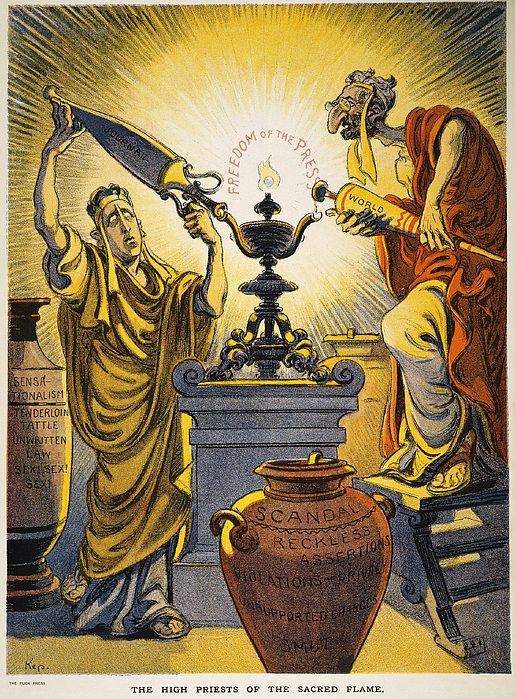
A Keppler cartoon depicts William Randolph Hearst and Pulitzer.
The organ was the delight of cartoonists, chief of whom to make use of it was his friend, Joseph Keppler. When idling together in the cafes of St. Louis, Keppler after racking his brains in vain for an idea and failing to scare one up, would remark: “Well, Joey, there’s only one thing left to do, I’ll go back to the office and draw your nose” — which he invariably did to the great disgust of the subject.
When Puck [the weekly magazine founded by Keppler] moved from St. Louis to New York in 1875 and later became a powerful publication in English, he kept up the habit. It must be said that Mr. Pulitzer lent himself admirably to caricature despite his splendid figure and majestic ways. It was easy with a touch to exaggerate his facial characteristics, and in the hot politics which he courted he came in for many a savage thrust with the crayon.
Mr. Pulitzer’s habits of thought and his later invalidism kept him aloof from affairs. Where a Horace Greeley [editor of the New York Tribune and 1872 presidential nominee] became personally one of the shapers of a cause, Mr. Pulitzer, after the early days of his World ownership, was in but slight touch with individuals in politics and public life. He did not wish to be in touch with or in the confidence of political leaders.
I recall once mentioning the visit of an eminent Democrat to the World editorial rooms. His instant comment was: “I don’t like that. I don’t want those fellows calling at the office.”
He did not care to have an inside share in moulding matters, wishing all of his efforts to appear openly on the editorial pages of his newspapers.
He believed in Liberty, Equality and Opportunity. Fraternity was not in his code. He lived most of his days apart from other men, having a feeling that this was the fate of the true journalist, that he must immolate himself upon the altar of the profession, devote his interest to his paper and have none other.
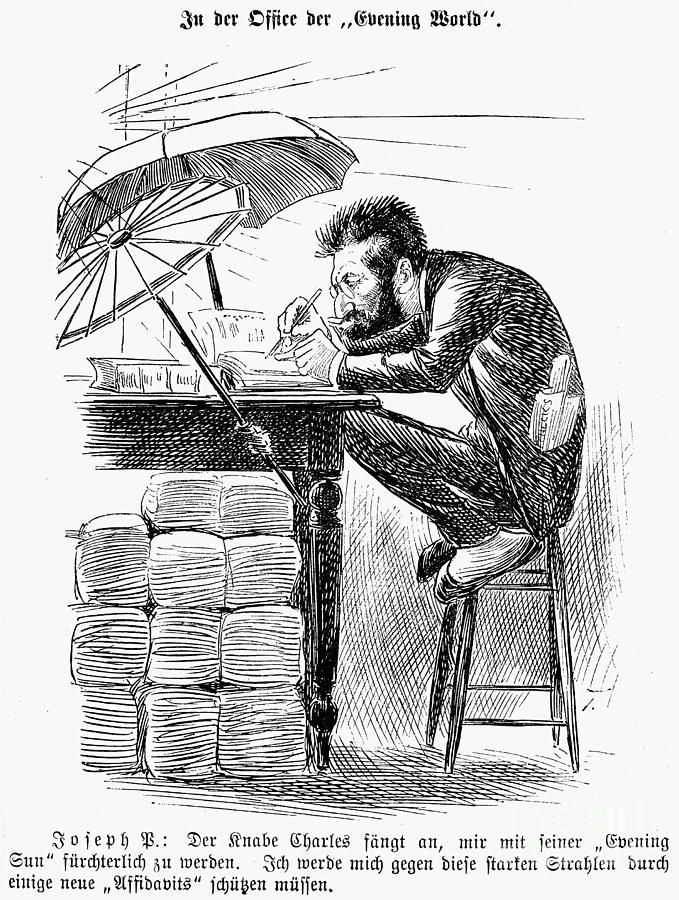
Pulitzer, caricatured as sitting alone at his desk.
His initiative, strange as it may appear, was not extraordinary. Indeed, he frequently showed a hesitancy that verged upon timidity in adopting policies that were often very successful, urged upon him by the juniors. His strength lay in stimulation. Here he had few superiors. The World establishment under him was always like a great steamship, going over a regular route, streaming with lights, quivering with motion, and gibing an impression of intense activity, even in commonplace moments, which were of course in the great majority.
He was a man of enormous impulses curbed by great reactions, who safeguarded himself from the effects of either by carefully warning his aids not to be swept off their feet by any order he might issue; all directions from headquarters were to be tempered by judgment or fuller information which he might not possess. If a very radical ukase came, the office custom was to reply, fixing a delayed day and hour for the execution. Usually a restraining telegram came about five minutes before the appointed moment.
Under his policy the virtues of the World were easily his own, while the mistakes and conflicts became readily the property of others. He suffered from overzeal, competition between minds, and errors of judgment. Yet without these much of the impetus would have been stayed and many of the great accomplishments impossible.
Just as old King Frederick William of Prussia, father of Frederick the Great, was always hunting Europe over for tall men to recruit his Potsdam grenadiers, Mr. Pulitzer, who much resembled his Majesty in many ways, was forever seeking men for readers and secretaries. Ballard Smith, while London correspondent, and after him Frederick A. Duneka, David Graham Phillips and James M. Tuohy, all English representatives in the order named, were on perpetual assignment. The secretaries in office were frequently set to finding other secretaries, and George H. Ledlie, his general and personal representative, had a constant commission to find “the right man.”
He proved a scarce article, although Alfred Butes, a clever young Englishman, came close to filling all the requirements. He had been in Africa with General Francis de Winton, was an accomplished stenographer, wrote an excellent hand, and above all was most discreet and deeper in his employer’s confidence than any of the other young gentlemen ever penetrated. Indeed, he was destined to become a trustee of the vast estate and to receive a handsome legacy, both of which he forfeited in 1907 to join Lord Northcliffe in a secretarial capacity. His departure was a real blow and left a gap never quite filled again — certainly not in the matter of close relationship.
The duties of the secretaries were exacting. Personal desires, like hope in Dante’s hell, had to be left behind. The young Englishmen were all men of parts — had to be to retain their hold. The late Arthur H. Billing was the son of a bishop; Norman G. Thwaites, later Lieutenant-Colonel in his Majesty’s service, was the son of a canon, and Randall Davies, F.S.A., the son of a curate. These were all with him during the last years and constituted an unusual galaxy of talent. To their number, in 1908, was added William Romaine Paterson, a brilliant scholar and writer, of Scottish descent, and Alleyne Ireland, the eminent authority on British colonization and political economy. This group gave the entourage an intellectual atmosphere hard to duplicate.
The secretary who served Mr. Pulitzer longest was Dr. George W. Hosmer, who was both friend and physician, besides aiding in correspondence and selecting his literature, editing and reading in the latter to high satisfaction. He was nearly twenty years the senior of his patient and had an influence over his temperament such as no other possessed, partly from his firmness, tact and knowledge, and partly from the authority of a doctor.
Though a medical man of high rank, he had practiced little, taking early to journalism under the elder James Gordon Bennett on the New York Herald. As a war correspondent it was his privilege to report the battle of Gettysburg for the paper and to perform a great service for his country on the field. It was he who, crossing Cemetery Ridge in the gloom of the second evening, saw a dark mass moving across the fields below and gave the warning which enabled Gen. George S. Greene to hold his thin lines until the aid came that stopped Longstreet. For a time Hosmer was in charge of the London office of the Herald and it was his further fortune to be shut up in Paris during the days of horror contrived by the Commune.
For the elder Bennett he had much respect; for the younger, none. He was wont to say of him that he was half Scotch and half Irish, and when sober, displayed the worst qualities of the one, and when drunk the worst of the other.
His taste of literature was of the finest and his knowledge exact and wonderful. To Mr. Pulitzer, no small reservoir of information himself, he was a perpetual marvel, outrivaling in memory even Prof. Thomas Davidson, Mr. Pulitzer’s long-time friend and instructor in St. Louis.
“I never knew a man who knew so much, or knew it so well,” he once observed, speaking of the doctor.