When Emily Genauer began writing art reviews for The New York World in 1929, she was paid by the word. She wrote enough to make a weekly wage that peaked at $92. Soon the editor called and told her he was putting her on the staff — for $35 a week. “Aren’t you happy?” he asked.
Through Grenauer’s criticism her readers met many modern artists, including Mark Chagall, Diego Riviera and Pablo Picasso. After the World-Telegram’s owner chided her for hyping “Communists and left-wingers,” she left the paper for the New York Herald Tribune, where she was chief art critic for 17 years.
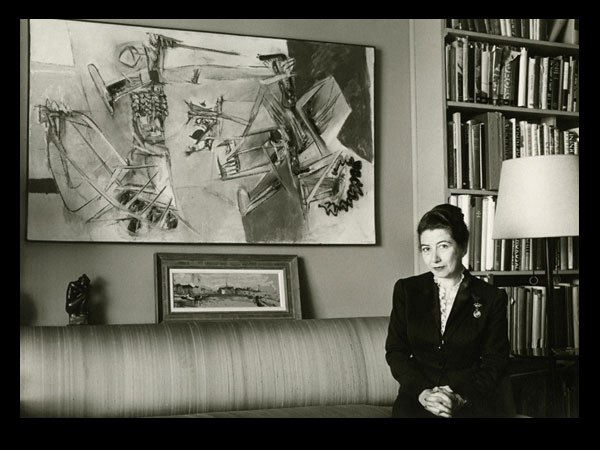
Emily Genauer in New York City in 1956.
The New York Times interviewed her in 1992 about her long career as a critic. “I could do it for 60 years because I’d rather look at art than anything else, because I love the art world and because every day was different than every other,” Genauer told the interviewer.
For most of her career there was no Pulitzer Prize for Criticism. She became the fifth winner of the prize in 1974 while reviewing art for the New York Sun.
Genauer had been present at the first showing of Picasso’s now-famous Guernica in 1937. She returned to that moment in the piece reprinted below, which was written 36 years later. It ran on April 14, 1973, six days after Picasso’s death at 91, and was part of her Pulitzer-winning portfolio.
Genauer also died at 91, in 2002.
At his death, Picasso was ‘in’ again
By EMILY GENAUER
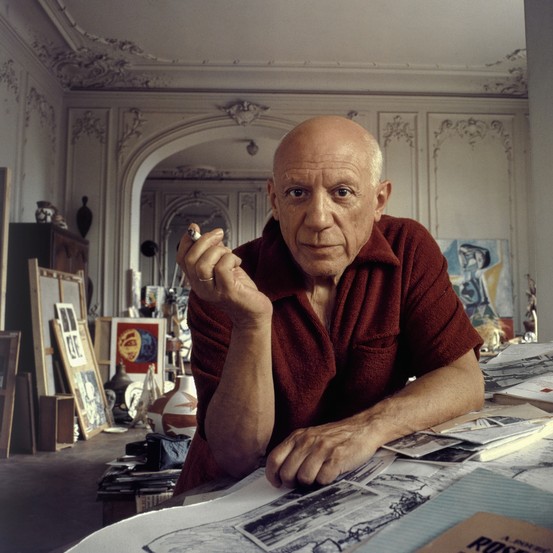
Pablo Picasso in Cannes in 1956.
Among the thousands of words on Picasso’s life and art published since his death, I’ve found no reference to the fact that a dozen or so years ago countless artists of stature all over the world had, in effect, written him off: he was a historical figure holding no meaning for them whatever as a seminal force.
In their work, the human figure, the visible world, any sense of social participation or responsibility were less than inconsequential; they were impermissible. Their total conscious concern was with the means of art, not its meaning. Their models and mentors, of course, were Jackson Pollock, Kadinsky, Hans Hoffmann and the few others today recognized as the fathers of abstract expressionism.
That phase of art history is over. Everywhere new styles of painting and sculpture command attention, none more imperatively than a new sharp realism. Picasso, who started as a realist and returned to realism intermittently to the end, at his death was “in” again. I’m not sure he knew he had been out, or, if he knew, cared.
His own concern for much of the last two decades had been with art by the old masters, on which he painted endless variations, almost as if to re-establish himself in the great tradition that had been virtually discarded by everybody else — and himself, too, in his youth. Perhaps he saw this salvaging of the past as an extension of his own physical incorporation in his early work, like his children’s battered toys, or sticks and stones he picked up on beaches.
My point is that Picasso, who had, especially in his cubist phase, revolutionized art as did no other artist in history, was no less responsible for the later developments which seem to deny him his importance, even to erase it (for young working artists, that is, never for art-lovers and scholars). To recognize the enormous extent of direct influence, one has only to look at early works by artists who, in rebellion, shaped a totally new esthetic — men like Pollock, for instance, and David Smith, the sculptor. They were, of course, children who abandoned their father in order to be able to find and assert themselves.
Picasso’s strength was so great no one could function in his shadow. He was a huge tree whose roots absorbed all nourishment in the surrounding soil, whose branches soaked up all available sun and air. To avoid strangulation his “children,” so recognizably his own, had to move completely out of his range — or die. They deliberately and painfully had to evolve an expression which would not only avoid but actually deny everything he stood for.What most of us forget is that there has been a first denial, even before this, in Paris. By the beginning of the ’30s, when Picasso was only around 50, a group of painters already saw him as a modern old master breathing down their necks. Though he had himself experimented imaginatively and richly with the caprice that would later come to be known as surrealism, they saw fantasy as their only escape. Instead of employing it, as Picasso did, as but one aspect of an art in which pictorial architecture and human meaning were almost always present, they built their whole expression of memory and hallucination. They painted dream landscapes peopled only with unidentifiable or illogical shapes. They were, most notably Miro, Max Ernst, Yves Tanguy and Andre Masson.
American painters at the beginning saw the surrealist work as too languid, too effete to hold generative ideas for themselves. But World War II brought many of them to this country, to become fascinating, provocative factors on the New York scene.
Then our own artists recognized in their work road-signs pointing to escape. And they followed them, adding their own vigor, energy, force and lack of inhibition to surrealism — and shaped that uniquely American idiom, abstract expressionism.
Now, clearly, a still younger and more atavistic generation is turning back to their grandfather, Picasso. This too is a familiar behavioral pattern. Pop art and the new realism which grew out of it project a need of artists not only to paint recognizable images again, but also to make social statements.
But here is where they still differ from the giant whose shadow is still very long. Picasso didn’t satirize the existing scene, or concern himself with its trivia, no matter how frivolous individual works may be. He was, at every stage of his life, and whether he realized it or not, a prophet.
His cubist works before World War I (along, of course, with those of Braque and Gris) presaged a world that was falling apart.
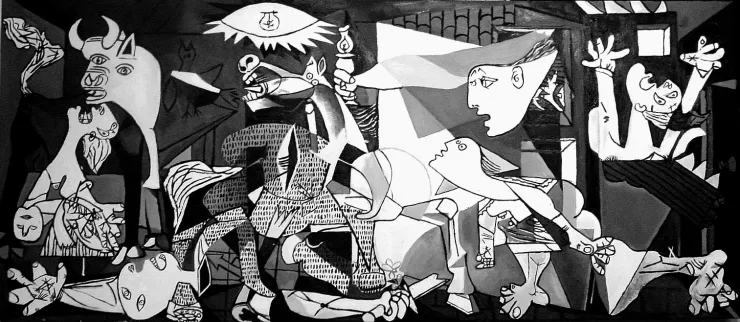
In “Guernica” he was prophet of a doom that apparently will never lift. The great mural was painted in May 1937, as a commission from the Spanish Republican Government to decorate its pavilion at the Paris Exposition to be held that summer. A month before this, German planes in alliance with Franco’s anti-loyalist army, had, in a test of the efficacy of incendiary bombs, dropped them on a small, unprotected, totally civilian Spanish village called Guernica, killing 2,000 persons.
In June, a preview party was held at the pavilion and in it “Guernica” made its first appearance outside Picasso’s studio. Picasso was there, but nobody paid much attention to him or the work, as I remember it. The special guest, actually, was not a Spaniard, but the American sculptor Alexander Calder, who had created an out-of-doors mobile in which delicately balanced spoon-like arms were moved by the shifting weight of mercury from Spanish mines.
Speaking no Spanish and inadequate French for an interview, I asked an art dealer friend if he would introduce us and act as interpreter. I wanted to ask Picasso about his enormous, extraordinary panel painted entirely in blacks, grays and white. It was a complex, symbolic, powerful montage of bulls’ and horses’ heads, of fragments of distorted human bodies. Overall was a huge eye whose iris was an electric bulb.
Perhaps because it was the newest work by a man so prolific, nobody, I recall, paid it special attention. Certainly there was nothing in the air that festive day — or in the work, on first sight, apparently — to suggest that it would be hailed as the greatest painting of the century.
It was only time that told us that, time in which we came to know what Picasso already knew. The war was over, and with it the cause was lost, and the time when human life had value. Technology harnessed to bestiality would soon make constant and commonplace the slaughter of the innocents. Compassion was dead. This was Picasso’s message in that great composition of fragmented forms and muted colors. I was not, in zeroing in on “Guernica” that afternoon, more perceptive than the others. I was just being a good journalist, getting an article that would be the first on the work to be published in America.
The picture, all these years on loan to the Museum of Modern Art, was never given or sold to it, and the museum, in the unspoken expectation of one day seeing it removed, acquired another although relatively minor work on the same theme, called “Charnel House.”
The general understanding is that after Franco’s death “Guernica” will go to Spain, to the museum in Barcelona which was constructed, with Franco’s blessing, in the shell of a magnificent Gothic palace, solely to house and honor the artist’s works. With it, probably, will go many others among the great pictures and sculptures Picasso over the years withheld from the market. There reportedly is no will. A Spaniard who ought to know, Salvador Dali, told me two weeks before Picasso’s death that arrangements have, nevertheless, been made.
Source for biographical material: New York Times obituary by Robert Worth, Aug. 25, 2002.
Footnote: Since 1992, Guernica has been on display at Museo Reina Sofia, Spain’s national museum of modern art, in Madrid.