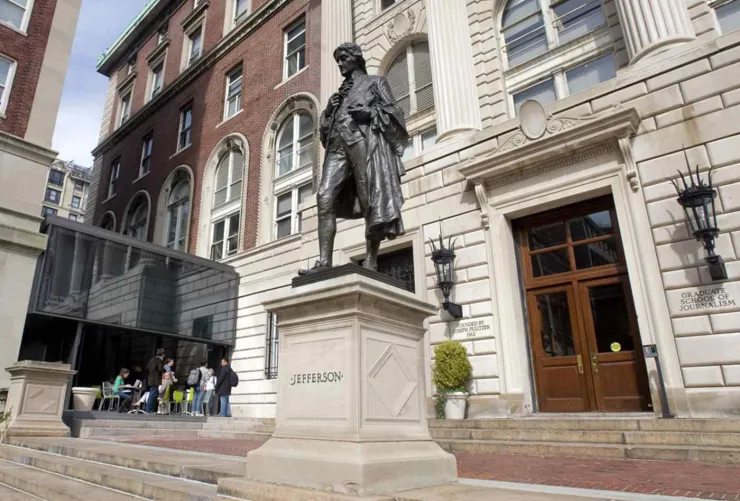
Each year, in addition to the core Pulitzer Prize finalists and winners, the Pulitzer office announces the recipients of five Pulitzer fellowships. The fellowships are awarded to top graduating students of Columbia Journalism School, which also houses the prize offices.
The fellowships support graduating Master’s students. Four provide financial backing for travel required for reporting out a project, while the fifth is designated for arts criticism. Due to the ongoing Covid pandemic, numerous journalistic projects have been temporarily suspended — and the traditional Pulitzer spring luncheon and awards ceremony, during which fellows stand and are recognized, has been postponed as well.
Before the next group of Pulitzer fellows is announced and as the class of 2021 prepares to graduate, the Pulitzer Prizes wishes to call attention to the work of the 2020 CJS graduates who were chosen to receive the honor. They are Eugene Michael Joseph, Rita Omokha, Carson Kessler, Benoît Morenne and Zachary "Harry" Tafoya.
Joseph earned a dual degree in journalism and computer science at Columbia. He developed a narrative visualization language and used it to show how misinformation rippled across Twitter during President Trump’s impeachment trial, shedding light on what grew in intensity and what faded away. For his project, he is enhancing the visualization language and publishing additional stories about misinformation on a new media outlet called the Nth Estate.
Kessler hails from San Antonio, Texas, and is an investigative business fellow at ProPublica in New York. Her favorite J-school experience was scouring the city for stories with Currie Engel for City Newsroom. She aims to explore bankruptcy practices by coal companies across Appalachia for her project.
Morenne has worked as a reporter in the New York Times Paris bureau, and has written about race relations and the coronavirus pandemic as an intern for The Wall Street Journal. At Columbia Journalism School, Benoît reported on chronic pain in the construction industry, discovered the identity of one of the first catfishers and scoured archives to tell the story of a forgotten Yankees batboy. He hopes to use the Pulitzer traveling fellowship to write about the intersection of religion and politics.
Tafoya is a New York-based art and music writer from Southern California. He wrote his master's thesis on Instagram and the rise of queer figurative painting under the guidance of Alisa Solomon. His project will focus on the development of alternate 'queer' identities in art.
Omokha used the Pulitzer Fellowship to report across America, speaking to marginalized groups about what it was like to be them at this moment, deep diving into their racial experiences. She interviewed more than 100 people and visited 30 states in 32 days between September and October. The result is a collection of writings about America at a crucial moment in time.
Read Omokha's work in Elle magazine, here.
In February, she spoke with the Journalism School about her experience reporting out the project, saying, "There’s something really beautiful and enriching in spending time and really taking in a stranger. I always looked forward to going on each of their journeys — learning about them, the experiences that formed their identity, their struggles. All those things that make us who we are. It’s amazing the stories we’d find if we did that more."
Read her full interview at Columbia Journalism School's website, here.
Congratulations again to all the fellows, and stay tuned to see which members of the Columbia Journalism School class of 2021 will follow in their footsteps.