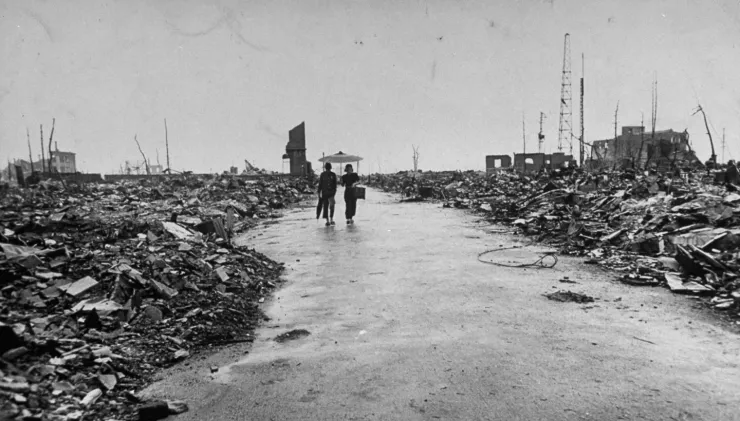
Like many of the soldiers he covered, Homer Bigart never had a doubt about the dropping of the atomic bomb on Hiroshima. Even after seeing the destruction a month after the bomb detonated over the city on Aug. 6, 1945, he considered it a logical act in what had become a war to annihilate the enemy.
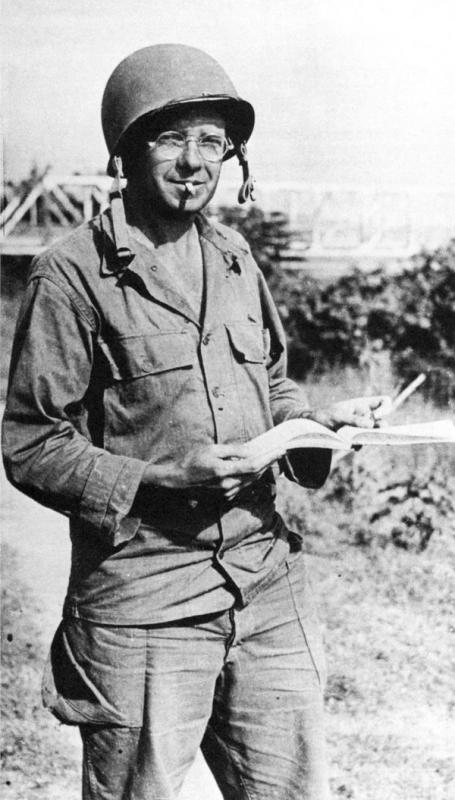
Homer Bigart
Bigart was a slow typist with a stutter — not a promising skill set for a reporter. But he got a job and wound up covering three wars: World War II, Korea and Vietnam. Along the way he won two Pulitzer Prizes, the first for his 1945 coverage of World War II in the Pacific Theater, the second in 1951 for coverage of the Korean War.
Today’s offering consists of two pieces: Bigart’s September, 5, 1945, New York Herald-Tribune story about his tour of Hiroshima and an excerpt from his oral history with Karen Rothmyer for her 1991 book, Winning Pulitzers.
Hiroshima still can’t believe it
By HOMER BIGART
Hiroshima, Japan, Sept. 3 (Delayed) — We walked today through Hiroshima, where survivors of the first atomic-bomb explosion four weeks ago are still dying at the rate of about one hundred daily from burns and infections which the Japanese doctors seem unable to cure.
The toll from the most terrible weapon ever devised now stands at 53,000 counted dead, 30,000 missing and presumed dead, 13,960 severely wounded and likely to die, and 43,000 wounded. The figures come from Hirokuni Dadai, who, as “chief of thought control” of Hiroshima Prefecture, is supposed to police subversive thinking.
On the morning of Aug. 6 the 340,000 inhabitants of Hiroshima were awakened by the familiar howl of air-raid sirens. The city had never been bombed — it had little industrial importance. The Kure naval base lay only twelve miles to the southeast and American bombers had often gone there to blast the remnants of the imperial navy, or had flown mine-laying or strafing missions over Shimonoseki Strait to the west. Almost daily enemy planes had flown over Hiroshima, but so far the city had been spared.
At 8 a.m. the “all clear” sounded. Crowds emerged from the shallow raid shelters in Military Park and hurried to their jobs in the score of tall, modern, earthquake-proof buildings along the broad Hattchobori, the main business street of the city. Breakfast fires still smoldered in thousands of tiny ovens — presently they were to help to kindle a conflagration.
Very few persons saw the Superfortress when it first appeared more than five miles above the city. Some thought they saw a black object swinging down on a parachute from the plane, but for the most part Hiroshima never knew what hit it.
A Japanese naval officer, Vice-Admiral Masao Kanazawa, at the Kure base said the concussion from the blast twelve miles away was “like the great wind that made the trees sway.” His aide, a senior lieutenant who was to accompany us into the city, volunteered that the flash was so bright even in Kure that he was awakened from his sleep. So loud was the explosion that many thought the bomb had landed within Kure.
When Lieutenant Taira Ake, a naval surgeon, reached the city at 2:30 p.m., he found hundreds of wounded still dying unattended in the wrecks and fields on the northern edge of the city. “They didn’t look like human beings,” he said. “The flesh was burned from their faces and hands, and many were blinded and deaf.”
In the part of the town east of the river the destruction had looked no different from a typical bomb-torn city in Europe. Many buildings were only partially demolished, and the streets were still choked with debris.
But across the river there was only flat, appalling desolation, the starkness accentuated by bare, blackened tree trunks and the occasional shell of a reinforced concrete building.
We drove to Military Park and made a walking tour of the ruins.
By all accounts the bomb seemed to have exploded directly over Military Park. We saw no crater there. Apparently the full force of the explosion was expanded laterally.
Aerial photographs had shown no evidence of rubble, leading to the belief that everything in the immediate area of impact had been literally pulverized into dust. But on the ground we saw this was not true. There was rubble everywhere, but much smaller in size than normal.
Approaching the Hattchobori, we passed what had been a block of small shops. We could tell that only because of office safes that lay at regular intervals on sites that retained little else except small bits of iron and tin. Sometimes the safes were blown in.
The steel door of a huge vault in the four-story Geibi Bank was flung open, and the management had installed a temporary padlocked door. All three banking houses — Geibi, Mitsubishi and the Bank of Japan — were conducting business in the sturdy concrete building of the Bank of Japan, which was less damaged than the rest.
We stood uneasily at the corner of the bank building, feeling very much like a youth walking down Main Street in his first long pants. There weren’t many people abroad — a thin trickle of shabbily dressed men and women — but all of them stared at us. There was hatred in some glances, but generally more curiosity than hatred. We were representatives of an enemy power that had employed a weapon far more terrible and deadly than poison gas, yet in the four hours we spent in Hiroshima no one spat at us or threw a stone.
Neither Dadai nor local correspondents who asked for an interview seemed to believe that the atomic bomb would end war. One of the first questions asked by Japanese newspaper men was: “What effect will the bomb have on future wars?” They also asked whether Hiroshima “would be dangerous for seventy years.” We told them we didn’t know.
London, Germany, North Africa, Okinawa ...
The story behind Homer Bigart’s story (from his interview with Karen Rothmyer):
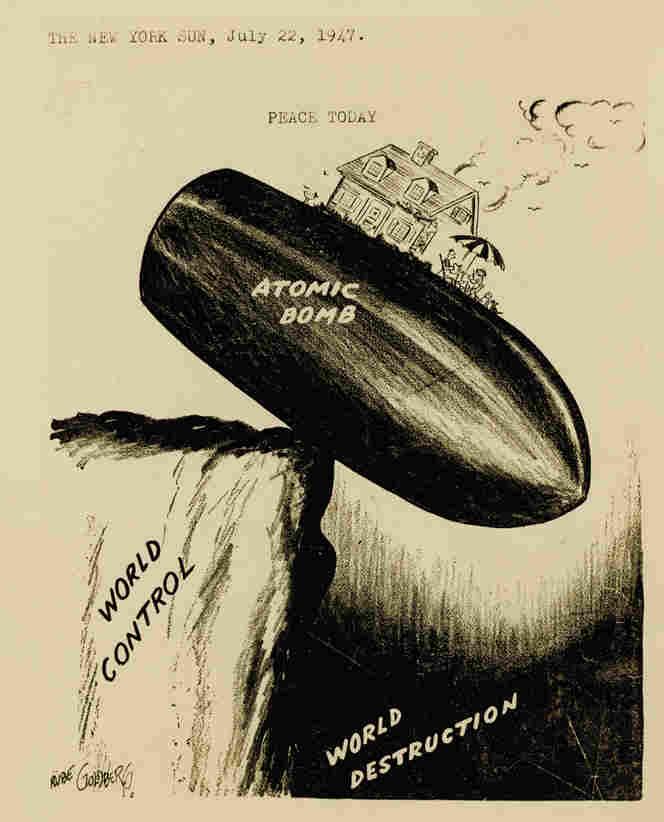
Rube Goldberg won a Pulitzer in 1948 for this editorial cartoon depicting the atomic bomb.
I tell you, I’ll never run down war. I got sent to London and those first few months were about the happiest ones I think I’ve ever spent in journalism. I liked the people and I liked the city. There was sort of a lull in the air raid war so you had all the excitement of being in a war area without any real danger.
But then the Air Force got this crazy idea of letting correspondents go on every major air raid over Germany. At the time, February 1943, the bombers flew in daylight and without fighter escort. Casualties were heavy.
The deepest penetration of Germany by American bombers was scheduled for Feb. 26 and the target was Bremen. Six reporters went along. We never saw Bremen. Too many clouds. So we flew around and bombed the secondary target, Wilhelmshaven. Or thought we did.
What we did see quite plainly was a rising swarm of German fighters. They got seven of our 60 bombers including the one with the New York Times correspondent*. That put a long halt to taking newsmen on raids. It was bad publicity.
After six months in London I was sent down to North Africa and I covered the invasion of Sicily and Italy from there. I never deliberately got into the thick of the fighting, but I found being at headquarters such a rotten bore and the army personnel so awful that I just wanted to get away. The job of the officers at headquarters was to give out propaganda, but the ones in the field, the actual field commanders, would tell the truth.
I didn’t want to leave Europe for the Pacific, but the paper asked me to go so I did. I was in Okinawa when the bomb was dropped on Hiroshima. An Air Force general showed me air photographs of Hiroshima, but I wasn’t terribly impressed. I got to see it for myself a month later when they organized a trip for about a dozen correspondents.
I don’t know what I was expecting, but it was visually an enormous letdown. None of us knew what Hiroshima had looked like before the bomb, but I think we were expecting to see vast heaps of debris as in Hamburg or Dresden or Coventry or London. But apparently the bomb demolished everything. There were only a few shells of buildings left standing, those made of iron and steel. And of course most of Hiroshima had been made of wood and it was just consumed by fire.
We traveled around a few blocks in the center of the city but there really wasn’t much to see. There were no civilians to talk to because everyone had been ordered out. Some Japanese officers kept warning us not to loiter, but we were suspicious of their warnings. In fact they were doing the correct thing because if we had hung around very long we probably wouldn’t be here today. I knew nothing about radiation at the time and I don’t think most Americans knew any more, although certainly the army knew enough by then not to send troops in.
It’s very easy to look back and express shock and horror, but the fact is that at the time we thought it was just a hell of a good raid, just another big bomb. We were still full of the war spirit and Japan was an all-out war. We felt we had to win it and that we had to practically exterminate the enemy. Hatred was something you lived with. I’m very suspicious of people’s expressions of shock now. They’ve forgotten how they felt then.
*This was Robert Post. German fighters shot down the B-24 Liberator in which he was flying, killing him and most of the plane’s crew.