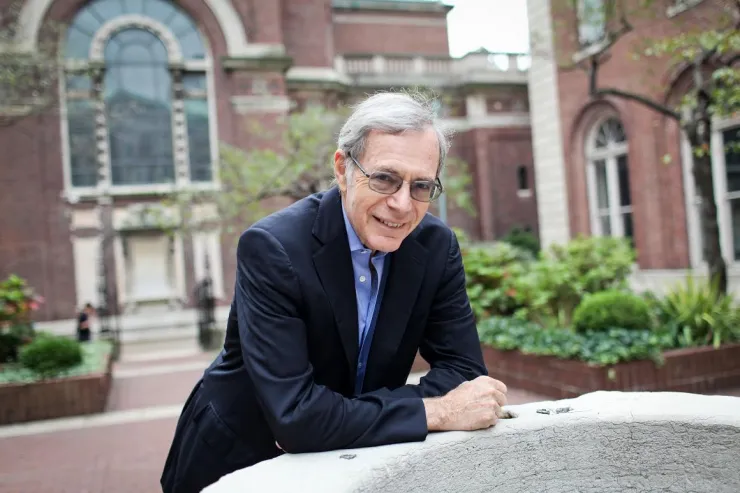
Born in 1943, I was raised in Long Beach, Long Island, in many ways a typical child of America’s postwar suburban boom. In one important respect, however, my upbringing was unusual. Shortly before I was born, my father, Jack D. Foner, and uncle, Philip S. Foner, both historians at City College in New York, were among some 60 faculty members dismissed from teaching positions after informers named them as members of the Communist party. During my childhood and for many years after, my father was blacklisted and unable to teach.
Given the profession of my father and uncle, many people assume that it was inevitable that I would become a historian. But, as I frequently tell my students, events are inevitable only after they happen. As a youth I was fascinated with science and math. But I also imbibed a lively interest in history. The history, however, was rather different from what I was learning in school. At home, I encountered ideas today taken for granted but then virtually unknown outside black and left-wing circles: slavery was the fundamental cause of the Civil War and emancipation its greatest accomplishment; Reconstruction was a tragedy not because it was attempted but because it failed; the condition of blacks was the nation’s foremost domestic problem. W. E. B. Du Bois and Paul Robeson were friends of my family, Frederick Douglass a household name.
I entered Columbia College in 1959 fully intending to major in astronomy. By the end of my sophomore year my interest — or perhaps my talent — in science had waned. Then, in my junior year, I somehow persuaded James P. Shenton to allow me to enroll in his senior seminar on the Civil War era. By the end of the course I was not only a history major but had also developed what became a lifelong passion for that era.
Now that I am rapidly heading into retirement, I look back on the teachers from whom I learned what it is to be a historian. The first was my father. Deprived of his livelihood while I was growing up, he supported our family as a freelance lecturer on history and current affairs. His lectures always emphasized how present concerns can be illuminated by the study of the past — how, for example, the repression of the McCarthy era recalled the days of the Alien and Sedition Acts, the Vietnam War recalled the earlier American suppression of the Philippine struggle for independence, and the civil rights movement ought to be viewed as the second Reconstruction. I also inherited a way of thinking about history in which visionaries and underdogs — Tom Paine, Wendell Phillips, Eugene V. Debs — were as central to the historical drama as presidents and captains of industry.
Then there was Shenton, who demonstrated that the essence of good teaching lies in the ability to convey to students your own passion for your subject. At a time when the civil rights revolution was transforming American society, Shenton urged us to study the historical origins of the movement — the struggles a century earlier of the abolitionists, Radical Republicans, and slaves themselves, to make this a land of freedom and equality. He directed us especially to Reconstruction, the turbulent era that followed the Civil War, when the laws and Constitution were rewritten to establish the principle of equal citizenship regardless of race, and when a remarkable experiment in interracial democracy rose, and then fell, from the ashes of slavery. Thanks both to the world around me in the 1960s and to Shenton’s teaching, much of my writing has been inspired by a desire to understand how social change happens and why it sometimes succeeds and sometimes fails.
I was also strongly influenced by my doctoral supervisor Richard Hofstadter, whose own career as a public intellectual demonstrated the value of reaching beyond the ivory tower to address a broad reading public. This is something I have tried to do throughout my career, bearing in mind Hofstadter’s strictures on the craft of writing (starting with his two favorite maxims: “ninety percent of writing is rewriting,” and “make war on the verb to be”). His books directed me toward subjects that have defined much of my own scholarship. Although the answers I propose in my books are different from his, the questions I ask remain Hofstadter questions — about the development of political language, the connections between political leaders and social movements, the intersections of ideology and material reality, and, not least, how to understand the enigmatic figure of Abraham Lincoln, about whom Hofstadter included a brilliant essay in The American Political Tradition.
The book for which I was fortunate enough to be awarded the Pulitzer Prize for history, The Fiery Trial: Abraham Lincoln and American Slavery, is in many ways a reflection of all the above influences. It is not a biography, of which there are many, but a study of the evolution of Lincoln’s ideas and policies about slavery, from his early career in Illinois to the end of his life. There is no reason to doubt the sincerity of Lincoln’s statement in 1864, “I am naturally anti-slavery. If slavery is not wrong, nothing is wrong. I can not remember when I did not so think, and feel.” But a moral aversion to slavery does not translate into any particular set of policies regarding how to rid the country of the institution, or how antislavery principles should be weighed against other commitments, such as party unity or devotion to the Constitution. It does not tell us what the place of African-Americans should be in a post-slavery America. On these and other questions, Lincoln changed enormously during the course of his life. I try to tell this story, as it were, forward, not backward — not as a teleological trajectory toward a predetermined goal, but as an unpredictable progress with twists and turns along the way, backward steps and false paths, and with the future always unknown.
One of the pleasures of working on this book was simply reading, slowly and carefully, Lincoln’s writings. Like others who have studied Lincoln, I came to admire his amazing command of the English language. Even the Emancipation Proclamation itself produces surprises when read really carefully. Lincoln urged freed slaves to go to work for “reasonable wages.” Lincoln always chose his words with extreme care. With that “reasonable” he wanted to make clear that as free laborers, the former slaves had the right to judge for themselves the wages offered them. In other words, in the Proclamation Lincoln addressed African-Americans not as property, subject to the will of others, but as actors on the stage of history, men and women whose loyalty the Union must earn.One of my themes had to do with the complex relationship between Lincoln and more radical opponents of slavery — the abolitionists, who generally operated outside the political system, and Radical Republicans, who represented the abolitionist sensibility in party politics. Lincoln was not an abolitionist and never claimed to be one. But to borrow a phrase from modern-day politics, Lincoln understood that abolitionists and Radicals were essential parts of the Republican “base.” The party, Lincoln said, could not win with this base alone, but it needed the Radicals’ enthusiasm, commitment, and impact on public sentiment.
Unlike many presidents, Lincoln did not surround himself with yes men. He was intellectually curious, willing to listen to critics. As the stage on which he acted expanded, Lincoln absorbed new experiences and encountered new people, and he learned from them. He combined a commitment to bedrock principles with a capacity for moral and political growth. These are qualities sorely needed in the strange political world we live in today.
As Max Weber wrote in his celebrated essay, “Politics as a Vocation,” “What is possible would not have been achieved if, in this world, people had not repeatedly reached for the impossible.” Every one of Lincoln’s major actions relating to slavery — abolition in the District of Columbia, the enrollment of black soldiers, emancipation under the Constitution’s war power, proposing the right to vote for some blacks in Reconstruction — had first been staked out by abolitionists. The Fiery Trial tells the story of how the combination of an enlightened public leader and a committed social movement can achieve transformative social change — a lesson as relevant to our own times as to Lincoln’s.