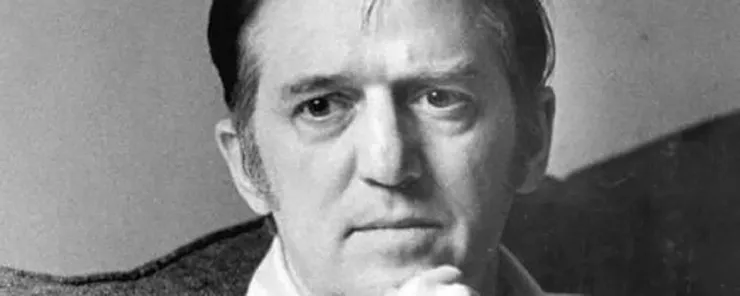
As his son Jeff, also a writer, tells his late father’s story on his website, Michael Shaara wrote his first novel after many years of producing science fiction and short stories for pulp mags and slicks. While working on the novel late at night after teaching classes, he had a heart attack that nearly killed him. The Broken Place, published in 1968 when he was 40, did not make Shaara rich and famous.
His next novel was already in his head. In 1964, on the way home from the New York World’s Fair to Tallahassee, where he taught writing at Florida State University, he and his family stopped at Gettysburg. Inspired by a visit to the battlefield, Shaara set out to write a novel of the fighting as seen through the eyes of soldiers. Maybe he was channeling Stephen Crane, although his subject was certainly not a soldier’s angst over cowardice and courage. Shaara’s theme was courage alone; his protagonist, Joshua Lawrence Chamberlain, led Maine troops at Little Round Top as they helped save the Union line.
Shaara researched the history of the battle deeply and spent years writing the book. Fifteen publishers rejected the manuscript. Finally, the David McKay Company, whose principal business was publishing Blondie, Dick Tracy and Fodor’s travel guides, took a chance on The Killer Angels. Even though the company was sold to Random House before publication, Shaara’s book attracted few readers and little fanfare.
Then a Pulitzer Prize jury read it. Then the Pulitzer Prize Board read it. Then it won the Pulitzer Prize. Then, many years later, Ted Turner financed the film version of The Killer Angels, calling it Gettysburg. Over time, more than 3 million copies sold.
Michael Shaara lived long enough to enjoy some of the glory of this, but not all. He died of a heart attack in 1988 at the age of 59, five years before the film came out.
Here is the 1975 Pulitzer Prize jury report, written by Carlos Baker of Princeton University.
Just one book
December 16, 1974
Your fiction jury has now made up its collective mind and I am empowered by Jean Stafford and Albert Duhamel to tell you that out of the immense welter of indescribably bad fiction we have chosen one novel to which all of us would be happy to see the prize awarded – happy both now and in the future. We recommend no other.
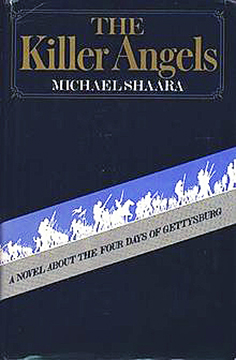 The novel is The Killer Angels by Michael Shaara, published by David McKay Company, New York. Its subject is the four days of the Battle of Gettysburg, and the narrative is carried forward from the points of view of half a dozen officers, Union and Rebel.
Mr. Duhamel strongly recommends the novel as a credible recreation of what happened – like Tolstoi about Borodino – but, more importantly, as a rouser of a story which needs no obscenities to remind us of what man might be.
Miss Stafford says that she became engrossed in the book, reread it with admiration, and adds that she is pleased that the three of us can be really radical by choosing a book written in the tradition of the novel. She also notes, amusingly, that she was raised in the knowledge of the War Between the States, since her father was a dedicated Civil War buff when he wasn’t being a Punic War buff or a Franco-Prussian buff. He read the Anabasis to her in her bassinette, and until she was seven she believed that he had personally been at Runnymede.
I should like to add to the comments of my fellow-judges that The Killer Angels seems to me much more than a historical novel: it is a very disciplined imagination of the four days of skirmish and battle, an exploration of the minds and motivations of responsible officers in the midst of the conflict. Having read it, I feel that I understand men at war, I understand the war itself, I understand the whole battle as a human and martial and geographical and sociological and logistic phenomenon better than I ever have before, although for years I have been on the edges of Civil War buffhood.
I could go on for some hundreds of words, but let it suffice here to say that in our several ways all of us were picked up and borne forward by the force of the narrative. Despite the diversity of points of view, it is a remarkable unit. The book contains no hokum, and the portraits limned are sharp and admirable.
So we nominate this one novel and hope very ardently that the Advisory Board on the Pulitzer Prizes will see eye to eye with us in this selection.
We cannot bow out of this long task without telling you how much we appreciate your sense of responsibility, your patience, and your kindness from last summer to now. We all join in wishing you a merry Christmas and a better than average new year.
Yours very sincerely,
Carlos Baker Chairman, Fiction Jury,
Who could have done nothing without
the superb efforts of Miss Jean Stafford
and Professor Duhamel, who proved to be
ideal and highly responsible fellow-judges
Sources: Pulitzer Prize files; “Making ‘Killer Angels,’” by Phil Leigh, The Opinionater, New York Times blog; Jeff Shaara website