
During a recent visit to Florida, I forced myself to drive downtown to the site where the Miami Herald once occupied a squat, rectangular, six-story building on Biscayne Bay and where huge pillars at the entrance erased any doubts about the weightiness of what went on inside. An entertainment conglomerate from Malaysia purchased the property in 2011 with plans to tear it down and build just what the world needs, another casino.
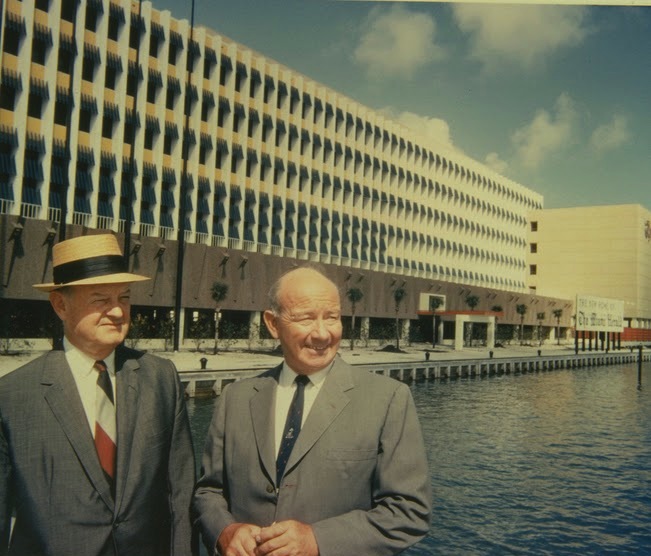
John S. and James L. Knight at the then newly built Miami Herald offices, in 1963.

The building was demolished in 2015.
I reacted as if I were mourning a person. I made the sign of the cross, wanting to give the building a proper burial, hoping it would rest in peace.
Like most of the young reporters new to Miami in the ’70s, I was shocked by the serious, often deadly, nature of the news. We had come from small dailies or weeklies where we filled the maw with copy inspired by harmless assignments, such as covering Easter egg hunts or riding an elephant when the circus parade came to town.
I had my eyes on Tropic Magazine which fancied itself an outlier within the Herald — the testing ground for irreverence, for how far the paper was willing to go, both in terms of creating whimsy and offense. Operating out of a big room with little privacy in the west side of the building, the location had one major perk: a sunset view, even if it was of the parking lot and of the old Sears tower. Someone had written, “Go for it,” on one of the windows and for years no one erased it.
The staff was a mixed bag of hard-asses and dreamers, misfits and magicians — pretty much the usual formula in any self-respecting newsroom at the time.
The art director at Tropic, Leon Rosenblatt, scrutinized font choices and sizes with Talmudic intensity, trying to figure out the best formula for luring readers in. In a town where “Honk if you hate culture” was a popular bumper sticker and, judging by all the honking, a popular sentiment, Leon was a crusader for the opposing view.
The editor, Lary Bloom (yes, Lary, just one “r”; his mother wanted to befuddle copy editors the world over) had the shuffling air of Columbo, a television detective whose bumbling manner disguised his true cunning. Lary would scratch some part of his body, look off into space, smile way too broadly, and before you knew it, he had helped you get to your vision of a story by giving you the air time to talk it out. Lary was the idea guy, the rainmaker.
Doug Balz, the assistant editor, had his doctorate in American studies, a level of erudition almost unheard of in newspapers. I was never sure if he wore his glasses or his glasses wore him: either way, he radiated studiousness. He had written his dissertation on Norman Mailer and had an early understanding of how reality had outstripped the imagination as a source of the outlandish
All together, they were a charmed combination for me: the visual dash of Leon, the long leash from Lary, Doug’s scholarly rigor.
The first story I wrote as a staffer for Tropic was about an old man named Ed Zepp who felt he had been unfairly discharged from the service during World War I. He claimed to be a conscientious objector, but his superior officers refused to grant him that status. When he in turn refused to fight, he was sent to Leavenworth and given a dishonorable discharge. Now he had a chance to travel to the Pentagon for a formal hearing.
Zepp was known at newspapers along the coast of South Florida, big and small, from Miami up to Deerfield Beach, where he lived. Still strapping for a man in his early 80s, he was persistent for a person at any age as he tried to get someone to write his story. When its outline reached Lary, instead of dismissing it as the cranky tale of a malcontent, he sensed a larger drama. He asked me to meet with Zepp.
Zepp had one story to tell and told it over and over. On the train to D.C., his nonstop recital wore out me and my photographer, John Doman. At midnight, we gently shoved our garrulous source into his roomette and repaired to the club car for a moment of peace.
Back at Tropic, I sat with notebooks piled on my desk, uncertain of where to start. Doug sensed the agony in my inertia and said, gently, “When in doubt, put the reader on the road. Learn from the best. If the journey motif was good enough for Homer, surely it’s good enough for ...”The lede then flowed: “All his life, Edward Zepp had wanted nothing so much as to go onto the next world with a clear conscience. So on September 11, 1979, the old man, carrying a borrowed briefcase filled with papers, boarded an Amtrak train in Deerfield Beach and headed north on the Silver Meteor to our nation’s capital.”
After that, I was still adrift. Doug helped me see the two trajectories: the trip to the Pentagon in present time and the trip backward to when the story really began, in Europe, with a young man saying no. “That way,” said Doug, “You get time going in two directions.”
He sat at my side as I auditioned sentences. “How’s this?” I asked. “During any long trip there is a distortion of landscape and time ... the closer he got to the Pentagon, the closer he got to 1917.”
“Good,” said Doug, “Keep going.”
“Maybe I should foreshadow his contradictory nature, how despite being a conscientious objector, he uses a blackjack in his Margate condo?”
“Good,” said Doug. “Keep going.”
“And how he has a sensitive side. He keeps talking about how much he misses his wife who recently died.”
“Good,” said Doug. “Keep going.”
“Of course it was wife No. 3.”
“Good,” said Doug. “Keep going.
I tried to capture the Zepp’s rhythms of his speech, the occasional formalisms:
“My father was a blacksmith, not the kind who makes shoes for horses but rather he made all the iron work pertaining to a wagon.”
His phoniness:
“When I was at the Community Chest, I called all the women darlings and I would dance the polka with them at the parties. I used the oil can profusely.”
His sadness, when the hearing was over and he was at the station in Washington, waiting for the train back to Florida to await the verdict:
“Here’s my problem. Now that I don’t have anything to battle for, what will I do? There’s nothing I know of on the horizon to compete with that.
“Well, I can go swimming. And I can keep square dancing. Something happens to me when I square dance; it’s the — what do they call it? — the adrenalin. I am a top form dancer. Maybe I can go back to being the treasurer of the Broward Community Senior Center. I did that before my wife became sick, but I quit to take care of her. I always was a fine office man. Maybe I’ll become active in the Hope Lutheran Church. In other words, keep moving. Keep moving. That’s the secret.
“All I know is that I could not face my departure from earth if I had failed to put up this fight.”
That was the ending Doug and I agreed to, a wistful note, waiting only for the final decree from the Pentagon as the coda before shipping the story to the printer’s.
When the decree arrived, Zepp was vindicated. His records were amended to reflect an Honorable Discharge from now until the end of time, but his euphoria was short-lived. A week later a copy of the decision arrived at his condo. The decision was not unanimous. One member, James Hise, had voted against him.
“I’m so mad,” he said, “I could kick the hell out of him. A guy like that shouldn’t be sitting on the board. I am going to write to the Pentagon and tell them he should be thrown off the panel. It would be better to have just a head up there loaded with concrete or sawdust than this guy Hise, who doesn’t know the first thing about justice. If he can’t judge better than that, he should be kicked off. He’s a menace to justice in this world.
“I’d like to go up there and bust his head wide open.”
I was bereft.
“My story is ruined,” I said, on the verge of tears. “And I thought he was such a sweet old man.”
“This,” said Doug, grinning widely and speaking slowly, adjusting his eyeglasses as if to receive even clearer reception, “is actually better. He is still a sweet old man who happens also to be a cantankerous S.O.B.”
The Monday the Pulitzer Prizes were to be announced at 3 p.m., I was out on assignment, exhausted because the previous weekend my fiancé and I had moved into our first house, on Miami Beach. An alleged selling point, that the house was on a bus route, didn’t sink in as a deficit until those first two nights as I tried to acclimate all night long to the screech of brakes and the wheeze of the hydraulics as doors opened and closed.
Back at Tropic, Leon, Lary, Doug and I, stunned, proceeded toward the newsroom. As we approached, we heard the old teletypes, clackety-clack, clackety-clack. Their pressurized staccato delivered the news of the world, one loud letter after another, and now it would tap out, “And the recipient of 1980 Pulitzer Prize in the category of feature writing ...”
As we strode in, four across, a team of our own making on a victory lap, every one in the newsroom stood up and started clapping.
It lasted a minute; it has lasted forever.
Someone interviewed me for the paper about what it felt like to win, and I said, “I’m thrilled but I know that’s not sexy,” wishing I had something more clever to say. In the pinch I succumbed to that Irish Catholic tic of diminishing the moment, undercutting it. I could already hear my future self, nattering in the same belittling vein: oh, yes, the Pulitzer: a handy credential, like knowing shorthand or how to change a tire.
The party that night at my new house consisted of a potluck highlighted by a bucket of Kentucky Fried Chicken washed down with a bottle of Dom Perignon. The range perfectly suited the highs and lows of being a reporter: the glory, sure, of a moment like this, but also the certain knowledge that the mundane tasks, the patient listening, the endless availability to one’s sources are the true backbone of enterprise.
Soon, Zepp faded from the limelight, in the tradition of old soldiers everywhere.
As for me, well, everyone knows a reporter is only as good as her next story.
Truths and truisms from those days still dog me, above all, the great writing lesson from Doug: “When in doubt, put the reader on the road.” To this day I tell myself and anyone else who will listen, begin your story by putting your character in motion. That will put your reader in motion as well. It doesn’t matter whether it is a train, as it was with Private Ed Zepp, or a plane or truck or roller blades or ice skates or a shopping cart or a scooter or a parachute or a boat. As Doug said, in the most diplomatic advice ever given to me by an editor “If the journey motif was good enough for Homer, it’s good enough for ...”
I’ve been trying to finish that sentence ever since I first heard it.