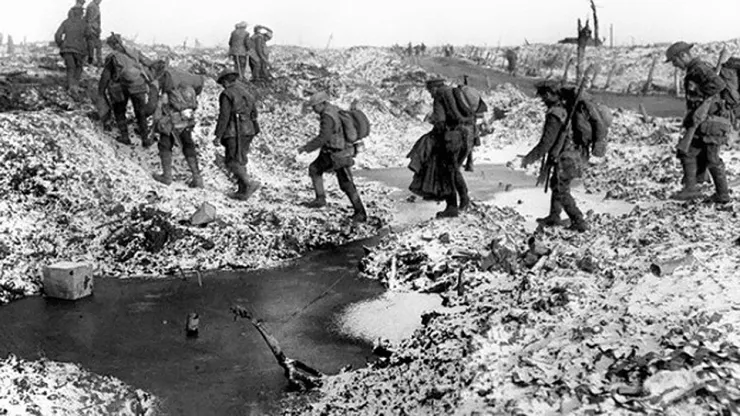
Herbert Bayard Swope of the New York World reported from Germany for the first four months of World War I and returned two years later for an update. These two trips allowed him “to contrast the wild exaltation of 1914 with the serious, somber Germany of to-day.”
Swope’s work during the 1916 trip won him the first Pulitzer Prize in reporting. This came in an era when “airplane” was spelled “aeroplane” and pigeons were the high-speed info carriers of their day.
But quaintness is not the chief takeaway for modern readers of Swope’s report from the front. His stories convey the utter brutality that would become familiar in the 20th century and continue into the 21st. A German general told Swope that after headquarters did not hear from soldiers in the front trenches for 12 days, everyone marveled that they had survived on only whatever field mice and rats they could catch. The same general boasted to Swope: “The English have not won enough ground from us to bury their dead in single graves, and they won’t.”
Swope was 34 years old when he visited the German lines at the Somme. He was one of the best-known reporters of his day and hobnobbed with the New York literary elite. While he was executive editor of the World during the 1920s, the paper twice won the Pulitzer Prize for Public Service.
With James W. Gerald, Swope quickly reprised his prize-winning 1916 reporting in the book Inside the German Empire during the Third Year of the War. It was published in 1917, the year the United States entered World War I.
With the German troops fighting on the Somme
By HERBERT BAYARD SWOPE
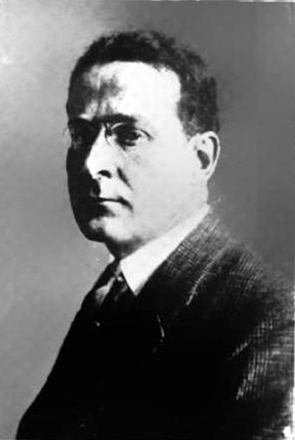
Herbert Bayard Swope
To get into Germany in these days is hard enough, but to get through the wall of secrecy that is built around every phase of military life (excepting visits to the front, which are now made by correspondents freely and with few restrictions upon what they may see) is much harder. It took four weeks to get certain questions answered, and to others I could get no answers. Ordinary precaution, coupled with the spy-fear that is still strong in the empire, makes for suspicion every time one sees replies to even harmless queries.
To get the official view of the situation held by the officers of the general staff, I called on General von Freytag-Loringhoven at the general staff building in Berlin, where the great Moltke long presided. He received me in a room the distinguishing features of which were maps, not only showing the disposition of the German forces, but immense wall-sized ones on which were diagrammed the present locations of the Allies, showing their number, their commanders (designated by name and location of headquarters), with their ranks indicated by little particolored flags. I had just returned from the Somme, and as I saw how each of the French and British lines was clearly marked, I expressed my surprise.
The general smiled. “Yes, our intelligence department is pretty thorough,” he said, “but it is no better on the Somme than our enemy’s is, for in France, where we stand on occupied soil, almost every civilian is an aid to the Allies. But despite that, despite all the French and English can do at the Somme,” he went on, “they will never break through. They timed the movement well and took us at a place and time when we were weakest; but the worst has passed, and they have failed to gain their goal. Now it is impossible, for we have so strengthened our positions with new trenches, reserves, and guns that the operation has lost its significance beyond pounding away, which we can stand at the price they are paying.
“It is to be expected that we may lose a few more villages. The losses will be such as we can afford, since they will be of use in strengthening our lines. But no place will be given up without making the Allies pay a high cost, as at this post. The offensive began on June 23. From that time to the end of September the French and English have gained about three per cent of the French ground we hold. At that rate it would take about eight years to drive us out of France, and with the new positions we have prepared, that ratio will not hold. And in Belgium we are untouched.”
Freytag concluded with the sentiment that every German general utters: “It is too bad that circumstances have forced this Stellungskrieg [trench war]. In the open, with an opportunity to use strategy and tactics, we could soon bring an end to the war.” The same opinion was expressed by General von Kirchbach, commanding one of the armies of Field-Marshal Crown Prince Rupprecht of Bavaria at the Somme. He had lost Ginchy the day I saw him at the front, but he too was certain that “the Allies will never come through.”
The most interesting of the generals at the Somme was von Wenninger, commanding the First Division of the Guards, who held Thiepval for a long time in the face of continuous attacks. He told me that for twelve days previous to the loss of the village he had no communication with his men in the first-line trenches, which had lost all semblance of trenches, being merely crater-holes, in the bottom of which the men burrowed and hid from artillery fire, popping up to repel attacks. No one knows what the men lived on while they were cut off except for the field mice and rats that they caught and ate.
With a party of correspondents and neutral army observers in September I stood in the general’s field headquarters and watched the big guns drop shells all around the famous “windmill of Pozieres” on the high ridge which had been taken by the British and was being used by their artillery observers, who gamely held on, although the position was anything but comfortable.
While we watched the bombardment a squadron of English fliers passed overhead. I ducked and made for the bomb-proof. “Don’t worry,” said the general, “the fliers rarely bomb us. Our aviators generally leave their generals’ headquarters alone, and they usually do the same by us. It is a sort of understood courtesy.”
The Somme represents war raised to the nth power. At different times one can see and hear every phase of military activity – drum-fire, light field pieces, machine-guns, hand-grenades, mine-throwers, infantry attacks, mine explosions, liquid fire gas, observation balloons, anti-aircraft cannon, while aeroplane observation and flights are so common that they fail to stir up any excitement even among visitors. I counted as many as sixty machines aloft in half an hour a few weeks ago. The large majority of them were French and English, for the German machines are heavily outnumbered, so much so that their value as observers is sharply curtailed.
Talking of the offensive, Wenninger said: “The English have not won enough ground from us to bury their dead in single graves, and they won’t. The English losses are terrific, but their soldiers fight well. The mortality of officers is very heavy among the English. We can tell that apart from the casualty lists by the few officers who are taken prisoners in comparison to the number of men we take.”
At the Somme the Germans have taken a leaf from the English book and emplaced many of their big naval cannons. We were permitted to see two of the great 42-centimeter howitzers opposite Pozieres. They had just been brought up to the line. The 21-centimeters were common.
Where before a division covered about three miles front, the fighting is so intensive on the Somme that it now holds less than one mile. This is true on both sides. In one day the Third Division, standing opposite the Courcelette-Martinpuich line, shot away 160 heavy truck-loads of ammunition. This is a fair example of the tremendous drain on supplies. That is why the roads on both sides are generously sprayed by cannon-fire after sunset.
Only the exceptionally fine roads permit a battle of the nature of that being fought on the Somme. In the east, the experts agreed, the outcome would have to depend upon infantry attacks, since the roads are so bad as to preclude supplies sufficient to permit any long-continued engagements.
The Germans have pushed the railroad construction right up to the firing lines to facilitate replenishment of supplies. It is rather incongruous to see locomotives puffing away, with harvesters at work on one side (the Germans till the ground right up to the volcano’s edge) and heavy guns shooting on the other.
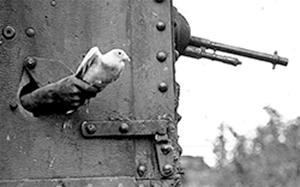 Pigeon-posts are much used at the Somme. The birds are taken into the front lines, and when communications are broken, they are released, two at a time, each carrying the same message, and they fly back to headquarters. As you pass through the villages in the line of fire you notice that every house has a sign on it indicating how many soldiers can find [a] place in the cellar when bombardment begins.
Bapaume, one of the great objectives of the British just now, is under almost constant fire, yet many French villagers still stay there. They no longer live in the houses; they live entirely in the cellars, and the improvised chimneys stick up along the street in weird manner.
In going down the roads and across fields under fire, the reserves go single file and several paces apart. So do the correspondents, and the precaution is not calculated to heighten one’s feeling of safety, especially when fountains of earth are kicked up by exploding nine-inch shells only eighty or one hundred yards away. One finds himself thinking that if the gunner had deflected only two points – well, as Bennett of the Chicago Tribune and I were leaving a 21-centimeter position opposite Pozaires a shot scythed through a tree not ten yards from us.
The English are doing much mining along the Somme. The Germans say that the Welsh miners are brought over for this purpose. It usually takes two or three weeks to dig the tunnels. Some are ninety feet long. This shows why the progress is so slow. At the Somme I met Captain von Papen, the former German military attaché, who was sent home by America. After six weeks on the firing line he was made chief of staff to General Count Schweinitz, commanding the Fourth Guard Division and holding the Grevillers-Warlencourt-Ligny line. He has proven himself an efficient officer.
The reports that Hindenburg might shorten his line in the west by retiring from his present position grew out of a proposition in which many of the German generals believe. They are so confident of their superiority to the enemy in a Bewegungs-Krieg (mobile battle, in contradistinction to trench war), the type Napoleon used, that they seriously suggested a retirement from the Somme to a position forty or sixty miles in the rear, where a decisive action could be fought in the open. Hindenburg had more than half a mind to consider the plan were it not for the evil effect upon the morale of his country in the event of a retiring moment.
The highlight one carries away from the front in the west is that it is more than a battle-field of physical forces. It is a fight of spirit, not how many dead can be counted, but how many of the living can be disheartened. The Germans realize this, and that is why their leaders make every effort secondary to the supreme one of lifting up the morale of the troops and preserving their courage and confidence. They believe that the English have abandoned the original plan of trying to break through and are now pounding away in the hope that, if they cannot break the German line, they may be able to break the German heart.
The German flag floats over 20,000 square miles of Belgian and French soil, a region almost as large as the combined areas of Connecticut, Massachusetts, and Vermont. All of Belgium except for a piece less than two hundred square miles in size is tributary to the Kaiser, and one twenty-fifth of all France is in his hands. With the German flag there has come the German rule, severe, suspicious, ruthless at times, and permitting no deviations from the course it prescribes for the subject peoples. But in the rule there is to be perceived a sense of responsibility, the recognition of which is a matter of fairness on the part of any neutral observer.
The iron heel of the conqueror, as some partisans have pictured it, is not crushing the life out of the people by deliberate starvation, nor is it depriving them of all privileges. The yoke of the conqueror sits heavy upon the Belgians and the French, and they are not happy under it. But their businesses are permitted to continue, they are urged and helped to till their fields, their schools and churches are open, their hubs and gathering-places are freely used, and while the display of no other flag than Germany is tolerated, it is a common thing to see displayed in Belgium pictures of King Albert and his family, and in France photographs of President Poincare and of French generals.
The reaction I carried away from a visit to the occupied territories was certainly not that which the Allies seek to produce, nor was it that which official Germany tries to create. A military occupancy at best is a source of unhappiness to the people whose lands are thus seized, but it is not in Belgium and northern France characterized by the cruelty and viciousness often described.
My visit to Belgium was not made under the usual conditions that the Foreign Office in Berlin throws about the tours made by neutral observers. They are sent to the conquered country in the care of officers who are particularly instructed as to what their charges shall and shall not see. My trip to Belgium was a byproduct of my visit to the Somme battlefront. We stopped in Belgium on our way there and on the way back, and on both occasions I was given unusual opportunity to wander about, seeing and hearing the things I wanted to see and hear rather than things carefully picked for me by others.
I did not find Belgium the scene of vast desolation, the dreary, stricken, hopeless land that I had been led to believe I would find; on the contrary, instead of coming away with my sympathies for the unfortunate country accentuated, I found their edge rather dulled. In the French area I found the conditions different, and there my sentiments were quickened into a passion of pity and admiration.
In the cities of Belgium, such as Brussels, Antwerp, Liege and Louvain, many of the men who worked at first later refused to work. They said they were engaged in a passive strike and that they would do nothing likely to advance the interests of their German rulers; but in this refusal they declined also to advance their own interests, even to the extent of refusing to support themselves.
In captive France, there are no young men, and the opposition of the people to their subjugation, though unspoken and unacted, is a flame, and I felt its strength and depth. The spirit of the French is one of unbroken pride; there is no bending of the neck, no passivity, no yielding to their temporary fate. And this spirit becomes the more remarkable in that the conditions of the French are much worse than those of the Belgians, because of the nearness of the war and the attendant difficulties of supporting life.
In the cities of “German France” the old men and the women – all of them – work. They tend to their flocks, they till their fields, they open their shops, and with that thrift which characterizes the French they make all the money they can so that later they may help their country recuperate from the ravages of the war, and help her in the economic struggle that is to follow after this one of arms. In contradistinction to Belgium, there are no young men -- they are all fighting for the motherland.
In both the countries, while the administration has been taken over by the German military, the native police are still at work, and the inferior courts are still open and doing business. If one did not have advance knowledge of the fact, one would not know in walking the streets of Brussels that it was a captive city, save for the presence of the German field-gray uniform and the black, white and red flag. Theaters are open, museums are visited, and most of the restaurants do a flourishing business.
Travel between Belgium and Germany is virtually limited to troop movements, although those in either country having actual business in the other may, after a great deal of trouble, obtain passports. This does not hold good regarding France, in which no travel of any sort is permitted the natives. Around Bissing’s palace in Brussels there is a cordon of guards by which one is stopped two blocks away, and unless one can show a highly particularized pass with countless endorsements thereon one is turned back most unceremoniously.
In Lille, where the booming of the big guns is to be heard all day and night, the hatred of the German is something that awes you. Not that it is given vocal expression; it would be better if it were. It is in the actions of the people that you read it. You see women step off the pavements when German officers come near, or stop dead and turn their faces away. You see little children quiet their play, and the men go by with eyes straight ahead. In the shops the officers are waited on, but never an unnecessary word is wasted on them.
But most of the Germans in Belgium think that Belgium is unnecessarily alarmed as to her future. They feel that Germany has learned a lesson in the danger of breeding hatred through her possession of Alsace-Lorraine, and they think she has small wish to add to that heritage. The officers and soldiers in Belgium and France are the most outspoken opponents of the plan, sometimes urged, to hold Belgium and a part of the occupied French territory. “No more of that, for God’s sake!” said one distinguished officer. “We see what Alsace-Lorraine brought us, so in our own interest let us give Belgium and France back their conquered territory rather than make certain, as it were, another war.”