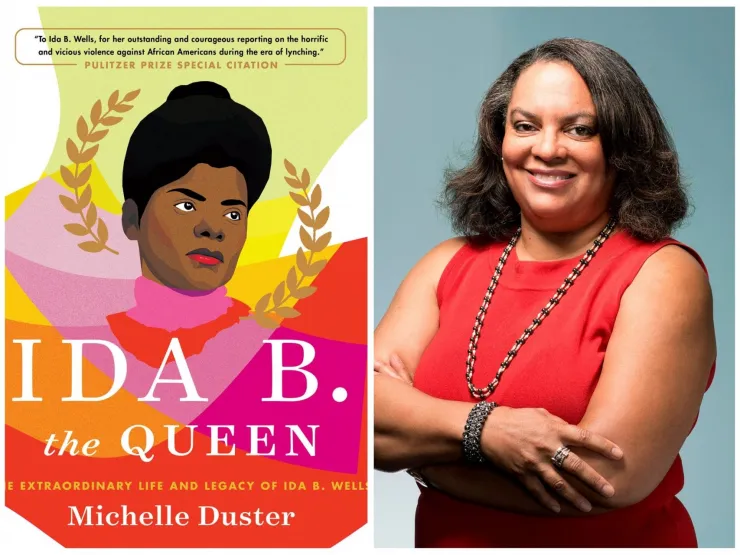
In 2020, the Pulitzer Prize Board awarded a Special Citation to Ida B. Wells "for her outstanding and courageous reporting on the horrific and vicious violence against African Americans during the era of lynching." Now, one of Wells' descendants, Michelle Duster, has published a book chronicling the life and career of her great-grandmother — and their broader impact.
In honor of Black History Month, read an excerpt of "Ida B. the Queen: The Extraordinary Life and Legacy of Ida B. Wells" (One Signal Publishers/Atria/Simon & Schuster).
The Power of the Press
The people must know before they can act and there is no educator to compare with the press.
—Ida B. Wells
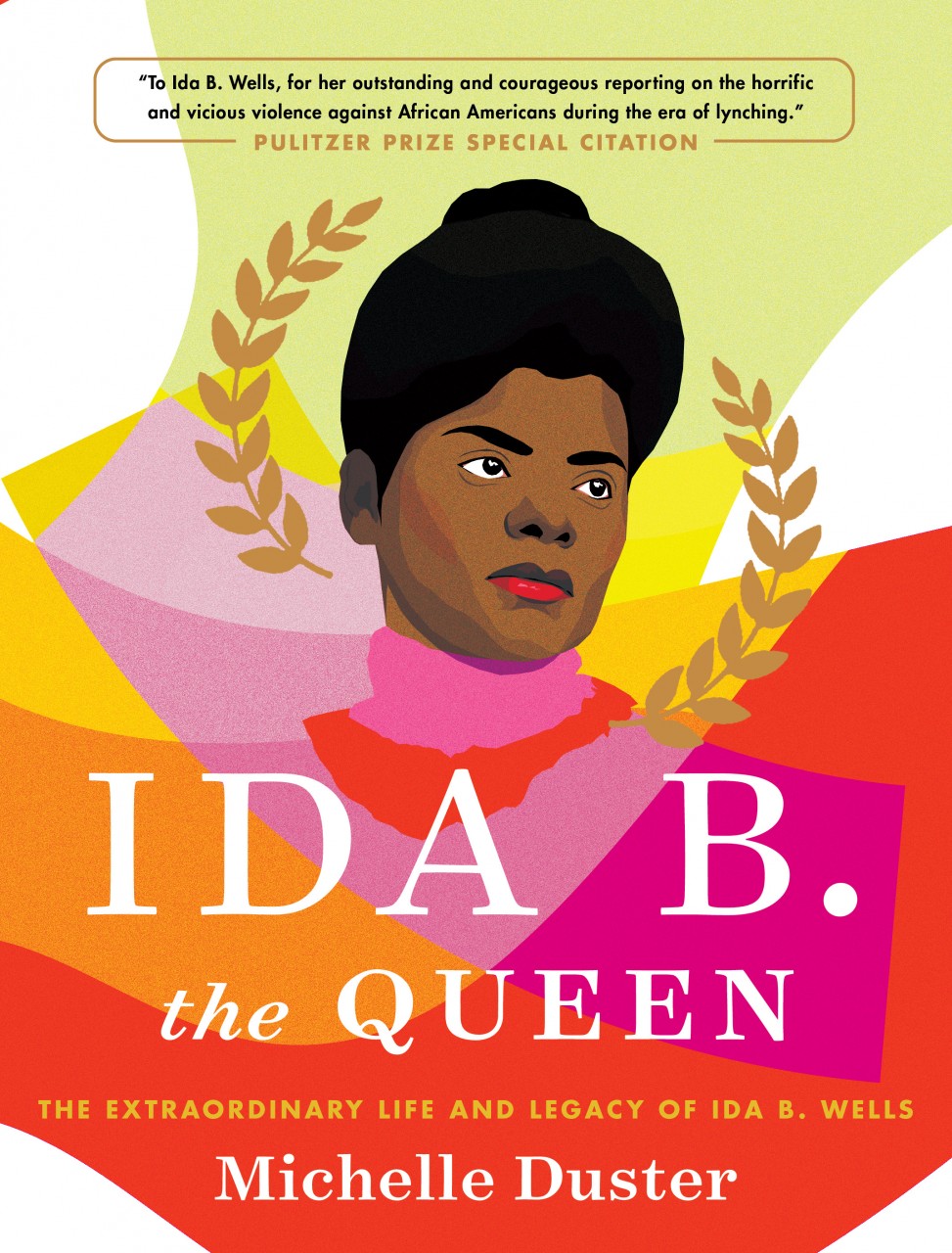
'Ida B. the Queen' by Michelle Duster. Cover art: Monica Ahanonu
Ida began her foray into journalism with the Evening Star, the publication of her local lyceum, or literary club. Ever full of charisma, she not only wrote and edited the Evening Star, she also read aloud from its pages every Friday night. Ida’s readings regularly packed the lyceum, including with nonmembers. One local Baptist pastor, a man named R. N. Countee, came to hear Ida read.
Although Ida only regarded writing for the newsletter as a creative outlet, her talent stood out and caught the attention of Rev. Countee. He approached her with an offer to write a weekly column for a larger publication with a broader audience — the Living Way newspaper. The idea excited Ida, even though the opportunity did not pay.
Ida accepted Rev. Countee’s offer. Soon she began writing a column for the Living Way. According to our family stories, Ida had seen her name written on a document, and it looked as if the d was written as two letters: o and l. She liked that different name and decided to use it as a pen name to start her journalism career. “Iola” was born.
In the 1880s, it was extremely rare for a Black woman to write about racial issues.
Few women of any race went into journalism. Less than five percent of journalists were women, out of those who worked for the almost two hundred Black-owned newspapers. Now Ida was one of them. Most female journalists of the time — Black and white — wrote on subjects that were considered “women’s topics”: book reviews, school, fashion, home decorating, or cleaning. Aside from these narrow categories, women journalists were also relegated to writing articles about marriage and children.
But that was never going to work for Ida, and Rev. Countee knew that when he hired her. Ida had strong opinions about everything and believed she had the right to express them. Ida’s primary aim was to write toward justice, not just away from racism. And so in her columns, everyone was fair game for “Iola” to criticize — Black, white, men, women, institutions, ministers, and laypeople. When she believed that Black people who were considered leaders did nothing to help their people, she laid into them.
Since the appetite grows for what it feeds on, the desire came to own a paper.
—Ida B. Wells
[In 1889] Ida was invited to become editor for the Free Speech and Headlight, a Black-owned newspaper in Memphis with a large circulation. The paper was created through a merger of the Free Speech, by Rev. Taylor Nightingale of Memphis, and the Marion Headlight, by J. L. Fleming from Marion, Arkansas. The two men had different strengths. Nightingale led the largest Black congregation in the state, and Fleming was an established publisher. But the men needed an editor, and Ida B. Wells had the skills and the following they were looking for.
Ida was ecstatic about the opportunity. The only holdup was that she wanted to be in on the business deal, too. Once she scraped up the money to buy a one-third ownership share, she became one of the few women in the country to be both editor and owner of a newspaper. Naturally, Ida had big plans for the paper. But first things first: she thought the paper’s name was too long. Now simply the Free Speech, Ida B.’s paper wasted no time in publishing articles and opinion pieces that caused controversy. She was direct in her criticism and exposure of the truth around her.
She was so bold and determined to expose every form of inequality that she even had the audacity to criticize the Memphis school system — her only source of full-time income. She wrote about the vast differences in pay, resources, and teaching environments between white and Black schools. As a result, she was out of a job.
She needed to decide what to do with her life. Rather than look for another job, from that day forward she worked for herself. She threw herself into working full time to grow the newspaper. She continued her newspaper work undeterred — especially in the face of a devastating loss. As she was selling subscriptions for the Free Speech in Natchez, Mississippi, tragedy struck close to home in March 1892. She didn’t learn about it until she returned to Memphis and was met with the distressing news that three of her friends had been lynched.
Ida knew that [the] men she had called friends, were upstanding citizens. They had committed no crime at all. Ida later wrote in her autobiography: “This is what opened my eyes to what lynching really was. An excuse to get rid of Negroes who were acquiring wealth and property and thus keep the race terrorized and ‘keep the nigger down.’” Her grief turned into anger, and she vowed that the Free Speech would battle the lynchers and the people who “looked the other way.” She wouldn’t rest until the world knew the truth. She knew that she had the ability to make people react based on her words. And she wanted to make sure the rest of the country knew what had happened in Memphis.
Through the distribution of her newspaper, and having her story be picked up in other publications, she hoped that the truth of domestic terrorism would help put a stop to lynching. No one deserved to die because they had the wherewithal to open and run a successful business. She picked up her pen and wrote an editorial that appeared in her newspaper a few days after the murders:
The city of Memphis has demonstrated that neither character nor standing avails the Negro if he dares to protect himself against the white man or become his rival. There is nothing we can do about the lynching now, as we are out-numbered and without arms. The white mob could help itself to ammunition without pay, but the order was rigidly enforced against the selling of guns to Negroes. There is therefore only one thing left that we can do; save our money and leave a town which will neither protect our lives and property, nor give us a fair trial in the courts, but takes us out and murders us in cold blood when accused by white persons.
Ida wanted the white community to feel the consequences for the destruction of life and property. She felt that those who did and said nothing in the face of such violence against Black people were just as guilty as those who had committed the murders. Knowing that Black people had almost no rights to vote and only limited ownership of business, she urged the Memphis folks who could not leave the city to leverage their economic power. Ida encouraged them to boycott the streetcars and white-owned businesses. She had the social savvy, emotional fortitude, and skill set to make an impact on the community. With her scathing newspaper articles, she did just that.
Taking Control of Our Narrative
When Ida wrote about the realities of her friends being lynched, she was countering false narratives about Black people. She took control of the narrative and presented the Black perspective to counter propaganda that framed Black people as biologically or sociologically inferior, dangerous, and violent.
The prevailing narrative at the time was that Black men were sexual predators who targeted white women and therefore deserved to die in a most brutal way. Other victims of lynching had been framed as dangers to the social order, specifically threatening to white people, or robbers. Horrific acts against Black people were normalized over time: torture, collecting their teeth and bones as souvenirs, or even burning them alive for the enjoyment of spectators.
Ida investigated these atrocities with the goal of humanizing their victims. Time and time again, she found that the victims were misidentified scapegoats targeted to be punished for a crime that was committed by someone else or swept up in an act of terror intended to institute social control over unwanted Black communities and neighbors. When Ida wrote her articles in the Free Speech about the lynching of [her friends], she highlighted how the murders’ implication of violence against any Black person, at any time, kept the surrounding community terrorized and economically disenfranchised for a generation.
Many people have followed Ida’s example of taking control of disputed history — most often shaped by the wealthy and powerful and telling those stories through the lens of Black people’s perspective. From the first Black newspaper, Freedom’s Journal, started in 1827, to Frederick Douglass establishing the North Star newspaper in 1847, to John H. Johnson founding the Johnson Publishing Company in 1942 (the publisher of Ebony and Jet magazines), Black people have had to write, create, and own dozens of other media outlets to have their own stories heard.