Walter Kerr found his calling early. He worked as a movie critic for his hometown paper while in high school and edited the arts page at the Daily Northwestern in college. In 1951, after several years teaching drama and directing plays, he joined the New York Herald Tribune as drama critic.
Zero Mostel’s rise, by contrast, was more gradual. He was 26 when the Café Society, a Manhattan nightclub, hired him as a comedian. He entertained servicemen during World War II and appeared in plays and movies. After a witness named him as a former member of the Communist Party, he was blacklisted by the House on Un-American Activities. He survived both this and a 1960 accident in which a New York City crosstown bus crushed his leg.
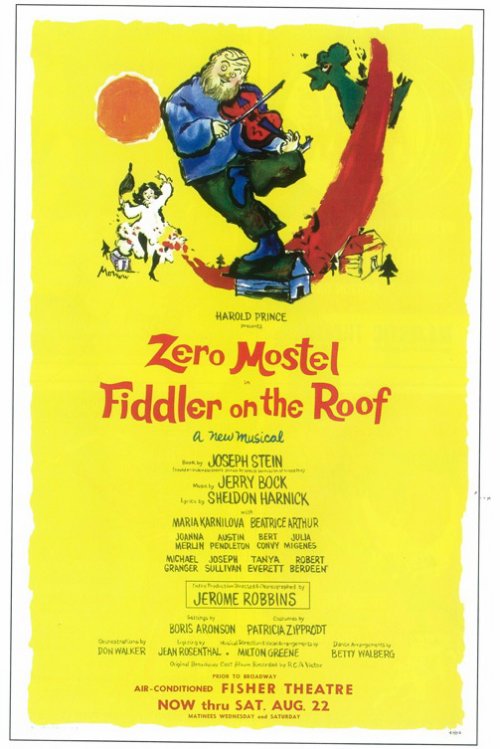
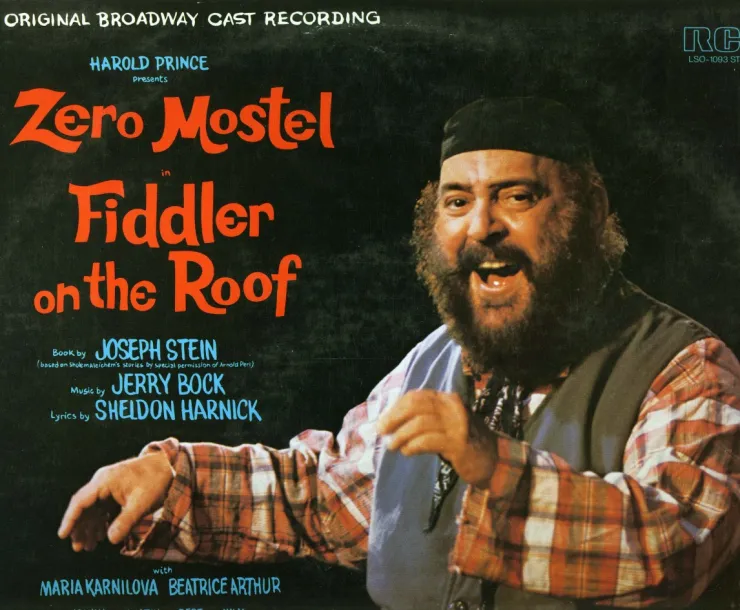
In 1964 Mostel landed the role of Tevye in "Fiddler on the Roof." Kerr gave the play a bad review in the Herald Tribune. Audiences flocked to it anyway. "Fiddler" won six Tonys, including best musical and best actor in a musical for Mostel. It was the first musical to surpass 3,000 performances on Broadway. ("The Subject Was Roses" won the Pulitzer that year.)
Twelve years after the original opening, Mostel returned to Broadway as Tevya in a revival. Given a second chance, Kerr made the most of it. His piece on Mostel for the Jan. 16, 1977, Herald Tribune, was part of a portfolio that won Kerr the 1978 Pulitzer Prize in Criticism.
Nine months after it appeared, Mostel suddenly fell ill and died at the age of 62.
When a great actor plays the fool
I am sorely tempted to pronounce Zero Mostel simply unreviewable and let it go at that. What is one to say of him? That he is a magnificent, wholly legitimate actor capable of tearing your heart out as he bends himself double, brow pouring sweat, over the milk cart he must push on alone?
No, you can’t quite say that, indelible as the image is in "Fiddler on the Roof," because just a few minutes earlier in the same "Fiddler on the Roof" he has been bringing down the house with a cross-eyed grimace — tongue lolling wildly — contorted enough to resurrect vaudeville, burlesque and possibly the commedia dell’arte in one great swivel of his head. The swivel undercuts the sweat. The seriousness on the second image can’t be taken at face value because of what the man has so recently been doing with his face.
What then? Do you treat him as a clown, almost as a king among clowns, because the manic impulse to which he so frequently surrenders is, for him, irresistibly real, a seizure rather than a posture, an inspiration from his daimon rather than a reflex acquired during stand-up entertaining? God knows he is one of the four or five funniest men left alive; it is scarcely a year since I saw the man do ten minutes at a banquet that left me gasping with admiration whenever I could stop laughing. But in "Fiddler" he is playing Sholom Aleichem’s Tevye, Tevye the dairyman with all those daughters to marry off sensibly; Tevye, the intimate of God with whom he is candid but to whom — as he points out — he never complains. (“After all, with your help, I’m starving to death.”) Wryness, yes. But crossed eyes, cap and bells?
The professional fool intercepts the great actor, the role the actor is playing inhibits the fool — somewhat. And you can, as a reviewer, point out the contradiction, the quarrel of styles. What you will still not have done is account for the effect Mr. Mostel imposes upon the yielding Winter Garden stage, upon the shtetl folk around him who live in designer Boris Aronson’s lovely floating spill of houses along a backdrop that threatens sunset, upon the audience. It is not that he is good, not that he is funny, not that he is one where he ought to be the other. It is simply that he is there.
Zero Mostel is a mighty presence rather than a completely honest performer, so enormous in his nimble bulk and so violent in his willed impact that he doesn’t invite judgment; he defies it, successfully. You can measure what he is doing, if you want to; but it’s not going to get you anywhere, he’s going to roll right over on you no matter what. And so you surrender, agree to let him dictate terms, and simply watch him.
You watch him do things that Sholom Aleichem would surely approve; tilt a sad head toward one weary shoulder not because he has a crick in the neck but because his eyes have opened so wide so often at the world’s unexpected ways that they’ve grown top-heavy, developed a list; wring out a wet sleeve as though the elements themselves had planned this injustice, while glancing at God to let Him know he knows just who perpetrated the joke; try desperately and helplessly to keep a stern finger pointed at the impoverished young tailor who’d like to marry his eldest daughter while that same daughter strokes his beard and begs him to reconsider his wrath. Even this behemoth, properly handled, can be tamed, touchingly.
You watch the actor do things that might have brought a bemused shrug from his original author, since even authors understand that adaptations for the musical stage must be given a little leeway; hold his head during a hangover and then wince mightily as his wife claps her hands in joy at a piece of welcome news; lapse into an unintelligible prayer as a means of silencing the woman he married long before youngsters were making marriage a matter of love; find himself utterly immobilized because he is standing on his own nightgown. And you watch him, listen to him, engage in familiar routines that haven’t much to do with folkways; nearly strangle on a drink and then pronounce it “very good”; camp a bit by rolling his belly during an otherwise charming marriage dance; pursue the intimidated tailor in circles until, losing him, he lifts a tablecloth to see if that’s where he’s hiding.
Whatever is done is done with such almost indifferent authority that it seems irreversible, like a landslide. One hesitates to raise questions about natural forces. Mr. Mostel is a natural force, going its own predetermined and quite conscienceless way, effortlessly brushing aside such obstacles as present themselves, using up all the oxygen in the immediate vicinity. The performer never seems to be contriving effects calculated to please us; he seems simply to exist, to let who will issue challenge. With the heft of Mount Rushmore and the wingspread of a giant condor, the man goes by, lifting one finger in acknowledgement of God and the rest of us. No, he doesn’t go by. He happens. He will happen again and we will go to watch him again. It’s like that.
Sources: Pulitzer files; Playbill, December 1976; Mostel Wikipedia entry.