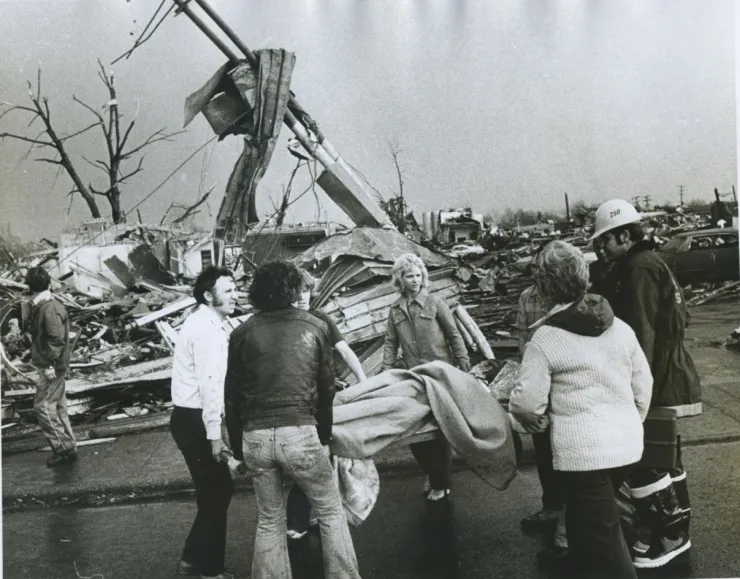
What till then had been the largest tornado outbreak in recorded U.S. history occurred on April 3-4, 1974. A particularly vicious tornado hit Xenia, Ohio, killing 34 people and injuring more than 1,100. The storm also destroyed nearly half the buildings in Xenia, including five schools and nine churches.
The next day, the Xenia Daily Gazette put out an 8-page paper with the front-page banner headline, “Xenia digging out from day of horror.” The cover price of the paper was 15 cents.
A column in the Gazette was written by Rich Heiland, the city reporter. Readers could surely identify with his account, just as he identified with theirs.
The Gazette building had lost its roof. “I wrote this column at 3 a.m. with water dripping around me in our second-floor newsroom,” he remembered years later. “I had candles for light and wrote it on an old manual typewriter.”
The paper’s coverage won the 1975 Pulitzer Prize for Local General and Spot News Reporting. Heiland said: “I always stress ‘I' did not win it, nor did any other reporters. ‘We’ won it.”
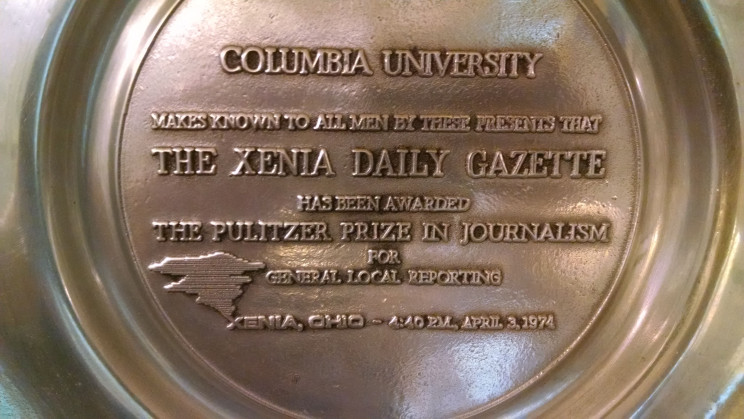
The commemorative plate given to staffers by Gazette publisher Jack Jordan.
In recognition of this, the Gazette’s publisher, Jack Jordan, used the prize money to make a commemorative plate for each staff member. Heiland heartily approved of this decision: ‘It is testimony to the power of a team to prevail.’
Here is the story Heiland wrote in the roofless newsroom.
‘We Should All Be Dead Today’
By RICH HEILAND
I will cry a hundred years from now, no matter how many memories come and go, when I think of what this wind did to my city and its people.
Yes, my city, now more than ever, though I have absolutely nothing left to show for my existence here except the most important thing of all — life. My life, the lives of my children, and my wife.
We should all be dead today as, sadly, too many are. But we are alive and we will be back, and we will survive, as will my city, your city.
It was terror, a time when people, myself included, did things that today will make us vomit and tremble when we recall them.
Something funny hit me moments before the tornado struck yesterday, something funny that made me call my wife and tell her to lie down in the only protected part of our Arrowhead home, only 75 yards from the shell that was Warner Junior High School.
Not more than 10 seconds later, we heard a sheriff’s deputy scream over his radio, “Twister by the bypass and 42.” For some reason (we had just told each other we’d never do something like that), Randy Blackaby and I grabbed a camera and ran down Second Street to his car.
We thought the twister was on the edge of town. My God, how wrong we were! At the Five Points intersection, I got out of the car and looked almost straight up at the funnel, swirling with dead birds and debris as it neared St. Brigid Church, which it ripped and killed like a demon that had waited 2,000 years for a victory.
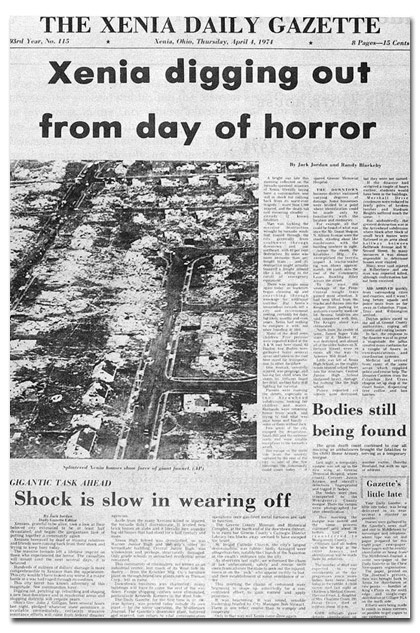
The Xenia Daily Gazette front page following the tornado.
We got back to the car, the roar around us, and escaped the path of the funnel somehow. Our first thoughts were to be newsmen, find out what happened and fast. I copped out, failed, I guess.
As soon as we got near Cincinnati Avenue, I knew. It had hit my house. There was no way it could have missed. We circled around on the bypass, trying to get to Arrowhead. No luck.
I finally found a boy, the son of Tom McCatherine, our associate editor, to show me a shortcut behind Warner Junior High.
When I rounded the corner, I just thought, “No, God no. Don’t go any farther, remember them like they were.”
The house was destroyed. A couple of walls were standing, the rest had caved in. No one could have lived through it. But, like a ray of sunshine out of the most terrible sky to ever cover Xenia, came my wife’s voice, and I never knew how much I loved her and my six-week-old son and five-year-old daughter, who were untouched.
Our only casualty was the family Doberman Pinscher, a gentle dog named Baron who I think escaped. I pray someone will return him to us.*
After I rushed the family down to my parents’ home in Wilmington, I came back to begin an all-night grind with hundreds of other people trying to help.
There were moments of beauty in terms of sacrifice:
– Men straining to lift fallen timbers off bodies that might still have life in them.
– Bob Stewart, Xenia’s city manager, with only half a city, taking charge of a massive rescue and cleanup operation, and not knowing until early morning if his family was alive or dead.
– Gene’s Corner, throwing open its doors and coffeepots to anyone who needed a warm drink and a doughnut.
By the time the sun came up, it was apparent what the wind had done, and I hate it for that. But we are alive, most of us, although many of us are now homeless and must dig through the wreckage of our dreams for bits of furniture, mementos such as a family photo album.
And dig we will. And survive we will, dammit.
*Heiland wrote in his 2015 reminiscence: “And, if you are wondering, after being missing for a week, Baron, our dog, was found — skinny but safe.” This piece appeared on the website EmptyingMyBrain.