
“What makes you qualified to be an architecture critic?”
It’s a question I am often asked, usually by people who disagree with something I’ve written. As they correctly point out, I am not an architect. I’ve never built anything remotely capable of keeping people dry in the rain, and that includes one particularly sad attempt at putting up a tent. I suppose I could tell them that I took architectural history classes in college, or that I’ve spent hundreds of hours sitting through planning and zoning meetings. What I prefer to say is that writing architecture criticism is just another way of being a reporter.
The reason this question is asked, I suspect, has to do with the sharp line readers and journalists draw between traditional news reporting and point-of-view writing. The assumption is that reporters don’t have opinions and critics don’t need to report. Critics are seen as the journalistic equivalent of Jedi knights – the force is in you! But you can’t understand a design or building without basic reporting, like visiting the site and talking to the people who made the project happen, the architects, developers and politicians. Critics “are not given to revelatory interpretation, like some saintly vision,” Ada Louise Huxtable wisely wrote. Huxtable, who pretty much invented architectural criticism, and was the first person to receive a Pulitzer specifically for it, explained that “the insights come together when the facts all come together.”
Unlike Huxtable, I was a reporter long before I became a critic. When I was growing up, I was unaware that such a job even existed. I had always wanted to be a newspaper reporter, and being a reporter, I assumed, meant covering news. My twenties were spent in the municipal trenches of New Jersey, covering small-town zoning battles and urban renewal fiascos. Not until I discovered the work of Jane Jacobs and Huxtable, Paul Goldberger and Tom Hine, my predecessor at The Philadelphia Inquirer, did the idea of combining the voice of the critic and the techniques of the news reporter begin to take hold. But I didn’t become a critic until I was almost 40. By then, I had lived in seven cities in five countries. I had been a foreign correspondent, covered two wars and become a mother, packing lunches in the morning and hustling my child off to school on the city bus. I think of all of it as preparation for being a critic.
I can’t claim I had a clear idea of what kind of critic I would be when I started down this path in 1999. What I did have were strong biases about how cities should be treated and a reporter’s instincts about what makes a good story. My biases came from several places. The wars I covered as a foreign correspondent in Russia and Yugoslavia were effectively wars against cities – Sarajevo, Mostar, Grozny – and the diversity they represented. As a municipal reporter in America, I had seen how bad policy decisions could be almost as devastating as mortars – it’s one reason that “bombed out” is such a common modifier for describing urban neighborhoods.
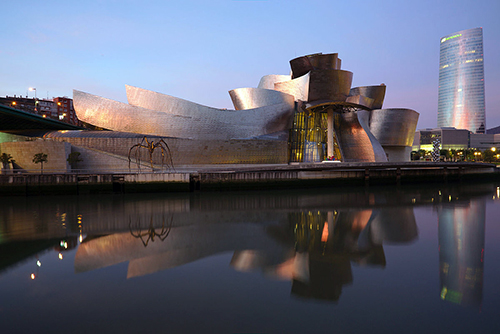
Frank Gehry's Guggenheim Museum in Bilbao, Spain
I started writing about architecture at the dawn of what’s been called the “Bilbao effect.” After the success of Frank Gehry’s Guggenheim museum in 1997, every desperate, rust-belt city wanted its own architectural trophy, and critics began jetting around the globe to evaluate the results. I made some of those trips, but I was more interested in what was going on at home.
At the time, America’s struggling cities were still being written off as dysfunctional, unsafe places beyond redemption. Philadelphia had narrowly avoided bankruptcy but was still hemorrhaging population and jobs. Politicians talked about “managing decline.” Because there was so little glamorous architecture to write about, my reviews focused on more mundane construction projects, like parking garages and suburban-style big-box stores, which were taking the place of more substantial 20th Century buildings. I wrote about the disregard for the city’s historic patrimony and poor planning. I became a Jane Jacobs crusader, pointing out the urban damage caused by blank walls, fortress facades and the absence of human activity. Philadelphia suffered from a “beggars-can’t-be-choosers” mindset, and I felt it was my job to prod officials out of their complacency and make them demand better-quality buildings.
Those early columns about everyday buildings were fundamental to my development as a critic. Because I was going against the conventional wisdom, I was forced to articulate a new narrative. It wasn’t enough to say garages were bad, I had to lay out a convincing case to readers why that was so. In my columns, I explained how garages and surface lots upset the urban ecosystem, making Philadelphia duller and less safe. My training as a reporter also proved useful when I wrote columns calling out the links between city subsidies for garages and campaign donations from parking operators. Some days I felt more like an investigative reporter than a cultural critic, and I jokingly began thinking of myself as an investigative critic.
The pairing of urban reporting with a design sensibility turned out to be a powerful hybrid. Although my columns appear on the culture pages, alongside the food and movie reviews, there is no consumer component. Those reviews help you make up your mind whether it’s worth patronizing a restaurant or buying a ticket to the latest blockbuster. My columns won’t save you any money. Yet architecture is something people can’t avoid. If you encounter a building in your daily travels, you have no choice but to engage in some way. Whether the experience makes you feel happy and connected to your city or sad and alienated depends on how the project was designed. And that design is the result of an interplay among money, politics, law, civic values and architectural creativity. Writing about how those forces come together is a form of accountability journalism, just like the stories that appear on the news pages.