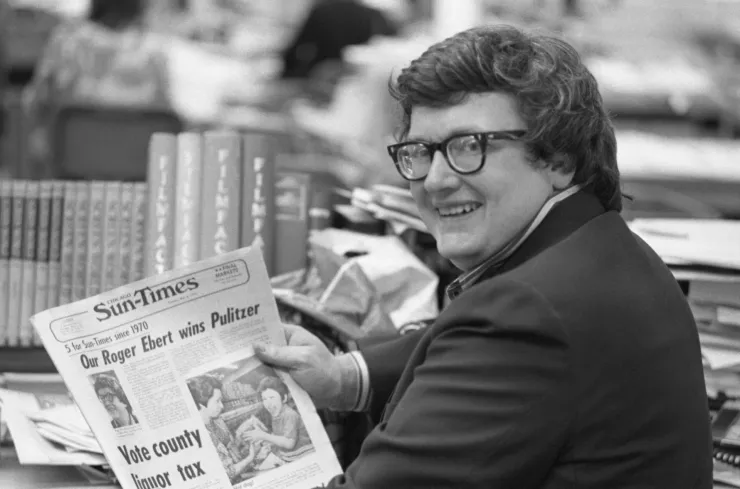
The establishment of a Pulitzer Prize category in Criticism and Commentary in 1970 (followed by a dedicated category in Criticism three years later) dovetailed with what was arguably the Golden Age of the form.
Although American newspapers long had published reviews of books, films, restaurants, theatrical productions and classical music concerts, a generation of writers added dynamism to the form in the 1960s.
From inaugural winner Ada Louise Huxtable's explorations of architecture as social form for The Times to Pauline Kael's director-venerating film reviews for The New Yorker to Paul Nelson's intertextual work for Rolling Stone, the new journalistic criticism was driven by exploring the cultural gestalt, and the genre remains a key marker for gauging the contradictions and incremental progress of the American experience.
Indeed, as seen firsthand in interviews and public talks, one could argue that it is nothing less than a way of life for these Pulitzer-winning critics.
"The Cottage and a Complete Set of Dickens"
Eight years before writing the reviews that would earn him the first Pulitzer for film criticism in 1975, Roger Ebert took an entry-level position at the Chicago Sun-Times to support his doctoral studies in English at the University of Chicago. Drifting away from academia, he became the newspaper's film critic in March 1967, a position he retained until his death in 2013.
While he cultivated a friendship with 1972 Commentary winner and hard-boiled municipal columnist Mike Royko, his sensibilities were rooted in the otherworldly: the amateur press of science fiction and comics fandom, where his first writings were published; the exploitation fantasias of Russ Meyer (leading him to script several of the underground auteur's films, including "Beyond the Valley of the Dolls"); and the epics of Werner Herzog and Federico Fellini. Nevertheless, with the support of editor and future Pulitzer Board member James Hoge, Ebert became a homespun authority on film, celebrating the appeal of blockbusters (and always mindful to grade them against each other as opposed to the likes of "Tokyo Story" or "Vertigo"), while maintaining his fair share of betes noirs.
"My master plan was to become an op-ed columnist and then eventually, of course, a great and respected novelist," he recalled in 1992. "My reveries ended with a deep old wingback chair pulled up close to the fire in a cottage in the middle of the woods, where the big dog snored while I sank into a volume of Dickens.
"I now find that I have been a film critic for 25 years. I am not on the op-ed page, have not written the novel, do not own the dog, but do have the cottage and a complete set of Dickens. And I am still going to the movies for a living. My mother never knew how to handle that, when her friends asked her, 'And what about Roger? Is he still just ... going to the movies?' It didn't seem like a real job."
It certainly was. Upon his death two decades later, then-President Barack Obama reflected: "For a generation of Americans — and especially Chicagoans — Roger was the movies."
"Brilliant, Outrageous, Charming, Impossible"
Many cultural critics have cautioned against embracing an advocacy role or fraternizing with subjects.
According to a 1998 Playbill report, two-time Criticism finalist Frank Rich "never went to afterglows or opening night parties, never hung out or socialized with artists, rarely did interviews with artists and didn't read preview stories" during his tenure as theater critic of The New York Times.
Longtime Washington Post fashion critic and 2006 Criticism winner Robin Givhan has advised: "When we get into this idea that part of our job is to advocate or champion, then you’re getting into a gray area of what it means to be a journalist. As a critic and a columnist, I have opinions and the license to focus attention on matters I believe have been overlooked. But I never feel like I’m an advocate of something. That means you’ve relinquished some of your journalistic capacity to be critical."
Occasionally, that line is porous. A respected novelist in his own right who drew attention to the financial vicissitudes of older writers in a 2014 essay for The Hedgehog Review, the late 1977 Criticism winner William McPherson made an exception for Harold Brodkey.
Largely forgotten at the dawn of the 2020s — a testament to the fact that the zeitgeist is never televised — Brodkey's reputation was derived from a series of gossamer-like short stories published as he labored for three decades (and increasingly generous advances) on his first novel, "A Party of Animals," later retitled "The Runaway Soul." He died from complications of AIDS five years after the work (prematurely hailed by editor Gordon Lish as "the one necessary American narrative work of this century") was released to tepid reviews and public indifference in 1991.
But when McPherson favorably reviewed his second collection, "Stories in an Almost Classical Mode," in 1988, Brodkey was, for what proved to be an evanescent moment, on the verge of literary canonization — and the critic could not resist befriending the man whom he regarded as "rather a genius." He recalled: "I rarely, if ever, stood in line clutching my review copy for the author’s signature, but I did this time and I’m glad I did. [...] He may have been everything that anyone said of him — and plenty was said, God knows. But for me, Harold was a brave man, a great writer and a generous friend. He was also very funny. He made me laugh. I miss him."
"Strange Little Fractures and Fissures"
As a solitary and often subjective enterprise, criticism holds what can be a fractious middle ground between the disciplines under review and the reportorial heft of other journalistism.
For 1984 Criticism winner Paul Goldberger, who embraced the sociological orientation of Huxtable and Yale University historian Vincent Scully in his writings on architecture and urbanity, this was a key facet of the work. "I suppose a critic is a very complex combination of judge and celebrator, and I’ve taken great pleasure in sharing my own pleasure," he said in 2012. "This goes back to Scully, at least indirectly, because if there’s any overarching lesson I learned from him, it was that architecture inevitably is not about itself. It’s about culture and community in the broadest sense. It affects all those things and is affected by them. Trying to both understand that better myself and then communicate it to others is what I’ve wanted to do."
1995 Criticism winner Margo Jefferson has echoed Goldberger's sentiments: "It’s being open to encountering a work with a combination of analytical and sensory material. How encountering a work or an idea doesn’t have to close down to a series of conclusions, however fascinating, but that it can open up to questions, strange little fractures and fissures."
But she cautions that the critic's "trick" of repeating "what makes people impressed by and excited by your work" has often resulted in the form being perceived as a secondary or even tertiary pursuit: "[A] lot of us are also rattled by this sense that we’re kind of at the bottom of the hierarchy you’ve just named. It used to make me crazy. I knew it was just a phrase or a trope, but it said something when people would say, as they often still do, 'We’re going to invite critics and writers.' I remember once saying to a writer friend of mine who was writing journalism but also fiction — I said, 'Critics are writers too!'"
The Work Continues
Amid the structural changes wrought by the advent of social media, the death of 2007 Criticism winner Jonathan Gold (whose appraisals of Los Angeles' immigrant restaurants helped to shape the contours of American dining in the first two decades of the 21st century) in 2018 may be perceived by future media historians as an important signpost.
If a review from a Gold or 1998 Criticism winner Michiko Kakutani could make or break a career, as evinced by two-time Pulitzer winner Norman Mailer's frequent and offensive invectives against Kakutani, the Age of Twitter has opened new vistas for practitioners by liberating them from the burden of top-down newsworthiness in the so-called "hot take." Per Givhan: "Rarely is the smoking-hot first take the most thoughtful. It may be the one that rises to the top of Google searches and gets tweeted around first, but in order to have a thoughtful opinion, you need to take a little time to think about it."
Accordingly, 2016 Criticism winner Emily Nussbaum, who has focused on television throughout her career, uses her platform to draw attention to pernicious gender disparities in the medium among both viewers and creators. "It’s always a little shocking to me that some men that I know haven’t watched certain overtly great female-centered shows: 'Broad City,' 'Crazy Ex-Girlfriend,' 'Fleabag,' 'Lady Dynamite.' It is a perpetual frustration for me." She added: "I don’t require people to love 'Sex and the City.' Some people really don’t like that show. I get it. But part of my thing is to oppose the default condescension, and also the sort of stink of, 'Oh, that’s a teen girl show. I don’t want to watch with teen girls, because that’s somehow embarrassing …'"
While the dynamics of cultural criticism may be shifting to a slightly different key, some things will always remain the same, as 2017 Criticism winner Hilton Als attests: