Whether reporting on the bonds between two New England justices on the U.S. Supreme Court or suggesting how the Founding Fathers might have scoffed at the influence of polling on elected officials, David Shribman covered Washington with a sense of history. In his Pulitzer Prize-winning columns, he also showed a gift for summarizing his subjects in a single sentence that stuck.
In one story he wrote, “Newt Gingrich is a new and different force in Washington.” In another, on President Clinton’s adding a reference to God to a speech, he wrote: “There are no atheists in the foxholes of the American presidency.”
Shribman covered Washington for The Boston Globe in 1994, and 10 of the stories he wrote won the 1995 Pulitzer in Beat Reporting. He later became executive editor and vice president of the Pittsburgh Post-Gazette.
The Pulitzer Prize Board cited Shribman for “analytical reporting on Washington developments and the national scene.” These stories in his winning entry were typical: he listened hard for the historical resonances in two momentous events — the deaths a month apart of former President Richard Nixon and Jacqueline Kennedy Onassis.
A surprisingly generous impulse
By DAVID SCHRIBMAN
WASHINGTON — There are great ambiguities in the moments of silence for Richard Milhous Nixon, late president of the United States.
As the nation prepared for this day of mourning, the divisions that tore Americans apart in the Nixon years have become evident again. Mr. Nixon, who used political division as a tactic in life, cannot escape it in death.
But this time, after Mr. Nixon’s final crisis, it is different.
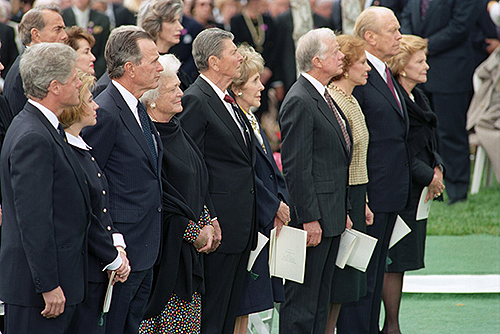
It has returned to our discourse a tone of civility that Mr. Nixon himself helped to expel.
It is not only sentimentality – or the sort of nostalgia prompted by sepia-toned images of the past – that has arisen in recent days. Commentators, politicians, millions of those who voted for and against him, and millions more of those too young to understand the passions he let loose on the country are talking of Mr. Nixon’s accomplishments and fall from grace. But they are doing so in muted tones, with quiet decency.
“People are conflicted about him,” said Michael Cromartie, senior research fellow in Protestant studies at the Ethics and Policy Center in Washington.
“They see him as a man who was vindictive but was personally troubled. And they see him being magnanimous toward communists he used to hate. His insecurities drove him to obsessive preoccupation with those who wanted to do him in. There are a lot of people who want to forgive him, and there is something not bad – something charitable – about that.”
No amount of historical revisionism will erase the fact that Mr. Nixon left office just short of certain impeachment in the House and conviction in the Senate, not only for the famous break-in at the Watergate complex but also for the cover-up and other actions that made a mockery of the rule of law, produced a constitutional crisis and endangered the legitimacy of his office.
And so the many quiet moments that have been offered to mark the passing of Mr. Nixon have been awkward ones. There has been silence, to be sure, but, like the 18½-minute gap in the Nixon presidential tapes that played a major role in Watergate, the silence has caused uneasiness, not comfort.
No American of our century was at the center of our politics for so long. No American reached such heights only to fall to such depths, and then rise again. Only Franklin D. Roosevelt rivals him in the depth of feelings he inspired, and in the number of people whose views on politics and government were defined by opposition to his way of conducting them.
And even now that Mr. Nixon is dead, he remains a divisive figure.
Around the country and in odd corners of the capital, the announcement of a national day of mourning for him caused a subterranean stir. A number of government officials are grumbling privately about the cost of such a gesture ($23 million, according to the Office of Personnel Management) and about the symbolism of honoring a man some describe as a crook and dissembler.
One Washington lawyer called today’s federal holiday Mr. Nixon’s final obstruction of justice. The Los Angeles Times ran a cartoon showing a tombstone with the epitaph, “Here lies Richard M. Nixon,” a mordant double-entendre and a reminder of the passions that he stirred.
Few of the criticisms of Mr. Nixon have been expressed publicly, in part, perhaps, because of the recognition that he brought out the worst in people and that they, in turn, brought out the worst in him. As angry as people were at Mr. Nixon, they were also angry at themselves.
In that spirit, President Clinton, who often talks about sin and redemption, was moved on Saturday night to reflect on the life and difficulties of one of his most controversial predecessors.
“The thing that impressed me about him was that he had a tenacious refusal to give up on his own involvement in this country and the world, and his hopes for this country and the world,” Mr. Clinton said at the annual dinner of the White House Correspondents Association.
He pointedly added, “I think we should all try to remember when we are tempted to write off anybody because of our differences with them that we share a common humanity.”
Mr. Nixon himself learned that, and he counseled dozens of others who fell from grace.
Now, as we begin the day of mourning for Mr. Nixon himself, the sort of garden-variety remarks at his expense that have been a staple of American politics and comedy somehow seem discordant.
In today’s silences, someone may recall that Sen. Bob Dole of Kansas once referred to a joint appearance of former Presidents Gerald Ford, Jimmy Carter and Nixon as a gathering of Hear-No-Evil, See-No-Evil – and Evil. This afternoon Dole, whose own anger and sharp tongue have helped keep him from the White House, delivers a eulogy for Richard Nixon, dead at 81.
All America, it seemed, was silent
May 24, 1994
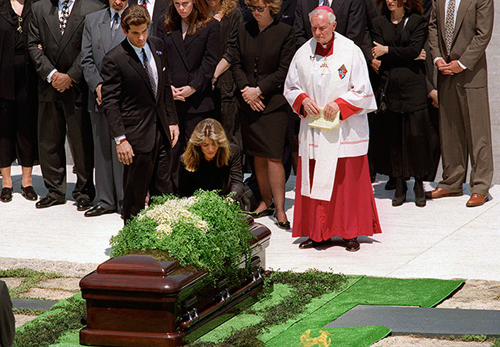
ARLINGTON, Va. – After all the tributes, after all the film clips, after all the reminiscences, after all the eulogies, there was simply this: A coffin. A crescent of mourners. A president's solemn remarks. A son's kiss and his touch – a loving pat, really – at the gravestone of his father. And silence.
All America, it seemed, was silent yesterday afternoon. And the silence was deepest here, on a Virginia hillside, where Jacqueline Bouvier Kennedy Onassis was buried beside her husband, a martyred president of the United States, and two of their children.
In that silence, a kaleidoscope of images from President Kennedy’s burial raced by: A caisson, drawn on its funeral route by three pairs of matched gray horses, the right row saddled but riderless. A widow, the black veil shielding but not hiding her grief. A scrawl on White House letterhead in the first lady's own hand, intended to be instructions for the memorial program of her husband: “Dear God, please take care of your servant.”
And yet it was no struggle – here in the hot sun or in millions of homes, factories, farms and offices scattered around the country – to linger not on the funeral and burial of three decades ago but on the one that was happening that very afternoon.
The commentators all said this was the final tattoo of Camelot, and there was, to be sure, something of that. But this afternoon wasn't about the man she married, but the woman she was.
Born to privilege, she was buried in quiet understatement in the Virginia soil on which she had ridden and which she loved. It was, of course, at the site of the eternal flame, placed there at her request – one of the few things she asked of the country after her president was killed – and assembled by the Washington Gas & Light Co., which hastily put together the tanks and copper tubing that November weekend so long ago.
More than a few have thought this one of the loveliest spots in the nation. It is a place where, almost by miracle, the Jefferson Memorial, the Washington Monument and Capitol Dome all are visible, even in yesterday’s haze. The setting inevitably triggers allusions to John Winthrop, the Puritan leader who vowed from the deck of the Arbella off the Massachusetts coast in 1630 that the new land would be a “City Upon a Hill.” The phrase, borrowed from the book of Matthew, was cited by John Kennedy himself on Beacon Hill just before he departed for Washington and his inauguration.
Jacqueline Kennedy visited this spot shortly before the funeral of her husband; her sister-in-law, Jean Smith, had told her it was “the most wonderful place,” and, in a scene that William Manchester likened to “the opening of the final act of ‘Our Town’ ” she stood there, silent, for a quarter hour. Then she nodded and the choice was made.
Yesterday the heads were bowed again, this time for her.
It was simpler than in 1963, and the handful of press observers gathered on the hill to record the moment felt less like witnesses, more like intruders. For John Kennedy’s funeral, Mrs. Kennedy arranged for the skirling of the Black Watch bagpipers and saw to it that Irish cadets from the Military College at Curragh, County Kildare, were there, marching at a hundred paces a minute (counted in Gaelic), their rifle butts reversed, a symbol of mourning for the martyrs of Ireland.
This time there were only the Navy Sea Chanters.
Three decades ago John F. Kennedy Jr., at his mother’s urging, saluted his father. He had seen the big men, the soldiers, execute a salute, and he did it himself, crisply and unforgettably. Earlier in the day, his third birthday, he had received a toy helicopter and a copy of “Peter Rabbit.''
This time, a man himself, he kissed his mother's coffin, tapped his father’s gravestone, and paid his respects to his brother, Patrick, who died shortly after birth. It was a completely spontaneous moment, overwhelming in its power.
Hours earlier, his uncle, Sen. Edward M. Kennedy, who has spoken at these events all too often, noted that Mrs. Onassis never wanted public notice, in part because it brought back “painful memories of unbearable sorrow,” all in the glare of a million lights.
And so the proceedings here at America's most famous military cemetery – with row upon row of markers, tributes to our military dead – were extraordinarily controlled. The Army Military District even distributed a statement to news organizations: “Those who try to penetrate the grave site area will be escorted out by law-enforcement officials.”
The 11-minute graveside service had the boast of heraldry, the pomp of power, and symbols of all the beauty and wealth that Thomas Gray cited in his famous Elegy. There was, for the living, the sobering reminder that, as Gray put it, the “paths of glory lead but to the grave.”
At the grave of Jacqueline Onassis the mind returns to a picture, laid across two pages of the special memorial edition of Life magazine, tucked away in thousands of closets, retrieved from many of them in the last few days. The headline from 1963 reads: “The warmest way to remember him.”
The background is the dunes of Hyannis Port and, beyond it, a sandy pathway to the sea. In the foreground is a little child, Caroline, feeding an animal cracker to her dad. And there, on the right, is a woman, sitting amid the dandelions, laughing at the scene, content, thoroughly at ease. She was a lovely lady.