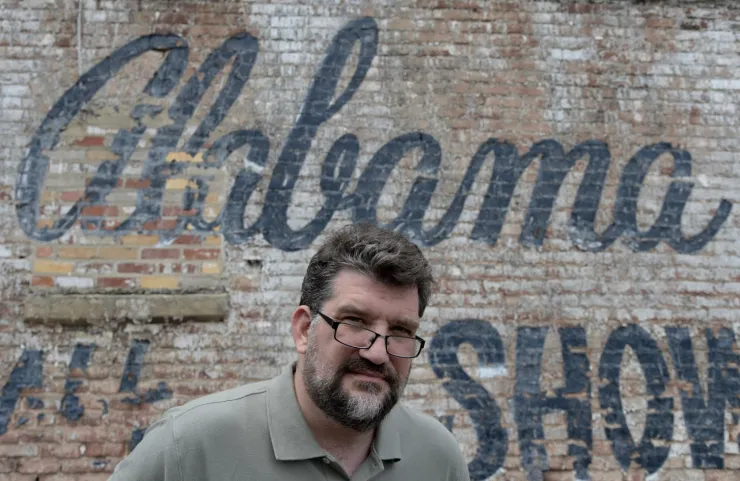
John Archibald of Alabama Media Group won the 2018 Pulitzer Prize in Commentary "for lyrical and courageous commentary that is rooted in Alabama but has a national resonance in scrutinizing corrupt politicians, championing the rights of women and calling out hypocrisy." He spoke to Katti Gray about what motivates him.
How do you decide which Alabama issues to write about?
A lot of it is based on my internal conflict, over how much I love this place and how much I know it could be better and how the people do deserve better. There is a never-ending stream of issues in Alabama. It’s a target-rich environment for a journalist because there is so much that needs to be done today. What I write about also is a warning to the rest of the world about what happens when we don’t do better.
Today, before this interview of you, what were you working on?
For Birmingham magazine I’m writing about how I never appreciated Birmingham’s airport and how easy it is to get in and out, and how I don’t have to leave four hours ahead of time to catch a flight. I’ve been traveling all over recently. It dawned on me that I’ve beaten up on the Birmingham airport a lot; it has been quite corrupt and not very successful. The previous manager was paid more than the manager of Hartsfield International in Atlanta, and used the airport as his own personal travel agency. There was this tragedy of a child who was killed when shoddy workmanship resulted in a TV falling on him.
How does Alabama mirror America? Americans?
Far more than many of us realized and admitted before now. Many of us have had this idea that Alabama was a separate place, five and 10 years behind everyone else on everything else. Back in a previous media age, that was true. But, today, instead of being behind, much of the South is ahead when it comes to cultural and political conflicts. Much of what we are seeing across the nation is being pushed by [that realization]. We call it the Alabama-fication of America. So much of the rhetoric these days, across the country, proves that we’re all in one place. We are fighting it out. As goes the South, so goes America.
As a native southerner with a New York residence, I’m annoyed when New Yorkers try to insist that racism, classism, so many -isms aren’t as egregious in the North. I moved to New York a few years after whites in Howard Beach, Queens ran Michael Griffith, a black man, onto the Belt Parkway where he was hit and killed by a car. -Isms exist everywhere; they vary, if you will, by vocal accent and inflection.
Exactly. It has become clear that we, in Alabama, don’t have the market on all of that. A lot of that was born here, but there’s also been a lot of progress that [outsiders] don’t always see.
From time to time, we, in Alabama, have to remember our history … Today, we also have the Roy Moores of the world, who step up and make people continue to believe that he is representative of Alabama. A slim majority of voters rejected Roy Moore. And I think most of the people who supported him also are glad he didn’t win.
To support him and be glad he lost is hypocrisy. No?
The stunning thing was the people who said that, even if all the allegations against Roy Moore were true, they wouldn’t support a Democrat. This party-purity thing is frightening ... We’ve fought over issues, including many issues of race and class. Now those issues are disguised as party loyalty.
If you practiced journalism somewhere other than Alabama, what would you write about?
No matter where we are, the questions are the same. Are people treating each other fairly? Are some people treated better because they have more money or power? It goes back to basic tenets of journalism. “Afflict the comfortable. Comfort the afflicted.” There are a multiplicity of issues. You have to look out for those who have the shortest end of the stick.
[In 2005, Connie Schultz of the Cleveland Plain Dealer] won a Pulitzer in the commentary category for writing so beautifully about waitresses whose bosses were stealing their tips. Those are the kinds of wrongs that just amaze me. The everyday life that’s right in front of you, that’s what we’re supposed to be focusing on.
Are you one of those journalists who, almost forever, wanted to be a journalist?
I had five majors in college before I found journalism. Hospital administration, geology, history, speech communications … When I started working for the Crimson White newspaper at the University of Alabama, I found myself with other student journalists fighting the University of Alabama machine. It was student politics, really, but it seemed so important.
They used to say, “It’s the ink in your veins.” I say, “It’s not the ink; it’s the information.” That sense of indignation, that belief that you can right wrongs, give voice to the voiceless, those sound like clichés, but they are just magic and motivation. Trying to make a difference is more important than money.
Why, as you wrote in an email to me, is your Pulitzer such an unbelievable win for you?
Have you seen the list of people who’ve won that prize in commentary? These are remarkable people, almost always at large media organization in a large city. We are out of much of the public eye in Alabama. I don’t take it for granted or lightly that this happened to me. It’s a rare thing that the stars align in your favor, so, I am super grateful.
What’s the buzz in Alabama about you and your Pulitzer?
I think people are tired of hearing about it. The company had quite a party and has been pretty nice. But they are ready for me to really get back to work in earnest. So am I.