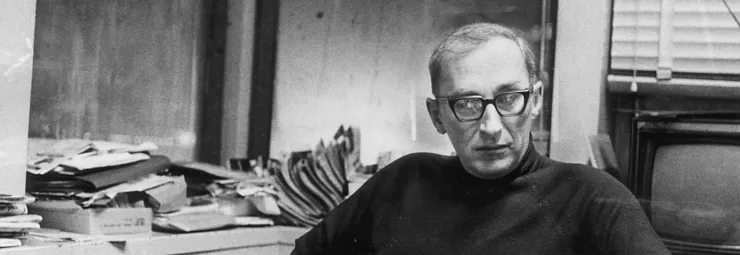
His 1997 obituary in the Chicago Tribune started like this:
Mike Royko, a self-described ‘flat-above-a-tavern youth’ who became one of the best-known names in American journalism, wrote with a piercing wit and rugged honesty that reflected Chicago in all its two-fisted charm.
His daily column was a fixture in the city’s storied journalistic history, and his blunt observations about crooked politicians, mobsters, exasperating bureaucracy and the odd twists of contemporary life reverberated across the nation.
It was Royko’s inimitable combination of street-smart reporting, punchy phrasing and audacious humor that set his column apart, along with his remarkable durability in facing daily deadlines for more than three decades.
Royko won the 1972 Pulitzer Prize for Commentary while writing for the Chicago Daily News. This column from his winning entry, which ran on Jan. 22, 1971, lived up to his reputation.
New in town? Here’s how things work, Bub
BY MIKE ROYKO
Jerry Parrott has been in Chicago only a few months, so he wasn’t sure if the wild things he read in the papers were really true.
You can’t blame a newcomer for wondering. Rich high-rise owners pleading poverty for tax breaks; shoeboxes filled with money; fictitious children in a politician’s Who’s Who entry. This city could seem to be a political Disneyland.
Now Parrott, 24, a graduate student at Northwestern University, is a believer. In fact, he now qualifies as a real Chicagoan. He got indoctrinated a couple of days ago.
It happened when he went to take a driver’s license test at the Secretary of State office at 5401 N. Elston.
Parrott didn’t expect to have any trouble passing the test. He considers himself a good, careful driver. During the last few years in Florida, his home state, he had only one ticket.
After passing the written test, Parrott was turned over to an examiner for the moving test. He got in his car with a man named Sam.
Sam. I know a few things about Sam. Although Parrott didn’t realize it, he was riding in a car with a classic Chicago public servant.
First payroll job: City Engineering Department, 1929 to 1934, sponsored by the 24th Ward Regular Democratic Organization, where he was a precinct captain. He held a rod for a survey in that job.
Second payroll job: In 1934 Sam switched over to the Sheriff’s Office as a deputy bailiff. His sponsor was Ald. Jacob Arvey, the boss of 24th Ward. It was then that the greatest Democratic ward in the country. Sam was a deputy bailiff for almost 30 years, even when Republicans held the office. His sponsors would merely make a deal with the Republican to keep Sam. They would give a Republican a job elsewhere. You do that for a good precinct captain.
Third payroll job: Richard Ogilvie, elected Sheriff in 1962, didn’t want to make deals. So Sam was fired. He scuttled down the hall and was promptly hired by the Democrats for a job in the Cook County Building Department as an engineering technician. Then he was promoted quickly in two or three jumps until he was an engineering instructor. Good precinct captains learn new jobs fast.
Fourth payroll job: Sam qualified for a pension from the county, so he took it and promptly went to work for Sec. of State Paul Powell. Since 1969 he has been a driver’s license examiner.
Over the years he has had about six different political sponsors, he has manned precincts in several different wards and he has had jobs with the city, the county and the state. In fact, if you include two years working for the U.S. Post Office in the ’20s, Sam is a superpayroller.
But Parrott couldn’t know he was sitting in the car with so remarkable a creature, a man who knows more about ticket-fixing, vote-hustling, pushing tables for political banquets, ward heeling and other political sciences than all the city’s civics teachers put together. All Parrott knew was that Sam made him nervous.
“I could tell he was trying to make me nervous. It was the way he talked as I rook the test, the way he gave me instructions, quickly and urgently. Jerry, do this; Jerry, do that, obviously trying to unnerve me.
“But I thought the test went OK. There was only one turn I didn’t do properly, and that’s because he wasn’t clear when he told me what to do. When I had him explain it again, I did it perfectly.”
The test finished, Sam shook his head and sighed.
“You flunked it, Jerry. You didn’t do that one turn right. You flunked it and you’ll have to come back next week.”
Disgusted, Parrott said: “OK, OK, I’ll come back next week.”
Sam looked at him in surprise. “Hold on, hold on. Maybe if you pop for lunch, I’ll give you a break.”
It was Parrott’s turn to look surprised. Public servants in Florida had never invited him to pop for lunch.
“Gee, sure. What time do you go out to eat?” Parrott said.
“I eat later,” Sam said, “so why don’t you give me lunch money now?”
“How much do you need?” Parrott asked.
Parrott looked in his wallet. “All I have is $4.”
“That’ll do fine,” said Sam, deftly pocketing the cash.
As they got out of the car to get the license, Sam whispered: “Don’t mention this to nobody, huh?”
Later, Parrott pondered the incident and discussed it with a native Chicagoan.
“Why is a fellow his age still doing things like that?” Parrott asked.
It’s probably an unbreakable habit after all those payroll jobs, the Chicagoan explained.
“Did I do the right thing?” Parrott asked.
The truthful answer was: No, you did the wrong thing. You should have left $2 on the seat when you first got in. That way you would have saved yourself $2. Everybody knows that, dummy.