“The thing about writing is you can write what you want,” a friend said to me by email recently. He’s an essayist, whose cogitations appear in prominent journals, and the author of eight books with ever more in the works. He added the important caveat — “Of course no one may read it.” At this stage of his career, he doesn’t have to worry much about that. But when we were starting out, we both did. Neither of us ever thought then, in the early 1980s, that we could write what we wanted. We were looking to pique the interest of editors and then to please them. If we had thought we could write whatever we wanted, the freedom would have overwhelmed us.
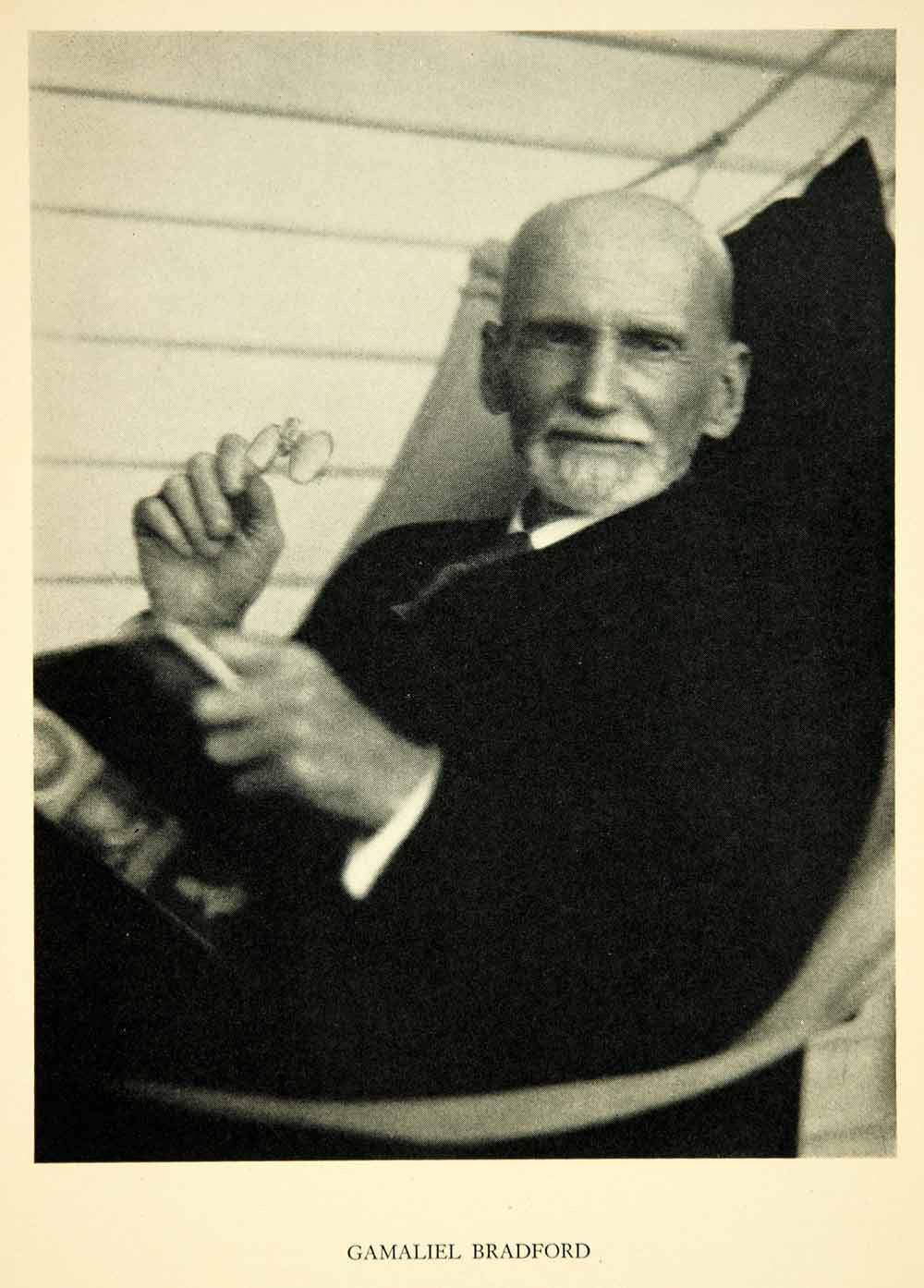
Gamaliel Bradford
Although the biographer generally hopes readers will not guess this, the work of researching and writing a biography has much in common with the autobiographical project, the direction in which “write-what-you-know” is usually expected to lead. The writer Gamaliel Bradford, who published over a dozen collections of biographical miniatures in the first decades of the 20th century with titles like Saints and Sinners, Damaged Souls and Wives, taking in subjects from Mussolini to Mary Todd Lincoln, offered the theory that “every living human being is a biographer from childhood in that he perpetually studies the souls of those about him.” To measure ourselves against other lives as we shape our own is human nature. To take the measure of several remarkable lives as I worked to establish myself as a writer seemed natural, too, a safe but not too safe step away from the market-driven demands of editors that had begun to weary me as a freelance journalist.
Inevitably there are aspects of the subject with whom a biographer settles down that resonate with her own experience or aspirations. The resemblances may not be obvious at the moment of selection, but that is part of the fun of finding out. A pleasant feeling of prescience, a sense that the match was meant to be, arrives at unpredictable moments, usually during the research phase.
As I read the letters and journals of Sophia Peabody Hawthorne for my first biography, The Peabody Sisters, and learned about her ambivalent struggle to establish herself as an artist, I thought of my mother, a talented landscape painter living a century later who, like Sophia, set her personal ambitions aside when she married. There was a soul — maybe the soul — I had studied avidly since childhood. When I noticed that after Mary Peabody married Horace Mann she signed her letters, “M.M.,” my own initials, I felt a shiver of recognition, perhaps even a nod across 150 years. The many unkind (to my way of thinking) descriptions by friends and family members of Elizabeth Peabody’s disheveled appearance, most often her messy hair, brought further opportunity for cross-century solidarity. I’d never forgotten my fifth-grade teacher’s comment on my report card: Can’t we get Megan to brush her hair? Mercifully, my artist manqué mother was affronted too and wrote a letter of protest to the school principal, just as Elizabeth’s mother often defended her eldest daughter’s eccentric ways, habits not just of dress but of mind that made Elizabeth Peabody a leading intellect in her day.
Is it dangerous to practice “sympathetic identification,” to borrow a phrase from literary theory, when writing a biography? Does sympathy, or identification, get in the way of an accurate portrayal of a previous life and times? I don’t think so, although it could if the writer let go of the reins, gave in to writing whatever she wanted. I’ve been lucky to write about women with copiously documented lives — in Margaret Fuller’s case, thousands of letters and diary entries, hundreds of published articles, two books, and a collection of essays, all written before she died at age forty. The profusion of evidence keeps me honest. Sometimes I’ve felt I’m not really writing, only assembling a portrait by mosaic as I piece together the bright, most telling phrases of my subjects the way my mother, after work and on weekends, produced several beautiful table tops and a lamp from shards of glass, as Sophia Peabody painted “in mosaic style” a tiny image of the Temple of Paestum on a pendant for Nathaniel Hawthorne to wear during the early days of their romance.
Gamaliel Bradford called his method “psychography,” which has to be distinguished from the Freudian and psychoanalytic biographies that came into vogue soon after he wrote. Bradford meant, simply, innate curiosity and keen intuition are the biographer’s best tools in animating and revealing characters from the past. It’s not very scientific, and that suits me fine, although I’m not about to take the term for my own. I’m a feminist, but I don’t write “feminist biography.” I pay attention to the complex social forces at work on my characters, but I don’t write “cultural biography,” the phrase now most likely to follow a subject’s name in a subtitle. I’m working on a book about the 20th-century poet Elizabeth Bishop, but does Bishop’s career as a writer make mine a “literary biography"? I hope not. Biography needs no modifiers.
I hadn’t expected biography to become my calling, but it couldn’t have gone any other way after I spent twenty years on my first one. I lived from age thirty, a mother of a baby girl, to age fifty, a mother of two daughters — one in college, the other in high school — as I wrote about three sisters who grew up along with New England Transcendentalism, two of them marrying in the span of years I covered. Then, in my fifties, I wrote about another heroine of Transcendentalism and of the failed Roman Republic of 1849, a woman who died too soon in a shipwreck with her two-year-old son in her arms.
Although by the conclusion of the first book and at the start of the second, I was older than the women who were my subjects, I always felt I was the young one, studying the souls I’d gathered about me and hoping to convey to my readers the lessons I read in their surviving words. Of course they had come before me; they were always older, born so long ago. But there was the fun: to pretend we’d been through it all together. And in the writing of it, we had.