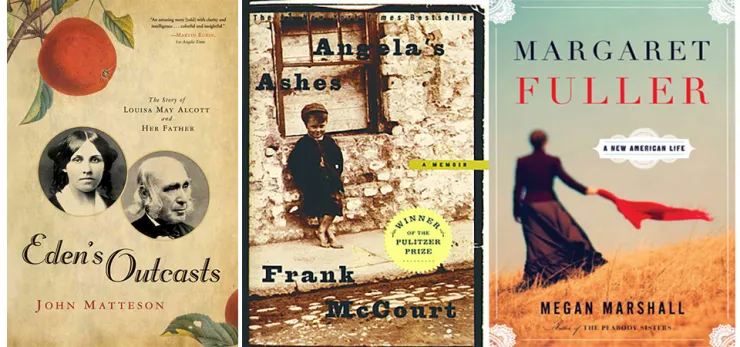
Louisa May Alcott. Katharine Graham. W.E.B. DuBois. Harry S. Truman. Margaret Fuller. Robert J. Oppenheimer.
These are just a few of the lives told in the Biography or Autobiography Pulitzer Prize-winning books of the last quarter century.
Here, in a sampling from the jury reports of that period, the jurors often pose fascinating questions.
Consider the only brother-sister combination on the list. How could Harriet Beecher Stowe, who had children so constantly that she and her husband had to stay away from each other for long periods, emerge as a major literary figure? And where did Henry Ward Beecher fit in the steady march from America’s Puritan past to the scandal-crazed America of today?
For the answers, the juries suggest, pick up the book and behold the life.
1993 (Truman, by David McCullough)
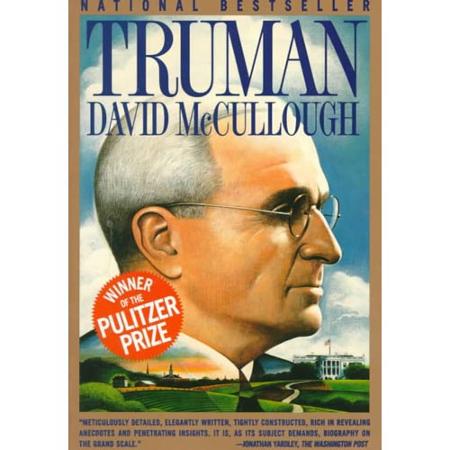
This spellbinding tour-de-force weaves together the life of the thirty-third President and the great events of the modern era. This richly detailed story – from Truman’s humble Midwestern origins to the highest office in the land – provides tribute to “the American century.” David McCullough’s robust yet elegant prose brings to life both Harry Truman and the complexities of the age in which he lived. . . . McCullough apparently took a lesson from his subject: with hard work, plain speaking and intellectual gusto this study of Truman emerges as a stellar Presidential biography.
1995 (Harriet Beecher Stowe – A Life, by Joan D. Hedrick)
For most American readers, Harriet Beecher Stowe is the author who created characters and scenes indelibly stamped into our national vocabulary and literary consciousness: Simon Legree and Uncle Tom, Eliza crossing the ice floes, Little Eva ascending to heaven. Joan D. Hedrick reveals Stowe as more than the author of Uncle Tom’s Cabin and lesser-known works by skillfully and sensitively marrying literary biography with social history. She argues successfully that Stowe should be seen as a key nineteenth-century woman in transition.
Hedrick meets the challenge of bringing Stowe and her era to life for today’s reader by ably exploring why religion had such a hold on the famous Beecher clan yet how chillingly ministers reacted to the frequent deaths of children, how women were regarded in general and women writers in particular, why the western movement was so unsettling, and how Stowe was able to write the strongest statement of the abolitionist cause despite coming to the issue later than its main crusaders.
Yet Hedrick’s book transcends the public Harriet Beecher Stowe to probe an intensely personal story as well: how a woman who has children so constantly that she and her husband had to stay away from each other for long periods could emerge as a major literary figure, and how her talents pushed her forward as a writer. Hedrick builds solidly on feminist scholarship of the last 25 years; her scrupulously researched biography enriches both her field and her readers.
1997 (Angela’s Ashes, by Frank McCourt)
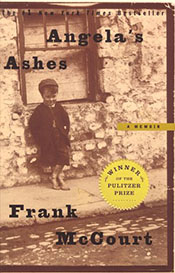
When Frank McCourt was four years old, his parents, born in Ireland, residents of depression-desperate Brooklyn, returned to Ireland, to Limerick, along with his three brothers. Frank’s father, Malachy, rarely works and when he does he drinks up his pay. As a result, the family is desperately poor, always.
“When I look back on my childhood I wonder how I managed to survive at all,” McCourt writes. “It was, of course, a miserable childhood: the happy childhood is hardly worth your while.” . . .
What Dad does is tell stories – about the terrible English and the great Cuchulain, the Hound of Ulster “who could take on King Arthur and all his knights in a fair fight which, of course, you could never get with an Englishman anyway.”
So it is that Frank McCourt becomes a storyteller, with a perfect ear for the talk of the Irish and an eye for absurdities. “The three of us get back into our own bed, huddling under the overcoats and trying not to roll into the hole in the mattress. It’s pleasant there till Michale starts to worry over Alphie getting Mam’s disease and me getting hanged for an outlaw. He says it isn’t fair because that would leave him with only one brother and everyone in the world has brothers galore.”
Frank McCourt somehow survives his miserable childhood, and at 20 returns to America, where he has written this heart-wrenching, funny and lyrical memoir.
1998 (Personal History, by Katharine Graham)
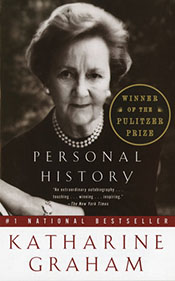
Katharine Graham’s creative, formidable mother, Agnes Meyer, was so self-absorbed that she showed lifelong disinterest toward any of her daughter’s concerns. Her wealthy father, Eugene Meyer, gave no apparent thought to passing leadership of his newspaper to her, choosing instead her mercurial husband. Publisher Philip Graham moved with his wife through the power circle of John Kennedy and Lyndon Johnson’s Washington but, like her parents, overlooked Katharine Graham’s talents and strengths – indeed, often belittled her. Increasingly, she saw herself “as the tail to his kite.”
Yet hers will be the name remembered. Her memoir shows why. Her natural style allows her to tell her personal and professional histories, including her complicated love affair with her troubled husband, with remarkable candor and no hint of trendy victimization, self-pity or sensationalism.
Personal History goes to the heart of life in Washington as the city emerged as a true world capital and at the Washington Post as it emerged as one of the foremost heralds in the nation during critical times – the assassination of a President; the civil rights movement; the Vietnam War; the antiwar movement and the publication of the Pentagon Papers; the printers’ strike at Graham’s newspaper; and, of course, Watergate. Hers is a unique take on twentieth century America from a person who quietly influenced its course.
2001 (W.E.B. Du Bois: The Fight for Equality and the American Century, 1919-1963, by David Levering Lewis)
This is the second volume of David Levering Lewis’s monumental biography of W.E.B. Du Bois (1868-1963). The first volume won a Pulitzer and the highly coveted Bancroft prize in history.
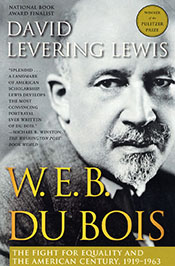
This volume, picking up where the first left off in 1919, takes Du Bois through the Harlem Renaissance, the Great Depression and its jarring effects on his political ideas, the 1940s with his decisive swing to the far left, his arrest and arraignment early in the 1950s for alleged subversive activity, and his astonishing decision near the end of his long life to join the CPUSA, renounce his U.S. citizenship and emigrate to Ghana. This volume brings to a superb conclusion the first full-length biography of Du Bois ever published. Lewis, a relentless researcher, has made full use not only of the Du Bois papers at U-Mass, Amherst, but of other archives and informants in abundance. He engages Du Bois at every important level involving intellect, character, and personality, and writes with clarity, wit and authority. By almost any standards, this is a magisterial achievement in biography.
2003 (Master of the Senate: The Years of Lyndon Johnson, by Robert A. Caro)
In volume three of his remarkable biography of Lyndon Johnson, Robert Caro takes the reader through the 1950s, when LBJ, the youngest Senate Majority Leader ever, helped transform the nation’s legislative agenda through the sheer force of his personality and political skill. On one level, Master of the Senate is a sweeping history of post-World War II America, with brilliant digressions about the lives of very different people, from the powerful elites of Washington to the forgotten African Americans of the segregated South. On another level, it is the story of a consummate politician, “possessed of a talent that was beyond talent – a rare, instinctive gift.” . . . As this towering biography concludes, and Lyndon Johnson leaves the Senate, we can well understand his capacity for greatness – and self-destruction.
2006 (American Prometheus: The Triumph and Tragedy of J. Robert Oppenheimer, by Kai Bird and Martin J. Sherwin)
To write a mighty book one must have a mighty theme, Ishmael says; thus Melville justified the Leviathan of a narrative that is his masterpiece.
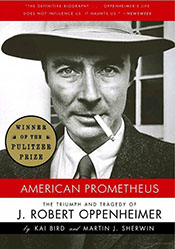
In American Prometheus: The Triumph and Tragedy of J. Robert Oppenheimer, two skilled scholars, Kai Bird and Martin J. Sherwin, take on a demonstrably mighty subject, one brimming with challenges. That subject is the rise and fall of one of the most important scientists in world history.
Perhaps more than anyone else, Oppenheimer was responsible for the development of the atomic bomb. Thus he was also in a way responsible for the destruction wrought not only on Hiroshima and Nagasaki but also on the security of our “postmodern” consciousness. . . . Oppenheimer rose to become the archangel of American science, and then he fell swiftly when he advocated the placing of limits on the power he had unleashed virtually without remorse.
At work on this project for a quarter-century, Bird and Sherwin respond magnificently to its challenges. The research, with materials imported from myriad sources, is extremely impressive. The structure of this book is such that the long narrative flows without abatement. The science is lucidly presented. The writing throughout is poised, engaging and dramatic. . . . In every significant way this is a brilliant example of biography at its very best.
2007 (The Most Famous Man in America, by Debby Applegate)
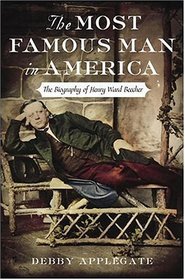
Debby Applegate’s The Most Famous Man in America: The Biography of Henry Ward Beecher is a transcendental biography – a paragon of incisive research and insightful reflection, all of which is related with the eloquence and passion that her subject demands.
This superlative book examines a life filled with superlatives: Henry Ward Beecher was the most eminent (and colorful) New England preacher of the nineteenth century, a leading advocate for bold liberties – Free Soil (as he spurred Abraham Lincoln to abolish slavery), Free Thought (embracing the revolutionary ideas of Herbert Spencer and Charles Darwin), Free Press (which would ensnare him in the most salacious scandal of the era), all because of his views on Free Love (which led feminist Victoria Woodhull to accuse him of adultery with one of his parishioners).
Carrying spears in this grandly operatic story are the most important American writers of this century – Emerson, Thoreau, Whitman, and Twain, and Beecher’s own sister Harriet, who wrote the most influential novel in the American canon, Uncle Tom’s Cabin. Ms. Applegate’s protagonist emerges as the great transitional figure between America’s Puritan past – which his father, Lyman Beecher, summoned in his fire-and-brimstone sermons – and its future – the scandal-crazed America of today, in which piety and hypocrisy so often drive our leaders into a slough of despond.
Fraught with ironies, The Most Famous Man in America is a veritable page-turner, one that chronicles Henry Ward Beecher’s melodramatic life as it illuminates his turbulent world, revealing not only who he was but also who we are.
2008 (Eden’s Outcasts: The Story of Louisa May Alcott and Her Father, by John Matteson)
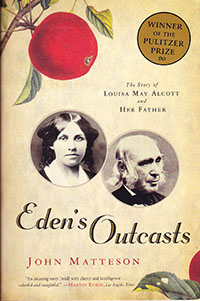
Fathers and daughters have furnished a timeless theme to poets, playwrights and novelists. John Matteson develops the theme as it emerged in nineteenth-century New England, in the life of the Alcott family of Massachusetts.
Bronson Alcott scandalized Boston with his uncompromising quest for moral perfection; Louisa May Alcott shocked her father with her willful determination to make right what he had got wrong. She achieved the greater commercial success and lasting fame, as the author of Little Women, which refracted her family experience through her frustrated hopes, her unfolding regrets and her enduring love.
Matteson’s elegant and sensitive rendering of the relationship between daughter and father, and between this perfectionist pair and their world, is a joy to read.
2009 (American Lion: Andrew Jackson in the White House, by Jon Meacham)
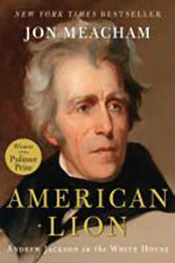
Great presidents attract great writers and Andrew Jackson has had his share of the best. Now, Jon Meacham has joined that talented crowd of historians, adding insights to the portrait of the president appropriately identified as the American Lion. During his years in the White House Jackson, no less than Washington, Jefferson, Lincoln and Roosevelt, defined the powers and purposes of the American presidency. How he did it, and especially why he did it the way he did it, is the focus of this exceptionally well-written biography.
American Lion focuses on the intertwining of the personal and political, on the varied forces that formed the unique character that played such an important role in shaping Jackson’s policy decisions during his tumultuous White House years. . . . Meacham takes good advantage of newly found correspondence to weave existing scholarship with new analytical insights that give both the knowing and first-time reader of Jackson’s life an unflinching portrait of a not always admirable democrat, but a significantly transformative president.
Meacham’s prose is animating and agile, putting the reader as if at Jackson’s shoulder.
2011 (Washington: A Life, by Ron Chernow)
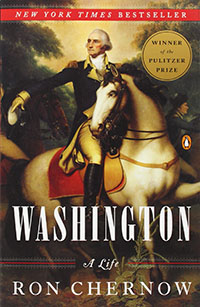
Biographies of our first president are hardly rare; ones of this sweep and interpretative caliber certainly are. Ron Chernow manages to pull all the disparate phases of Washington’s life into a single magisterial volume. . . . Chernow gives a picture of a Washington who was on one side the strong commanding soldier and statesman – an object of awe to all who met him and dealt with him. On the other side was the private man, buffeted by impulsive passions, bouts of pessimistic self-pity and a fierce, at times almost uncontrollable, temper.
Washington: A Life shows a man learning to master his private feelings in order to fulfill his public duties, and to defend his incipient nation from both foreign tyranny and, in the case of incidents like the Whiskey Rebellion, domestic chaos. . . .
In achieving a balance between his inner and outer selves, Washington became a symbol of strength to his contemporaries and a powerful icon for the future. Chernow’s work is likewise a model of balance between meticulous research and the writing of biography that has a contemporary, even enduring, relevance.
2014 (Margaret Fuller: A New American Life, by Megan Marshall)
Megan Marshall’s richly researched and elegantly presented biography of Margaret Fuller reads like a novel – but with a twist. Marshall takes her cue from Hawthorne, who called his books “romances” rather than novels, in order (as he put it) to “bring out or mellow the lights and deepen and enrich the shadows of the picture” while maintaining allegiance to the “truth of the human heart.” The result is thrilling. Marshall’s keen observations and rigorous analysis are expressed in fresh, creative ways that honor her subject’s own imaginative boldness in life and art.
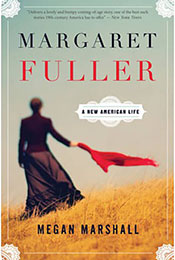
Marshall is keenly aware that there was little distinction between public and private in Margaret Fuller’s life. She shows how Fuller, in fact, aimed to break down such a distinction, which she felt hemmed in the lives of women. Marshall, exhilaratingly, writes Fuller’s story “from the inside out, using the most direct evidence – her words and those of her family and friends, recorded in the moment.” She provides deft and vividly sympathetic reconstructions, bolstered by newly discovered documents, of the interesting times and locales – in Cambridge, New York, and Italy—in which Fuller lived. . . .
Like all great historical works, Margaret Fuller informs us about the past as it forces us to think about our present. Fuller, who helped spark the nineteenth-century movement for women’s rights, opened a path that we still follow. Megan Marshall’s beautiful rendition of her life inspiringly links past to present, and is a classic of modern biography.