
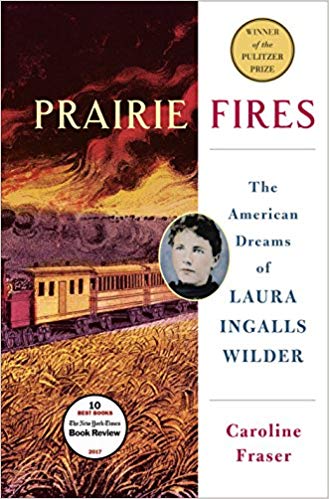
"Prairie Fires: The American Dreams of Laura Ingalls Wilder," by Caroline Fraser.
The 2018 Pulitzer Prize for Biography went to Caroline Fraser for her deeply researched portrait of Laura Ingalls Wilder, author of the Little House on the Prairie series. Here, Fraser shares her reporting techniques and sets the record straight regarding ghostwriting controversies that have surrounded Wilder’s books.
How did the biography of Laura Ingalls Wilder come about? When and how was this idea conceived?
I’d written about Wilder in the 1990s but had never considered writing a biography until I was asked to edit the Library of America’s two-volume edition of her Little House books, published in 2012. For that, I wrote a chronology and was struck by how critical moments in her life overlapped with major historical movements — the Plains Indian Wars, the degradation of the Great Plains, recurrent economic panics, and of course the Dust Bowl and the Great Depression.
The times when her life intersected with history were deeply fascinating to me, and I began to think they might support an historical biography that examined her life in a larger context.
Can you tell us a little more about the process: How long did it take you to complete the book? What was the research, reporting and writing process like?
The book had a long gestation. I discovered the Little House books as a kid and loved them. But the beginning of "Prairie Fires" (long before I imagined it might exist) was the moment in 1993 when I first heard, on NPR, that a biography of Wilder’s daughter, Rose Wilder Lane, was claiming that it was Lane who was the true author of the books, not her mother.
I asked Barbara Epstein at The New York Review of Books to let me write about it and worked on that article for about two years, looking at some of Wilder’s manuscripts and letters. And while I came to disagree with the biography’s premise, I was fascinated by Wilder’s writing process — that her daughter was her secret editor and had influenced the books. So that stayed with me until years later when the Library of America asked me to work on their edition, which involved close examination of Wilder’s and Lane’s papers, much of which are at the Herbert Hoover Presidential Library.
For research on the ground, I drove to the site of Little House on the Prairie, and to Rocky Ridge, Mansfield, Mo., only a few hours farther east, where Wilder and her husband spent much of their adult lives. Many of the places she lived are different now, but it’s still revealing to get the lay of the land. A lot of the sites have ferreted out land records and plat maps associated with the Ingalls and Wilder families. Several maintain extraordinary collections of family memorabilia — books, photographs, letters, postcards, quilts, cookware, clothing, farm equipment, Pa’s fiddle — just about everything you can imagine.
I was able to find additional records like details of tax payments, tax liens, mortgages, deeds and plats. That stuff may sound dry, but these were people who lived and died by their land and the debt on it. So it was essential to know how their homesteads and farms fared.
What according to you would be the most interesting fact about Wilder's life (something that was previously unknown)?
It was a long life. She died at 90, having lived from 1867, just after the end of the Civil War, to 1957, which is the Eisenhower administration.
If I had to pick one thing, it would be the fact that the Little House books had their genesis in yellow journalism. In 1915, Wilder went to visit her daughter in San Francisco, a hotbed of the yellow press, self-consciously intending to apprentice herself to her daughter. And her daughter was a novice as a journalist, working for the San Francisco Bulletin. Virtually everything she wrote was fiction, even when it was supposed to be fact. While her mother was visiting, Lane wrote a fake autobiography of Charlie Chaplin and fictionalized biographies of other celebrities, including Henry Ford. And what would the two of them end up working on years later? Another kind of fictionalized autobiography.
The implications are revealing, because both Wilder and her daughter
became deeply committed to assuring the public — children and fans of the Little House books — that these stories were “all true.” They weren’t, of course, so that shows the chasm between the real story and the fictional tales and raises questions about the emotional reasons behind that claim.
How does Wilder's life offer a different perspective on American history?
Wilder lived most of her life in poverty, and we don’t have as many biographies of the poor as we do of the wealthy and powerful. Her life also shows what American farmers went through and casts light, I hope, on their continuing struggles.
Are there are similarities/differences between Wilder and American women today?
It depends on which American women you’re talking about. As a number of scholars have noted, Wilder was not what you’d call a feminist — judging by her columns in the Missouri Ruralist, a farm newspaper, she wasn’t entirely sure that women having the vote was a great idea. In her home-spun values and later politics, she more strongly resembles women who are conservatives: She was sharply critical of high taxes, government relief programs in the form of the New Deal, and lax morals.
What does winning the Pulitzer Prize mean to you? Where were you when you found out that you had won?
Winning the Pulitzer Prize is the most gratifying professional recognition imaginable — although I have to say that I never imagined it.
I was in my office answering someone’s email (about Laura Ingalls Wilder!) when I heard the news — from my husband, who had been watching the live-streaming announcement in his office. He came to the door with a funny look on his face. I almost didn’t believe him, skeptic that I am. So we went and watched the video together, and sure enough, it was true.