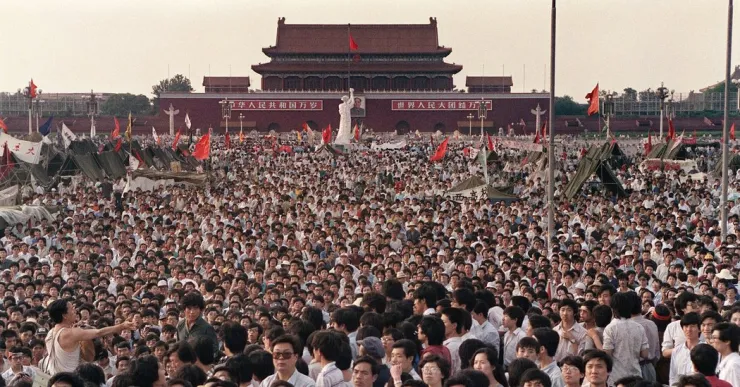
During the spring of 1989 a student protest in Beijing’s Tiananmen Square challenged the Chinese regime with demands for democracy. The world watched, hopeful but uneasy.
Nicholas D. Kristof, The New York Times’s 30-year-old Beijing bureau chief, and Sheryl WuDunn, his wife, who had just joined the bureau as a reporter, worked tirelessly to get the news out. In May and June they wrote 131 stories.
Their coverage won them the 1990 Pulitzer Prize in International Reporting. “They got it right,” said the jury that judged their entry.
The protests came to a brutal end on June 4. Kristof and Dunn were on it. Here, slightly abridged, are their stories in that day’s Times.
Ed. note: Scroll down to read WuDunn's piece, "A man is not a soldier without his gun."
Crackdown in Beijing
By Nicholas D. Kristof
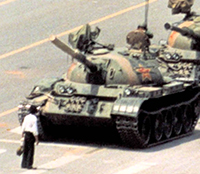
Tanks roll into Tiananmen Square.
Tens of thousands of Chinese troops retook the center of the capital early this morning from pro-democracy protesters, killing scores of students and workers and wounding hundreds more as they fired submachine guns at crowds of people who tried to resist.
Troops marched along the main roads surrounding central Tiananmen Square, sometimes firing in the air and sometimes firing directly at crowds of men and women who refused to move out of the way.
Early this morning, the troops finally cleared the square after first sweeping the area around it. Several thousand students who had remained on the square throughout the shooting left peacefully, still waving the banners of their universities. Several armed personnel carriers ran over their tents and destroyed the encampment.
Reports on the number of dead were sketchy. Three Beijing hospitals reported receiving at least 68 corpses of civilians and said many others had not been picked up from the scene. Four other hospitals said they had received bodies of civilians but declined to disclose how many. Students said, however, that at least 500 people may have been killed in the crackdown.
Most of the dead had been shot, but some had been run over by armored personnel carriers that forced their way through barricades erected by local residents.
The official news programs this morning reported that the People's Liberation Army had crushed a “counter-revolutionary rebellion” in the capital. They said that more than 1,000 police and troops had been injured and some killed, and that civilians had been killed, but did not give details.
Changan Avenue, or the Avenue of Eternal Peace, Beijing’s main east-west thoroughfare, echoed with screams this morning as young people carried the bodies of their friends away from the front lines. The dead or seriously wounded were heaped on the backs of bicycles or tricycle rickshaws and supported by friends who rushed through the crowds, sometimes sobbing as they ran.
The avenue was lit by the glow of several trucks and two armed personnel carriers that students and workers set afire, and bullets swooshed overhead or glanced off buildings. The air crackled almost constantly with gunfire and tear gas grenades.
“General strike!” people roared, in bitterness and outrage, as they ran from Tiananmen Square, which pro-democracy demonstrators had occupied for three weeks. “General Strike!”
While hundreds of thousands of people had turned out to the streets Saturday and early today to show support for the democracy movement, it was not clear if the call for a general strike would be successful. The Government had been fearful that a crackdown on the movement would lead to strikes, but its willingness to shoot students suggested that it was also capable of putting considerable pressure on workers to stay on the job.
The morning radio news program reported that it would be “very difficult” to hold a meeting of the National People’s Congress standing committee as scheduled. The committee, which had been scheduled to meet June 20, has the power to revoke martial law and oversee the Government, and many members of the panel are known to be deeply upset by the crackdown.
The announcement by the Beijing news program suggested that Prime Minister Li Peng, who is backed by hard-liners in the Communist Party, was still on top in his power struggle for control of the Chinese leadership. The violent suppression of the student movement also suggested that for now, the hard-liners are firmly in control, and that those who favor conciliation, like party leader Zhao Ziyang, at least temporarily have little influence on policy.
It was too early to tell if the crackdown would be followed by arrests of student leaders, intellectuals who have been critical of the Party, or members of Mr. Zhao’s faction. Blacklists have been widely rumored, and many people have been worried about the possibility of arrest.
Students and workers tried to resist the crackdown, and destroyed at least 16 trucks and 2 armored personnel carriers. Scores of students and workers ran alongside the personnel carriers, hurling concrete blocks and wooden staves into the treads until they ground to a halt. They then threw firebombs at one until it caught fire, and set the other alight after first covering it with blankets soaked in gasoline.
The drivers escaped, but were beaten by students. A young American man, who could not be immediately identified, was also beaten by the crowd after he tried to intervene and protect one of the drivers.
Clutching iron pipes and stones, groups of students periodically advanced toward the soldiers. Some threw bricks and firebombs at the lines of soldiers, apparently wounding many of them.
Many of those killed were throwing bricks at the soldiers, but others were simply watching passively or standing at barricades when soldiers fired directly at them.
Two groups of young people commandeered city buses to attack the troops. About 10 people were in each bus, and they held firebombs or sticks in their hands as they drove toward lines of armored personnel carriers and troops. Teen-age boys, with scarves wrapped around their mouths to protect themselves from tear gas, were behind the steering wheels and gunned the engines as they weaved around the debris to approach the troops.
The first bus was soon stopped by machine-gun fire, and only one person – a young man who jumped out of a back window and ran away – was seen getting out. Gunfire also stopped the second bus, and it quickly caught fire, perhaps ignited by the firebomb of someone inside. No one appeared to escape.
It was also impossible to determine how many civilians had been killed or injured. Beijing Fuxing Hospital, 3.3 miles to the west of Tiananmen Square, reported more than 38 deaths and more than 100 wounded, and said that many more bodies had yet to be taken to its morgue. A doctor at the Beijing Union Medical College Hospital, two miles northeast of the square, reported 17 deaths. Beijing Tongren Hospital, one mile southeast of the square, reported 13 deaths and more than 100 critically wounded.
“As doctors, we often see deaths,” said a doctor at the Tongren Hospital. “But we’ve never seen such a tragedy like this. Every room in the hospital is covered with blood. We are terribly short of blood, but citizens are lining up outside to give blood.”
Four other hospitals also reported receiving bodies, but refused to say how many.
In addition, this reporter saw five people killed by gunfire and many more wounded on the east side of the square. Witnesses described at least six more people who had been run over by armored personnel carriers, and about 25 more who had been shot to death in the area. It was not known how many bodies remained on the square or how many people had been killed in other parts of the capital.
It was unclear whether the violence would mark the extinction of the seven-week-old democracy movement, or would prompt a new phase in the uprising, like a general strike. The violence in the capital ended a period of remarkable restraint by both sides, and seemed certain to arouse new bitterness and antagonism among both ordinary people and Communist Party officials for the Government of Prime Minister Li Peng.
“Our Government is already done with,” said a young worker who held a rock in his hand, as he gazed at the army forces across Tiananmen Square. “Nothing can show more clearly that it does not represent the people.”
Another young man, an art student, was nearly incoherent with grief and anger as he watched the body of student being carted away, his head blown away by bullets.
“Maybe we’ll fail today,” he said. “Maybe we’ll fail tomorrow. But someday we’ll succeed. It’s a historical inevitability.”
The violence on both sides seemed to mark a milestone in the democracy movement, and the streets in the center of the city were a kaleidoscope of scenes rarely if ever seen in the Chinese capital: furious crowds smashed and overturned army vehicles in front of Zhongnanhai, and then stoned the Great Hall of the People; grim-faced young soldiers clutching submachine guns tried to push their way through thick crowds of demonstrators near the Beijing train station; and the police charged a crowd near Zhongnanhai and used truncheons to beat men and women disabled by tear gas.
“In 1949, we welcomed the army into Beijing,” said an old man on the Jianguomenwai bridge, referring to the crowds who hailed the arrival of Communist troops at the end of the Communist revolution. Then he waved toward a line of 50 army trucks that were blocked in a sea of more than 10,000 angry men and women, and added, “Now we’re fighting to keep them out.”
‘A man is not a soldier without his gun’
By Sheryl WuDunn
As the crackle of automatic weapons filled the air today on the Avenue of Eternal Peace, tens of thousands of Beijing residents, even elderly men and women, rushed out to see what they could do to turn back the troops.
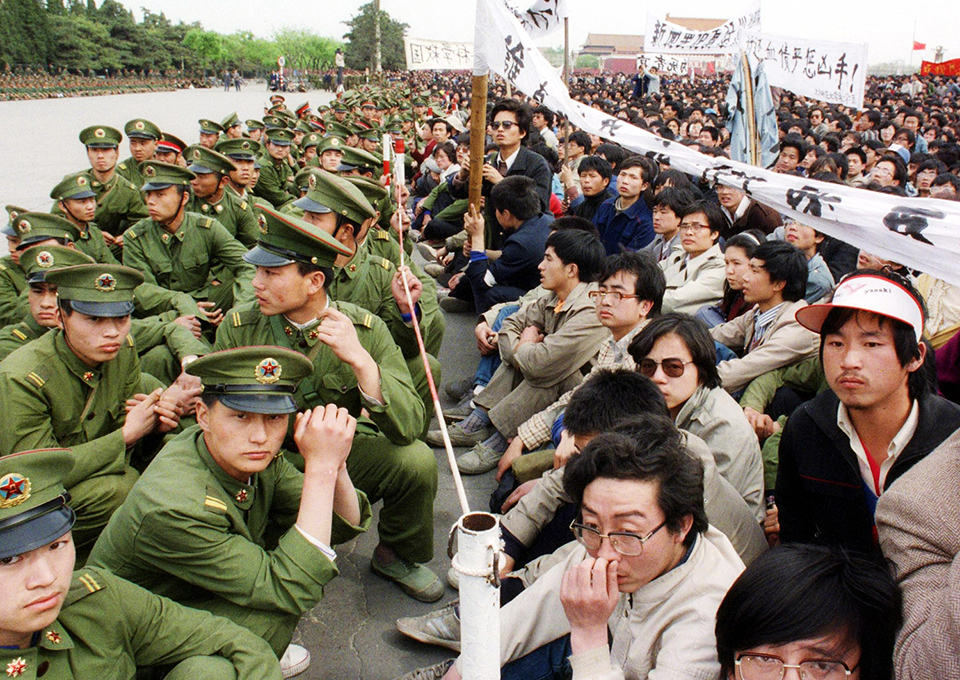
Tiananmen Square
“The citizens have gone crazy,” said a driver watching as a tank plowed its way down the main thoroughfare. “They throw themselves in front of the tank, and only when they see it won’t stop, they scatter.”
The driver himself was shaken by what he had seen: A tank had rammed into an army truck used as a barricade. As the truck turned over, it crushed a man to death. Elsewhere, he had seen three bloodied bodies lying in the street. Several soldiers still standing in their trucks were crying.
“We have to obey orders because we are soldiers,” said one uniformed trooper. “Otherwise, we will be punished. In any case, there’s no way they will order us to shoot the people.”
Students and workers threw beer bottles, gasoline bombs, lead pipes, whatever they could find, at the tanks and armed personnel trucks, which nevertheless continued rumbling down the avenue. One truck drove back and forth along the east side of the Changan Avenue, as the Avenue of Eternal Peace is known in Chinese, and did not stop when people stood in its path.
Amazement had already turned to fear and defiance earlier in the evening as citizens saw the military convoys entering the city. Some troops from other provinces practically paraded their AK-47 rifles as they stood in their trucks, stranded by the human blockades that had formed around the trucks.
By dark, tensions had soared throughout the city. Hundreds of thousands of people were impelled outdoors by their disbelief and anger, yet brought back to their homes by fear of the violence. The sound of tanks whizzing by and reports of open firing fanned their fears.
“You beasts! You beasts!” shouted the people at the troops.
Around a convoy of about 45 military trucks in the eastern part of the city, people pushed and shoved their way to the troops, shouting and urging them to consider their role as fellow citizens. But the sympathy that had characterized the troops last week was gone; the soldiers seemed to have a certain resolve.
“Will you shoot at us if they order you to?” was a question asked by many of the people surrounding the truck. The soldiers gave weak assurances to the people that they would not fire, but they also admitted that they had to follow orders.
“We have to obey orders because we are soldiers,” said one uniformed trooper who was driving a truck. “Otherwise, we will be punished. In any case, there’s no way they will order us to shoot the people.”
His platoon commander was firm. “We don’'t fear being beaten by you people,” he said as he climbed out of the truck. “We just fear that our guns will be taken and then we will have chaos.” Everywhere in the vicinity of the convoy was the sound of hissing, as people let out the air from the tires of as many trucks as they could.
“Why do you have guns?” shouted one man.
“A man is not a soldier without his gun, is he?” came the reply of a soldier carrying an AK-47 automatic rifle.
An old man took up the cause. “I tell you, there will be no good end for you if you follow your order loyally,” he screamed as though his life depended upon it. “You have parents, you have brothers and sisters. You should not beat your fellow citizens under any circumstances.”
The nearly crazed citizens were climbing onto the trucks, trying to intimidate the soldier. But everywhere in the vicinity, anger was mixed with horror as the people saw how the soldiers handled their rifles and watched as several tanks pulled up.
“'Is this the way Li Peng shows how martial law protects the people?” said an old man sitting on a rail.
Another young man said, “When they shoot with real bullets, it will be doomsday.” Only hours later did the troops open fire.
In the afternoon, the scene near the walled-in Communist Party compound, where about 30 tear-gas bombs were released, had been the first site of violence. But now that seemed tame. A 20-minute conflict between 300 to 400 riot policemen and hundreds of citizens seemed to have galvanized the citizens. They began to believe that the Government was willing to use force – rubber bullets, broken bricks, truncheons – against the people.
“I couldn't keep my eyes open because of the dense tear gas,” said Lu Baochun, a 26-year-old assistant engineer. “It was the troops that first used bricks and tiles to attack, and the citizens fought back.”
Mr. Lu had rushed back out to the scene, a chaotic swirl of thousands of people darting back and forth inspecting broken bricks and glass and examining the white powder-like splotches on the street apparently from the tear gas.
“When I went into the house of a nearby citizen to wash my eyes with fresh water, I saw several children lying on their stomachs on a bed,” said Mr. Lu, whose own face and neck were reddened from the gas. “They had wet towels covering their mouths, and an old woman was beside them weeping.”
He was standing at the Communist Party headquarters shouting with rage now at the two-dozen military troops with long truncheons and green helmets, sweating in their heavy green uniforms under the pelting sun.
Some citizens gathered in small huddles around people they thought had been witnesses to the attack. Others crowded together discussing the event, many apprehensive about how far the Government would go.
“They are simply ruffians and bandits,” said a young well-dressed woman who had gotten caught in the cross-fire of bricks and stones as she was on her way to the office. “They bit people just like mad dogs.”
A Chinese journalist was trying to comfort her. “We are shocked,” he said. “We thought that this kind of thing only happened during the reign of the corrupt Government of the Kuomintang. Yet this happened in our People's Republic. The troops and the police, they are supposed to be our brothers.”