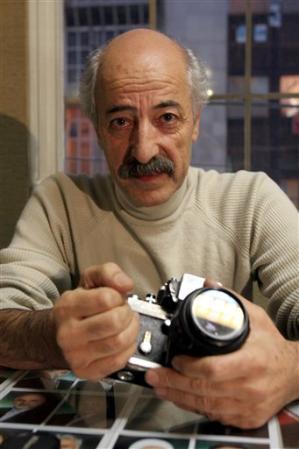
Jahangir Razmi
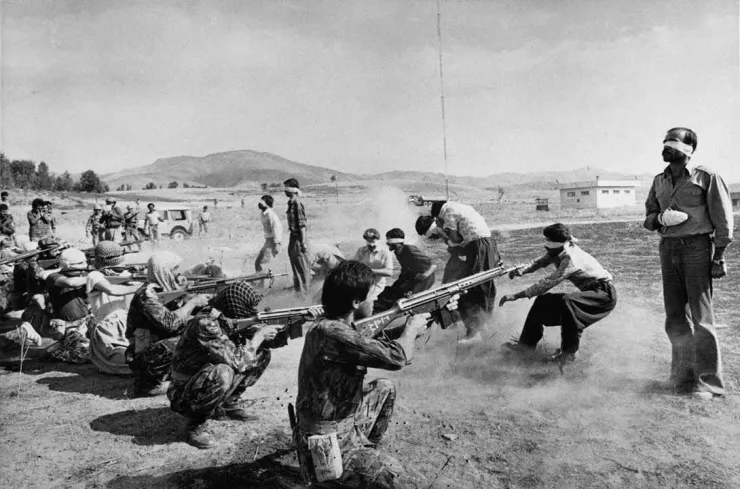
“Firing Squad in Iran” was a stunning black and white image of 11 Kurdish men being shot to death in a dusty field in the Iranian province of Kurdistan. Standing a few feet behind and to the right of the riflemen, an Iranian photographer, armed with his Nikon, his savvy and his courage, had recorded the scene. The Pulitzer Prize jury decided this was “probably the single most important photograph of 1979,” writing: “It is not only a picture of enduring and memorable quality but also has the power to shape the viewer’s feeling about a compelling international crisis.”
Ayatollah Khomeini and his theocracy had been in control of Iran for just a few months. When this close-up of a state execution appeared the next day across the front page of Iran’s biggest newspaper, Ettela’at, the nature of the Islamic Republic could no longer be denied. So the newspaper’s editor, fearing for the photographer’s safety, withheld his name. When UPI distributed the picture around the world, it did the same.
Thus it happened that in 1980, the Pulitzer Prize Board, on the advice of its jury, awarded the Spot News Photography prize to “an unnamed photographer of United Press International.”
Shortly afterward, in Popular Photography magazine, Harold Blumenfeld, one of the jurors who recommended the photo for the prize, wrote: “There’s still danger ahead for Anonymous since threats have been made by student militants who strongly objected to the worldwide publication of the picture. ... If Anonymous is identified, he or she might well become the subject of another Iranian execution photo.” Blumenfeld closed with the hope that some future “easing of world tensions” might allow Anonymous to accept the Pulitzer Prize and other press awards his photograph had won.
But for years to come, “Firing Squad in Iran” remained the only anonymous winner in the history of the Pulitzer Prizes.
In 2002, Joshua Prager, a reporter for the Wall Street Journal, saw the word “anonymous” where the shooter’s named should have been in a collection of Pulitzer-winning photographs. It bothered him. As he later told Editor & Publisher’s Joe Strupp, he found it “a glaring word.”
Prager decided to find “Anonymous.” The search took years. Finally, on Dec. 2, 2006, he reported on the front page of the Journal that the photographer was Jahangir Razmi of Tehran. Prager wrote that Razmi, who had worked for Ettela’at in 1979, had prints and contact sheets hidden in a closet at home that proved he had taken “Firing Squad.” Only after receiving his family’s blessing did Razmi agree to be identified publicly.
Prager’s revelation was huge, especially to Sig Gissler, the high-energy administrator of the Pulitzer Prizes. Soon Razmi had a visa, plane tickets for his first visit to the United States, and an invitation to the annual luncheon where the Pulitzer Prizes are awarded.
At long last, Razmi was to receive the 1980 Pulitzer Prize for Spot News Photography. It would happen in the rotunda of Low Memorial Library on the Columbia University campus on May 21, 2007, nearly 28 years after he took the winning picture.
This was going to be the most memorable event in my nine years on the Pulitzer board. Mike Pride, then editor of the Concord (N.H.) Monitor, and I were co-chairs of the Pulitzer Prize board that spring. Mike’s responsibilities included giving the annual luncheon address. So it was my good fortune to introduce Razmi and his wife Parvin and deliver the Pulitzer Prize to this courageous man.
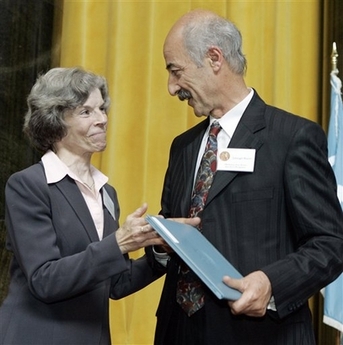
Joann Byrd presents Razmi with a certificate at the 1980 Pulitzer awards luncheon.
I was humbled to welcome two other people to the luncheon who appreciated Razmi’s photography for personal reasons. They were the mother and sister of two men shot by that firing squad. Monir and Roya Nahid talked with me before lunch as we examined the picture. Monir Nahid knew it well. Before she and her daughter left Iran, she had carried “Firing Squad in Iran” to meetings and rallies to argue for Kurdish independence from the Islamic Republic.
I have always been in awe of work worthy of a Pulitzer Prize. But to me, what is really important is acknowledging the people who do this work, whether they are journalists, authors, composers, poets or playwrights. After all, it is they who produce and create such excellence.
Anonymity, as necessary as it was in 1979, robs the winner of the prize’s permanent glory. And it means a grateful public doesn’t know whom to admire and thank.
At the luncheon I was thrilled to point out Josh Prager to a roomful of Pulitzer winners and their families. Without Prager’s shoe leather and tenacity, Jahangir Razmi might never have received his due — or a standing ovation from dozens of others who know what it takes to earn a Pulitzer Prize.