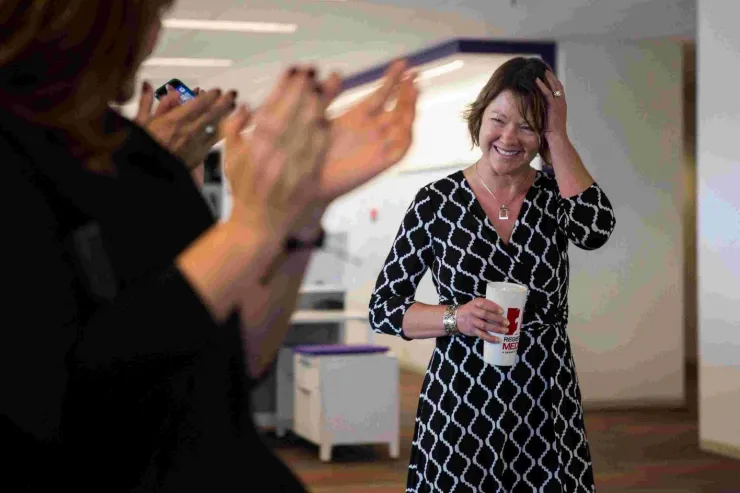
Andie Dominick of the Des Moines Register won the 2018 Pulitzer Prize in Editorial Writing "for examining in a clear, indignant voice, free of cliché or sentimentality, the damaging consequences for poor Iowa residents of privatizing the state’s administration of Medicaid." Here, she talks about her process, and balancing passion against temperance.
Legislatively, and in other ways, what has been the response to the Des Moines Register’s coverage of Iowa’s Medicaid program and the people in it, including to your editorials?
ANDIE DOMINICK: We have a state completely controlled by the GOP. Our system was privatized by a Republican governor, with no legislative approval of that change. Other states have a mechanism to keep that from happening. Iowa does not.
But there was so much opposition to this. Hospitals opposed it, providers opposed it, consumers opposed it. This was an executive action by Gov. [Terry] Branstad who’d gotten a federal waiver to privatize. He’s since gone to China, taking a [U.S. ambassador] job with Trump. Gov. [Kim] Reynolds has stayed the course of her predecessor.
How does that make you feel?
AD: It’s frustrating. But we’ve done some polling on this. People disagree with privatizing, and that disagreement is pretty widespread. I think this going to be a major election issue in November.
You mentioned that the editorial board was just discussing how to weigh in on the murder of Mollie Tibbetts, who was white. The main suspect is an undocumented Mexican immigrant who, police say, admitted to the crime. Of today’s many fraught topics, that one is especially fraught. What’s your approach to editorializing on the tough topics?
AD: It’s important for us to ask, "How do we add to the conversation?" We talk it out, we disagree quite a bit. We now have two males and three females on the editorial board. That’s a better gender balance. In the past we have been a board made up entirely of women, and I was the only woman during a period of time.
I have a personality that is a little more extreme. I have to be reeled in a bit. My editor once said to me, "We have to take out the profanity." It was kind of a joke. His point was that you do need to have passion in editorial writing, but also [temperance]. That can be hard.
So, what does that mean for your writing process?
AD: Writing is done, alone, in a room. You sit down and look at the screen. I agonize over that first sentence because it is so important. I rewrite a lot. I like to come back to something.
I like that editorial writers don’t do breaking news. It gives you time to sleep on and think about. For instance, the employers of the man accused of murdering Mollie Tibbets first said that they used E-verify [to confirm that the suspect could legally work in the United States]. When we realized they weren’t registered with E-verify, they came back and said they’d changed their mind. You get pretty frustrated by things like that. But when I sleep on it I say, "This employer needs workers. It’s hard to find people in rural Iowa who want to do some of this work." There are so many sides to many of these issues.
There are some issues it’s hard to see the other side, including many aspects of women’s rights. Our editorial board is very much pro-choice on abortion.
With Medicaid privatization, there is so much tragedy and a fair amount of anger at watching people who lose health care. I’ve interviewed and talked to a lot of them. It gets personal. You feel for people.
In what ways does your chronic diabetes influence your writings on health care?
AD: I’ve had diabetes since I was 9. I give myself about eight shots a day. I check my blood sugar about eight times. I’ve had about 12 eye surgeries. But I am healthy. I bike every day and exercise. With health care, I bring a lot of personal knowledge and years of background.
With Medicaid’s privatization here, we started raising concerns before it happened, encouraging Iowans to contact the federal government about their concerns. A lot of the problems that we are having, we knew would happen … Since private insurers took over the Medicaid system here, not a week goes by without someone contacting me about how problematic this is. And I feel like we are the last people they call. They have been on the phone for hours and hours trying to fix a problem. They are pretty desperate by the time they get to us.
Since winning the Pulitzer, what stories have you been telling?
AD: Just recently I wrote about a small provider of care for about 20 severely physically and mentally disabled people. That provider is owed more than $300,000 by one of the private insurers. There are small social service agencies or group homes that aren’t being paid and, because of that, are going to close. People running those homes and doing in-home care … call me. I get a lot of calls. But I have a rule: I talk to people only if they are willing to go on the record, use their names and provide me photos of bills or some kind of documentation. You lose about 30 percent of people when you tell them that. A lot of the providers, especially, are really nervous. Lower-income people sometimes are embarrassed to be on Medicaid — even if they want people to know their story — and that’s pretty sad.
The boost from winning a Pulitzer, describe that.
AD: I don’t know if I’d call it a boost. It’s more like a pause. You stop. And you’re very grateful. But, afterward, I just wanted to get back to work … Right now, I’m also working a piece about cancer patients not being able to get the pain-killing opioids they need.
I have to say that I was surprised at the outpouring of support and congratulations, even from my preschool teacher. Iowa is such a small place. And winning the Pulitzer have given the Medicaid issue much more attention around the state.
An aside: One of your three adult kids is in the Army? What does that mean for a mom who is also a very opinionated editorial writer?
AD: All three of my kids were adopted from foster care. We adopted Jacob when he was 3. We are not a military family … Jacob just signed up one day. He got tired of going to college. But he’s really thrived in the Army. He’s in his third year, speaks fluent Japanese — and speaks some other languages not so well — and translates for the military.
I’ve wanted to feel I could trust the nation’s leader with my son’s life. That’s been hard with this president, with the North Korea stuff and not knowing Trump’s philosophy and listening to his changing philosophy. My son reassures me. He trusts his superiors. He says, "It’s fine, Mom … "
There are some things in the world you have a little bit of power and, then, some things you have to trust will work out OK.