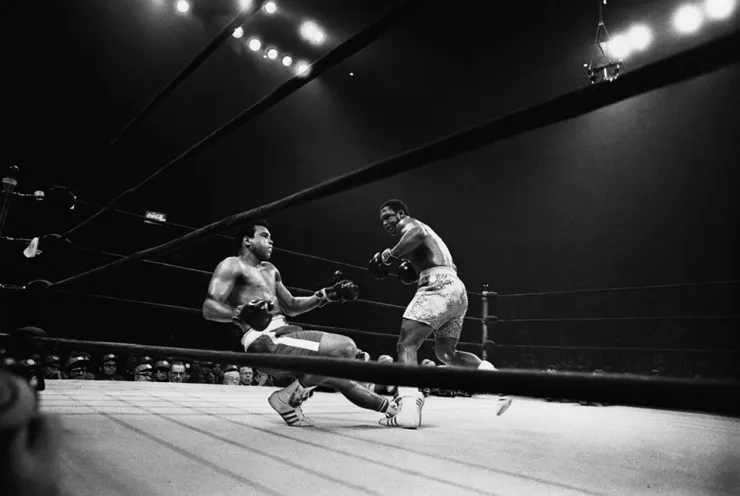
Muhammad Ali and Joe Frazier fought three times during the 1970s, and two of the matches helped David Hume Kennerly and Red Smith win Pulitzer Prizes.
Kennerly’s 1972 prize-winning Feature Photography portfolio took him from Madison Square Garden to India to Vietnam. It was the Vietnam photos that the Pulitzer Prize Board focused on in its prize announcement, but United Press International’s portfolio on Kennerly’s behalf including his photo of the key moment of the first Ali-Frazier fight. That match occurred 45 years ago today.
Ali, the former heavyweight champ, had been stripped of his title and banned from the ring after refusing induction into the army in 1967. He returned to boxing in 1970, when Frazier was the undefeated champ.
The fight was a classic, fast, brutal and closely contested. Frazier was ahead on points through 14 rounds and clinched his victory with a knockdown of Ali in the 15th.

David Kennerly. Photo by Mark Wexler.
Kennerly later recalled how he got the famous photo of the knockdown: “Because I was in the right place, I had the picture of him getting hit and going down. . . . And when I saw the film of that fight years later, he went down so fast I have no idea how I got that picture. . . . It was really very lucky.”
The next day, the photo ran in newspapers all across the country. “What was particularly satisfying to me was that it appeared on page one above the fold in The New York Times,” Kennerly said. “It was March 9, 1971, my 24th birthday, and the photo represented my last domestic assignment before I left to cover the war in Vietnam. What a way to head off to the war.”
Ali turned the tables when he and Frazier met again, winning a 12-round unanimous decision in 1974. After regaining the championship later that year by knocking out George Foreman in Zaire, Ali fought Frazier again.
The “Thrilla in Manila” in October 1975 was the rubber match between two of the greatest heavyweights ever, and neither fighter disappointed.
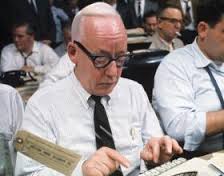
Red Smith at ringside of an earlier Ali fight against Sonny Liston in Lewiston, Maine.
Yet there was disappointment in Red Smith’s assessment of the fight. Like many others, Smith, the legendary sports columnist of The New York Times, thought Frazier would have won the fight had it gone to the scorecards. This proved to be false, as his column acknowledged, but he wrote what he saw.
Smith, who had just turned 70, had made a career of providing deadline literary accounts of big sporting events on deadline. He was also famous for saying: “Writing is easy. All you have to do is open a vein and bleed.”
Sports columnists seldom win Pulitzer Prizes, but Smith won the 1976 Commentary prize, and the Ali-Frazier column was part of his entry. Here it is:
Joe was still coming in
By RED SMITH
When time has cooled the violent passions of the sweltering day and the definitive history is written of the five-year war between Muhammad Ali and Joe Frazier, the objective historian will still remember that Joe was still coming in at the finish.
For more than 40 minutes, the former heavyweight champion of the world, who was now the challenger, attacked the two-time champion with abandoned, almost joyous, ferocity. For seven rounds in a row, he bludgeoned his man with hooks, hounding him into corners, nailing him to the ropes.
And then, when Ali seemed hopelessly beaten, he came on like the good champion he is. In the 12th round, the 13th, and all through a cruel 14th, Ali punched the shapeless, grinning mask that pursued him until Eddie Futch could take no more.
After 14 rounds of one of the roughest matches ever fought for the heavyweight championship, Frazier’s trainer, Futch, gave up. At his signal, the referee stopped the fight with Ali still champion.
All three Filipino officials had Ali leading on points at the end, but in the New York Times book, Futch snatched defeat from the jaws of victory. On the Times’s two scorecards, Frazier had won eight of the first 13 rounds when he walked into the blows that beat him stupid. He lost while winning, yet little Eddie was right to negotiate the surrender. Frazier’s $2 million guarantee wasn’t enough to compensate him for another round like the last.
So now the saga ended. It began on March 8, 1971, when Ali and Frazier met for the first time, both undefeated as professionals, both with valid claims to the championship, both in the glory and strength of youth. That time Frazier won it all. They fought again on Jan. 28, 1974, when both were ex-champions and Ali got a debatable decision. Today’s might have been debatable, too, if a decision had been needed.
It has been a series both men can remember with pride – and pride has been the spur for both. All three meetings were happenings, memorable chapters in the annals of the ring, and in many respects this was the best of the three. It will be some time before anybody knows whether the gross revenue from the live gate, closed circuit and home television around the world will equal the $20 million drawn for their first encounter, but this day’s business in the Philippine Coliseum may have broken all records for an indoor fight. Attendance was estimated at 25,000, with a gate of something like $1.5 million at $333 tops.
If a price can be put on the suffering of brave men, this returned a dollar in pain for every dollar involved. Curiously, the winner’s suffering was the greater. Not many men could have stood up under the punishment Ali took from the fifth round through the 11th.
Yet Ali not only endured when he had taken all that Frazier could deliver, but he also had enough to win.
Say what one will about this noisy extrovert, this swaggering, preening, play-acting side of theatrical ham: the man is a gladiator. He was a callow braggart of 22 when Sonny Liston surrendered the title to him 11 years ago. At the ripe age of 33, he is a champion of genuine quality.
Whatever can be said to Ali’s credit must be said with equal emphasis about Joe Frazier. This man was a good champion in his own right. He is the best man Ali ever fought, an opponent who searched Ali’s inner depths and brought out qualities Ali never had to reveal to any other man.
It was Joe, rather than Muhammad, who made this a great fight. In the early rounds, Ali made half-hearted attempts to strut and posture the way he has done against men like Joe Bugner and Chuck Wepner, but Frazier’s persistent advance brooked no such nonsense. Ali’s faster hands and circling retreat held Joe off for a while. Joe was remorseless, though, and single-minded.
He brushed pawing gloves aside, rolled in under punches, bore straight ahead and slugged, and by the fifth round he was getting the message across. It was hook, hook, hook – into the belly to draw Ali’s hands down, then up to the head across the ropes.
He beat the everlasting whey out of Ali. His attack would have reduced another man to putty. The guy in the white trunks was not another man. He was the champion and this time he proved it.