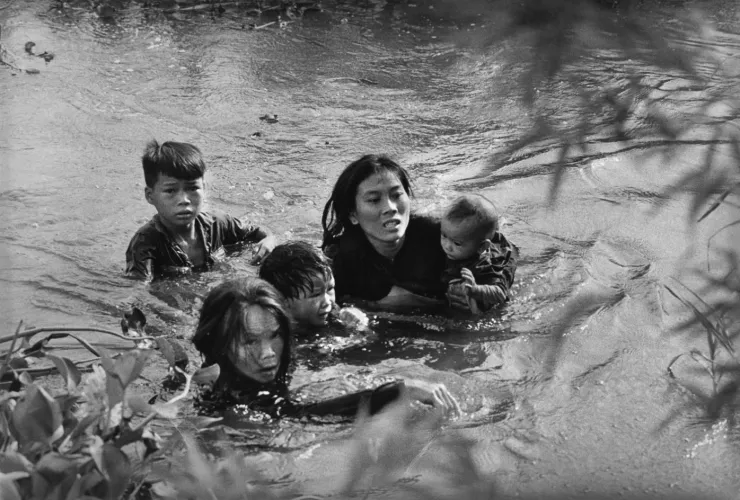
Robert McNamara, the U.S. secretary of defense, was not the only one who became convinced in 1965 that the United States could not win the Vietnam War. Robert Lasch, an editorial writer for the St. Louis Post-Dispatch, actually beat McNamara to the punch.
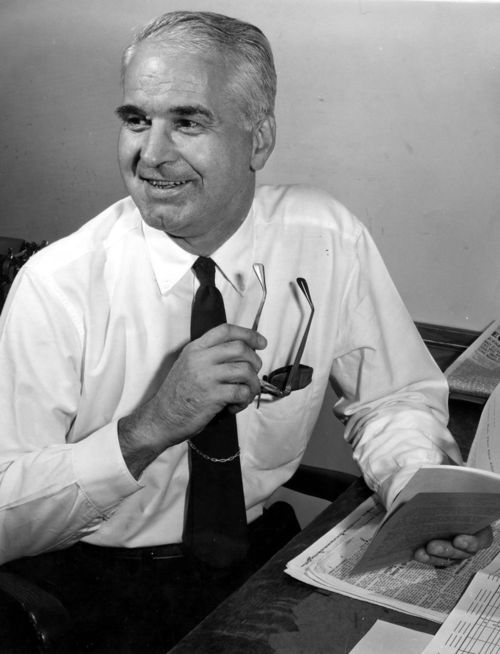
Robert Lasch
Lasch urged a negotiated settlement rather than a troop buildup early that same year. And the Pulitzer Prize Board apparently found his holistic view of American foreign policy persuasive, awarding him the 1966 prize for Editorial Writing.
Lasch had worked as a part-time police reporter while studying philosophy at the University of Nebraska. He went to Oxford as a Rhodes Scholar, worked at the Omaha World-Herald and won a Nieman Fellowship at Harvard.
After first writing editorials for the Chicago Sun, he joined the Post-Dispatch as an editorial writer in 1950.
If the powers-that-be had heeded the advice in Lasch’s Jan. 17, 1965, Vietnam editorial, history would have unfolded differently. As it was, McNamara told President Johnson late the same year that the war could not be won, but that stopped neither man from continuing to act as though it could.
The containment of ideas
By ROBERT LASCH
Coming events in South Viet Nam promise for many Americans a profound psychological shock, which a foresighted Administration would be preparing to offset. When the day comes for American forces to leave Viet Nam after 10 years of vain effort to build an anti-Communist bastion there, not only will our national pride be hurt, but some basic assumptions of our postwar foreign policy will be called into question. As fresh thinking is always more painful than mouthing shibboleths, this is going to cause a certain degree of anguish.
Unpleasant as it may be, the time for reappraisal has come, and thoughtful Americans should resolve to be realistic about it. The first step is to cast off the illusion of omnipotence, under the spell of which many of us have for years assumed that our mission in the world is to contain, roll back, destroy or otherwise combat Communism.
After World War II, the Soviet Union sought to expand its national power wherever possible. The United States, as the leader of the free world, was thoroughly justified in undertaking to contain that thrust, and it was contained. Only where the Red Army stood on land taken from the Nazis — which is to say, only in Eastern Europe — were the Russians able to impose their national will on other peoples; and the passage of time has indicated that even there, subjugation is most likely temporary. National identities have survived and are persistently asserting themselves. There could be no better evidence that the Communists are not going to rule the world, and neither are we. Aspirations for independence, self-respect and self-government are too universal and too powerful to be subdued by any ideology.
In the meantime, however, American policy increasingly has tended to confuse the containment of Russian (and later Chinese) national power with the containment of Communism. We undertook to apply the methods appropriate to a national power struggle — the methods of diplomatic maneuver, armed confrontation and in some cases war itself — in a realm where they are totally ineffective. Communism as an idea cannot be contained by such methods, but only by a better idea.
It is not the American function to combat revolution everywhere — to stand as the universal, all-embracing guardian of the status quo. This is an odd role, by the way, to be thrust upon a nation that was itself born of revolution less than two centuries ago. More important, it is a role that lies beyond the capabilities of any nation. Change is the law of life. Social change will sometimes take revolutionary forms in some countries, no matter what the United States or any other nation thinks about it. A wise foreign policy begins with recognition of this fact.
American foreign policy is in deep trouble in Africa, in Asia, in Latin America precisely because we have let ourselves be pushed into a counter-revolutionary posture. Wherever oppressed masses struggle toward a better life, millions of persons look upon the United States as their natural enemy, which means that they inevitably look elsewhere for friends.
Ours is not a revolutionary society, and we should not try to behave as if it were. But we can behave like a mature nation which knows that it has no right and no power to decide for the people of Cuba, Viet Nam or central Africa what form of revolution they should have. We can behave like a nation which is prepared to accept change, even in forms unpalatable to it, and is ready to work with peoples of any political faith for a peaceful world of diversity.
It is often said that we must hang on in Viet Nam, even to the point of an escalated war, because the effects of defeat there would be so damaging elsewhere in Asia and Africa.
Unfortunately it is true that if we got thrown out of Viet Nam, millions of people would be delighted. That is one reason why our Government would be wise to encourage a political settlement through negotiation before we are thrown out — unless it is already too late. Whatever happens in Saigon, however, the American cause will not be damaged thereby half so much as it is already being damaged by the growing conviction that our power and influence are dedicated to the suppression of social revolution and political change wherever they occur.
We shall improve our position with the developing nations and the world at large not by proving that we can wage endless war in Viet Nam, but by showing, through actual conduct, that the CIA is not enfranchised to swagger around the world setting up governments and knocking them down; that we do not undertake to dictate the form and pace of political change anywhere; that we are prepared to accept revolutions even when we do not approve of them; and that we have enough faith in the ideas of freedom to entrust to them, rather than to arms, the task of containing the ideas of Communism.
Sources: Lasch obituary, April 11, 1998, The New York Times. Pulitzer Prize Editorials: America’s Best Writing, 1917-2003 (Third Edition), William David Sloan, Laird B. Anderson (eds.), Iowa State Press, 2003, pp. 162-64.