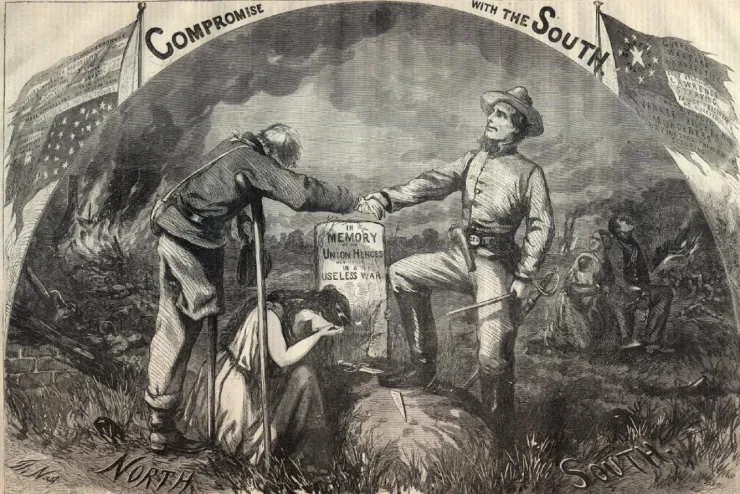
For many years the Pulitzer Prize Board has had strict rules in place to prevent conflicts of interest. This was not always the case.
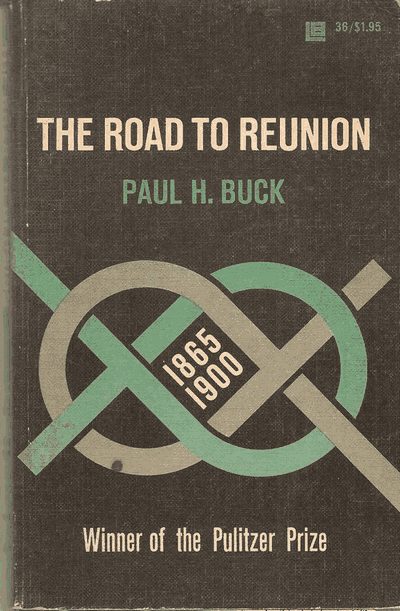
Consider Road to Reunion, Paul Buck’s 1938 prize-winner in History. Buck was a Harvard University colleague of two of the three members of the jury. One of them, Arthur M. Schlesinger (father of the aide to President Kennedy), had written a blurb for Road to Reunion that took up half the front dust cover. Not only that but Buck also dedicated the book to Schlesinger. This did not stop Schlesinger from strongly advocating Road to Reunion for the Pulitzer Prize.
Schlesinger’s coziness with Buck caught the notice of the jury chair, Guy Stanton Ford, acting president of the University of Minnesota. Ford also disagreed with his two fellow jurors about the book’s scholarship and point of view. He suggested that the book had exaggerated the extent to which North and South were truly reconciled. Where Buck perceived cold ashes, Ford saw live embers likely to burn far into the future.
Here are excerpts from the correspondence of the three jurors, Ford, Schlesinger and James P. Baxter 3rd, the other Harvard history professor. The other books in contention for the prize were Bessie Pierce’s A History of Chicago: 1673-1848, Vol. 1; Dexter Perkins’s The Monroe Doctrine, 1867-1907; James G. Randall’s Civil War and Reconstruction; Charles W. Andrews’s Colonial Period of American History: The Settlements, Vol. 3; and Samuel Elliot Morison and Henry Steele Commager’s The Growth of the American Republic.
February 19, 1938: Schlesinger to Ford:
In sifting through the fairly considerable number of books I have found it necessary to adopt criteria of elimination and acceptability. These may or may not agree with those of my committee brethren. In any case, I have placed out of the running: (1) books of a predominantly local-and-antiquarian character; (2) journalistic treatments of men and events; and (3) books designed as texts for high-school and college classes. Let me add at once that a work of genius might conceivably turn up in one of these categories, in which case I should want to reserve the right to consider it.
On the positive side I should hope that we might find a work of original research that represents a fresh and unconventional approach to American history or a new synthesis of subject matter, or which yields significant new light as to allegedly well-established facts. Besides being of unimpeachable scholarship, it is highly desirable that the work should possess distinction of literary style.
With these criteria in mind I venture to propose a preferred list of three books, in the following order:
1. Buck, The Road to Reunion
2. Pierce, A History of Chicago, 1673-1848 (vol. 1)
3. Perkins, The Monroe Doctrine, 1867-1907
To my mind, Buck’s book meets most completely the several criteria. The other two works have not been submitted to our committee, but both were published in 1937, Miss Pierce’s book by Knopf and Perkins’s by the Johns Hopkins Press. Miss Pierce’s book is noteworthy for applying the techniques and insights of modern historical scholarship to the history of a great city. Inasmuch as urban history is a field that has been neglected by trained historians, the book possesses added significance as a model for later work in this field.
I defer to Baxter’s judgment when I say that Perkins’s scholarship is solid rather than brilliant, but at the same time he displays insight and discrimination. I should suppose that his study displaces all earlier treatments of the Monroe Doctrine.
You will remember that you and I discussed at Philadelphia the question of considering C.M. Andrews’s new volume for the prize inasmuch as he had already received the award for an earlier volume. We then agreed, as I recall it, that if there were other outstanding books in the competition we should give the preference to these other authors. I have not myself read Andrews’s Volume III, but have heard opinions that it is not the equal of the other two.
If this letter will start the ball rolling, I shall be satisfied.
March 9: Baxter to Ford.
Your special delivery letter of March 7 has just come to hand as I was composing to you.
My six preferences fall in two groups. The books by Buck and Perkins which Schlesinger ranks first and third, I should place in a top group with Morison and Commager. The second group is comprised of Randall’s Civil War and Reconstruction, Andrews’s Volume III, and Colonel Spaulding’s United States Army, which I should place sixth on the list. I am just starting Miss Pierce’s book on Chicago.
Frankly it would seem rather strange to me for Morison to win the prize this year for a much less important book than several of his earlier contributions which failed to win it. The book is better written than other text books but is it not a text book after all?
To help clarify my ideas in the Massachusetts sector of our committee I have talked with Arthur Schlesinger on the telephone and have arranged to lunch with him on Friday in Cambridge after which we will send you an air mail letter or letters.
March 10: Schlesinger to Ford
I am writing to comment on the Morison and Commager volumes to which you refer in your letter of March 7.
There are several reasons why I feel strongly that they should not be in the running. One is that the volumes are a revision of two earlier works and not, in any genuine sense, a new production. I have compared the first volume of Morison and Commager carefully with the first volume of Morison’s Oxford History of the United States and, except for the period prior to 1790, which is not covered in the Oxford History, the present volume is almost an exact transcript.
The same holds true, though to a less degree, of the second volume of the present Morison and Commager which should be compared with the post-Civil War chapters of the one-volume Morrison and Commager. The order of the chapters is substantially the same and the treatment of events is much the same except, of course, that the earlier work ended in 1917.
I have gone over with a fine tooth comb the treatment of the New Deal and have discovered that they rely principally upon Dumond*, taking over his errors and omissions as well as the good features of his treatment.
As a matter of fact, the work follows conventional lines of organization and makes no fresh contributions either in regard to subject matter or points of view. The only possible basis for an award that I can see would be its stylistic merits, but however desirable it may be that a textbook be well written, this one commendable feature does not seem to me sufficient for our purpose.
I think no one would be more surprised than Sam Morison if the work were awarded the Pulitzer Prize. Had I been on the committee last year, I would have certainly urged the eligibility of Morison’s Harvard College in the Seventeenth Century (2 vols.) for the award. It is at least interesting that for this work he has received the Jusserand Medal and, more recently, the award of the American Educational Research Association. But Morrison’s great work on Harvard College is of a different order of merit from that represented by the work under discussion.
Baxter has asked me to lunch with him tomorrow to discuss possible recommendations. Within a day or so, therefore, you should hear from both of us.
[*A doctoral alumnus of the University of Michigan, Dwight Dumond (1895-1976) spent all but one year of his career at Ann Arbor, where he specialized in the antislavery moment and occasionally dabbled in contemporary American history. Schlesinger is likely referring to his Roosevelt to Roosevelt: The United States in the Twentieth Century (Henry Holt, 1937), lauded by Morison and Commager for its “excellent” overview of Herbert Hoover’s economic policies. Schlesinger’s appraisal seems to have prevailed into our era.]
Undated Baxter telegram to Ford from Cambridge, Mass.
After consultation with Schlesinger my choices rank as follows
First Buck Second Perkins Third Peirce Fourth Randall Fifth Andrews (stop)
On second thought I feel Morison and Commager are out of the running for reasons stated in Schlesingers letter of March 10. Wish you could have been with us.
Undated Schlesinger telegram to Ford from Cambridge, Mass.
I rate Paul Buck first, Dexter Perkins second, and Bessie Pierce third (stop) In a group below these I place James G Randall fourth and Charles M Andrews fifth.
March 14: Ford to Frank D. Fackenthal, provost, Columbia University
I am enclosing the report, or rather reports, of the sub-committee on the Pulitzer award in the field of American history.
For the guidance of the Committee on Award, I am enclosing copies of the telegrams and letters sent me by Messrs. Baxter and Schlesinger following their conference.
I have enclosed a rating of the first six books considered by any or all of us in our final summation. As the letters from President Baxter and Professor Schlesinger give some comment, I am supplementing my judgment as shown on the rating sheet by brief comment.
I shall send copies of this comment to my colleagues on the committee. I have not had the opportunity to confer with them personally except as noted in my supplementary remarks.
I wish the report might have been unanimous. The two to one majority may, however, be sufficient for the Committee on Award.
March 14: Ford to Fackenthal (supplementary comments)
Buck’s Road to Reunion is the choice of Messrs. Baxter and Schlesinger. I agree that it reads as smoothly as almost any book submitted. It has to me the character of a pleasant, prolonged, and well-organized historical essay. The title is its most striking feature and will be worth money if the moving picture producers spot it. The execution of this idea, given the theme in the title, required no great research. The basic work has been done by Fleming* and others who have blazed the trail and amassed the facts. I see no new material of note for the Nation, Harper’s Weekly, and other periodicals have been used by many. Having been brought up in a home where the Civil War and reconstruction and everything the G.A.R.** stood for were living things, the book seems pleasant but pallid and unreal. Where he sees dead ashes of extinct controversies, I sense burning embers down to the end of the road the author follows.
The author has read widely, selected well and done an excellent synthesis that will in no way be a landmark or modify in the slightest the opinion of students at all well informed.
I do not have the advantage of the other judges in knowing the author’s scholarship or intellectual vigor by years of association as a colleague, intimately I judge by the dedication and dust jacket in the case of Professor Schlesinger. I have dissented regularly, therefore, but have felt somewhat fortified in it by the comments, elicited indirectly, by four of my own colleagues in American History, all of whom work in this period in varying degrees. They all thought it written pleasantly but not distinguished nor arresting.
If it had not been for Miss Pierce’s History of Chicago, I should have put the case for Morison and Commager. Although not put out in a trade edition, it is far less a text book in form and intent than Randall’s Civil War and Reconstruction which avails itself, as did Buck, of the best material in part of the same period covered by Buck, but in a heavier style and under the stereotyped title for texts in this period. In my opinion the Morison and Commager represents even more adequately the kind of historical treatment recognized and rewarded some years ago in Beard’s Rise of American Civilization.
Perkins’ third volume on the Monroe Doctrine is the Shaw lecture at Johns Hopkins. It is less a contribution than the first, I judge, though I never read the second. It is much better written than the first due to the author’s own advance and to the audience for which he prepared it. The Hopkins press has bulked the material by printing devices and paper into a relatively stout volume. The author has contributed to this, not unjustifiedly, by attention to what foreign journalists and publicists have said. There is, too, solid evidence of archival research. None of us think of it as first rank.
I have ranked Miss Pierce’s History of Chicago, Volume 1, as my first choice.
This work has no advantages of attractive style and rarely a striking phrase. It is, however, clearly and competently written. It is highly factual but well organized. It will get no bouquets from a review in the Saturday Review of Literature. It is, however, the one book in the whole forty or more that breaks new ground, lifts into significance the history of a city and seeks to apply social and economic factors in a significant area to the history of its population center and its industrial and economic capital. It throws light on the history of many phases of the Upper Mississippi Valley. It is a largely conceived undertaking planned for four volumes apparently. Its scholarship and the wide search for material will set a high standard in a field that others will cultivate perhaps with more graces but at their peril with less industry and breadth of conception.
Perhaps in my judgment of Miss Pierce’s work I have the advantage which the other two had in ranking Professor Buck’s work number one. I have known her not intimately as a colleague but as one I have seen from time to time during her work at Iowa and Chicago. On those occasions she has talked of other work she was doing in writing or editing. Of this work I had no previous knowledge and am indebted to Professor Schlesinger for calling the attention of the committee to the fact that it and the Perkins were eligible for consideration this year.
This earlier knowledge of Miss Pierce’s methods of work and my appreciation of her clear headedness may have affected my judgment though I think every page would bear out what I have said about her solid scholarship and a style that would be better if it were less solid. No scholar working in the history of the Midwest, and that means American history, since the nineteenth century can ever ignore her work even if it ends with this volume.
[*This is probably Walter Lynwood Fleming, a Vanderbilt historian of Reconstruction and its aftermath.]
[**Grand Army of the Republic, the largest Union army veterans’ organization.]
Ford’s scorecard
| Buck | Perkins | Pierce | Randall | Andrews | Morison/Commager | |
| Baxter | 1 | 2 | 3 | 4 | 5 | -- |
| Ford | 3 | 5 | 1 | 6 | 4 | 2 |
| Schlesinger | 1 | 2 | 3 | 4 | 5 | -- |
(With thanks to Sean Murphy of the Pulitzer office for preparation and help with annotation.)