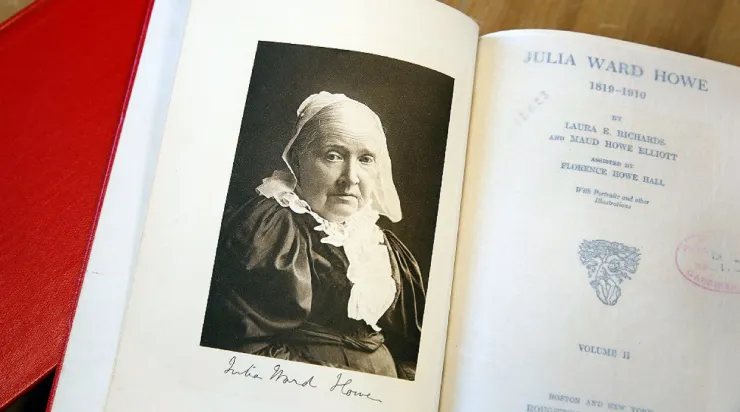
In 1917, while women were still waiting for the right to vote and the worlds of journalism and publishing were restricted mostly to men, a Pulitzer Prize jury awarded the first prize in biography to a pair of a sisters who wrote a sweeping account of their mother’s life.
The authors, Laura Elizabeth Richards and Maude Howe Elliott, chronicled the long and complex career of Julia Ward Howe, an abolitionist and suffragist best known for writing "The Battle Hymn of the Republic." Richards and Elliott were the first women to win a Pulitzer but, until recently, neither was widely associated with the prize. The book itself, meanwhile, was often overlooked — or outright dismissed — by literary scholars.
“Why Julia Ward Howe was awarded the first Pulitzer Prize in biography ... I do not know,” Edward O’Neill wrote in A History of American Biography in 1935. “It is not a particularly difficult matter to put together such a book, for a book of this kind is not and is not intended to be critical.”
It’s true that the biography feels sometimes celebratory, but O’Neill is wrong to overlook the challenges the authors endured. The sisters lived hundreds of miles apart, Richards in Gardiner, Maine, and Elliott in Newport, R.I. It took them several years to write the book, sharing drafts by mail and, in letters, debating tone, narrative structure and the accuracy of memory. Each woman was also managing daunting domestic and professional responsibilities. And it was no easy task to navigate the Howe family’s internal politics.
Many of the sisters’ letters are on file at the Gardiner Public Library and the Maine Historical Society, and it’s clear they struggled to maintain their mother’s carefully crafted public image while still giving a thorough account of her life. The letters hint at manuscript reviews by Howe’s other relatives and close friends, but Richards argued often for some level of neutrality.
“We must not, cannot be too much hampered by partisan feelings and ideas,” she wrote in early 1915.
Elliott responded in agreement: “A little color I do think we need not be too much afraid of,” she wrote, “though I think I catch your idea, that our part should be like a neutral gray background that best brings out the jewel colors of the picture she makes of herself.”
Julia Ward Howe’s life made quite an intricate picture. She lived for nearly 92 years, building a reputation as a writer and activist at a time when it was rare for women to play major roles in civic life. She raised six children with her husband, Samuel Gridley Howe, and the family was well known among Boston’s intellectual elite. Her work intersected with and often shaped key social movements of the late 19th and early 20th centuries. Her daughters recognized that some of Howe’s achievements, though historically significant, might make dull reading.
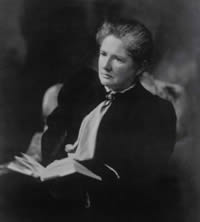
Laura Elizabeth Richards
“The terrible task that is before us in this second volume is to keep it alive,” Richards wrote to Elliott in mid-1913. “The Causes, vital thought they are, weigh down the narrative. ... We must lighten, vivify, aerate, as best we can.”
Like their mother, Elliott and Richards built careers that reached far beyond the domestic. Richards moved to Maine in the 1870s where her husband, Henry, struggled to manage his family’s paper mills and she maintained their affluent lifestyle by writing popular children’s stories, including one that later became a Shirley Temple film. She produced 90 books, including biographies of Abigail Adams, Florence Nightingale and Joan of Arc, plus a two-volume chronicle of her father’s life called Letters and Journals of Samuel Gridley Howe.
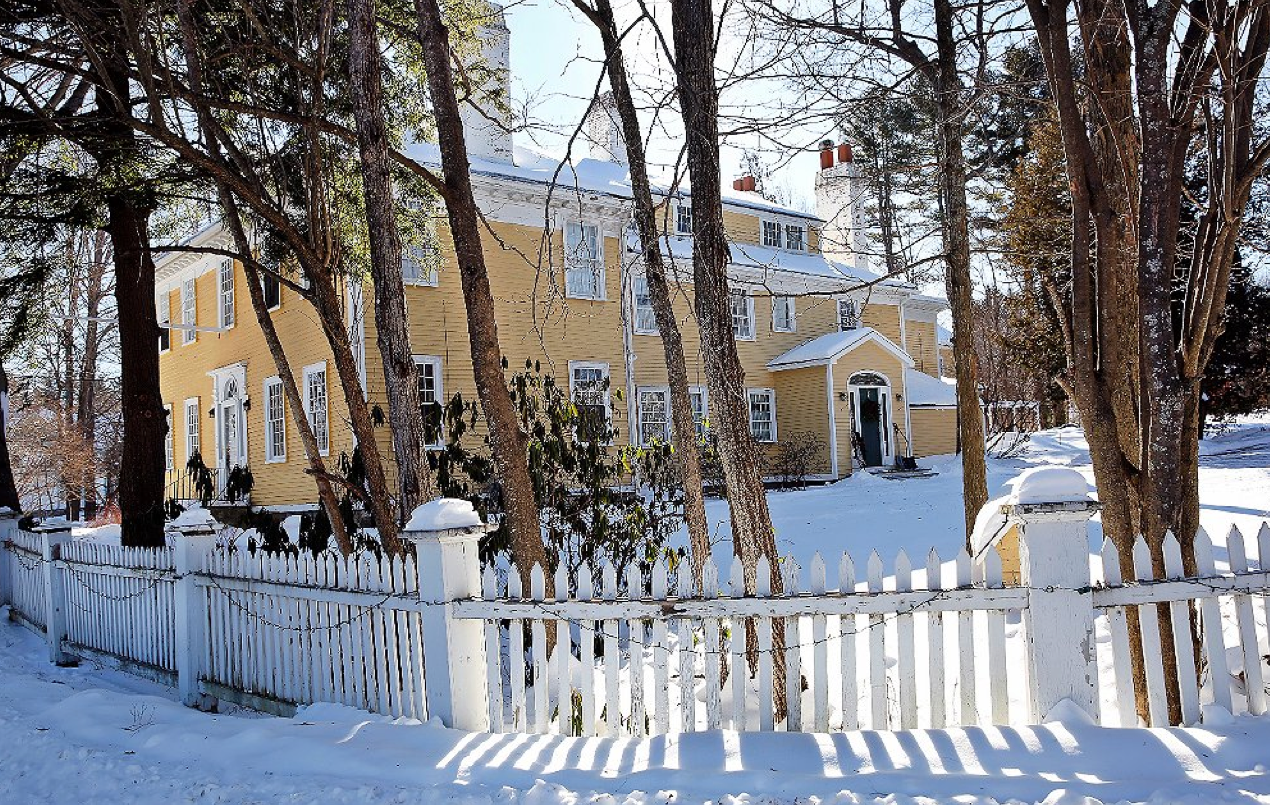
The Richards' yellow house in Gardiner, Maine. Photo: Michele McDonald
“It was unusual in her time for a woman to be successful,” said John Shaw, the Richards’ great-grandson and current owner of the family’s rambling yellow house in Gardiner. “She bought this house. That’s not really seemly in 1880-whatever. ... That’s a lot of chutzpah.”
Shaw and other descendants know Henry and Laura Richards best for their work founding a summer camp on Maine’s Belgrade Lakes. Camp Merryweather operated for nearly 40 years, and its list of notable alumni include Theodore Roosevelt’s sons. After the camp closed, the Richardses kept the land to use as a summer retreat, a family tradition that still continues. It wasn’t until Shaw moved to Gardiner in the 1980s that he learned about Richard’s literary fame.
“I knew them from camp,” Shaw said. “It's not like anyone said, that lady there, she’s the first winner of the Pulitzer Prize.”
Elliott was a socialite who spent years traveling the world and lecturing on the arts before marrying the English artist John Elliott and settling in Newport, R.I. During Howe’s final years, Elliott cared for her, gaining access to the inner workings of her mother’s life.
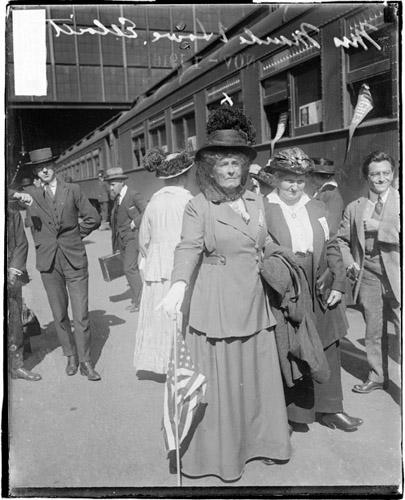
Maude Howe Elliott
Elliott is best known for her efforts on behalf of the arts. In a new biography called Carrying the Torch, Nancy Whipple Grinnell documents Elliott’s work founding what is now the Newport Art Museum. Elliott, Grinnell writes, was “respected and well-known during her lifetime” but, like many women, became lost to history.
A third sister — Florence Howe Hall — helped Richards and Elliott research the book. Hall lived in New Jersey, where she lectured on women’s suffrage and wrote etiquette books. Hall is listed as a contributor on the Pulitzer citation but, according to Richards’s papers, had a limited role. In one letter, Richards dismissed Hall, saying to Elliott that “of literary judgment she has absolutely none.” Nor did Elliott associate Hall with the project when, years later, she referred to the Pulitzer in her autobiography.
Richards served as lead writer and chief editor, trimming chapters, merging drafts and making stylistic decisions that shaped the book. Elliott mined Howe’s papers and the memories of friends and relatives. The sisters struggled with which anecdotes to include and how to refer to their subject.
“'Our heroin’ will not do, no ma’ma,” Richards wrote Elliott in an undated letter. “I agree that we must be as sparing as possible of ‘our mother,’ but it is the only thing, except in rare cases, as where you can (and do) say ‘the president.’ ”
The book, available digitally for free, was published in December 1915 by Houghton Mifflin. It’s unclear who — if anyone — submitted it to the Pulitzers. The biography jury was charged with choosing “the best American biography teaching patriotic and unselfish services to the people, illustrated by an eminent example, excluding, as too obvious, the names of George Washington and Abraham Lincoln.” (Most of these restrictions, including the Washington and Lincoln bans, were later lifted.) Five books were entered but after complaints about their quality, jurors were encouraged to consider other works.
Howe’s life was worthy of such an honor, although her daughters glossed over many of its complexities. Historians generally agree that Howe struggled with depression, especially when her children were young, but that’s not apparent in the book. It’s likely other information is also missing.
“They would frequently have fireplace sessions,” said Shaw. “And a fireplace session is where you can do some serious editing of history and make sure only the good stuff gets out."
Shaw’s home, known to locals as The Yellow House, sits on a hill just above downtown Gardiner. The town’s public library has an extensive archive devoted to Richards and her family: books, letters and photos carefully organized in boxes and files. And there’s more in storage at the Maine Historical Society, but special collections librarian Dawn Thistle says the collection, while extensive, represents only what the family wanted to share.
“They were proper,” said Thistle. “They made sure everything that was made public fit the portrait.”
Also missing from Richards’s papers: more than a passing mention of winning the Pulitzer – although there are several letters in which she argued with her sisters over how to divide the $1,000 prize.
"It was the first year of the Pulitzer,” said Thistle. “They didn't really know what it was.”
Novelty may help explain why neither woman was widely associated with the award during most of the 20th century. Brown University’s library holds a collection of Elliott’s papers, but the summary of her life says nothing about the Pulitzer. Richards was a local celebrity in Maine, but newspaper clippings from the last decades of her life seldom mention the prize. (In one instance, she’s identified as a Pulitzer winner, but for a 1935 biography of her father. In fact, the book about her father was published decades earlier, and the prize in biography that year went to Douglas S. Freeman for R.E. Lee.)
Still, Richards saw fit to keep the letter from New York telling her of the Pulitzer. She tucked it and a program from the awards ceremony inside a thick tan and tattered scrapbook. On the page before the citation is a photo of cabins in rural Maine. On the page after, a snapshot of grinning children on the porch of her yellow house.