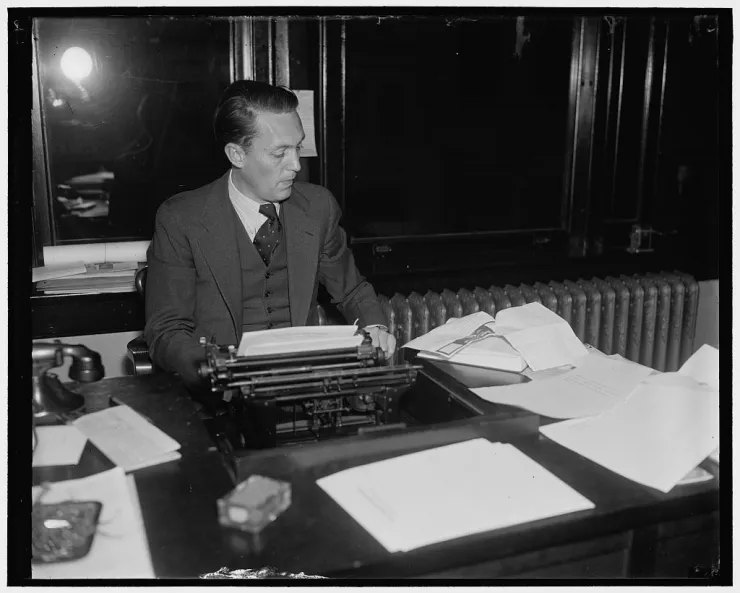
Marquis W. Childs had been around. He figure-skated on the Mississippi River as a boy and rode horses as an adult. He wrote in depth about Sweden’s social advances. He bird-dogged FDR across the country during his 1936 re-election campaign. He wrote essays, magazine pieces, novels and nonfiction books. He covered the Big Four conference in Berlin after the death of Stalin, the British-French invasion of the Suez, the funeral of Winston Churchill. He accompanied President Johnson to South Vietnam.
In 1969, the year Childs turned 66, he was still a contributing editor of the St. Louis Post-Dispatch, which had first employed him in 1926. The job title sounds like a polite way of putting an old pro out to pasture.
Not so fast. Child’s columns that year, syndicated nationally, won the first Pulitzer Prize in Commentary.
Here is a column from his winning entry.
Tentative footprints in the wasteland we have created
By MARQUIS W. CHILDS
NEW YORK – One of the city’s great museums is the American Museum of Natural History. For its hundredth anniversary the museum has an exhibit that would have startled the daylights out of the supremely confident establishment figures who provided the millions for one of the most comprehensive collections of man’s past and present on this troubled planet.
It is called, “Can Man Survive?” With films, sound tracks and a blown-up photo montage, the despoiling of the elements fundamental to life – air, earth, and water – is shown in appalling detail.
Here is an industry belching out vile fumes and dense smoke – 133,000,000 tons of aerial garbage a year, says the sound track. Waste poured into rivers big and small that are hardly more than sewers.
The consequences of the population explosion are shown in the dire proliferation of peoples far beyond the food supply in many parts of Asia and Latin America. The films of Asians on the ragged edge of starvation are strong stuff, hardly conducive to sitting down to that full dinner with complacent disregard for one’s fellow man. Teeming millions move before the camera looking like lemmings swayed by herd instinct.
In the latter part of the exhibit, the sound track blares out the defiant words of the individualist challenging any restraints on his right to exploit air, earth or water falling under his domain. “Why can’t I do what I want with my own land?” “Who’s going to tell me how to run my plant?” “Why shouldn’t we try to get ahead of the Russians?”
The overwhelming impact is of the destruction of the vital oxygen in the air and the fresh water essential to all animal and plant life. In a few decades technological man has begun to undermine the elements built up over millions of years since the first animate creatures crawled out of the slime. The answer posed by the exhibit must be a hesitant yes, maybe no.
With a jolt, this country has begun to wake up to a realization of how far down the road to devastation we have gone. The first small steps are being taken to reverse the trend. But as an answer to “Can Man Survive?” they are only the most tentative footprints in the wasteland.
The bureaucracies have been created in Washington to clean up the rivers and restore the balance in the polluted air of our cities. The Federal Water Pollution Control Administration is housed in the Department of the Interior. Secretary Walter Hickel has testified that the administration could effectively spend $600 million a year to build sewage disposal plants. This is almost $400 million more than the request in the budget for the upcoming fiscal year.
The estimate of leaders of the cleanup drive – Senator Edmund Muskie of Maine in the forefront – is that between 1969 and 1973 alone it will take $10 billion to make a substantial advance. At the rate of $214 million a year, which is the budgetary request, you can see how far we’ll get in four years.
Most states, which pay 40 percent of the construction cost for sewage plants as against 60 percent from the federal grant, put the cleanup cost much higher than the federal estimates. This is particularly true in the big-city states where industry adds a constant stream of pollution to the raw sewage flowing into the rivers.
Here in New York State, the federal estimate is $1 billion. The state’s own estimate is more than twice that amount. For Pennsylvania, the Federal Water Pollution Administration puts the cost at $331 million, the state at $454 million. Maine, where the vision is of sparkling streams and lakes, sets a goal of $148 million against the federal estimate of $47 million.
The National Center for Air Pollution Control is in the Department of Health, Education and Welfare. The request in the budget for next year is $95,800,000. As with water, that is woefully inadequate when measured against the cost of doing a job that will begin to remove the poisons that millions breathe every day. “Can Man Survive?” shows how these poisons harass the city dweller and help fill up the hospitals with victims of respiratory diseases.
Senator Gaylord Nelson of Wisconsin, a valiant champion of clean environment, tells a story of how the animals of the earth held a congress to charge man with destroying their world. They voted with one exception to find man guilty as charged. The exception was the dog. “Pay no attention to him,” said the presiding officer. “He’s an Uncle Tom.”