For the Record


Roger Golubski, ex-KCKPD detective accused of abuse, dead of apparent suicide before trial
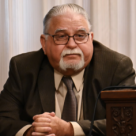
Subject of Pulitzer-Winning Commentary Entry Dies in Apparent Suicide Immediately Preceding Trial:


Roger Golubski, the retired Kansas City, Kan. police detective whose decades-long trail of alleged sexual predation toward working-class Black women was foregrounded in the popular consciousness by 2022 Commentary winner Melinda Henneberger in a Pulitzer-winning series for The Kansas City Star, "was found dead of a gunshot wound at his house" in nearby Edwardsville Monday after he failed to show up for trial, according to Peggy Lowe, Gabe Rosenberg and Madeline Fox of KCUR. They added: "Police rushed to Golubski's home in Edwardsville, where an electronic monitoring device showed he was located, after he failed to appear for the first day of his federal trial in Topeka at 9 a.m. Monday morning. A judge issued a warrant for his arrest and delayed the start of trial. According to a statement from the Kansas Bureau of Investigation, Edwardsville Police received a 911 call from a neighbor reporting a gunshot." The Kansas Bureau of Investigation announced that there were no signs of foul play. The journalists continued: "Golubski had been confined on house arrest for the last two years. Under the conditions of his release, Golubski was prohibited from possessing a 'firearm, destructive device or other weapon.' The KBI said it's scheduled an autopsy and will continue to investigate." Golubski, who joined the suburban police department in 1975 after attending a Catholic seminary and nearby Rockhurst University, was "accused of using the power of his badge to violate the civil rights of two women by rape, kidnapping and sexual assault [...] [He was] charged under a federal statute making it a crime for government officials, including law enforcement officers, to deprive a person of federally-protected civil rights," according to Lowe, Rosenberg and Fox, who noted that Golubski pleaded not guilty to the charges. The trio continued: "On the white side of Kansas City, Kansas, Golubski was considered a legendary homicide detective who rose quickly through the ranks and closed cases. In the Black community, he was called the Grim Reaper, the devil, and a snake. Once the accusations against him arose during the 2017 trial exonerating Lamonte McIntyre of a double homicide he didn't commit, people called Golubski 'a chameleon.' His victims have long feared Golubski would die before he went to trial on a host of federal charges. They were also furious that Golubski was released from prison and allowed to remain on house arrest while awaiting trial, even though the magistrate found the allegations 'shocking.' In March, Golubski was even allowed to remain on home detention despite violating his pre-trial release conditions by going to a fast-food restaurant. However, the court modified Golubski's terms of release to explicitly restrict his movement outside the house, except for employment, religious services, medical treatment, attorney visits, or court appearances."

Associated Press to Cut Staff by 8%

Associated Press Cuts Staff by 8%:


The Associated Press "said Monday it was cutting its staff by 8 percent as part of a plan to adapt to fast-changing conditions in the media industry," according to Benjamin Mullin of The New York Times. The reductions, which the news organization maintained would be conducted via contract buyouts, are part of a plan to meet the "evolving needs" of the news organization's customers and will affect employees in its editorial and business divisions. "This is about ensuring AP's important role as the only truly independent news organization at scale during a period of transformation in the media industry," the organization said. In a note to employees, the AP News Guild "said that the cuts were the result of revenue declines and would affect the organization's global bureaus and administrative staff." Mullin added: "The note said that as many as 121 employees would be eligible for a buyout package, adding that managers said the buyouts aimed to avoid layoffs." Long structured as a "news cooperative that licenses its content to member organizations" (including many newspapers and digital news organizations), the Associated Press "has come under financial pressure over the last year as some news organizations have abandoned the service," most notably remaining industry behemoths Gannett and McClatchy. Although it retains an increasingly rare global presence in its coverage areas, "periodic belt-tightening has stretched the ranks of international correspondents ever thinner over the years, even as crackdowns in press freedoms have made foreign reporting more hazardous," Mullin wrote. He continued: "The cuts come two weeks after Election Day, when The Associated Press played a key role by calling races across the United States. The wire service temporarily increased its staff for the election, bring aboard thousands of contractors to cover the results. Like other traditional news organizations, The Associated Press has turned to philanthropy to shore up eroding finances. The news cooperative said in June that it was setting up a nonprofit to raise money for statewide and local funding. The [AP] was also among the first news organizations to strike a deal with Open AI to license its news content to the artificial intelligence giant." Daisy Veerasingham, the news organization's chief executive, "said in a statement that employees eligible for the buyouts would be notified by the end of the day, adding that fewer than half the cuts would be coming from the news division." (Pulitzer Prize Administrator Marjorie Miller is The Associated Press's former vice president/global enterprise editor. Past Pulitzer Board Co-Chair John Daniszewski is its vice president/editor at large for standards.)

Senate Democrats Are Running Out of Time to Pass a Shield Law to Protect Journalism

Bipartisan PRESS Act Stalls in Lame-Duck Senate:


The PRESS Act (constituting "legislation that would bar the United States government from spying on journalists [...] except under rare, specific circumstances") has stalled in the U.S. Senate "despite having passed the House of Representatives with unanimous support nearly one year ago," Dell Cameron of Wired reported Thursday. He added: "The bill, also known as the 'Protect Reporters from Exploitative State Spying Act,' would broadly prevent federal agencies from using subpoenas and warrants to target journalists and their sources. The protections would cover any information 'obtained or created' while 'engaging in journalism,' and would extend to phone and email records possessed by third-party services, such as Google and Meta." Although the bill enjoys widespread bipartisan support in the Senate, the lame-duck Democratic majority caucus is "scrambling to accomplish what little they can before ceding control" to the incoming Republican majority on January 3"; accordingly, it "remains unclear whether the Senate majority leader, Chuck Schumer, who is said to be prioritizing judicial vacancies in the coming weeks, is going to fight to get the PRESS Act a vote before his window expires." While Schumer declined a request for comment, Senate Committee on the Judiciary chair Dick Durbin (who supports the bill along with Republican counterpart Lindsey Graham) has "said he would continue to work with colleagues to pass the PRESS Act, calling its protections 'necessary' and 'fundamental to holding politicians and others in power accountable.'" Cameron continued: "The PRESS Act is the culmination of more than a decade’s worth of debate on the topic of a federal 'shield law.' Forty-nine states and the District of Columbia already have laws on the books that protect journalists from being forced to disclose information about their sources; however, the protections vary widely and many predate the internet age. Who, precisely, is considered a 'journalist' worthy of being shielded from government overreach can also vary from state to state." Exemptions in the bill "would still allow the government to pursue access to a journalist's work product, so long as it’s necessary to prevent an 'act of terrorism' or to 'prevent the threat of imminent violence, significant bodily harm, or death,' exigencies that traditionally take precedence over concerns about free speech and privacy in court." Currently, many shield protections are embedded in administrative policies. Guidelines maintained by the Justice Department (most recently updated in 2021) "forbid federal agencies from targeting reporters, except under limited circumstances—think preventing a death or a kidnapping," Cameron added. "The guidelines, which first came about in the 1970s, have for years allowed federal prosecutors to obtain journalists’ records if they are said to be both 'essential to an investigation' and not obtainable by other means." Democratic Senator Ron Wyden of Oregon notted that there is "nothing more commonsense, or more bipartisan, than shielding journalists from unnecessary government surveillance [...] Conservative, liberal, and nonpartisan media all depend on speaking to sources without fear of being spied on by government officials who want to suppress unflattering information." 

Jim Hoagland, Pulitzer-winning voice on world affairs, dies at 84

Jim Hoagland (1940-2024):


1971 International Reporting and 1991 Commentary winner Jim Hoagland died on November 4 in Washington, D.C. from complications of a stroke. He was 84. Considered to be a "leading voice in world affairs" throughout his long affiliation with The Washington Post (where he remained a contributor until 2020), Hoagland became a syndicated columnist after an illustrious reportorial career (exemplified by his first Pulitzer, for revelatory 1970 "coverage of the struggle against apartheid" in South Africa) but "did not indulge in the armchair opining that separates journalists from pundits," according to Emily Langer of The Post. "As a columnist, he remained a reporter first and foremost. David Ignatius, a fellow foreign affairs columnist for The Post, recalled in an interview that he often said of his friend: 'If you don’t understand why Jim Hoagland wrote something, wait a week and then you’ll understand.' Such was the depth of [...] Hoagland's sourcing." Primarily raised by his paternal grandparents in rural South Carolina, Hoagland ascribed his early circumspection (and resulting affinity for journalism) to his family's involvement in an eschatologically-oriented church that failed to predict the end of the world. "So you can imagine on New Year’s Eve going to bed rather upset [and] waking up on New Year’s Day and saying, 'I'm always gonna need at least two sources,'" he recalled in a 2017 interview with the Kunhardt Film Foundation. He began working in journalism at South Carolina's Rock Hill Evening Herald while still enrolled at the University of South Carolina (from which he was graduated in 1961) before spending three years based in Europe, first as a graduate student at Aix-Marseille University (1961-1962) before completing his military service obligation as a West Germany-based Air Force intelligence officer (1962-1964). After additional journalistic work in South Carolina and as a copy boy at The New York Times' international edition (subsequently folded into the International Herald Tribune) in Paris, he "paid a visit to The Post in late 1965 to meet with Benjamin C. Bradlee, recently named the newspaper’s managing editor," according to Langer. "Bradlee had set out to establish The Post, then by all accounts an also-ran, into a major national and international newspaper. He hired [...] Hoagland essentially on the spot." During his tenure on the metropolitan desk, Hoagland assisted future Executive Editor Leonard Downie Jr. as a writing coach on an "investigative project that exposed the local savings and loan industry for preying on minority borrowers." After sustaining a head injury while covering the Orangeburg Massacre (resulting in the police-initiated deaths of three civil rights protesters) at South Carolina State University in 1968, Hoagland was a fellow of Columbia University's now-defunct Advanced International Reporting Program during the 1968-1969 academic year before beginning his posting in South Africa. It "took him thousands of miles from home but in some ways back to the Jim Crow South, as he observed the brutality of the apartheid system of racial segregation," Langer continued. "In one of his Pulitzer-winning dispatches, he interviewed two gold miners — one who was white and earned the equivalent of $420 per month, and another who was Black and made $28 for the same work." Upon leaving South Africa in 1972, he "spent much of the 1970s in Beirut as Middle East correspondent and then in Paris, where he solidified a reputation as an elegant Francophone and inveterate Francophile," according to Langer. His second Pulitzer, for "searching and prescient columns" addressing the ramifications of the Persian Gulf War and the contemporaneous political decline of Mikhail Gorbachev, was underpinned by painstaking interviews conducted by Hoagland alongside 1998 Biography winner Katharine Graham, then the newspaper's chairwoman. Three of Hoagland's marriages ended in divorce. He is survived by "his wife of 29 years, mystery novelist Jane Stanton Hitchcock; two children from his marriage to Becker, Lee Hoagland and Lily Hoagland; two half-brothers; and three grandchildren." A daughter from his first marriage died in 2003.

Top New Jersey Newspapers Will End Print Editions, and One Will Close

Star-Ledger Ends Print Edition; Jersey Journal Closes:


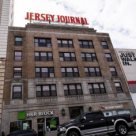
The Star-Ledger of Newark, N.J. "will stop publishing its print edition early next year, ending a lengthy run as a dominant source of print news in the region, its owners announced on Wednesday," according to Lola Fadulu and Tracey Tully of The New York Times. They added: "The shuttering of The Star-Ledger’s printing plant will cause its sister publication, The Jersey Journal, a Jersey City-based newspaper with a storied, 157-year history, to cease publication altogether." The demise of the publication will leave Hudson County (a virtual extension of the urban core of New York City vis-à-vis more suburban locales in other adjoining areas and a longstanding locus of political corruption, as evinced by the recent conviction of former Senator Bob Menendez on 16 federal counts in a transnational political corruption case) without its own daily newspaper. In a statement, Jersey Journal Editor and Publisher David Blomquist said that the decision to end the publication directly hinged on the closure of the Montville, N.J. printing plant: "Unfortunately, we have concluded that it doesn’t make sense to continue. This is certainly an emotional day for all of us." Several newspapers with coverage areas in the southern and western tiers of the state also will shutter, although parent company Advance Local "said they would remain available online," Fadulu and Tully continued. They added: "The closures come as a number of newspapers across the country have ended their print operations or closed entirely, as audience numbers have declined and advertisers have shifted their money away. Despite the industrywide trend, news of The Jersey Journal's closure stung for readers and journalists who had worked there or had long admired the paper’s work. Albio Sires, the mayor of West New York, N.J., in Hudson County, who represented the region in the U.S. House for nearly two decades, said he would miss flipping through the pages of The Journal and The Ledger," while Democratic gubernatorial candidate and Jersey City Mayor Steven Fulop (who began his political career as a reform-oriented Jersey City Council member in 2005) "said on social media that The Journal had scrutinized him 'daily' but that he viewed its coverage 'as an asset.'" (Pulitzer Prize Board members John Archibald and David Remnick are employed by news organizations under the aegis of Advance Publications.)

This Reporter Was Arrested for Asking Questions. The Supreme Court Just Revived Her Lawsuit.

Supreme Court Revives Texas Citizen Journalist Lawsuit:


The U.S. Supreme Court recently "threw out a ruling against a Texas citizen journalist whom police arrested for asking the government questions, injecting new life into a free speech case that essentially asked if reporters working outside traditional media are entitled to a weaker version of the First Amendment," according to Billy Binion of Reason. Based in the border city of Laredo and primarily known through a digital moniker that draws upon her appropriation of a seemingly derogatory epithet ("Lagordiloca") pertaining to her physical appearance, Priscilla Villarreal "has built a large Facebook following over the years by livestreaming directly from crime scenes and traffic accidents" despite lacking a traditional journalistic background, Binion wrote. He added: "She is a celebrity around town, known for her colorful and profane commentary, as well as for her muckraking, which has zeroed in at times on law enforcement misconduct." In 2017, local law enforcement officers "zeroed in on her after she published a story about a family involved in a fatal traffic accident and another about a Border Patrol agent who'd committed suicide [...] Villarreal corroborated her information with a source within the Laredo Police Department, which then arrested her for doing so," Binion continued. In order to facilitate criminal charges, the municipal government "invoked a statute that criminalizes soliciting nonpublic information if the person asking intended to 'benefit' from it," essentially alleging that Villarreal was a private citizen intending to garner non-journalistic attention through her platform in a comparatively self-serving manner more analogous to the work of digital influencers and content creators. According to Binion, "Though it appears to have been written to discourage government corruption, the police used the law to make a crime out of standard journalism: seeking information not yet known and publishing it." He continued: "Despite looking to many ideologically diverse organizations—from Christian conservatives to libertarians to progressives—like a textbook violation of the First Amendment, Villarreal had mixed results in court. The U.S. District Court for the Southern District of Texas gave the public employees qualified immunity, which blocks federal civil suits against state and local government actors if the way in which they allegedly violated the Constitution had not yet been 'clearly established' in prior case law. That opinion was then forcefully overturned by the 5th Circuit. 'If that is not an obvious violation of the Constitution,' wrote Judge James C. Ho, a jurist widely regarded as a potential Supreme Court nominee in future Republican administrations, 'it's hard to imagine what would be.'" Ho's decision prompted the court to vote to re-hear the case with the full 5th circuit instead of the standard three-person panel; in January, it reversed the original decision. "Villarreal and others portray her as a martyr for the sake of journalism. That is inappropriate," wrote Judge Edith Jones (a former Texas Republican Party general counsel who served as George H. W. Bush's second choice for the Supreme Court nomination that ultimately went to David Souter, according to a 1990 report by Johnny Apple of The New York Times) in the majority opinion. "Mainstream, legitimate media outlets routinely withhold the identity of accident victims or those who committed suicide until public officials or family members release that information publicly." As a result, the defendants maintained their qualified immunity. "The Supreme Court's ruling [...] throws out that decision and adds yet another reversal to Villarreal's collection," Binion wrote. "The justices ordered the 5th Circuit to reconsider in light of the high court's recent guidance in Gonzalez v. Trevino, in which the majority last summer made it easier for victims of retaliatory arrests to get their day in court. Gonzalez, too, centered on a woman who was allegedly targeted and arrested for her speech, and the Court's ruling there also overturned a decision from the 5th Circuit."

Donald L. Barlett, former Pulitzer Prize-winning investigative reporter for The Inquirer and best-selling author, has died at 88

Donald L. Barlett (1936-2024):


Venerable journalist and bestselling author Donald L. Barlett, best known for his decades-long collaboration with longtime Philadelphia Inquirer colleague James B. Steele, died on October 5 from "complications [of] age-associated decline" at his home in the Chestnut Hill section of Philadelphia, according to The Inquirer's Gary Miles. He was 88. Over myriad publications spanning 42 years (including a celebrated 26-year tenure at The Inquirer, followed by later stints at Time and Vanity Fair), Barlett and Steele arguably eclipsed the comparatively evanescent partnership of 1973 Public Service contributors Bob Woodward and Carl Bernstein to become "almost certainly the best team in the history of investigative reporting," according to a 1990 profile by the Washington Journalism Review. In addition to receiving the 1975 National Reporting Prize (for "Auditing the Internal Revenue Service," a series that "exposed the unequal application of Federal tax laws") and the 1989 National Reporting Prize (for a long "investigation of 'rifle shot' provisions in the Tax Reform Act of 1986, a series that aroused such widespread public indignation that Congress subsequently rejected proposals giving special tax breaks to many politically connected individuals and businesses"), the duo was nominated for several other Pulitzers (including 1992 National Reporting Prize- and 1997 Public Service Prize-nominated entries that continued their comprehensive and prescient reportage on neoliberal-era deindustrialization and the concomitant foregrounding of income inequality in American life, influencing the messaging of predominantly Democratic politicians running the gamut from Bill Clinton to Alexandria Ocasio-Cortez) alongside several other laurels, including two National Magazine Awards, six George Polk Awards and five awards from Investigative Reporters and Editors. Although remaining steadfastly rooted in investigations of contemporary business and governmental malfeasance, Barlett and Steele also wrote the definitive biography of midcentury aviation magnate Howard Hughes (1979's "Empire: The Life, Legend, and Madness of Howard Hughes"); were among the first journalists to tackle the enduringly vexatious problem of nuclear waste disposal (in "Forevermore: Nuclear Waste in America" [1985]); and employed computer-assisted reporting techniques as early as 1972. Born to an insurance salesman and a homemaker in DuBois, Pa. on July 17, 1936, Barlett grew up in rural Johnstown. Following a year of undergraduate studies at Penn State, he worked as a general assignment reporter in Ohio, Indiana, and Pennsylvania for three years before serving in the U.S. Army until 1961 as a special agent in the now-defunct Army Counterintelligence Corps. Further journalistic assignments in Cleveland, Chicago and Akron eventually segued into his Inquirer role, which commenced in 1970. He began working with Steele (a native of metropolitan Kansas City and University of Missouri–Kansas City alumnus who was seven years younger) in 1971. Although never household names outside of metropolitan Philadelphia (where Inquirer-produced reprints of their various series were coveted items), future Washington Post Executive Editor Leonard Downie Jr. lauded their collaboration as "a significant step beyond traditional muckraking" as early as 1976, while noted contemporary and 2001 Beat Reporting winner David Cay Johnson characterized them as "far and away the best investigative team of all time. [...] There are lots of great investigative reporters, but nobody has their sustained track record." Throughout his career, Barlett was noted for favoring a wardrobe of a "blazer, blue button-down shirt, tie, and khaki pants" at The Inquirer's offices, according to Miles. Known for his gentle mien, Barlett enjoyed collecting first editions of books and never displayed his awards, instead taking his son to amusement parks on reporting trips. He is survived by his wife, his son and other relatives. Donations in lieu of flowers "may be made to the Center for Investigative Reporting, Box 584, San Francisco, Calif. 94104," Miles added.


Breaking Up Is Hard to Do: Antitrust Officials Weigh Splitting Google, Others

Antitrust Officials Consider Google Split:


The Justice Department "submitted a filing Tuesday that presented a federal court with a range of potential options—from conduct restrictions to a breakup—aimed at ending what a judge said was Google's unlawful monopoly in search," possibly precipitating the first breakup of a legally adjudicated monopoly by antitrust enforcers since the consent decree that relinquished AT&T's control of the Bell System, according to Dave Michaels and Jan Wolfe of The Wall Street Journal. The reporters added: "The filing said the government is considering a 'full range of tools' to restore competition, including 'structural' changes to Google's business that would prevent it from using products such as its Chrome browser or Android operating system to advantage Google's engine search." In a blog post, Google characterized the proposal as "radical and sweeping" while opining that it could have "negative unintended consequences for American innovation and America's consumers." U.S. District Judge Amit Mehta, who ruled that Google "ingrained its monopoly by paying billions of dollars to operators of web browsers and phone manufacturers to be their default search engine" in August, "will now spend the better part of a year deciding what to do about it," according to Michaels and Wolfe. Google also is a party to a second lawsuit targeting its online advertising operations, while Ticketmaster parent Live Nation and Facebook parent Meta Technologies "are defendants in antitrust cases that could lead the Justice Department and Federal Trade Commission to ask courts to unwind the megamergers that helped forge their corporate empires." Michaels and Wolfe continued: "The agencies alone can't order a breakup; that power lies with courts. But there is little modern precedent to guide judges on when such a forceful remedy is appropriate. The last major ruling came in 2001, when a federal appeals court in Washington, D.C., found a trial judge overstepped in ordering the breakup of Microsoft. [...] Most of the nation’s prominent breakups came in the trustbusting era of the early 20th century, when Standard Oil, American Tobacco and a railroad trust known as Northern Securities were split up. The last major one came with the 1984 breakup of AT&T, which then controlled long-distance and local phone service and had the telephone equipment market locked up. The telecommunications company negotiated the split with the Justice Department instead of waiting for a judge's ruling on whether it had violated antitrust laws."

Behind closed doors, Russia tries four journalists for links to Navalny team

Navalny-Adjacent Russian Journalists Receive Closed Trial:


A quartet of Russian journalists (including Antonina Favorskaya, Sergei Karelin, Konstantin Gabov and Artem Kriger) "went on trial in Moscow on Wednesday on charges of involvement in an 'extremist' group after authorities accused them of working for the banned organization of the late dissident Alexei Navalny," according to Mark Trevelyan of Reuters. The respective cases "highlight the increasingly precarious position of journalists inside Russia, where press freedom groups say dozens are currently behind bars," Trevelyan added. He continued: "After about 30 minutes of open proceedings in court, the judge granted a prosecution request to evict press and spectators for the remainder of the trial on the basis of a letter from the counter-extremism department of the interior ministry that Navalny supporters were preparing 'provocations.' Independent news outlet Mediazona quoted Kriger as telling the judge before journalists were ordered from the room: 'This is just some kind of archaism. This is how they do it in totalitarian regimes.'" The journalists, who will each face up to six years in prison if convicted, "were not invited to plead innocent or guilty in the portion of the hearing that was open to the press." Prosecutors allege that the defendants "created materials for the YouTube channel of Navalny's Anti-Corruption Foundation (FBK), which is banned in Russia as 'a foreign agent'" and also has been designated as an "extremist organization." Gabov and Karelin have previously worked as freelance contributors and producers for Western news agencies, including Reuters and the Associated Press. "We don't believe the charges against [Gabov] in any way relate to his freelance work at Reuters," a spokesperson said. "Reuters is deeply committed to freedom of the press and opposes the arrest and detention of any journalist for reasons related to reporting. Journalists must be free to report the news in the public interest without fear of harassment or harm, wherever they are." Favorskaya, who recorded the last known video of Navalny (at a February court hearing the day before his death), was arrested in in March, followed by Kriger in June. Trevelyan added: "Russia has intensified pressure on domestic and foreign reporters since the start of its war in Ukraine. According to the international press freedom group Reporters without Borders, 34 journalists and six other media workers are currently in detention in Russia. The Kremlin does not comment on individual legal cases, saying it is for the courts to enforce Russian law. It has cast supporters of Navalny as troublemakers out to foment revolution and destabilize Russia."

How Google Defended Itself in the Ad Tech Antitrust Trial

Google, Government Complete Arguments in Ad Tech Antitrust Suit:


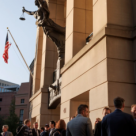
Last week, attorneys for Google "called more than a dozen witnesses to defend itself against claims by the Justice Department and a group of state attorneys general that it has a monopoly in advertising software that places ads on web pages, part of a second major federal antitrust trial against the tech giant," Nico Grant and David McCabe of The New York Times reported Monday. (The government completed its arguments on September 20 and delivered a "short rebuttal" following Google's arguments.) Judge Leonie Brinkema of the U.S. District Court for the Eastern District of Virginia, who presided over the nonjury trial at the Albert V. Bryan U.S. Courthouse in Alexandria, Va., "is expected to deliver a ruling in the coming months, after both sides summarize their cases in writing and deliver closing arguments on Nov. 25," Grant and McCabe added. The government argued that Google has "[abused] control of its ad technology and [violated] antitrust law" since acquiring advertising software company DoubleClick in 2008; as a result, Google "has pushed up ad prices and harmed publishers by taking a big cut of each sale," the government contended. In its defense, Google called upon such experts as Nobel economics laureate Paul Milgrom and Yale economist Judith Chevalier to argue that the company was not anticompetitive and set justified pricing benchmarks. Grant and McCabe continued: "On its marketplace where businesses buy and sell ads, Google takes about 20 percent of transactions as a fee, Dr. Chevalier said. That is only slightly higher than a roughly 16 percent industry average calculated by one of the Justice Department’s expert witnesses, she said. Dr. Chevalier compared these 'take rates' in the U.S. ad market, where ad exchanges charge more than elsewhere in the world. She added that a number of exchanges, whose names were redacted, charged more than Google did. In cross-examination, Justice Department lawyers countered that even by Dr. Chevalier's math, Google overcharged customers." In addition, former Google Ads engineer Nitish Korula testified that the tech platform "was responding to dynamic competitors and catering to the desires of publishers" by "dedicating thousands of employees and many millions of dollars to fighting ad fraud and spam," Grant and McCabe continued. However, the government argued that "ad industry groups and companies also fought fraud, piracy and malware, and that competitors had sometimes informed Google that there was suspicious activity on its platform."