The Boston Globe, by Timothy Leland, Gerard M. O'Neill, Stephen A. Kurkjian and Ann Desantis
Winning Work
Over the past decade, the tax rates in cities and towns across the state have skyrocketed. Some communities actually face bankruptcy today, as incoming revenue fails to keep up with expenses. The reason for the financial crisis lies, for the most part, with increased costs that are inescapable. But how well is public money spent on the local level? What happens to it? Who benefits?
The Globe Spotlight team has conducted a three-month investigation into municipal spending in the city of Somerville over the past decade. Somerville, which has a tax rate of $169, one of the highest in the state, is not necessarily typical of all other Massachusetts communities, but it almost certainly has parallels elsewhere. The first report on the Globe investigation, which involved examination of over 6000 documents and more than 120 interviews, begins today.
The city of Somerville channeled $4.3 million in no-bid business to five favored contractors between 1960 and 1970.
Approximately $2 million of this amount was for hundreds of jobs under $1000 apiece and therefore not covered by Somerville's public bidding law.
The remainder—some $2.3 million—was listed as "emergency" work, which also requires no public bidding. The largest item in this category was a $1.8 million "cost plus" contract to repair a fire-damaged high school.
The jobs and the payments were funneled to the companies by three different administrations. The work appears to include split contracts amounting to hundreds of thousands of dollars.
In a three-month investigation of Somerville's municipal affairs, the Globe Spotlight team has documented the decade-long no-bid payments to these companies; the work the firms did; and their connections both with public officials and each other.
Connections exist between four of the five contractors, The Globe has learned, either by blood, marriage or interlocking financial interests.
Today's report deals with a single striking relationship—that of former Mayor Lawrence F. Bretta and a Somerville family which did a vast amount of no-bid business under his administration. Details of the other companies and the work they performed will follow in subsequent articles.
It came as a surprise for many Somerville citizens, about five weeks ago, to learn that ex-mayor Bretta was in an insurance partnership with a member of the Sillari family, owners of two plumbing concerns in Somerville.
The partnership was inscribed in a big blue-and-white sign which appeared one day on a block of newly-renovated apartments along Highland Avenue: "BRETTA & SILLARI, Insurance, Auto Home Owners, Liability."
Passing Somerville motorists may not have known that the former mayor, who currently is president of the city's Chamber of Commerce, has been in this partnership with the Sillaris since 1968—one year after he resigned from office—and that he has been in another business (real estate) with the same family since 1969.
What they certainly did not know was that while Bretta was the city's chief executive, from 1962 to the middle of 1967, his administration directed to Sillari plumbing companies more than a quarter of a million dollars of no-bid business.
The Globe Spotlight team has in its files evidence of invoices paid to the Sillaris in this period amounting to $332,884.69. Virtually all of the documents were signed by Bretta.
The Globe also has learned that in 1969, two years after Bretta got out of office, Tony Sillari, Bretta and another individual pooled roughly $200,000 worth of property acquired largely during his administration. Since then, their real-estate trust has additional property valued at approximately $350,000.
Bretta made $10,000 a year as mayor during his six years in office. The Sillari brothers—doing business as Sillari Co., Inc. and T.J. Sillari Co.—had one of their biggest and best years with the city in 1967, the year Bretta abruptly resigned from office and took a Federal job. In that year alone, they did a total of $81,095.14 in no-bid work for Somerville.
In 1966 as well, Bretta's last full year in the executive suite, the Sillari family also walked off with the lion's share of no-bid plumbing work for the city: a total of $58,218 in business.
A close examination of payment vouchers to the Sillaris in 1966 reveals several payments in apparent violation of the city's bidding laws. Somerville's bylaws do not leave any room for doubt about what city business must be put out to bid.
Section 46A of the city's charter states, in part:
"No contract for construction work… or for the purchase of apparatus, supplies or materials, whether for repairs or original construction—the estimated cost of which amounts to ONE THOUSAND DOLLARS or more—shall be made by the city unless proposals for the same have been invited by advertisements…”
The law states further that: "No bill, contract or lease shall be split or divided for the purpose of evading any provisions of this section."
In laymen's language, the essence of this is very simple: Whenever the city of Somerville needs work done on its municipal buildings (beyond the capacity of its Dept. of Public Works) or needs to purchase supplies—the estimated cost of which is more than $1000—bids shall be solicited by public advertisement.
The reason for this is also clear: "The purpose of the law is quite simply to protect the public against collusion between its elected officials and favored contractors," explains the Rev. Lester Ralph, present mayor of Somerville, who was elected to city hall as a reform candidate in 1970.
"Another thing, of course, is that having to bid in a competitive situation obviously results in lower prices, since the lowest bidder normally wins the contract. This in turn results in considerable savings to the taxpayer."
One of the city departments in which bidding is most feasible and most important in purchasing supplies is the Water Department. According to the present Somerville water commissioner, 24-year-old David Reilly, it is relatively easy to estimate the amount and kind of equipment the department will need at the start of each year, and put contracts out to bid for it. This is what Reilly did, as soon as possible, after being appointed by Mayor Ralph.
It never was done during the three previous administrations, however.
In 1966, the city water department purchased "supplies" from the T.J. Sillari Co. amounting to $20,478.93—none of which was put out to general bid. The city purchases were made in small increments, the bills submitted at different times. When the invoices are matched up chronologically, an interesting pattern emerges.
On January 10, 1966, T.J. Sillari Co. billed Somerville Water Dept. for various items amounting to $479.52. On the very same day, the company billed the same department again, this time for items of a similar nature in the amount of $131.52. A third bill was sent the city on the same day from Sillari company for more supplies purchased by the department. This bill was for $116.97.
The next day, on Jan. 11, Tony Sillari was still busy billing the city for purchases made by its water department. The first bill, for 120 separate items, was for $350.22.
That made a total of $1078.23 worth of supplies purchased by the city's water department on a "no-bid" basis within a two-day period.
The second bill Sillari sent to the water department that day ($254.40) was for eight coils of copper tubing. This bill was part of an annual $5000 "bid" contract for that specific item which Sillari consistently came up with during previous administrations.
In 1969, under this "bid" contract with Sillari, Somerville was paying $.87 per foot for copper tubing. In 1970, however, when the present administration came in, Reilly obtained a price for similar copper tubing of $.57 per foot—a savings of 34 percent. (Another way of looking at this would be that at $.87 per foot, Somerville was paying 52 percent more than it did the following year.)
There was a lot more than copper tubing that Sillari was selling the city in that year of 1966, however.
On Jan. 26, two weeks later, the Sillari Co. billed the water department for more supplies. One bill was for $144. Another was for $506.76. The third and final bill on that day was for $221.50. That totalled $872.26. One week later, on Feb. 4, two more bills came in totalling $507.92. And less than a week after that another one for $487.68.
Thus, in a period of two weeks, the city of Somerville bought plumbing supplies from Sillari company amounting to $1867.86.
These were not exotic, unusual items that the water department might use once a year. For the most part they were common, everyday supplies that the department uses all the time—gate boxes, adapters, couplings, valves—supplies that can be put out to bid on a wholesale basis.
But very little was put out to bid by the water department during the Bretta administration, and virtually nothing was bought wholesale. The supplies were purchased in small shipments, always for under $1000 a delivery—and almost always from Sillari brothers.
On March 7, Tony Sillari sent the water department three separate bills amounting to $770.54. And just one week later he submitted three more, all dated the same day, which added up to $1199.28. The total amount of bills paid to Sillari in this nine-day period totalled $1969.82.
On July 15, the water department bought plumbing supplies from Sillari amounting to $1481.46. And on Aug. 23, Sillari billed the water department for a total of $2215.02 (more than twice the $1000 no-bid limit) for the same general supplies the department had been purchasing all year long.
In the 1069s, when all this city business was being directed to the Sillaris, there were several other plumbing and plumbing-supply companies in Somerville, not to mention the surrounding communities of Cambridge, Arlington and Medford.
In fact, in 1967, the year Bretta resigned, the city business directory, published by Somerville Chamber of Commerce, listed 13 other plumbing companies and nine other plumbing supply firms. It also listed four companies which dealt in "wholesale" plumbing supplies. Neither Sillari company appeared under this last category.
In an interview with The Globe, however, Bretta flatly denied that his administration had shown any favoritism to the Sillaris—or to any other contractors.
"I tried to put as much work out to bid during my years in office as possible," he said. "I did not play favorites." As to whether he was conscious of the amount of no-bid work that was being directed to the Sillari plumbing enterprises, the former mayor replied: "You must remember that when you're sitting in the mayor's chair there are a million things to do with little time to do it; you can't study each and every bill."
According to records at the State House, the Sillari Co. Inc. was formed in 1951. Charles and Tony J. Sillari, who are brothers, were directors.
The Globe could find no record of the T. J. Sillari Co. on file at the Somerville city clerk's office, although by law any company doing business in the city is supposed to have a certificate. The company was incorporated in 1969, with Tony, his wife and his son listed as directors.
Former Mayor Bretta is now in two partnerships with Salvatore Sillari, Tony's son. The Bretta and Sillari Insurance Co. was formed Sept. 20, 1968, with Salvatore listed as treasurer and clerk and Bretta as president.
The Bretta and Sillari Realty Co. Inc., appeared on the scene eight months later, May 15, 1969. Corporation papers at the Secretary of State's office show Bretta as president and Salvatore as treasurer. Both are directors, as well as Mary Sillari (Tony J.'s wife) and Bretta's wife, Josephine.
Bretta's ties with the Sillari family also exist in a realty trust known as "Community Realty Properties," which appears to have been formed on Aug. 5, 1969. According to records on file at the Middlesex Registry of Deeds on that day, Tony J. Sillari, Joseph Travaline and Bretta transferred their interest in numerous parcels of land at that time to Community Realty Properties Co., which was owned by Sillari, Travaline and Bretta. (Travaline was Bretta's campaign manager and a former state representative. )
Having pooled all their property, Travaline, for a sum of $49,500, immediately gave up his interest in Community Realty—leaving Bretta and Sillari in sole ownership of nine parcels of land.
The bonanza of Somerville business did not end for the Sillari family with the Bretta administration. The two brothers (Charles and Tony) also did extraordinarily well in the short administration of former Mayor James F. Brennan, who served as the city's chief executive from 1968 to 1970. In those two brief years they did $136,722 worth of no-bid plumbing work for the city of Somerville.
Invoices in this period also reveal several ,apparently split contracts, as well as exorbitant prices charged the city for thousands of dollars of plumbing equipment and supplies—prices that, in some cases, are as much as 325 per cent higher than is being paid by the current administration for the same items. The supplies and equipment were purchased from the Sillaris without benefit of bid.
Some of the most striking Sillari bills during this period involved the city's central heating plant, the object of a lavish amount of no-bid work during previous administrations.
A collation of bills submitted by Sillari Co. in 1969 reveals the following "emergency" work on the heating plant, all of them signed by Mayor Brennan: Jan. 3 ($628); Jan. 7 ($814); Jan. 10 ($872); Jan. 11 and 12 ($858); Jan, 17 ($374); Jan. 22 ($900); Jan. 23 ($641); Jan. 28 ($588); March 14 ($984).
In July of that year— in the middle of the summer—Sillari Co. was still doing "emergency" no-bid plumbing work on the city's heating plant. On July 9 the company made a boiler repair that cost the city another $766.94.
On Sept. 18 the company was back again at the heating plant. This time it cost the city $872.00.
And before the year ended, Sillari Co. submitted two more bills for "emergency" work at the plant, one on Sept. 10 for $809 and the other for $927. All totaled, Sillari Co. did $10,036.86 worth of work on the central heating plant that year, none of it put out to bid.
Despite the money and attention that allegedly had been spent on the facility in 1969, the heating plant was in "disastrous shape" when Mayor Ralph took over in 1970, according to his building superintendent, William Fothergill.
It was so bad, in fact, that me of the first things the Dept. of Public Works did was to advertise for bids to have one of the boilers completely overhauled. The job was done by the lowest bidder for $2357—roughly one-quarter what the Sillari Co. had charged for the no-bid piecemeal work the year before.
The heating plant was not the only lucrative source of city business for Sillari Co. in 1969. The city's playgrounds were also a goldmine.
In all, the company billed Somerville for $4586.91 in that year for work performed on the drinking fountains at city playgrounds. Among other bills was one for $134.50 to fix the bubbler and outdoor shower at the Trade School playground in the dead of winter.
July 8 was a particularly busy day for the Sillari Co. in playground work. On that dale the company sent the city 12 different bills for work at 12 different playgrounds. The total amount came to $3984.31—nearly four times the $1000 limit requiring public bidding.
A contractor who spent two years in prison for defrauding Somerville on contract work in the 1950's was paid more than three quarters of a million dollars by the city for no-bid work in the 1960's.
For Luigi Analetto—convicted on seven charges of stealing from Somerville in 1950 and conspiracy to defraud the Commonwealth in 1960—the past decade was a boom time for business with his city government.
A three-month investigation by the Globe Spotlight team into municipal affairs in Somerville revealed that:
Analetto, doing business as the "Otis Construction Co.," was paid a total of $777,756.44 by the city of Somerville for no-bid work done between 1960 and 1970.
This was more than any other favored contractor received during that period, not counting a lump-sum contract for $1.9 million that went to one of the other contractors in 1969.
The six-year administration of former Mayor Lawrence F. Bretta paid the Analetto firm $336,513.04 for repairing “emergency” water leaks, sidewalk construction, snow removal charges and rental of equipment.
Between 1960 and 1963, while Analetto was being tried and serving two years of probation on charges stemming from an MDC contract scandal, his company received a total of $312,682 from the administration and that of former Mayor Harold Wells.
Analetto is a brother-in-law of Tony J. Sillari, one of four other favored contractors who did a grand total of $4.3 million "no-bid" business during the 1960's. The Sillari family is currently in an insurance and real estate partnership. with former Mayor Bretta.
Analetto's name first hit the newspapers in 1949, when he was found guilty by a Middlesex Superior Court Jury of forging a check for $826 in connection with city contracts in Somerville. A justice on the State Supreme Court ordered a stay of sentence on the conviction.
One year later. however. Analetto was brought to trial again, this time on seven charges of larceny connected with a municipal sidewalk contract. The indictments were the result of a 14-month-long State Police investigation into Somerville municipal affairs. Testimony during the trial revealed that although Analetto contracted to install some sidewalks for $94,000, he had collected $112,312 from the city. Instead of the contractual price of $3.75 a square yard, he was paid $4.50 a square yard.
On the stand, Analetto conceded he had billed the Somerville street department for 20 percent more concrete than was actually poured into the sidewalks.
While serving two years in East Cambridge Jail on this conviction, Analetto pleaded guilty to 10 additional counts of larceny on the same case and was sentenced to two more one-year terms, to be served concurrently.
In 1961, Analetto was back in the news. This time he was brought to trial —along with state Rep. Charles Iannello and others—in a highly publicized case involving conspiracy to avoid competitive bidding by the Metropolitan District Commission.
Luigi pleaded guilty, turned state's evidence, and was put on probation for two years.
None of these convictions hurt his relationship with the city of Somerville, however, when it came to doing municipal work.
During this period Analetto’s son-in-law, Paul T. Kelley, ran the firm and continued to do a land-office business in no-bid work for the city.
In 1960, the year he and Rep. lannello were indicted, Somerville paid the Analetto firm $72,438. The bills were made out in the name of Paul T. Kelley, contractor, doing business at 69 Otis St.—two doors away from Analetto's Otis Construction Co. (By 1962, Kelley's bills listed the address of his business as 65 Otis St., the same address as Otis Construction.)
Among other bills submitted to the city by Kelley in 1961, one set was particularly interesting. Somerville's Dept. of Public Works appears to have had a desperate need at that time for a Hough Payloader—a relatively small earth-moving vehicle—with a hydraulic bucket at the front end. The Somerville DPW rented such a machine from the Ana-letto firm in 1961 from March through December, along with "an operator."
The bills do not indicate the registration number of the machine, the name of the man who ran it, where the vehicle was used, or for what. Analetto's son-in-law, however, charged the city $112 per day for the service. The total "rental" bill came to $19,790.
For this amount the city could have bought a Hough Payloader of its own and would have had money to spare. According to a spokesman for the firm that makes the machines, a Hough Payloader cost "about $13,000" in 1961.
All of these rental bills were signed by former Mayor Harold W. Wells and by his, commissioner of public works, Edward T. Brady.
In 1961, the Analetto firm was paid $115,317, including $24,952 for snow removal charges.
And in 1962, the year Bretta became mayor, the total was $82,563. At least $18,705.12 of this 1962 amount was for contracts involving sidewalk construction—the same work Analetto was doing for Somerville in 1950 when he was sent to jail for defrauding the city.
In Somerville, all non-emergency municipal work by private contractors must, under the city charter, be put out to public bid if its estimated cost is in excess of $1000. This is to avoid the possibility of collusion between the favored contractors and public officials. It is also to assure the lowest possible price for the work done.
The city's bidding law is interesting in, connection with certain sidewalk construction. Kelley did within a six-block area in the Ten Hills district of Somerville in 1962. The work was not done on an "emergency" basis (which does not require bids) nor was there any contract listed on the invoices.
Analetto's son-in-law submitted 15 separate bills, each under $1000, on the following dates: June 1 ($429); June 4 ($220); June 5 ($523); June 6 ($359 and $734); June 7 ($633); June 8 ($720); June 11 ($986); June 12 ($666); June 13 ($561); June 14 ($433); June 15 ($641); June 16 ($411); June 19 ($867); June 21 ($853).
Within three weeks, the Analetto firm was paid $9041.04 by the city of Somerville for sidewalk construction in a six-block area. This is nine times the maximum cost of work which, by law, requires public bidding.
But there was no such bidding; the work was simply given to Analetto's son-in-law. And all of the 15 bills submitted by Kelley were signed by Mayor Bretta.
In an. interview with the Globe, Bretta said he could not discuss the sidewalk work because he did not remember the circumstances surrounding it. Shown the 15 invoices with his signature on them—plus a street map indicating where the construction was done—the former mayor declined comment.
A state representative the year Rep. Iannello was indicated in 1960, Bretta expressed surprise over the fact that Analetto had been indicted in the same case. "I didn't realize that," he told the Globe.
Two years later, as Somerville's chief executive, his administration gave Analetto's firm hundreds of no-bid municipal jobs. Bretta is in a realty trust with Analetto's brother-in-law, Tony J. Sillari, whose plumbing company received more than one hundred thousand dollars of no-bid business from the Bretta administration. Bretta is also in an insurance partnership with Tony Sillari’s son.
The Globe has copies of three other sets of bills submitted by Kelley in 1962 which appear to be in violation of the city's bidding law. The first, for work done on Franklin Street in a two-day period, amounts to $2355. The second consists of three bills for sidewalk construction along Curtis Avenue on three consecutive days amounting to $2320. The third is a set of bills for sidewalk construction along. Glen Street. The work was done in a 10-day period and amounted to $5081.
Analetto's business with the city picked up sharply after the year his term of probation ended in connection with the MDC scandal. That-year, in 1964, the Bretta administration paid the Otis Construction Co. $59,585 which was almost four times what his company had received the year before.
But the ex-convict's biggest years of all were still to come. Those were 1967—the year Bretta resigned—and 1968-1969 under the administration of former Mayor James F. Brennan. In that brief three-year span the Otis Construction Co. was paid nearly $300,000 by the city of Somerville, all for "emergency" or no-bid jobs under $1000 apiece.
In 1967 alone, Analetto's firm did $100,199 of no-bid business. Among other things, the city paid the Somerville contractor $5500 for the rental of a "compressor" (a piece of construction equipment which, in 1967, cost under $5000); $18,100 for the rental of Hough Payloaders; $34,490 for excavating and repairing broken water pipes; and $21,569 for "emergency" repairs to sidewalks.
In 1968 the Analetto figures went even higher. James F. Brennan took office that January after being elected on a wave of indignation over alleged corruption in Some-ville. Brennan pledged, if elected, "to replace split contracts and overcosts with open competitive bidding."
In his first year in office, Brennan's administration fed Analetto—a man who had been convicted of fraudulent municipal work twice before—approximately $106,024 of no-bid work, Virtually all of the Analetto bills were signed by Brennan.
"Sure, I suppose it looks like a lot of the work should have gone out to bid. Maybe it should have. But when someone calls you up and says 'I've got a job for you,' well, you do it. You don't ask about public bids. Nobody asks about public bids."
Three companies owned by a former Somerville commissioner of public works did nearly half a million dollars of no-bid business with the same Somerville department between 1960 and 1970.
For Walter J. Manning, Somerville's DPW commissioner from 1954 to 1960, those six years of public service were a worthwhile investment. They were fol-lowed by 10 years of land-office DPW business for his firms.
Manning—one of the only four recorded contributors to the 1968 campaign of Somerville's Sen. Denis McKenna —had a virtual monopoly on much of the DPW's most lucrative no-bid business in the past decade.
Between 1960 and 1970 (when the present administration put an abrupt end to his services), the city of Somerville paid Manning's companies a total of $481,063 for no-bid work, according to vouchers examined by the Globe Spotlight team plus at least $363,080 in "bid" contracts (one of which is still current). In the course of its three-month-long investigation into Somerville municipal affairs, the Spotlight team also learned that:
A company owned by the uncle of John Havican—Somerville's DPW commissioner between 1962 and 1966 and the city's interim mayor for six months in 1967—was paid $126,338 by the city between 1960 and 1970, all of it in "no bid" increments of under $1000 or less.
Known as Highland Auto Parts, the company's business with the city more than doubled the year Havican became DPW commissioner and almost tripled the year he became acting mayor.
Virtually all the firm's city business was with the department of public works—and all the invoices were signed by Havican, both as the department's commissioner and as mayor.
In 1968, another favored contractor submitted 25 separate bills within a four-month period for painting various rooms in the Somerville High School. The work, which was not put out to bid nor done on an "emergency" basis, amounted to $26,314, more than 26 times the maximum limit of $1000 that requires public bidding.
A third contractor did a total of $2.4 million in no-bid work for the city of Somerville during the 1960s. Approximately $1.8 million of this was a single "emergency" contract to repair a fire-damaged school. The remainder—some $539,593—was for emergency snow removal charges and in "no-bid" work of $1000 or less.
A company owned by the close friend of a former city alderman did $179,851 worth of business with Somerville in the past decade. Among other things, the company was paid $903 in 1963 for delivering 301 cubic yards of loam to a completely "hot topped" play-ground.
The story of these four companies during the 1960s is a classic story of political favoritism in a city where the funneling of public work to the favored few has become a way of life.
A city alderman whose family firm has done a considerable amount of municipal business over recent years expressed this tradition in a recent conversation with the present mayor: "You know I do that kind of work for a living," he said. "If there is anymore of that work to be done in this city, I want some of the ice cream."
Middlesex Equipment Co.
In 1959, when his six-year term as Somerville DPW commissioner ended, Walter J. Manning knew the department inside-out. He also knew how much no-bid work it could dispense—and how to secure it.
For the next 10 years, Manning's firms got the lion's share of one major category of DPW business.
Manning is the president and treasurer of W. J. Manning Inc., a firm located at 271 Newbury St., Peabody, which was paid a total of $33,860 by the city of Somerville in the 1960s, almost all of it for no-contract snow removal work. (It was also paid $189,838 in bid contracts.)
He is also the president of Middlesex Equipment Co., which is based at 612 Broadway, Somerville. This company was paid a total of $412,521 by the city for no-bid work in the 10-year period investigated by the Globe.
Much of it was performed on the city's $1.4 million incinerator which has soaked up vast amounts of Somerville tax money ever since it was first dreamed up under Manning's supervision of the DPW in 1958.
Between 1960 and 1964, Manning also owned a Somerville service station known as the Walnut Hill Garage and Service Station. In that four-year period, the garage received $34,682 worth of no-bid business from the city. Then mysteriously, in May of 1964, the Walnut Hill Garage and Service Station suddenly ceased to get any further city business.
That was the month Manning sold it.
Despite the boxes and boxes of invoices on file at Somerville City Hall documenting the no-bid work his companies have done for the city, and despite the history of Walnut Hill Garage, Manning insists that "there was absolutely no favoritism" shown in his behalf over the past decade.
"My connections in Somerville have always been of the best," he stated in a Globe interview. "I've dealt with Somerville all my life. I bet I know everyone that was ever an official in that city."
Arthur Shediac, Painting Contractor
Arthur Shediac's name is not in the Boston telephone directory. It isn't in the Yellow Pages, either.
A "painting contractor," Arthur Shediac was paid $51,528 by the city of Somerville in 1969 for no-bid painting jobs on various municipal buildings.
Today, the telephone number that was printed on the bills Shediac submitted to the city that year "has been discontinued," according to the telephone operator.
The Globe was unable to contact Mr. Shediac to ask him some questions about the no-bid work he did for the city during the 1960s—work that amounted, in that period, to $130,864.
Among other jobs was one of particular .interest in 1969 on Somerville High School.
Under Somerville's municipal charter, any city job that is expected to exceed $1000 must be put out to public bid.
The charter also categorically states that "no bill, contract or lease shall be split or divided for the purpose of evading any provisions of this section."
In all, Shediac submitted 30 separate bills—all just under $1000—for painting various interior rooms of the high school from January to September of 1969.
For this the city paid him $27,154.
Signing each of the bills was former Mayor James F. Brennan; former DPW commissioner, Anthony Rosselli, who is now a Somerville building inspector under Civil Service; and former superintendent of buildings, Thomas Burns, who is a Somerville heating inspector, also under civil service.
Rosselli refused to answer questions about the work in a face-to-face interview with Globe reporters, in-stating that inquiries be made in writing in order to give him a chance to go over them with "his attorney."
Burns likewise declined to be interviewed by the Globe on the matter and also demanded all questions in writing so that he could present them to his legal counsel.
Asked about the Shediac bills that he had signed, Brennan retorted: "I don't climb up on every roof every time somebody fixes a roof and I don't go into a room every time it's painted."
Lexington Loam Co.
Former Somerville Alderman Walter Steeves, president of the Lexington Loam Co., is a great friend of Walter W, Whitney, another former Somerville alderman and presently a member of the city's assessing board. So great, in fact, that according to records on file at Middlesex Registry of Deeds, Steeves sold Whitney a half interest in roughly 23 acres of Lexington land on June 1, 1965, "for under $100 consideration," as well as another adjacent piece of property for the same amount on June 3, 1968.
They sold the land to the town of Lexington in 1970 for $112,800.
Whitney, who has granted several abatements to Somerville property owned by Steeves over the years, de-clined to answer questions about the Lexington purchase, as did Steeves. "That's personal business," said Steeves. "I'm sorry but I can't discuss it with you."
Lexington Loam Co., received about $180,000 from the city of Somerville during the past decade for both bid and no-bid work. Much of the no-bid business was for delivering loam to various city playgrounds and parks.
In 1963, for example, the company unloaded 301 cubic yards at Somerville's Lexington Avenue Playground for which the city paid $903. The playground is completely hot-topped with asphalt.
Asked by the Globe about the delivery, Steeves said he recalled the details because someone else had questioned it at the time. "The explanation," he said, "is that the loam was used to build up the sides of the lot for a skating rink in the winter." According to the invoice, however, the loam was delivered on May 3 and May 4.
The Globe Spotlight team also has in its files eight other curious sets of bills submitted to the city by Lexington Loam, amounting to $5265.75. Five originally were dated in the month of November, 1962 and three initially were dated in the month of December. The dates on each of them have been scratched out, however, and the bills' redated and retyped. The final versions of the invoices indicate that the loam was not delivered in November and December of 1962 after all, but in April and May of 1963. (The bills are not signed, and the Globe was unable to ascertain their final disposition).
Highland Auto Parts, Inc.
When Lawrence F. Bretta became mayor of Somerville in 1962, he appointed John R. Havican, a former city assessor, as his public works commissioner.
From that moment on—for Highland Auto Parts, Inc. of Somerville—no-bid business with the city began to pick up at a rapid clip.
In the previous year the company had done only $2975 worth of business with the city. In 1962, however, with Havican at the helm of the DPW, this figure more than doubled to $6547. By 1964 it had more than doubled again, to $17,057. Two years after that it had almost doubled once more. That was the year John Havican became an interim mayor for six months, following Bretta's resignation.
Highland Auto Parts received $31,925 from the city in no-bid business that year. Virtually all was with the Department of Public Works. Virtually all the bills were signed by John R. Havican, both as DPW commissioner and as interim mayor.
Havican, a Somerville businessman, was born in 1920. His mother was a woman by the name of Elmire Irene Legere, who was the daughter of . Peter Leger and Minnie (Cassey) Legere.
Peter and Minnie Legere also had a son, Thomas J. Legere. He's John Havican's uncle. As it turns out, he's also the founder and current treasurer of Highland Auto Parts, Inc.
Interviewed by the Globe, Havican expressed surprise over the amount of no-bid work his uncle's company had done during his tenure as DPW commissioner. "I didn't sit there and examine item for item every bill that came across my desk," he said. "You couldn't do that."
A possible explanation for the sudden increase in the work Highland Auto did for the city, he said, was that he had initiated a "preventive care" program for DPW vehicles.
The number of individual bills submitted by the auto company reflect a truly lavish amount of preventive care. In 1966 alone, Highland Auto billed the city of Somerville on 217 of the year's 260 working days. In all, the company sent Somerville 492 bills that year, most of them signed for payment by Havican.
United Construction
There were 18 roofing companies and professional roofers listed in the 1967 Somerville business directory published by the city's Chamber of Commerce.
United Construction Co. was not one of them. That, however, was not held against United Construction when it came to doing no-bid roof repairs for the city.
In 1966, as in all other years of the past decade, United Construction was paid thousands of dollars by Somerville for roofing work on municipal buildings.
United was one of a handful of favored firms that did several million dollars' of no-bid business with Som-erville between 1960 and 1970.
Approximately $2.2 million went to United Construction. Some $1.6 million of this was a no-bid "emergency" contract let out by the administration of James F. Brennan in 1969 to repair the fire-damaged Western Junior High School.
The remainder—$539,593—was paid to the firm for snow removal charges and jobs of under $1000 apiece. The other most favored contractors during the past decade were: Luigi Analetto's Otis Construction ($777,766); the Sillari brothers ($639,047); and Walter J. Manning ($487,178).
The founder and president of United Construction Co., which operates out of a one-story cinder and brick building behind a florist shop on Washington Street, is Ralph Devitto.
Most of the no-bid work Devitto's firm did over the years was on the city's buildings. Some appear to be in violation of the city's bidding laws, which require that any job over $1000 be advertised for bids.
In 1966, for example, Devitto billed Somerville 13 times for cutting and installing doors in Northeastern Junior High School. The work was all similar, all in the same building, and it amounted over a a period of six months, to $9474.
In 1969, Devitto's company submitted 17 different bills to the city for work on the high school, amounting to $11,245.
This was minor, however, compared to the no-bid contract given Devitto's United Construction Co. for "emergency" repairs to the Western Junior High School, which was damaged by fire on Nov. 6, 1968. This million-dollar contract was not only no-bid—it was also, apparently, no-risk, as well.
Under its provisions, Devitto was to be reimbursed by the city for the cost, estimated at $1.2 million, and be paid a flat 20 percent of the total.
He was also to receive a 15 percent commission on all alterations from the original plans, made under "change orders." Thus, the more work done under change orders, the more profitable it would become for Devitto's firm; In all, change orders totalling $400,000—about one third of the original estimated cost—were subsequently submitted.
According to Mayor Lester Ralph, there is serious question as to whether all the work done on the school couldiegally be considered basis for an emergency no-bid contract in the first place. Both state and Somerville laws forbid, the awarding of such no-bid contracts except where public health and safety is clearly involved.
Among other items provided by Devitto under his "emergency" contract—ostensibly to preserve "public health and safety"—were: a flag pole with a concrete base; blacktop driveways; landscape, loam and grass; a fence at the front of the building; a new aluminum sign at the front of the school; extra wood floors and rugs in the auditorium and guidance rooms.
Devitto refused to discuss his work at the junior high school with Globe reporters, explaining that he is currently embroiled in a civil suit with the city over the contract.
He spoke openly, however, about the other no-bid business he did with the city during the past decade: "Hey, you've been looking into Somerville and I'll agree with you, the public bidding law should be changed. But no matter where you go—Cambridge, Malden, Revere, Chelsea, anyplace—you're going to find the same thing.
"This has been going on for 50 years. A hundred. years, even. I was born here sixty years ago and it was the same from then until (the present administration) got in.
"Sure, I suppose it looks like a lot of the work should have gone out to bid. Maybe it should have. But when someone calls you up and says 'I've got a job for you,' well, you do it. You don't ask about public bids. Nobody asks about public bids."
Property tax assessing in Somerville is a political ballgame that’s costing the city’s blue-collar families thousands of dollars a year.
The small homeowners, struggling with one of the highest tax rates in the state, is subsidizing a coterie of former officials and favored contractors who are parlaying Somerville real estate into small fortunes.
During the past decade, the loosely-knit group of officials and businessmen have acquired about $5 million in property and have received the lion’s share of tax breaks from the highly political board of assessors.
A three-month Spotlight team investigation, based on scores of interviews and the examination of hundreds of real estate records, has uncovered a system mired in confusion, favortism and apparent conflict of interest.
The investigation revealed that:
An assessor received a half interest in acres of prime suburban land after giving its owner several abatements—tax reductions based on “overvalue” of property.
The assessor paid “less than $100” for the suburban property, according to the deed, and it later sold for $112,000. Both men declined comment on the transaction.
Another Somerville assessor assessed his own brother’s business. He defended the action by pointing out that other board members assess their own homes, and told the Globe that it was “perfectly all right.” The attorney general’s office views such a practice as conflict of interest.
Five parcels, “secretly” abated in 1966, were discovered this year entirely by accident, to the embarrassment of the owner’s own attorney. The assessing board chairman at the time now insists that it “didn’t happen” because he would remember anything over a “few bucks.” The potential tax loss is $310,072.
One large retroactive abatement was granted last year in a closed meeting, without the knowledge or vote of the board’s own chairman.
[....]
Middlesex County Commissioner Frederick J. Connors was clerk and director of a firm to which the commissioners awarded a no-bid contract for insuring county boiler equipment in 1966.
Connors was chairman of the Board of the Middlesex County Commissioners at the time the policy was awarded.
A Middlesex County Commissioner since May, 1965, Atty. Connors held the positions of clerk and director in the insurance firm from its formation on Aug. 21, 1964 until Aug. 1, 1968. The firm—Bretta & Bennett Insurance Agency, Inc.—signed the policy with Middlesex County Commissioners to insure the boiler equipment in 13 county buildings on June 14, 1966.
President of the insurance agency was Lawrence F. Bretta, then Mayor of Somerville. Its treasurer was John C. Bennett, president of the Somerville Board of Aldermen the year before in 1965.
Both Bretta and Bennett were directors in the firm with Comr. Connors when the insurance policy was signed in June, 1966.
Connors, who has an active law office in Somerville, served as chairman of the three-man Middlesex Board of County Commissioners from Jan. 7, 1966 until the end of 1968.
The Globe Spotlight team discovered Come. Connors' connection with the Bretta & Bennett Insurance Agency, Inc. in the course of its investigation into Somerville municipal affairs.
Contacted by the Globe, Comr. Connors vehemently denied that he had ever been associated with the insurance agency.
"That's an out and out lie," he said, responding to the inquiry. "There's no such fact in reality."
However, the Spotlight team has certified copies of several documents filed with the Secretary of State's office which indicate that Comr. Connors was the clerk and director of the Bretta & Bennett firm, as well as its successor, the Bretta & Viola Insurance Agency, Inc.
Most of the documents contain Connors' signature, attesting to his positions in the firms.
The premium on the boiler insurance policy, which ran for three years—from 1966 to 1969— was for $6794.43. As broker on the policy, the Bretta & Bennett firm would have received 15 percent of the premium for a commission. The policy's total coverage for the 13 buildings was $365,000.
Comr. Connors has been a long-time political ally of former Mayor Bretta. He acted as Bretta's campaign manager when Bretta ran for Mayor of Somerville in 1962. Once elected, Bretta appointed Atty. Connors as Somerville City Treasurer.
Connors held the office of City Treasurer until 1965 when he was appointed to fill a vacant seat on the Middlesex County Commissioners. In January, 1966, Comr. Connors was elected by his colleagues, John F. Dever Jr. of Woburn and John L. Danehy of Cambridge, to serve as chairman of the board. The three are the present incumbents.
Six months later, the Bretta & Bennett Insurance Agency, Inc. was awarded the county boiler insurance policy.
Dever, who presently is chairman of the County Commissioners, told the Globe that the decision to grant the insurance policy to Bretta & Bennett was made at a board meeting.
"It was a meeting of the board and we decided to make that insurance agency the agency of record for the boiler insurance. That's something which we have every right to do," Comr. Dever said.
The policy was not subject to the public bidding law, according to Dever. The firm of Bretta & Bennett learned that the boiler insurance policy was available "by word of mouth," he said.
According to the organization papers of the Bretta & Bennett firm, Connors did not hold any of the 100 shares of stock issued by the agency. Mayor Bretta and Alderman Bennett each held 50 shares.
However, the original charter was sent to Atty. Connors at his law office at 38 Union Square, Somerville, indicating that Connors also was acting as attorney for the firm.
The insurance agency's business address was also 38 Union Square, Somerville.
Among the copies of documents which the Spotlight team has in its possession is the financial condition of the firm for fiscal year 1966—in which Bretta & Bennett received the insurance policy contract from the County Commissioners.
The signature of Frederick J. Connors appears under the category of directors. Also, Comr. Connors' name and home address — 88 Powder House Blvd., Somerville, Mass. — is listed beside the office of clerk.
The Bretta & Bennett firm changed its name to Bretta & Viola Insurance Agency, Inc. on Oct. 21, 1966. According to the Certificate of Change of Directors and officers, which was filed with the Secretary of State by Comr. Connors, Alderman Bennett dropped out of the firm at that time.
Taking Bennett's place as treasurer and a director was Benedict R. Viola, former assistant tax collector in Somerville and present member of the Somerville Housing Authority.
Viola was appointed to both city positions by Bretta, who was Mayor of Somerville from 1962 until July, 1967. Viola is Bretta's brother-in-law.
Comr. Connors remained in the new firm as both clerk and a director.
However, Comr. Connors resigned his two positions in August, 1968, when the firm changed its name again—this time to Bretta & Sillari Insurance Agency, Inc.
Comr. Connors' positions as clerk and director in the firm were filled by Salvatore Sillari of 13 Francesca Av., Somerville. Two construction firms owned by the Sillari family did more than $300,000 worth of no-bid contract work for the city of Somerville under the Bretta Administration.
As one of his last official acts as clerk of the Bretta & Viola Insurance Agency, Comr. Connors informed the Secretary of State of the new list of officers.
The boiler insurance policy was placed with the Bretta & Sillari firm by Middlesex County Commissioners in 1969. Comr. Connors, although a county commissioner, was no longer a corporate officer of the insurance agency.
This new three-year policy was suddenly revoked in June, 1969, just six months after it took effect.
The reason for the sudden revocation had been that Bretta, who was then being considered for appointment as clerk of Somerville District Court reportedly wanted to avoid any impression of conflict-of-interest.
An agency owned by Sen. Denis L. McKenna (D-Somerville) has served as broker for state and local government insurance policies placed within his senatorial district.
The commissions on known policies, paid out of public funds, amount to about $13,000 since 1968.
McKenna's private business dealings in the public arena—discovered during a three-month investigation of Somerville's city government—are an apparent violation of the Legislature's code of ethics and a test of the Massachusetts conflict of interest law.
The policies placed through the McKenna Insurance Agency, Inc. are:
All the fire insurance for public buildings in Somerville for 1968 and 1989, with fees amounting to about $10,800. Acting as broker of record, McKenna handled the policy through an agency that formerly employed him.
Payment and performance bonds for construction work on I-93, a highway that is funded with state and Federal funds. The road, which is bisecting Somerville, has been vigorously opposed by many civic groups.
A five-year fire and wind damage policy covering Somerville Housing Au-hority buildings, which are funded by the state, Sen. McKenna is a participating broker on this policy, which runs from 1969-1973.
It appears that the senator also may have received a $500 commission on an-other Somerville housing authority policy — Workmen's Compensation for its employees.
The Spotlight Team has a copy of an invoice from the McKenna agency to the authority informing it of a $7500 premium and a service fee "to be paid to us as broker of record obtaining Workmen's Compensation."
Following inquiries by The Globe, state officials were told by Edward J. Sweeney, the authority's executive director, to disregard the commission "as it is in error."
Sweeney is a self-proclaimed friend of McKenna's who worked for the senator at his State House office before his appointment to the housing authority. McKenna's bill startled state officials charged with supervising local housing authority expenses because the state-wide company holding the insurance "never uses local brokers elsewhere in the state."
McKenna claims permission
Locally, McKenna has claimed that former Atty. Gen. Elliot Richardson gave him permission to handle the municipal insurance, but no conflict of interest opinions concerning McKenna are on record at the State House, according to Asst. Atty. Gen. Walter H. Mayo, III.
McKenna's only public statement in connection with his city insurance is: "I don't feel that there's anything wrong with it at all. I'm like the minister whose job it is to save souls. I will sell insurance to anyone who will buy insurance from me."
This view—held by a senator who has served as chairman and vice chairman of the legislative Committee on Insurance — contrasts with Section 23 of the state conflict of interest law, which prohibits officials from impairing "independence of judgment" and even from raising "suspicion among the public that (an official) is likely to be engaged in acts that are in violation of his trust."
Sen. McKenna could not be reached for comment by The Globe, despite a dozen calls to his State House office and the assurances of several aides that the Globe's messages were being delivered.
The Somerville senator has not limited himself to municipal policies. His firm's name also appears on a document at the State Department of Public Works (DPW) headquarters showing McKenna to be broker of record on two construction-related bonds.
Sen. McKenna, according to a standard formula, received about $711 as broker for two bonds on work done for the DPW by M. DeMatteo Construction Co. in 1969. The company was hired to remove temporary fill in Medford in preparation for 1-93, which is being built with 90 percent Federal and 10 percent state funds.
The performance bond assures that the company does the work in accord with its DPW contract; the payment bond assures that the company pays its subcontractors in full.
Acquires firm in I-93 path
McKenna's commission was paid out of a $300 million appropriation for the DPW approved by the Legislature in 1967 after being recommended by the Committees on Transportation and Ways and Means.
As a member of Ways and Means—a potent committee which passes on all "money" bills — McKenna was involved in a piecemeal examination of the entire DPW appropriation.
McKenna had another business transaction concerning I-93. In 1963, he received an interest in an insurance business located in the path of the approaching highway. Two years later the DPW paid over $32,000 to McKenna's associate, Gasper Amato, who says the senator never received any of the money.
Sen. McKenna "controls" the housing authority—as he has other boards in the city—through patronage jobs. As former chairman of the Committee on Counties, which passes on a $70 million budget, McKenna virtually used Middlesex County as a private employment agency. He lost the chairmanship this year after a shake-up in Senate leadership.
At last count, 178 of Middlesex County's 1750 employees come from McKenna's home town of Somerville—or 10 percent from one of 54 cities and towns in the county.
Currently, a broad cross-section of past and present Somerville officials hold counts,' positions. The list includes aldermen, redevelopment board members, school committeemen and an assessor. The jobs range from assistant athletic director to dog officer.
One of the housing authority members holds a county job; another is scheduled to get an administrative job within the authority; the board's executive director is a close friend of Sen. McKenna's and serves at his pleasure.
[?] thority buildings. The senator's commission, holding fire and wind policy on housing au-participating brokers with Sen. McKenna was in office, his brother John was one of the is also a McKenna confidant. While Marciello [?]
The previous director, Frank Marciello, according to a document The Globe obtained, is $373 a year.
The state Department of Community Affairs (DCA), in response to tenant protest, refused to confirm Marciello's contract—one that gave him unlimited sick leave, a six-week's vacation and a $15,000 salary.
During the delay, Sen. McKenna button-holed DCA Comr. Leon Charkoudian in a State House corridor and warned him to "approve Marciello and fast.” But Charkoudian refused to buckle. After Marciello's rejection, Sen. McKenna started a move to cut $45,000 out of the department's budget.
Bar exam cloudy
The senator's control over most local officials is heavy-handed and absolute. When an alderman wanted to run for state representative last year. McKenna told him, according to witnesses, "you're not running for anything if you want to keep your job. You're helping me with my (re-election) fight."
McKenna's city business dealings do not end with insurance. An agency he formed became the unofficial travel bureau for most out-of-state trips by Somerville aldermen and school members during the past decade.
The Globe has in its files invoices detailing major trips handled.by McKenna's Pleasure Travel Agency taken by aldermen and school committeemen to Washington, D.C., New York and Detroit. Since becoming a senator in 1961, McKenna constantly has extended his business interests, becoming an insurance broker in 1963, a travel agent in 1964 and an attorney in 1970.
In 1965, after McKenna's first insurance office was taken for I-93 construction, the senator and his associate, Amato, received a $25,000 mortgage to construct another building from the Rockland Mutual Insurance Co.
Although the McKenna Insurance Agency is listed as a corporation, its membership and assets are not on file at the Secretary of State's office as required by law. Another source of public information concerning Sen. McKenna—his application to the bar—was originally unavailable because it, along with 40 others, has been retained by the Massachusetts Board of Bar. Examiners.
(The Globe received a copy of McKenna's application after providing a written request.)
The attorney general's office has questioned everyone who took the exam in December, 1969—including Sen. McKenna—because of persistent reports that copies were being sold before the test was given. A spokesman for the attorney general would say only that "the investigation is not completed."
In a state publication that profiles legislators, Sen. McKenna lists his educational background as "Somerville public schools and Boston University."
According to a B.U. spokesman, McKenna's only connection with the school is that he receives a periodical newsletter called "Boston University Reports" by virtue of being a state senator.
The spokesman said that records indicate McKenna never received a grade for taking a course at Boston University. McKenna does not list any undergraduate school on his bar application although the equivalent of two years of college was re-quired at the time of his entrance into law school.
He received an equivalency certification from the board of bar examiners in 1965—but no basis for the certificate is given on the document.
Walter Powers, chairman of the bar examiners, said the basis for McKenna's certification was the senator's "experience in life."
McKenna received his law degree from New England School of Law, formerly known as Portia Law School. The name was changed in 1969 when the school—with a big push from the Legislature—was accredited by the American Bar Association after 60 years without certification.
First elected in 1960
McKenna's political success lies squarely on the assessment of one Somerville official, who summed up the Somerville Democrat as a man "loved by the people as a likeable rogue and feared by the paid as a mean bastard."
McKenna constantly has solidified his political base since he was elected in 1960 when the incumbent died after winning the primary. In a wild scramble for succession, McKenna was picked by the Democratic ward committee—a nomination tantamount to victory in the heavily-Democratic district.
Local politicians estimate that McKenna has done "a favor" for one-third. of the city's population. The favors are returned biennially when the senator seeks reelection backed by an army of beholden supporters.
Between terms, McKenna is a low-key figure, seldom seen but always behind the scenes. "He'll pop up at a rent control hearing, shout about the pursuit of happiness and not be seen again publicly for weeks," one official said.
But once challenged, Sen. McKenna uses every recourse available to him.
When the Metropolitan District Commission (MDC) was about to take over Somerville's shoreline property in 1966, the owner—Silk Realty Trust—tried to get City Hall to approve a zoning change that would have doubled the land’s value with the stroke of a pen.
The MDC acquired the land by eminent domain the day before the board of aldermen were to vote on the zoning change. McKenna immediately formed a special legislative investigating commission that took the MDC over the coals—in the apparent interest of the private realtor who would have doubled his profit at taxpayer expense.
Sen. McKenna has held two fundraising "times" in 1966 and 1970, which, according to a former associate, grossed more than $100;000.
Notwithstanding the fundraising dinners, McKenna's opposition has only been token, He ran for reelection in 1968 on about $2000, according to campaign records at the State House.
Born 49 years ago in Castle Maine, Kerry County, Ireland, McKenna is known as a fighter in his district and has reportedly settled more than one dispute with his fists.
Clashes with citizen
In 1961, shortly after becoming senator, McKenna allegedly beat up a local druggist in the men's room of an auditorium during a man-of-the-year dinner for the Somerville police chief.
The druggist, A, Ernest Zangrilli, who was hospitalized, settled out-of-court two years later. McKenna dropped a cross-action which had charged Zangrilli with "publicly; falsely and maliciously" accusing McKenna of being drunk "while in conversation with the mayor."
More recently, in 1970, McKenna came close to squaring off with Joseph LoPiana, a brawny 40-year-old father of six, at a church meeting held to protest the construction of I-93 through Somerville.
McKenna clashed with LoPiana after rebuking the citizens for not joining him 10 years earlier when he opposed the highway extension.
LoPiana recalled: "I was in the third row and McKenna was glowering at me and could hear him calling me a '....ing bum, I'll take you outside and squash you.' "
Cooler heads prevailed but the episode left a bitter taste with LoPiana. LoPiana contends that dealing with McKenna and Somerville's board of aldermen "is always an ordeal,
"They're always trying to beat you down or threaten you or say you're a Communist. They never speak about the issues of your proposal. They only attack your appearance or your group.
"Well, if you've got to be a Communist to change the way this city is being run then dammit I'll become a Communist even„ though I'm a veteran. They're killing this city the way they're running it and it's got to change."
This series probing municipal affairs in Somerville over the past decade is the work of the Globe's Spotlight team, headed by Timothy Leland and including Stephen Kurkjian, Gerard M. O'Neill and Ann DeSantis, research secretary.
Previous articles have dealt with the city's politically-infiltrated assessing system; the association of a Middlesex County commissioner with a Somerville firm that received a county insurance contract; and the more than $1 million channeled to five favored contractors by previous administrations.
In the course of its three-month investigation, the Spotlight Team viewed more than 6000 documents and interviewed 120 persons. Formed last fall, Spotlight also has conducted investigations into the Roston Redevelopment Authority's West End parking lot and the State purchase of the Maryknoll Novitiate in Topsfield.
Three former Somerville mayors, the present City Auditor, and a former superintendent of Public Works were among 19 persons and four companies indicted yesterday by a Middlesex County grand jury.
The three-week grand jury probe, which has not been completed, resulted in 119 indictments of conspiracy to violate the Somerville public bidding ordinance and three counts of larceny.
Among those indicted were former Mayor Lawrence F. Bretta, three counts of conspiracy; former Mayor James F. Brennan, 12 counts of conspiracy; former acting Mayor John F. Havican, 16 counts of conspiracy; current. City Auditor Robert Bowdring, 27 counts of conspiracy; and former commissioner of the Department of Public Works Anthony Rossetti, 10 counts of conspiracy.
The three counts of larceny were returned against Simon Lamkin of the Kirkland Paving Co., 264 Beacon St., Somerville.
The findings were presented to Middlesex County Superior Court Judge Levin H. Campbell at 2:20 p.m. yesterday at the direction of assistant Attorney General John J. Irwin.
The investigation was initiated by the Attorney General's office to determine if violations of the public bidding law had occurred. Sections 46A, 13, and C of the Somerville City Charter state that all contracts in excess of $1000 must be placed out on public bids except in cases of emergency.
In February, the Globe Spotlight Team disclosed that Somerville administrations had allegedly channeled $4.3 million in no-bid and split contracts to five favored contractors between 1960 and 1970.
Following the Spotlight articles on Somerville, Attorney General Robert Quinn announced that an investigation into alleged irregularities in Somerville had been under way for several months. Quinn said on February 23 that the probe was initiated on "a complaint by a private citizen."
No date was set yesterday for arraignment of those indicted.
There was no indication of when or if more indictments will be handed down, although the Grand Jury probe is continuing.
Somerville Mayor S. Lester Ralph, Globe Editor Thomas Winship, Spotlight Team member Gerard M. O'Neill, and former Globe Somerville reporter William O'Neill were subpoenaed yesterday to appear this morning before the Grand Jury.
Four persons named in the Spotlight Series have not yet appeared before the Grand Jury, They are State Senator Denis L. McKenna (D-Somerville), Middlesex County Commissioner Frederick J. Connors, and Somerville tax assessors Walter Whitney and Gordon Faulkner.
Former Mayor Bretta, who was indicted on three counts of conspiracy, served three terms as Somerville's chief executive starting in 1962.
Bretta, who resigned in July of 1967 to take a Federal job, was succeeded by John R. Havican, who filled out the remainder of Bretta's term. Havican, also indicted on 16 counts of conspiracy, had previously served as a city assessor and Public Works commissioner.
Another former Mayor, James F. Brennan, who was indicted on 12 counts of conspiracy, served one term from 1968 to 1970.
Somerville City Auditor Robert Bowdring has served nine years under Mayors Bretta, Havican, Brennan, and Ralph. In February he was fired by Ralph, but the Board of Alderman voted to reinstate him the following month. Bowdring was indicted on 27 counts of conspiracy.
Also among those indicted were several present and former employees of the Department of Public Works. Anthony Rosselli, who was charged with 10 counts of conspiracy, was commissioner of public works under Brennan. He is now a buildings inspector under civil service regulations.
Thomas F. Burns, indicted on 13 counts of conspiracy, is a former buildings superintendent now serving as a heating inspector, also under civil service.
Edwin LaVelli, charged with one count of conspiracy, is a former Highway superintendent and former executive director of the Somerville Housing Authority.
Ten counts of conspiracy were returned against Thomas Corcoran, a deputy commissioner of Public Works under civil service for more than a decade.
In addition to the three former Mayors and the individuals named above, the following were also indicted for conspiracy:
Simon Lamkin of the Kirkland Paving Co., one count; Anthony J. Sillari of the Bretta and Sillari Insurance Co., three counts; Charles Sillari of the Sillari Plumbing Co., five counts; Walter Steeves of the Lexington Loam Co., one count.
Also: Edward J. O'Neil of the Alpine Tree and Landscape Co., one count, Ralph DeVitto of United Construction Co., two counts; Stanley and Michael Weinbaum of the Davis Square Wall Paper and Paint Supply Co., one count each; Luigi Analetto of Otis Construction Co., three counts; Arthur Shediac, a painting contractor, four counts; and John J. Courtney of the J.J. and M. Contractors, one count.
Four private Somerville companies, each of which was charged with one count of conspiracy, were Kirkland Paving Co., 284 Beacon St., Alpine Tree and Landscape Co., 61 Hall Av., United Construction Co., 400 Washington Av., and Davis Square Wall Paper and Paint Supply Co, 407 Highland Av.
Dear Sir:
The Boston Globe is proud to submit what is considered one of the best examples of investigative journalism in Boston’s history for consideration by the Pulitzer Committee in local investigative reporting.
In an investigation that lasted more than three months, the four-member Globe Spotlight team interviewed 120 persons and examined some 6,000 records to document municipal malfeasance over a 10-year period in Somerville, Massachusetts, one of Boston’s largest abutting cities.
The results of this series, a six-part “Spotlight on Somerville” series, published in The Globe in February, 1971, disclosed, among other things:
--$4.3 million in no-bid Somerville business was channeled to five favored contractors between 1960 and 1970.
--A three-term “reform” mayor was in partnership with one of his administration’s best-treated contractors.
--A contractor who had already been imprisoned for defrauding Somerville had done more than three-quarters of a million dollars in no-bid contract work in the past decade.
--Somerville’s highly political tax assessing board operated within a system mired in confusion, favoritism and conflict of interest.
--A lion’s share of tax rate abatements, by arbitrary and dubious rulings, went to former Somerville officials and favored contractors.
--Conflicts of interest on the past of a County commissioner and former city treasurer.
--How a state senator cut himself in for broker’s fees for state and local government insurance policies placed within his district.
The immediate reaction to The Globe Spotlight series included official requests for a full-scale investigation, and a dramatic, foot-stomping, standing-room-only hearing called by the incumbent mayor.
The meeting, at which some residents showed up wearing yellow “Spotlight” campaign buttons of their own devising, culminated with the firing of the city auditor.
After Globe editorials calling for a grand jury probe and a variety of follow-up stories on Somerville contractors, the Massachusetts Attorney General announced he would present the case to a grand jury.
The trial is due to begin in February, 1972.
In August, a Middlesex County Grand Jury returned 119 conspiracy indictments against:
--Three former mayors of Somerville.
--A Somerville city auditor.
--A former Somerville public works commissioner.
--A former Somerville highway superintendent.
--A former Somerville building department commissioner.
--11 favored contractors.
Other results of The Globe Spotlight series include:
--Reelection of the city’s reform-minded mayor.
--The wholesale ouster of aldermen in a recent local election.
--Numerous legislative bills aimed at controlling and monitoring expenditures at the local level across Massachusetts.
The Spotlight team, inaugurated in September, 1970, is The Globe’s first full-time investigative unit, and the Somerville probe was the team’s first major investigation. The team was set up by Timothy Leland after spending six months studying and working on the long-established Insight Investigating team at the Times of London.
It was the first of four major inquiries in 1971, all of which led to major legislative action or municipal election upsets.
I take great pleasure in submitting this investigative effort for consideration by the Pulitzer Committee in the local investigative reporting category.
Sincerely,
Thomas Winship
Editor
Biography
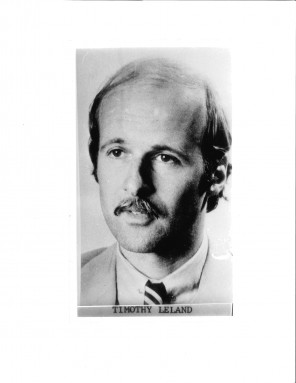
Timothy Leland, 34, was named Assistant Managing Editor of The Boston Globe on Feb. 1, 1972.
Leland was the founder and original editor of the Globe’s Spotlight investigative team from its establishment in Fall, 1970. He planned and coordinated organization of the team, employing knowledge and experience which he had gained as an investigative reporter during a year’s sabbatical from the Globe staff with the London Sunday Times.
Leland prepared at Noble & Greenough School; was graduated cum laude from Harvard in 1960; and was an honors graduate of the Columbia Graduate School of Journalism in 1961.
He joined the Globe in 1963 as Science Editor after serving two years as a science writer for another newspaper. In 1965 he was named chief of the Globe’s State House Bureau, and, in 1968 was appointed Assistant City Editor for the morning Globe.
Leland was cited in 1968 by the American Political Science Association for his reporting in the area of governmental reform.
Leland was awarded a year’s traveling fellowship in 1969, spending much of the time in South Africa, rounding out his sabbatical with the stint on the London Sunday Times.
Leland makes his home in the Waban section of Newton, Mass. with his wife, the former Natasha Bourso, and family.
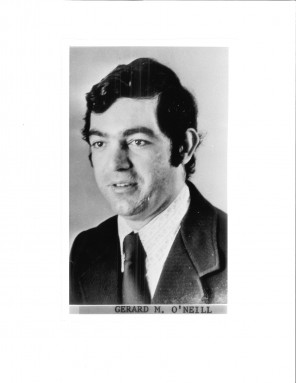
Gerard O’Neill, 29, is the current editor of the Globe’s four-man investigative Spotlight team.
His career at the Globe has been distinctly diverse, ranging from copy boy to investigative reporter.
He joined the Globe in 1965 after graduating from Stonehill College with honors and spending a year at George Washington Law School in Washington, DC.
While working as a copy boy at nights, he attended Boston University Graduate School of Journalism during the day, graduating in 1970.
His jobs at the paper have included serving as an “intern” during the summer of 1966, six months as a copy editor, two years as a district man for the Globe’s suburban department, and two years as a political reporter-columnist at both the State House and City Hall. He specialized in investigative reporting and was given wide latitude to seek out in-depth stories.
O’Neill transferred to the Spotlight Team when it was founded in late 1970 by Timothy Leland, current assistant managing editor of the Globe.
Earlier in 1970, O’Neill was voted the UPI’s civic service award for articles he did concerning the relationship between a Boston school committee member and a city contractor.
O’Neill’s main outside interests are sports, having played basketball and baseball at the high school and college level. He enjoys handball, tennis, and bicycling with his family, a wife, Janet, and son, Brian.
O’Neill and his family live in North Easton, a small town south of Boston.
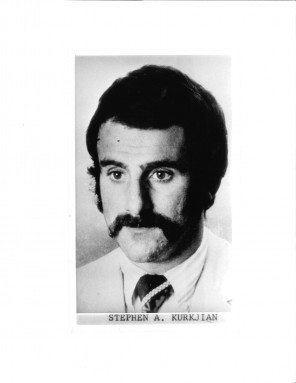
Stephen Kurkjian was a general assignment reporter with the Globe for two years before being named to the Spotlight Team. An original member of the team, Kurkjian is 28 years old.
Born and raised in Boston, Kurkjian graduated from Boston Latin School in 1962. Four years later, he graduated from Boston University where he majored in English literature.
After graduation, he became a reporter for the State House News Service, covering legislative, administrative and gubernatorial activities in the Massachusetts State House.
Evenings, after work at the News Service, Kurkjian studied law at Suffolk University Law School.
He continued his law studies on joining the Globe as a reporter in September 1968. In April 1971, he was admitted to the Massachusetts Bar.
While working on the Globe’s City Desk, Mr. Kurkjian’s assignments ranged from covering Sen. Kennedy’s auto accident and trial at Chappaquiddick to the Woodstock music festival.
Married to the former Ann DeSantis, Kurkjian lives in Quincy, Mass.
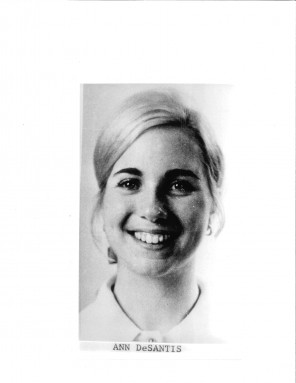
Ann DeSantis was the Spotlight Team’s research assistant until May 1971 when she became engaged to Stephen Kurkjian, a reporter on the team.
Ms. Kurkjian was a member of the team when it conducted its investigations on the West End Parking Lot, the Maryknoll Novitiate, the Somerville City Hall and the Massachusetts Turnpike Authority.
A graduate of St. Lawrence University in Canton, NY, where she majored in French, Ms. Kurkjian is the daughter of Mr. and Ms. Theddeus B. Lewkowicz of Schenectady, NY.
After her graduation in 1968, Ms. Kurkjian joined the staff of the Schenectady Gazzette as a general assignment and suburban reporter. Among her duties for the paper was the covering of town affairs in the community of Niskayuna, NY.
Ms. Kurkjian came to Boston June 1970 to enroll in the summer semester at Harvard University, where she took courses in drama and creative writing.
An original member of the team, Ms. Kurkjian was responsible for coordinating and collating all information memorandums into a central file from which the stories were eventually written. Also, Ms. Kurkjian conducted frequent interviews and took vital part in the investigation.