St. Louis Post-Dispatch, by Frank Peters Jr.
Winning Work
By Frank Peters
"They didn't care. It's the crowd itself, the experience, apparently, that they are after. They might snuggle up against the fence, a couple of those young people, with their bottle or whatever it is, and be set for the evening. Or wander around and talk. They want to hear the music, though, and they could; oh, how they could hear it! My ears ached and I had to leave."
The story of the Mississippi River Festival, for 1971 and perhaps for years to come, was written last Monday, when 32,123 people poured in to hear The Who. It was the event of the Festival and it made the difference between night and day in the Festival's vital statistics.
An expected net deficit of $14,000 was transformed, it now appears, into a balanced budget; a soggy attendance record was changed to show an increase of 17.7 percent over last year; and the backers, theretofore discouraged about chances. of prolonging the life of the Festival past its third summer, realized that the clouds had parted just in time. Of all the happy people who surveyed the post-Who debris on the Southern Illinois University-Edwardsville campus Tuesday, none were more relieved than the leaders of the St. Louis Symphony, for the Festival offers the Symphony six precious weeks of summer employment. 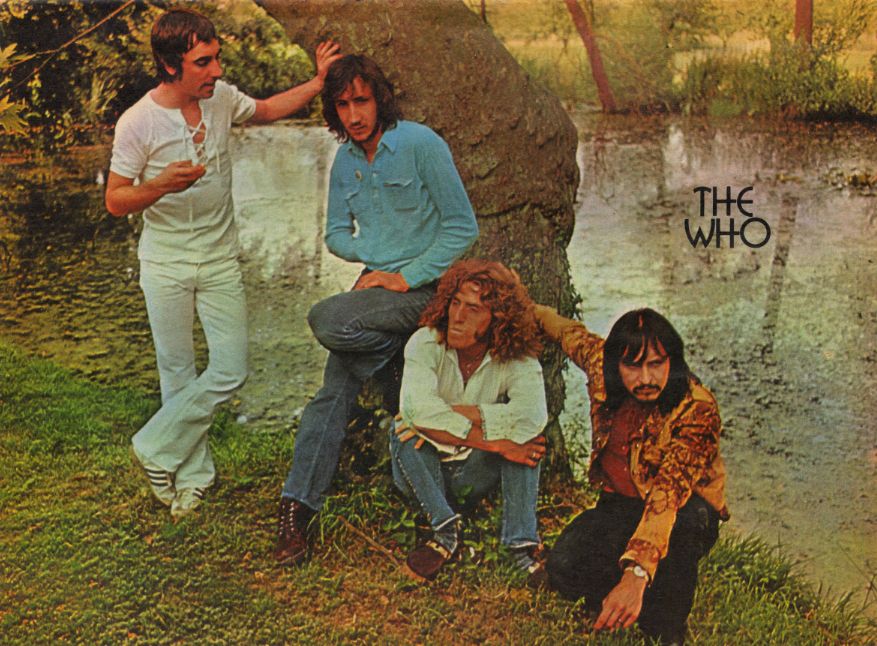
Promotional photo of The Who (L to R: Keith Moon [drums, vocals], Pete Townshend [guitar, vocals, songwriting], Roger Daltrey [lead vocals], John Entwhistle [bass, vocals, songwriting]) published in Mirabelle, September 1971 (Thewho.info). Following the crossover success of the Townshend-penned "rock opera" Tommy in 1969—later adapted for the screen by Ken Russell in 1975 and as a long-running Broadway musical in 1993—the band became known for melding sophisticated songcraft and equally inventive arrangements (subverting long-ensconced rock conventions, both Moon and Entwhistle favored unusually ornamental styles, while guitarist Townshend instead served as the de facto rhythm section) to a minimalist live sound rooted in the era's hard rock populism; both approaches would dovetail seamlessly on the 1971 album Who's Next.
Widely regarded as their definitive work, it evolved out of the dystopian Lifehouse, a proposed follow-up to Tommy that presaged many aspects of contemporary life, including climate change and a cybernetic interface analogous to the Internet. (While enrolled in a graphic design diploma course at Ealing Art College before pursuing a music career, Townshend studied under seminal computer artist Roy Ascott.) However, the narrative was ultimately abandoned in favor of an album of discrete songs, in part because Daltrey failed to grasp how Townshend's wireless system ("the Grid") would work. Following the dual triumphs of the album and 1973's Quadrophenia (another conceptual effort, this time set in the early 1960s mod scene that spawned the group), much of the band's later work took a subjective turn, tackling such concerns as Townshend's alcoholism ("However Much I Booze") and the ephemeral machinations of the music industry ("Who Are You"; "Eminence Front").
Nothing like the Who crowd had ever happened in St. Louis. The biggest pop music events in three Festivals had drawn half that many customers; The Beatles attracted fewer than 25,000 to Busch Stadium. The Festival people knew in advance that The Who was going to be big, but most of them expected about 18,000 to come.
Fortunately the event sent out enough advance vibrations ike a train or a tidal wave, to alert people standing in its path. A Powell Hall secretary expected something extraordinary "because of the way the kids in my church talked about The Who." Lyle Ward, the young concert manager for pop attractions at the Festival, and his SIU colleagues had felt the tremors. Ward and Gene Haffner, assistant program director of the University Center, studied descriptions of Who concerts in Billboard and went to the length of attending a recent Who appearance in Saratoga, N.Y., to. analyze audience behavior.
Back at Edwardsville, Ward, Haffner and Bill Hudgens, director of business services for the campus, pursued their clinical diagnosis. By then they had decided to be ready for a crowd of 25,000. The peripheral chain-link fence was crowned with barbed wire. The staff of 100 SIU students who deal with the crowds at pop events—"usher" is hardly adequate to describe their functionm in the Walpurgis Night atmosphere of a rock concert—were reinforced by 30 more students and 30 university staffers.
The Festival sound man, Robert Shaw, was advised to bring out another carload of loudspeakers to reach the far corners of the lawn. Portable toilets were deployed near the ticket booth so that the environment should not suffer from the thousands waiting to get in. An extra refreshment stand was set up outside the grounds, and two more inside. Twenty-four hours before they were to appear, while the St. Louis Symphony was playing its last concert of the Festival a few dozen young people had already settled down in their blankets to be first at the box office. By 8 o'clock Monday morning, instead of the hundreds Ward had expected, there were thousands outside the grounds.
At this point the Festival people knew they were in for a day without precedent. Everyone connected with SIU and the Symphony rushed in to help. Peter Pastreich, executive director of the Symphony, went around picking up discarded cans and bottles in the entrance area. The parking lot was full hours before the box office opened; 20 shuttle buses started ferrying kids to the site from the huge parking lot on the main campus. Local rock groups were moved in to serenade the throng outside the gates.
Ann Rice's day of of ticket selling began at noon. Twelve thousand tickets had been printed for the Who event, on the basis of pre-season estimates. They lasted a couple of hours. The subscription director reached into her reserves, unsold tickets from other concterts, and there were plenty. Three thousand yellow tickets, 13,000 green ones, 2,000 orange ones went ove the counter. By 11 p.m. Mrs. Rice and her assistants were working through a batch of pink tickets. The concert was almost over but people still wanted to get in.
Sornewhere in the green tickets, about 5 p.m., the Festival managers held a crisis consultation. Twenty thousand persons had bought tickets and were waiting for the gates to open—already more than could possibly crowd within viewing range of The Who. Should they turn away the thousands who were lining up for more? More to the point, could they turn them away? The decision was made to open the gates at 5, an hour and a half earlier than usual, and to broadcast appeals for others to stay away. St. Louis radio stations carried the appeals. They did not seem to stem the flow of customers over roads that had been traffic-snarled since mottling; the appeals may even have spurred stay-at-homes to set out for where the action was.
The audience for The Who is different from a Symphony audience in more than size. "We told them at the box office, after the first 15,000 or so, that they had little chance of seeing the show," a Symphony man said. "They didn't care. It's the crowd itself, the experience, apparently, that they are after. They might snuggle up against the fence, a couple of those young people, with their bottle or whatever it is, and be set for the evening. Or wander around and talk. They want to hear the music, though, and they could; oh, how they could hear it! My ears ached and I had to leave."
The preparations of Ward, Haffner, Hudgens & Co. were well calculated. The crowd came, heard, and—in a grounds-clearing process that took from 11 p.m. until. 3 a.m. Tuesday—went. There were no serious incidents; the Acid Rescue squad tended some patients, soda cans were flung at fans up front who obstructed the view, a dozen chairs were broken and the chain-link fence was breached at one point. But those are trifles as rock concerts go; what counts is that the throng, treated decently by management and disciplined only by student employes their own age, left in peace.
The uniforms that are kept out of sight at Festival performances, with salutary effect on the temper of the crowds, converged quietly on the box office as the money began piling up. At the end there was $68,000. The Who had come to the Festival for $15,000 or 60 percent of the box office, whichever was bigger, so their take was $40,800, not bad for an hour and a half's performance. Distrustful as most rock groups are of local impresarios, The Who had demanded cash payment on the spot; but impressed at the crowd and the Mississippi River Festival's management, they changed their minds and called it a night. The next morning Mrs. Rice, having been escorted by armed guards around St. Louis most of the night with her sactchelsful of cash and back on the job after two hours' sleep, drove over to the Edwardsville motel where The Who were staying, woke the boys up and gave them their check.
That ended the Mississippi River Festival for 1971. In one day the Festival racked up almost as many cash customers as there had been for the whole six-weekend series of Symphony concerts; more, in fact, than the total attendance at 18 Symphony concerts in the 1969 Festival. Total Symphony attendance at that first Festival was 26,855; it rose by nearly 34 percent to 35,918 at the 1970 Festival; this year it slipped 4.5 percent, to 34,303. Per-concert attendance was up because there were fewer Symphony concerts at the Festival just ended, 12 instead of the 18 of the two previous summers. The number was chopped because of the dispiritingly poor attendance at most of the Thursday-night concerts in 1969 and 1970. The cut brought an economy in operating expenses and guest artists' fees, and by lightening the program content the Symphony hoped to draw enough people on Saturday nights to make up for the sacrificed Thursday nights.
It didn't quite work, though. The light-symphonic formula was effective only with a big, television-exposed name (like Doc Severinsen or Henry Mancini) dominating the program. Van Cliburn played badly to 4,242 people: Jeffrey Siegel and Leonard Pennario played well to 1,724 and 1,535, respectively. But all the Symphony and show-music (Carlos Montoya, Ferrante & Teicher) statistics were overshadowed by eight big rock events. In other terms, 33 percent of the Festival attractions drew 66 percent of the Festival attendance. And most striking of all, The Who accounted for 23 percent of the entire Festival patronage. The moral of The Who experience is better left to the deliberations of the Festival board, which will be meeting soon; the main thing is that The Who virtually guaranteed in one day that the Festival will have a 1972. The attendance statistics and the Festival's $27,200 share of the box office gross are impressive enough, but even more impressive is the competent, fair, intelligent handling of Feestival crowds, proven over three summers and put to the supreme test last Monday.
Nixon's Order and the Symphony
President Nixon's wage-price policy has introduced new uncertainties into the St. Louis Symphony's dealing with the musicians' union over a new contract. The Symphony management, which is said to have offered no wage increase so far in the secret negotiations, is understandably inclined to take the wage freeze at its letter; the union presently, with negotiations in a vacation hiatus, is waiting for developments to interpret the Nixon policy. The special circumstances of a symphony contract raise dozen of questions—e.g. does an extension of the season involve a prohibited wage increase?—that presumably will have to be answered in time by bureaucrats, and that may be then subjelct to court appeal. The only conjecture advanced by either side at the moment is that the Nixon policy will postpone a showdown in the Powell Hall negotiations and that Symphony concerts will begin as scheduled Sept. 16, with talks continuing.
As to prices, the Symphony has raised its tickets 10 percent for the coming season, but by necessity the announcement was made last spring and many subscriptions were sold at the elevated price before the Nixon policy went into effect Aug. 14. The management hopes that this price rise is exempt, but until it can get clarification, new subscription orders are being held up. A prolonged delay in settling this queetion—one of thousands that have been raised around the country in the last week—might seriously damage the Symphony's subscription sales campaign.
By Frank Peters
One of them used the word "chutzpah" to describe the new assurance in the strings.
The pleasure of hearing the St. Louis Symphony at its first concerts this season has been like that of hearing one's piano just after it has been tuned. It was good before, we were used to it, but now the most ordinary chords have a bloom and freshness that come from nudging every string up to correct pitch. The bloom on the piano starts to fade before the tuner has banked his $15 fee; in the orchestra, a complex and passionate concourse of humans, it fluctuates under a thousand circumstances and the conductor works to steady it, to hold the fragile beauty another second, to prolong its life into minutes and hours. People who can nourish the bloom through whole seasons, more or less, get to be known as great conductors.
"Orchestra sound" is only one of a conductor's main concerns, but, it may take more patient attention, particularly in a city like St. Louis, than interpretation or programming. Provincial orchestras and choruses tend to get by on what might be called a leading-voice system, with strong principals setting out the lines of the music in relief, and weaker members of their sections filling out, their deficiencies of pitch and tone quality rounded off by the loud, sure leading voices. The extreme form of this systep may be seen in those massive school choruses where most of the kids just mug, or emit a faint whine, and in bands where certain students are encouraged to fake certain passages during contest performances.
From that level up to the Philadelphia Orchestra, whose every violinist is said to be capable of delivering a good solo, there is a vast range of accommodation to the leading voice system. There has to be, for economic reasons, sometimes for union and community-politics reasons as well.
A skilled conductor can do wonders with a typically lopsided orchestra, by choosing scores to favor his strong forces. If his interpretations are well conceived he may inspire his musicians to extraordinary feats and turn in performances of true splendor. All the local conductors of recent memory have demonstrated this. Carvalho with "Rite of Spring," Cleve with "Messiah," Slatkin with Gershwin and Susskind with Dvorak overrode technical difficulties so powerfully that one forgot their less successful concerts. The trouble with a lopsided orchestra is inconsistency in the ho-rizontal as well as vertical sense. It keeps coming to thin ice in the repertory and having to dodge in a safe direction. This tends to result in replays of surefire compositions, plus a sprinkling of showy novelties where the virtuosity of a few players is on exhibit.
The Shostakovich Sixth Symphony, heard in Powell Hall one weekend ago, is an example of thin ice in the repertory of a second-rate orchestra. It is not familiar or a crowd-pleaser, its opening movement is long and slow, and the viola-cello passage at the very beginning might well bring out the worst of an or-chestra. Yet here it came, and Shostakovich's lovely writing started to arch across the half-hour as clean and bright as a rainbow. This is something new, to listen to the St. Louis Symphony from measure to measure and enjoy it for how it sounds.
So something has happened in the orchestra, and the piano simile is not entirely frivolous because the difference is one of intonation—of right pitch deep inside the ensemble, of back-chair players delivering their notes confidently with a full, round tone. The personnel roster shows that changes have been made with a purpose, for of 11 new Symphony members, 10 are in the violins and violas. The other is a percussionist, John Kasica.
The first violins have six new players: John Kormand and his wife Joan, Kenneth Patti, Darwyn Apple, Eiko Kataoka and Patrick Rafferty. Kormand is called associate concertmaster, a new title that was to have devolved on his predecessor, Ronald Patterson, new concertmaster of the Denver Symphony. Two others in the section have left the orchestra—Isadore Grossman, a 50-year veteran, for retirement and Wanda Becker to join her husban Jeral at the University of Missouri. Two have been moved to the second-violin section, Jacob Levine and Rudolph Schultz. That makes five vacancies, so with six additions the total first-violin strength is up to 17, and since the seoond violins lost no members their total strength is up to 15.
There has been a 40 percent turnover in the violas, with Darrel Barnes in the first chair, Robert Vernon, the assistant principal, Linda Moss in the third chair and Gerald Fleminger in the seventh. Apart from this, Mrs. Korman is an expert violist as well as violinist, and will substitute as needed in the violas and second violins from her extra stand in the back of the first violins.
Those are the vital statistics of the new Symphony sound; the orchestra has been getting younger, more equally expert, more interested in music, better equipped with instruments (under a symphony-backed loan plan described on this page a month ago), and incidentally more married to each other (eight husband-wife pairs this year; a record). The musicians can hear how well they are doing, and are exhilarated by it. One of them used the word "chutzpah" to describe the new assurance in the strings.
The exhilaration is given an edge, even a lift, by the impending wage negotiations; the Nixon wage freeze postponed the crunch until November and in the meantime the musicians seem to take delight in playing like the $15,000-a-year club they want to join. St. Louis may not be able to afford that much, but no Symphony leader can look the musicians in the eye this fall and tell them they're not worth that much.
By Frank Peters
Cheerful news about the performing arts is a change, so let's look at dance. People are going to see it in St. Louis, New York and practically everywhere. They are paying good money for it, liking it and going back for more. The audience is the healthy kind, youngish but well mixed in age, class and occupation. Ballet-goers today are not fulfilling a ritual of either the hip or square variety; they are eager to see dance in all its forms, compare dances and dancers, form opinions and dispute volubly at intermission time.
The dance "establishment," such as it is, couldn't matter less. Neither could the 70-year-old distinction between ballet and "modern dance," a specious barrier today in philosophical terms, and one that survives only by the sort of Parkinson's law governing artistic organizations. Ballet is different from music and drama in that its biggest, strongest practitioners are its most restless innovators. The nearest thing we have to an "establishment" company, George Balanchine's brilliant New York City Ballet, keeps the most blase fans awake with a succession of new works in every style. Some succeed, many fail, but all are interesting, and the New York State Theater in Lincoln Center is full for almost every ballet program.
New York is unniistakably the dance capital of the world and hardly a night in the year is vacant, but last week's profusion was remarkable by any standards. There were 45 dance performances. The two Times dance critics, Clive Barnes and Anna Kisselgoff, rushed around trying to skim off the topmost cream. The most remarkable thing was that the theaters were full. Barnes estimated that 100,000 people went to dance performances in that week.
City Center had the Australian Ballet Company, at the culmination of a tour that had brought it to St. Louis for two near-sellout evenings. The Siberian Singers and Dancers were in Carnegie Hall, just in from Omsk on a tour that will lead them to St. Louis March 4. Both got good, gently patronizing reviews.
Over in Brooklyn, where they had been brought by an I. T. & T. grant for their first American appearances, Maurice Bejart's Twentieth Century Ballet drew big crowds and bad reviews. This Belgian company has a big European reputation for supply-ing avant-garde shockers, like the huge in-the-round production of Beethoven's Choral Symphony that is illustrated on this page.
Bejart proved to have a spendid troupe of dancers. His male star, Paolo Bortoluzzi, is in the league of Nureyev, Villella and Bruhn, and Bejart can manage such things as a 15-man line doing—repeatedly—double tours-en-l'air of beautiful style and synchronization. Bejart's choreographic invention appears limited, though, and it is an unpromising sign that the best of eight of his works on display last week was the oldest of them —a "Rite of Spring," rather naively meshed in places to Stravinsky's score but nevertheless an explosive, gratifyingly orgiastic spectacle. The worst of them, a full-length "Mass for Our Times," was a compendium of banal, modish cliches, including a Jesus-hippie hero, long readings from the Bhagavad Gita and very little dancing. New York's young people, sophisticated in a way that fashion-exploiters find hard to understand, wed out by the hundred. It is interesting that in St. Louis, when a similarly inept, pretentious "rock ballet" was put on by some Kansas Citians at Washington University last spring, the spectators reacted in much the same way; they spotted a phony.
At the ANTA Theater near City Center, Alvin Ailey was doing better with topical matters in his new "Flowers," which is supposed to be about Janis Joplin; he had Lynn Seymour of the Royal Ballet as his demon-driven show-biz heroine. Ailey is claimed by the modern-dance people as one of theirs, but his product is a free mixture of styles put together with an eya for slam-bang theatricality; Ailey is a more genial and relaxed Bejart. His 11-year-old favorite, "Revelations," is not really more than a set of show dances done to Negro gospel songs, but these simple elements are put together and executed so beautifully that they bring down the house. Ailey, a Negro with a thoroughly integrated company, is reported to labor under racist pressure toward an all-black troupe with a polemical repertory.
Dance fans, judging from the programs that are offered to sold-out houses, want to see varied dances and plenty of them. Three-hour durations are par, and one of Bejart's evenings ran to three and a half (not the "Mass" that so many people walked out on) without restlessness in the audience. One-act ballets, which touring companies usually do in groups of three, are often presented in New York four or five at a time.
One of the City Ballet evenings last week had "Bugaku," Balanchine's adaptation of classical Japanese dance; Jerome Robbins's wonderfully menacing "The Cage," with Gelsey Kirkland in command as the deadly little adolescent Amazon; a new "Concerto for Two Solo Pianos" (using the Stravinsky score), erratically choreographed by Richard Tanner but helped into bloom by Colleen Neary, a tall, slender young candidate for top roles, lately emerged from the corps; and Balanchine's rollicking 1930s-style show dance, "Slaughter on Tenth Avenue." It was a program of remarkable variety, and Balanchine's company shifted styles enthusiastically. City Ballet is not a "slick" stage presence, and it is a measure of Balanchine's genius that the troupe can be so formidably competent without lapsing into the ennui of sameness. The ensembles are not especially precise, but the hours are studded with unpredictable, unforgettable moments of dance. As, for example, when Gloria Govrin (as the Good Fairy in "Harlequinade") did a lazy, perfect triple pirouette in arabesque extension, coming to rest still balanced on her toe, looking as though she could have stayed in that impossible position the rest of the evening.
The awakening to dance in St. Louis does not lag behind New York by the usual width of the "cultural gap." The appe-tite is here. Australia's young company cane to Kiel with only the name of Nureyev and a modestly growing reputation to offer people in exchange for $12.50 tickets; nearly 6,000 came. Stuttgart, with Erik Bruhn and Carla Fracci as top names, not as well known to the general public as Nureyev's, drew 4,500 last season and would probably sell out the hall for two performances if they returned now. And if you still think that star names are all that matter, consider the three sellouts of a feeble, locally produced, semi-staged "Nutcracker" in Powell Hall last December, and the thousands that went amost simul-taneously to a rival "Nutcracker" mounted in Kiel by another local organization.
The figure of 100,000 that Clive Barnes cited for a one week's dance audience in New York recalls those figures of 60,000 or so racked up by the touring Royal Ballet on each of its two six-night stands at the outdoor theater in Forest Park. The numbers cannot in fairness be compared without reference to the hordes of Muny Opera "regulars" who would have been present for a musical comedy just as willingly; but the fact remains that the non-ballet people did go to see good ballet, enjoyed it and went back when the company returned in 1969. The Muny management tried to get the Stuttgart company back to open the 1971 Muny season, but the troupe was booked solid. William Zalken, head of both the Municipal Opera and the local impresario agency, Entertainment Enterprises Inc., intimates that some major dance attractions may be expected in the next winter season.
This has happened in St. Louis without fund campaigns or efforts to "sell" dance as something that we need to nurture for our society's well-being. People just like to go, which is nice. It would be even nicer if our local dancers could forget their squabbles and unite under the flag of a regional dance company, able to mount competent productions and alive to the great, beckoning audience.
Biography
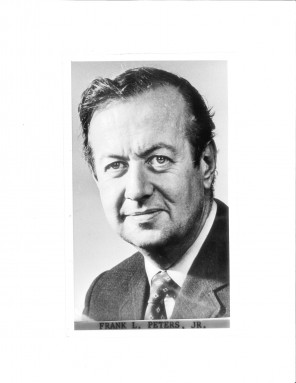
Frank L. Peters, Jr., was born at Springfield, Mo., October 19, 1930. He received a B.A. in English from Drury College in Springfield in 1951.
After two years in the Army, he did graduate work at the State University of Iowa [Iowa State University] in 1953-54, and returned to Springfield to write and edit news for radio stations IOU and KWTO until 1957. He went to the Arkansas Gazette, Little Rock, Ark., as a copy editor but returned to Springfield in 1959 as a feature writer for Springfield Newspapers, Inc. Peters was managing editor of the Rome Daily American from 1962 to 1964, when he came to the St. Louis Post-Dispatch as a copy editor.
He has long had an interest in cultural activities, especially music, and was named Post-Dispatch music critic on June 24, 1967.
Peters and hie wife, the former Alba Manciani, live at 1400 S. Rook Hill Road, Webster Groves, Mo., with their two children, Carl and Adrian.