Bethlehem (PA) Globe-Times, by John Strohmeyer
Winning Work
The Thanksgiving morning barroom fracas and the mass arrest of 21 persons in the near-riot constitute a matter of only the gravest concern.
We now see the rising militance of disaffected youth on one hand and the resort to blunter measures by police on the other. It is bad enough that two already hostile camps harden some more, but the tragic aspect is that police are losing the distinctions between the troublemakers and the peacemakers.
The humiliating arrest of Robert Thompson, a respected youth adviser, for the reasons stated is a sad turn. An honors English teacher at Freedom High who'spends nearly all of his spare hours working with youngsters at Mick's Mill, Thompson is one of few in the city who lives and feels the problems of youth. He has been the one person with a finger in the dike while appealing within the established system for help in a deteriorating situation.
It is a tribute to his dedication that Thompson left his bed in the middle of the night in an attempt to cool off the confrontation developing in the area of the Ale House in the early hours of Thanksgiving morning. But as far as police are concerned, he was part of the problem. They herded him among 21 others into a paddy wagon fbr a night in jail and an arrest for unlawful assembly, conspiracy and disorderly conduct. X ranking officer con-ceded that Thompson tried to mediate in the ruckus. When asked why he was arrested, he replied, "Well, he was there."
The actions of Patrolman John Stein, whii handed in his badge at the spot rather than participate in the arrests, is a far more vivid repudiation of such police shotgun tactics than any words of outrage.
It is not our intent to minimize the incendiary matters in the air that night. Coming so soon after a robbery and stabbing in another section of the South Side earlier in the night, the Ale House incident had all the signs of organized trouble. Yet, it is fully as important for police not to overreact as it is for them to capture the lawbreakers. Instead of resorting to hard police work to apprehend th\e real troublemakers and press the case against them to the hilt, police simply made a sweep.
The Thanksgiving morning incident is bound to set off new polarizations and cause more side-choosing in the community at large. Meanwhile, very little beyond words is happening to get at the root of the problem.
In a letter published elsewhere on this page, Prof. Victor Valenzuela of Lehigh University asks the crucial question: while frictions grow between the increasingly sadistic young and the increasingly irritated society, what is this city and its leaders doing to analyze the problem and bring forth the remedy? Strangely, this is the same question Robert Thompson asked two years ago, one year ago, and as recently as last month.
Provocations to retributive violence by juveniles yelling obscenities is immature and hardly meets professional police standards.
A councilmanic investigation of events centering around the "brutality" incident of Sept. 25 at the Bethlehem School District Stadium and, later in police headquarters is long overdue. Yet, the necessity for such scrutiny should never have arisen.
Last week's revelations by ex-patrolman John A. Stein must finally strip away a layering of contradictions and begrudging admissions by police and city officials which have eaten into the very fabric of community social relations in past months.
As an eerily reaction, certain officials have objected to this "new light" without an adequate advance warning and time to prepare further explanations.
The fact is that nothing his been revealed which has not been common knowledge within the police and administration circles for months. But the police reports of what transpired inside the station on the night of Sept. 25, when five young defendants were roughed up, have not been made part of the public record to this day. Meanwhile, neither the mayor nor council saw fit to explain the stunning contradiction in which the top police tried to cover up the incidents by stating they knew nothing of the beatings one day and then meekly accepting the findings of the Human Relations Commission the next day by admitting certain incidents had occurred and that verbal reprimand had been issued.
Now with former officer Stein's eyewitness account of what happened that night, more scurrying for cover is again evident.
John A. Stein came to Bethlehem a "new model" policeman—intelligent, educated, idealistic and yet practical enough to ierticipate in the department's own reorganization. His gradual disillusionment and eventual solitary stand for whet can only be considered minimal standards of investigation and discipline point a sorry finger at police moral leadership.
Any organization under constant public criticism cannot be expected to operate effectively and, sadly, the nation's police have borne much of the brunt in recent battles for social change.
Bethlehem, too, has changed much in recent years and police here have been shocked and dismayed to suddenly find themselves the objects of scorn. But just as much of this universal disrespect is unconscionable, the violent enforcement of seemingly more proper attitudes is dangerously reactive.
Besides creating Bethlehem's credibility gap, a head in the sand attitude by the Bethlehem police has permitted abrasions to grow into a full-scale alienation of many young people. It would have taken little time and training to recognize that certain police responses heighten the problem instead of lessening it. Provocations to retributive violence by juveniles yelling obscenities is immature and hardly meets professional police standards.
Acknowledgment that these standards were not met that night of Sept. 25 might early have cooled tensions and mistrust which finally culminated in the senseless events of Thanksgiving morning.
The new decade has commenced on a hopeful note. Council's budget, with the mayor's provision for professional youth workers and staffing of youth centers, points a community commitment to a cooperative direction.
Yet, the taint of the old will remain until the clouds lift from the contradictions that characterize the police actions following the night of Sept. 25. Only when all the facts are laid out and we get down to the real stock taking can we remove this stigma which hobbles honest police work and stifles the climate of goodwill.
The vote of confidence passed by City Council to reaffirm its faith in the Bethlehem Police force is about as meaningless as a vote for motherhood. It was an obvious attempt to apply a coat of whitewash on important issues raised by the concerns of former policeman John Stein.
Ex-Officer Stein, who served on the force two and a half years, might have found it easier to step out silently and concentrate on his studies at Lehigh, where he is completing his fourth year. However, the coverup of the role of high police officials in the station Souse beatings and the growing needless alienations between police and youth compelled him to state his views and risk the scorn of many of his former colleagues.
Only Councilmen William J.P. Collins and Waiter Dealtrey seemed to understand the issues raised by Stein's account: 1. How could a departmental hearing which recommended a verbal reprimand really deal with the matter when, as it now develops, Public Safety Director Irvin Good, was seen swinging at one of the youths corralled in the police station on the night of Sept. 25. Was Good identified as a participant, and, if so, was he supposed to reprimand himself? 2. There have been many police arrests but few cases ever get to the prosecution stage. Why? As Councilman Collins asked, "I would like to know whether any of these alleged criminals have been given a license to commit crime."
Council's blindness to these concerns was best expressed in the long harangue delivered by Councilman Ray Dietz who attempted to impugn the motives of John Stein. the Globe-Times, and apparently anyone else who would dare to question the operations of the Bethlehem police force. It never occurred to him that the motivations might have been public interest. Instead of recognizing his own public duty to clear the stigma, he chose to pour on platitudes about his pride in the police force. In the words of Mark Twain, Councilman Dietz showed only he ruld rather be popular than right.
A more proper way to "stand behind our police" is to ensure a responsible administration, to correct those abuses of police procedure which are letting so many arrest cases slip away, and to set standards for the vast majority of city policemen who want to do their duty above reproach.
By voting not to clear the air, City Council indicated that it either doubts its own ability to muster "a calm and serious approach" to the truth, or it is so certain of the outcome of an investigation that it fears the revelations.
At the close of Wesley United Methodist Church's six-part panel discussion, "The Street Scene: Youth In Bethlehem," Dr. Charles Chaffee, retired Bethlehem Area School District superintendent, expressed reservations concerning the recommendations drawn up by the 19 panelists who participated in the programs.
The response he received showed that others shared his beliefs.Among other suggestions, Dr. Chaffee urged "caution" when referring to proposals calling for the establishment of an area legal defense fund, and the support of the newly-founded Lehigh Valley Bail Fund, Inc.
He asked if anyone believed that a magistrate will hold a person over for court, and if the courts would take action against that person, unless sufficient evidence suggests that the party in question committed a crime. One point Dr. Chaffee apparently overlooked is that the basic assumption underlying our legal system states a man is innocent until proven guilty. Neither arrest nor arraignment establishes guilt or innocence; only the trial itself. Thus, until a verdict is pronounced, we are dealing with an innocent man.
That innocent man is guaranteed the right to proper legal defense, and does not have to spend the time pending his trial in jail if he can meet the financial requirements of bail.
For many citizens in this immediate area and the country as whole, however, both bail and proper legal defense are luxuries. Whether the barriers be economic or educational these people are denied the rights of due process of law. Because of inability to finance bail, they are forced to sit in jail or prison, having been convicted of no crime, while others accused of the same or even worse crimes are able to pay bail and go free. The difference is in the pocketbook.
The same is true for legal defense. For many, retaining a private attorney, no matter what the caliber, is totally unfeasible. They are forced to turn to the overworked, understaffed—and often inefficient—public defenders office. Again, another person accused of a similar or worse crime but with more economic resources available is able to retain a more effective attorney and perhaps win a more favorable verdict.
To balance the inequities, concerned citizens in both Bethlehem and the nation are forming bail funds and legal defense funds. These nonprofit organizations are established behind the premise of equal justice for all. They provide bail and assist in obtaining creditable defense for those unable to afford these items themselves. Without such groups, the noble ideal "equal justice for all" remains the biting reality of "justice for the wealthy and pot-luck for the poor."
Judge Michael Franciosa had some harsh words to say about the defend is as be threw out the charges against them in the now lamentable Ale House house case this week. It is too bad that the judge spoke with such a lack of distinction. He had good grounds to be distressed, but his blasts should have been leveled first against the ineptness of the police and the district attorney.
Serious misjudgments started when Bethlehem police swept 21 persons off the street after the Thanksgiving Eve barroom fracas. Among those thrown into jail was Robert Thompson, then an honors English teacher at Freedom High and now a full time youth worker. Thompson was called out of bed during the height of the melee to try to cool off the militant youths outside the South Side barroom. However, police made no distinction between the troublemakers and peacemakers. Officer John Stein deemed the seizures so outrageous that he handed in his badge and quit on the spot.
The ineptness was compounded in the all-night grilling and conferences at which District Attorney Charles Spaziani personally appeared for consultations. Bethlehem police insist the district attorney called the shots on the charges while Spaziani insists it was a police decision. Nevertheless, youth worker Thompson et al. were arrested for unlawful assembly, and conspiracy, charges more appropriate for those plotting the overthrow of government than participating in a common barroom fracas. Yet, in expressing his distress that the men before him had to be freed because evidence did not sustain the charges, Judge Franciosa refused to even obliquely suggest that the district attorney's office bungled badly for bringing such a poorly miscast case into court.
Finally, the judge himself added to the considerable errors in his tongue-lashing of all eight defendants as he threw the case out of court. He lumped Thompson, the city's most enlightened youth worker, and all others together and applied an even coat of tar on all of them. Again, in the judge's mind there were no distinctions between the troublemakers and the peacemakers when in fact each of the eight defendants had individual reasons for being at the scene. And each had a different purpose.
It was merciful perhaps, that Thompson and the other defendants never did get a chance to present their case. This spared Mayor Payrow the embarrassment of trying to explain a puzzling ambiguity that still lingers. At the hearing in December, Patrolman James Doyle testified he saw Thompson at the scene pointing his finger in Mayor Payrow's face and exclaiming, "You'll pay for this!" In the trial this week, Doyle did not have Thompson pointing a finger but simply "hollering something." Even the reduced version is inconsistent with Thompson's low-key character. Yet this accusation is bound to stand in the public mind even though the mayor publicly said shortly after the melee that he didn't remember seeing Thompson, a person who served in his boy scout troop and later emerged as the foremost supporter and worker in the mayor's youth programs. Fair play demands that the air be cleared of this contradiction.
Meanwhile, the whole case will go down as a sad chapter in Bethlehem history in which misjudgments, overreaction and undoubtedly political grandstanding almost shattered a city trying to deal with common frictions. But there are heartening aspects too. Bethlehem police have instituted changes in outlook and procedure which stress preventative work and caution on overreaction. Thompson and a crew of others trained for this specific duty now work with youth on the streets. But perhaps most heartening of all is that many citizens sensed the injustice in the Ale House mass arrests and came forth to put up bail money and later a defense fund. This was civic outrage expressed in the most constructive manner.
It was a hard lesson. Bethlehem is a wiser and a more sensitive city. And it has managed to preserve the loyalties of the Bob Thompsons despite ample cause for distress over the handling of the Ale House cases.
The Monocacy Creek is one of those dwindling natural resources that provides fun and fishing and breeds wildlife and vegetation in a rapidly growing urban area. This week, city council has been told that the State Health Department is about ready to clear the way for industrial firms to dump into the stream. wastes that are potentially dangerous. In short, the state is on the verge of lowering the quality of water standards for the Monocacy.
This straightforward indictment of Pennsylvania's concept of protecting the environment was made not by any of the many conservation groups which occasionally cry out about beer cans and litter. It was a documented charge launched by an individual, an Allentonian at that, who has enjoyed the many recreational treasures of days spent on the banks of the Monocacy. Harry Forker is heartsick that the Monocacy is about to be degraded and that the state is the villain in the rape of this stream.
So far, the State Health Department has not denied that it has approved, though not yet issued, a permit to let the National Portland Cement Co., north of Bethlehem discharge wastes into a prime fishing stretch of the Monocacy with an oxygen content lowered to six parts per million. Forker contends that this level is too low for marine and plant life to survive as natural trout food.
While both the cement plant and the state might put forth a biologist to debate Forker's contention on the level of oxygen necessary for marine life survival, no one can fault him on real thrust of charge. It is that in this age of vanishing natural resources the state should be raising the level of water quality, not lowering it.
No amount of industrial or economical development is worth degrading this fine public stream. Every effort should be made now to draw the line against further intrusion by man. In fact, hearings held earlier this year indicated that the Monocacy has the potential to be upgraded into a fine cold water fishing stream capable of holding over and breeding fish.
How then, does the State Health Department reconcile its tacit approval for lower standards simply to help an industry accommodate scrubbers that have failed to meet clean stream criteria? How, in fact, does it explain the long history of enforcement negligence which has permitted lagoons of a paint and pigment plant further down stream to ooze into another choice fishing stretch of the Monocacy? Does the State Health Department exist as a partner of industry or a protector of the public?
Governor Shapp made much in his campaign about getting tough on pollution enforcement. The sad abuse of the Monocacy deserves to be called to his attention. Everyone who has ever fed a duck on any of its calm pools, caught a trout in its swift waters, or thrilled at the sight of a migrating warbler on its shaded banks should recognize a personal mission to save the Monocacy.
Don't let them degrade it. Write the governor. Write Dr. Maurice Goddard (Department of Environniental Resources, Harrisburg), and write City Council. It is the only way left to head off this sellout by the State Health Department.
The Poconos International Raceway proved last weekend that it can draw 80,000 people in a single day to see big league auto racing. But are the Poconos ready to prove that they can deal with the problems that will inevitably mount with each raceway success?
This is more than an idle question for Bethlehem because the Raceway is virtually adjacent to this city's Tunkhannock water supply. While Bethlehem moved its water intake from downstream to upstream in anticipation of the track, the mere influx of thousands of people into the largely undeveloped countryside is bound to threaten not only the quality of the water supply but the future shape of the western Poconos.
Consider the scene last weekend when thousands of people clogged the roads, countryside, and the raceway grounds.
—Campgrounds offering water and sewage facilities were soon filled, forcing hundreds of overnighters into newly-skinned parking lots or in woodland recesses where there were no toilets.
—Hawkers set up stations along Rt. 115, some in tents and others on newly-bulldozed lots, creating a new commercial strip offering everything from hoagies to parking spaces.
—At the track itself, the sun-drenched multitudes enjoyed a whole day of beer drinking, in some cases causing a contest between the track's Job-johnnies and the tank trucks which emptied them. The crowds left miles of litter in their wake, much of it still blowing in the area four days after the race ended.
—It is to the Raceway's credit that the owners signed an agreement with the U. S. Department of Agriculture and Pennsylvania Department of Environmental Resources to prevent ecological damage. However, this is not a sufficient guarantee against blight on the outskirts. The rape of this area of the Poconoi is inevitable unless the townships, the county, and the state recognize their responsibilities together. The area must be zoned to prevent blight, shabby commercialism, and abuse of environment.
Up until now, this section of scrub oak, quiet streams, and marginal farms has been commercially undesirable. The Raceway changed that overnight. The big question now is whether local government can weather the assault?
Is it possible for Pennsylvania to have big time racing and an unspoiled Pocono countryside with an unpolluted watershed? This is the battle now down the main straight. Bethlehem has heavy stakes in the outcome, but so does everyone else. Not the least at stake is the future attractiveness of the Raceway itself.
The restoration of Bethlehem's tannery, the 210-year-old building opened to the public this week, ranks with one of the community's proudest civic achievements.
The colonial heritage of this city springs to life in the three floors of meticulously docu-mented exhibits within the original stone walls laid by talented craftsmen of the founding Moravian pioneers. Visitors can stand over the authentic vats and see how hides were tanned into goods to support life and commerce in the 18th and 19th centuries. But there is much more here—a vivid picture of the total life of those early families. A visitor finds rooms of displays showing tools, utensils, foods, herbs and other characteristics of those early lifestyles.
Perhaps there are historic complexes with more extensive trimmings, but certainly there are none more authentic. Most famous ones, such as Old Sturbridge Village, are total recreations at a random site. Bethlehem's is a restoration, a refurbishing of the original building on original around where the nation's earliest industrial village once flourished. Few can comprehend the amount of archival research and archeological exploration that was necessary to bring the tannery back to its life. But authenticity is what makes it a distinctive showplace.
Credit for success of the tannery belongs to many people. It starts with the members of the Moravian community who refused to raze the building after the industrial revolution made its functions obsolescent. It continues with those enlightened citizens from all walks of life who fought to save the building for public use after latter day commercial users abandoned it in the middle of a deteriorating neighborhood. City government can claim the first important breakthrough by clearing out the junkyards and shacks under the Monocacy Redevelopment and designating the old industrial quarter for park use. Finally, the citizens of Bethlehem, spearheaded by Historic Bethlehem Inc., a nonprofit organization, raised $620,000 in a public drive for capital funds three years ago. Thus, the physical restoration of the industrial quarter began and the tannery appropriately was the first to come back to life.
Mr. Merrill A. Hayden
Acting Postmaster General
U. S. Postal Service
Washington, D. C.
Dear Mr. Hayden:
We are sending along 80 cents to pay you for 10 envelopes without legal postage which the Globe-Times mailed the other day. The Lehigh Valley post office delivered all 10 as usual, even though one was stamped with only a TB seal, another with a Bethlehem Christmas City seal, and the others with canceled stamps pasted on from old envelopes.
It was eye-opening that not even one of these illegally-stamped letters was rejected by our post office's modern mechanized system. Particularly so, since your post office employes describe it as "infallible." However, the results of the tests were no more surprising than the reaction of Mr. Ron Powell, the information officer who speaks for you in Washington. His chief concern seemed to be that the Globe-Times "broke the law" in conducting the test.
We did break the law and we regret it was necessary. But we believe the culpability of the post office in all this is far more serious than our 80-cent defalcation. You, sir, have betrayed public confidence in your promises that the Postal Reorganization Act would increase the efficiency of the post office. What are we to make of your claims that a new structure with more authority and a 33 per cent increase in postage rates would permit you to operate on a business-like basis.
We do not think a business could long survive the practices that we observe from here. The Bethlehem area is served by a modern facility, the Lehigh Valley post office complex built only several years ago at a cost of $2 million. More mechanized equipment has been added this year as part of the $24 million catch-up program authorized for key post offices. Your men assure us that ours is about as modern an operation as you'll find in the nation.
And what has postal reform and heavy investment done for us so far? Months of observation of mails coming into our office show that nearly every mail brings letters where canceling machines have missed the stamps entirely. We can only guess how many unmarked stamps are recycled by alert office clerks all over the country. In view of our tests, we can only guess how soon it will be before members of this "ripoff society" discover that your modern machines are defenseless against re-used stamps, whether they have cancel marks or not. Or how soon it will be general knowledge that your automated systems do not reject letters stamped even with commemorative seals?
Your Mr. Powell suggests that the post office relies on an element of trust. Incredible. The days of trust and innocence are gone. No business today can survive the leakage of what amounts to an honor system and it is unfair to make the trusting citizens pay for such inefficiency. American know-how has solved far more difficult problems. Then why should the post office persist in installing costly machinery so lacking in technology that it does not have like capacity to reject a phony stamp?
We broke a regulation in conducting our test and we submit our reparations. What do you intend to do, Mr.. Hayden, about your broken promise to bring efficiency to the U. S. Postal Service?
The Bethlehem Globe-Times
The Bethlehem Redevelopment Authority, beset with setbacks in the Monocacy Renewal project and split by dissension within its board, has not had an easy time of it of late. The edgy weariness of its officers is probably no more apparent than in the incredible display of pettiness on Wednesday night. The Authority adjourned its monthly public meeting on the spot when officers saw that a Globe-Times reporter had arrived with a tape recorder to cover the meeting. This incident climaxes a series of diversionary actions which makes the taxpayer wonder. Is the Authority spending more of its time frying to choke off the bad news of its accumulating problems than it is in facing up to its problems? Consider the record leading up to the sad spectacle of Wednesday night:
—Last September, the Authority was jolted by Lehigh University's announcement that it was withdrawing from its agreement to build graduate housing on the 16-acre Monocacy Renewal tract which it held for two years. The university's participation had been counted on as an important catalyst in the Authority's total renewal design.
—On Feb. 11, 1971, with no tenants in sight to take up the abandoned tract, dissension from within broke into the open. Hugh Close, vice president of the Authority, criticized his own colleagues by declaring that the Redevelopment Autfhority was spending money to help business, industry and Lehigh University instead of helping people.
—On March 10, the next public meeting, the Authority president, Robert M. Fuller, castigated reporters from the Bethlehem and Allentown papers for featuring Close's charges. He said the press engaged in "unfair, unfactual, distorted reporting that is misleading the public." (Close offered a rebuttal, saying that in his view the reporting was fair. "It's what I said," he asserted.)
—In the April meeting, the Globe-Times reporter arrived with a tape recorder with instructions to record the meeting verbatim. It turned out to be the night when a heated hassle occurred over the Authority's pay policy before the coordinator's salary was raised from $17,700 to $18,500. The story was prominently published the next day with verbatim remarks and a portion of the tape was aired on the news shows of the Bethlehem radio station, WGPA.
There is no doubt in our mind that the too complete reporting of the pay policy debate led to the banning of tape recorders on Wednesday night. The ban poses no great principle of press freedom, since the Authority imposed no ban on reporters with pad and pencil. But it cannot be accepted. There is here a partial infringement of the people's right to a full, verbatim account of a public proceeding. Furthermore, the decree is contrary to all public policy. In the words of Housing and Urban Development, the federal agency which monitors the local redevelopment program, there are no federal laws barring a reporter from using a tape recorder. In the context of the Pennsylvania Open Meeting Law, there are no distinctions on whether a reporter uses a manual device or electronic device to cover a public meeting.
It seems to us the Bethlehem Redevelopment Authority can better spend its energy and legal funds dealing with some of the real problems facing the agency and the city's future. But if it persists in enforcing the ban, it leaves us no choice.
This is to serve notice that a Globe-Times reporter will be present at the next meeting with a tape recorder. If he is denied the right to use it, we are prepared to resort to every remedy to test this infringement on the public's right to know.
Dear John:
In 1971, the urban problems which have torn apart larger cities hit Bethlehem, PA. Although this newspaper, like others, has been challenged many times before by such familiar issues as municipal corruption and downtown renewal, this was a year of human crisis. Positions unpopular with community had to be taken, new directions had to be set, and collision courses often had to be averted. For his unheated judgement given almost daily on the editorial pages of the Globe-Times, I nominate John Strohmeyer for a Pulitzer Prize in editorial writing.
A brief word of history is necessary to put this perspective. Since its founding more than two centuries ago Bethlehem has been a secure community. The industry of steel has supplied with reasonable constancy a firm base of employment. The people who manned the mills were largely Middle European immigrants and their sons. They worked hard, rarely questioned police, and kept their doorsteps clean. Stability was more highly regarded and independence more prized than cooperation.
But in 1971, Bethlehem was forced to face the present and future so very different from its past. From New York, Newark, and Philadelphia, came an influx of different people, attracted by jobs in the mill. In the space of five years, the Puerto Rican population in Bethlehem jumped from a few hundred to an estimated 7,000 or about ten percent of the city's total population.
The sudden transition of neighborhoods brought civic hostility, police brutality, and even bloodshed as this exhibit will show. The editorial positions of the Globe-Times during this year were, in our opinion, the most crucial we have had to make. The leadership and the impact of Mr. Strohmeyer's editorials were in the highest Pulitzer tradition. I am proud to recommend them for a Pulitzer Prize.
Sincerely,
Donald S. Taylor, President
Biography
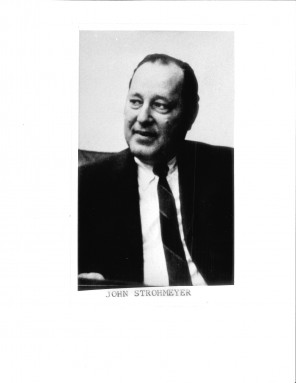
John Strohmeyer has a newspaper career that spans 30 years and two newspapers—the Bethlehem Globe-Times and the Providence Journal-Bulletin.
He started in 1941, working as a night reporter on the Globe-Times while attending Moravian College. He spent three years in the Navy during World War II, attaining the rank of lieutenant. He graduated from Muhlenberg College in 1947 and the Columbia Graduate School of Journalism in 1948. Columbia gave him a Pulitzer Traveling Fellowship.
Recruited from Columbia by the Providence Journal, Strohmeyer became a full-time investigative reporter, specializing in crime and corruption. His early stories on irregularities in the Boston internal revenue office were forerunners of the tax scandals which brought the conviction of the director of the Boston Internal Revenue office and contributed to major shakeups in the U.S. Treasury and Justice Departments in Washington. He was a Nieman Fellow in 1952-53.
In 1956, he returned to his hometown to become editor of the Bethlehem Globe-Times. As chief executive of news and editorial operations, Strohmeyer writes an average of five editorials a week. He is active in a variety of civic affairs, ranging from leading a drive to build a $2 million public library to protecting endangered species of wildlife as a board member of Hawk Mountain Sanctuary. However, to preserve his editorial independence, he assiduously avoids appointments to outside business boards. After 15 years he still declines to join the local country club which is heavily subsidized by the area's leading industry.
Strohmeyer is also active in professional activities. He is a frequent discussion leader at the American Press Institute and writes on newspaper topics. Three of his articles have been published in Harper's.
Among his other professional activities:
—Speaker and discussion leader at the 1963 International Press Institute at Hamburg, Germany.
—Member of a four-man team that conducted a two-month seminar for African newsmen in Kenya and Sierra Leone, 1964.
—Member of editorial board of Nieman Reports and member of a Nieman Selection Committee.
—Pulitzer Prize juror, three years.
—Chairman of ASNE nominating committee, 1969.
—President of the Pennsylvania Society of Newspaper Editors.
Among honors received for distinguished service to his profession:
—Recipient of bronze medallion at 50th Anniversary Honors List of the Columbia Graduate School of Journalism.
—Recipient of 1971 Comenius Award at Moravian College for "prodding the conscience of Bethlehem to critically examine itself and its progress."