The New York Times, by The New York Times
Winning Work
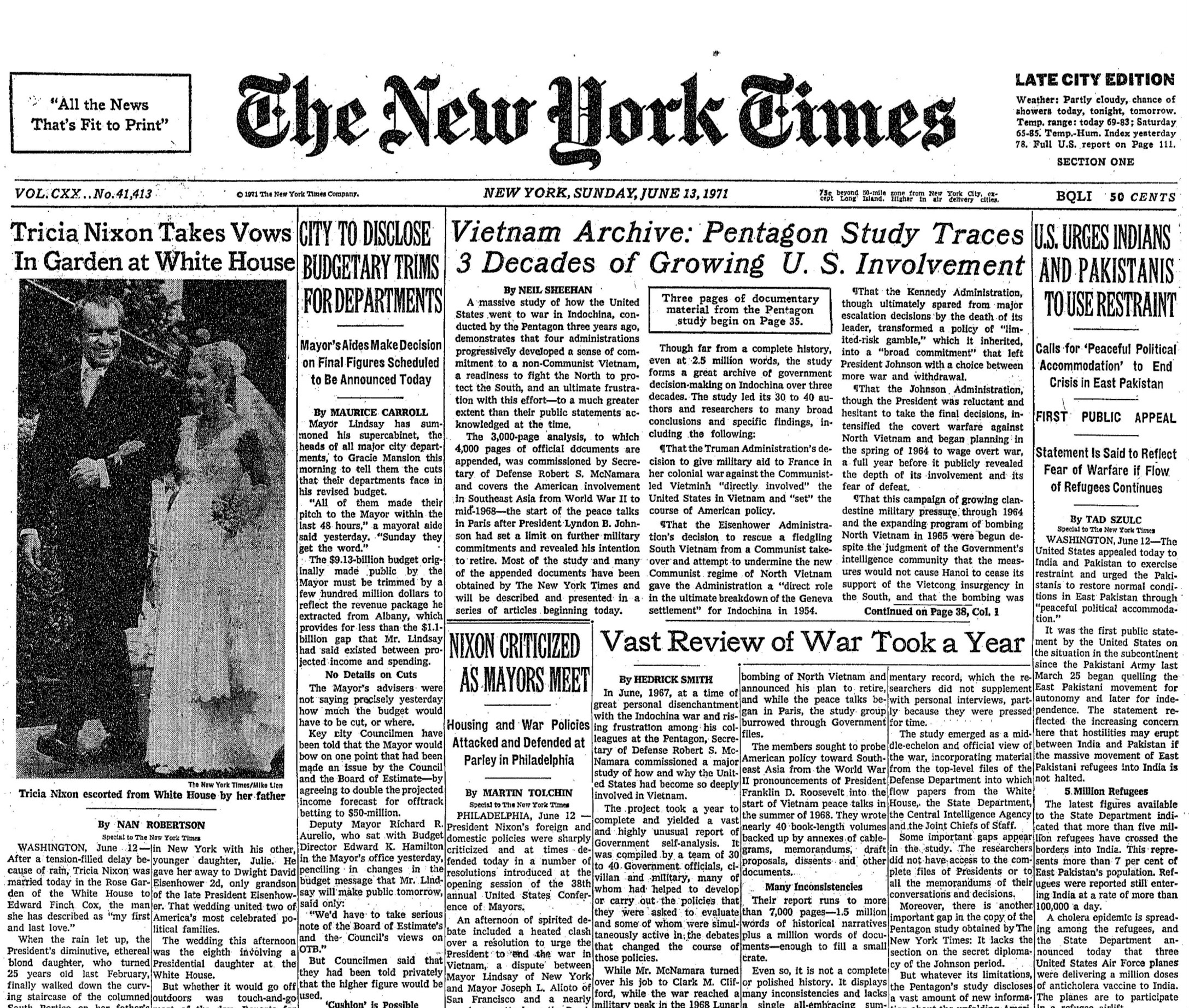
June 13, 1971 edition of The New York Times (File)
By Neil Sheehan
The New York Times
June 13, 1971
The accompanying article, as well as the rest of the series on the Pentagon's study of the Vietnam war, was a result of investigative reporting by Neil Sheehan of The New York Times’ Washington bureau. The series has been written by Mr. Sheehan, Hedrick Smith, E. W. Kenworthy and Fox Butterfield. The articles and documents were edited by Gerald Gold, Allan M. Siegal and Samuel Abt.
A massive study of how the United States went to war in Indochina, conducted by the Pentagon three years ago, demonstrates that four administrations progressively developed a sense of commitment to a non-Communist Vietnam, a readiness to fight the North to protect the South, and an ultimate frustration with this effort—to a much greater extent than their public statements acknowledged at the time.
The 3,000-page analysis, to which 4,000 pages of official documents are appended, was commissioned by Secretary of Defense Robert S. McNamara and covers the American involvement in Southeast Asia from World War II to mid-1968—the start of the peace talks in Paris after President Lyndon B. Johnson had set a limit on further military commitments and revealed his intention to retire. Most of the study and many of the appended documents have been obtained by The New York Times and will be described and presented in a series of articles beginning today.
Though far from a complete history, even at 2.5 million words, the study forms a great archive of government decision-making on Indochina over three decades. The study led its 30 to 40 authors and researchers to many broad conclusions and specific findings, including the following:
That the Truman Administration's decision to give military aid to France in her colonial war against the Communist-led Vietminh "directly involved" the United States in Vietnam and "set" the course of American policy.
That the Eisenhower Administration's decision to rescue a fledgling South Vietnam from a Communist take-over and attempt to undermine the new Communist regime of North Vietnam gave the Administration a "direct role in the ultimate breakdown of the Geneva settlement” for Indochina in 1954.
That the Kennedy Administration, though ultimately spared from major escalation decisions by the death of its leader, transformed a policy of "limited-risk gamble," which it inherited, into a "broad commitment" that left President Johnson with a choice between more war and withdrawal.
That the Johnson Administration, though the President was reluctant and hesitant to take the final decisions, intensified the covert warfare against North Vietnam and began planning in the spring of 1964 to wage overt war, a full year before it publicly revealed the depth of its involvement and its fear of defeat.
That this campaign of growing clandestine military pressure, through 1964 and the expanding program of bombing North Vietnam in 1965 were begun despite the judgment of the Government's intelligence community that the measures would not cause Hanoi to cease its support of the Vietcong insurgency in the South, and that the bombing was deemed militarily ineffective within a few months.
That these four succeeding administrations built up the American political, military and psychological stakes in Indochina, often more deeply than they realized at the time, with large-scale military equipment to the French in 1950; with acts of sabotage and terror warfare against North Vietnam beginning in 1954; with moves that encouraged and abetted the overthrow of President Ngo Dinh Diem of South Vietnam in 1963; with plans, pledges and threats of further action that sprang to life in the Tonkin Gulf clashes in August, 1964; with the careful preparation of public opinion for the years of open warfare that were to follow; and with the calculation in 1965, as the planes and troops were openly committed to sustained combat, that neither accommodation inside South Vietnam nor early negotiations with North Vietnam would achieve the desired result.
The Pentagon study also ranges beyond such historical judgments, It suggests that the predominant American interest was at first containment of Communism and later the defense of the power, influence and prestige of the United States, in both stages irrespective of conditions in Vietnam.
And it reveals a great deal about the ways in which several administrations conducted their business on a fateful course, with much new information about the roles of dozens of senior officials of both major political parties and a whole generation of military commanders.
The Pentagon study was divided into chronological and thematic chapters of narrative and analysis, each with its own documentation attached. The Times—which has obtained all but one of nearly 40 volumes—has collated these materials into major segments of varying chronological length, from one that broadly covers the two decades before 1960 to one that deals intensively with the agonizing debate in the weeks following the 1968 Tet offensive. The months from the beginning of 1964 to the Tonkin Gulf incident in August were a pivotal period, the study makes clear, and The Times begins its series with this phase.
The New York Times
June 13, 1971
The Pentagon papers disclose that in this phase the United States had been mounting clandestine military attacks against North Vietnam and planning to obtain a Congressional resolution that the Administration regarded as the equivalent.of a declaration of war. The papers make it clear that these far-reaching measures were not improvised in the heat of the Tonkin crisis.
When the Tonkin incident occurred, the Johnson Administration did not reveal these clandestine attacks, and pushed the previously prepared resolution through both houses of Congress on Aug. 7.
Within 72 hours, the Administration, drawing on a prepared plan, then secretly sent a Canadian emissary to Hanoi. He warned Premier Pham Van Dong that the resolution meant North Vietnam must halt the Communist-led insurgencies in South Vietnam and Laos or "suffer the consequences."
The section of the Pentagon study dealing with the internal debate, plan-ning and action in the Johnson Administration from the beginning of 1964 to the August clashes between North Vietnamese PT boats and American destroyers—portrayed as a critical period when the groundwork was laid for the wider war that followed—also reveals that the covert military operations had become so extensive by August, 1964, that Thai pilots flying American T-28 fighter planes apparently bombed and strafed North Vietnamese villages near the Laotian border on Aug. 1 and 2.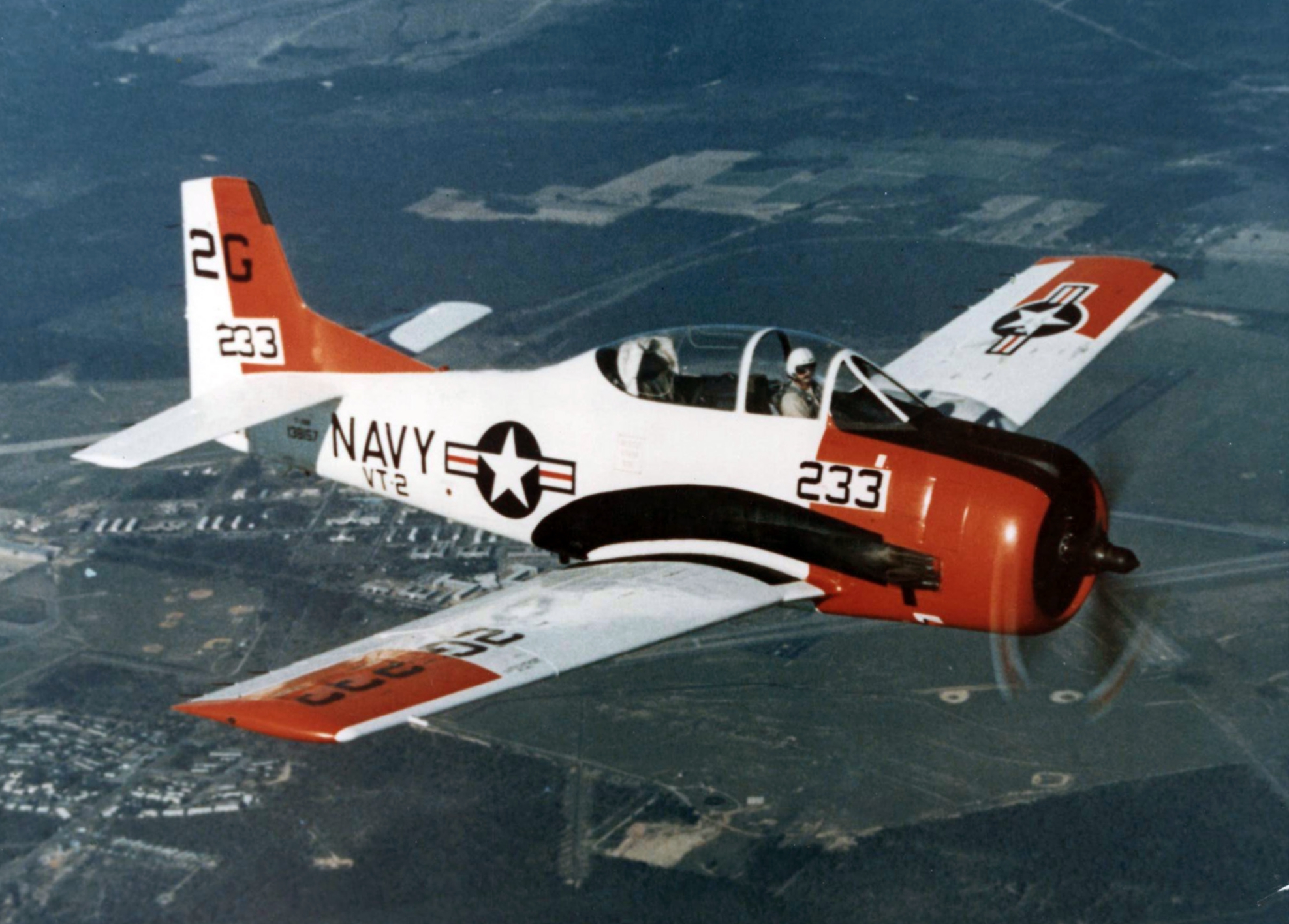
T-28 fighter plane (Wikimedia Commons).
Moreover, it reports that the Administration was able to order retaliatory air strikes on less than six hours' notice during the Tonkin incident because planning had progressed so far that a list of targets was available for immediate choice. The target list had been drawn up in May, the study reports, along with a draft of the Congressional resolution—all as part of a proposed "scenario" that was to build toward openly acknowledged air attacks on North Vietnam.
Simultaneously, the papers reveal, Secretary McNamara and the Joint Chiefs of Staff also arranged for the deployment of air strike forces to Southeast Asia for the opening phases of the bombing campaign. Within hours of the retaliatory air strikes on Aug. 4 and three days before the passage of the Congressional resolution, the squadrons began their planned moves.
'Progressively Escalating Pressure'
What the Pentagon papers call "an elaborate program of covert military operations against the state of North Vietnam" began on Feb. 1, 1964, under the codename Operation Plan 34A. President Johnson ordered the program, on the recommendation of Secretary McNamara, in the hope, held very faint by the intelligence community, that "progressively escalating pressure" from the clandestine attacks might eventually force Hanoi to order the Vietcong guerrillas in Vietnam and the Pathet Lao in Laos to halt their insurrections.
In a memorandum to the President on Dec. 21, 1963, after a two-day trip to Vietnam, Mr. McNamara remarked that the plans, drawn up by the Central Intelligence Agency station and the military command in Saigon, were "an excellent job."
"They present a wide variety of sabotage and psychological operations against North Vietnam from which I believe we should aim to select those that provide maximum pressure with minimum risk," Mr. McNamara wrote.
President Johnson, in this period, showed a preference for steps that would remain "noncommitting" to corn-bat, the study found. But weakness in South Vietnam and Communist advances kept driving the planning process. This, in turn, caused the Saigon Government and American officials in Saigon to demand ever more action.
Through 1964, the 34A operations ranged from flights over North Vietnam by U-2 spy planes and kidnappings of North Vietnamese citizens for intelligence information, to parachuting sabotage and psychological-warfare teams into the North, commando raids from the sea to blow up rail and highway bridges and the bombardment of North Vietnamese coastal installations by PT boats.
These "destructive undertakings," as they were described in a report to the President on Jan. 2 1964, from Maj. Gen. Victor H. Krulak of the Marine Corps, were designed "to result in substantial destruction, economic loss and harassment." The tempo and magnitude of the strikes were designed to rise in three phases through 1964 to "targets identified with North Vietnam's economic and industrial well-being."
The clandestine operations were directed for the President by Mr. McNamara through a section of the Joint Chiefs organization called the Office of the Special Assistant for Counterinsurgency and Special Activities. The study says that Mr. McNamara was kept regularly informed of planned and conducted raids by memorandums from General Krulak, who first held the position of special assistant, and then from Maj. Gen. Rollen H. Anthis of the Air Force, who succeeded him in February, 1964. The Joint Chiefs themselves periodically evaluated the operations for Mr. McNamara.
Secretary of State Dean Rusk was also informed, if in less detail.
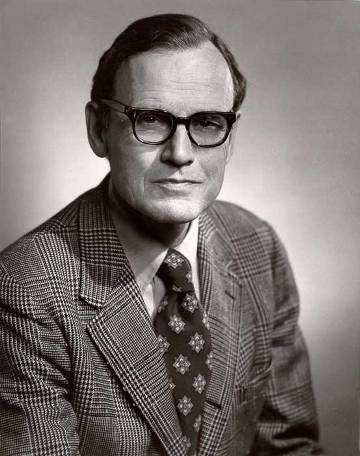
One of the more enigmatic members of the Johnson administration, William P. Bundy was Assistant Secretary of State for East Asian and Pacific Affairs under Dean Rusk and the elder brother of comparatively hawkish National Security Advisor McGeorge "Mac" Bundy (File). Despite advocating for a moderate course (including withdrawal) in 1964, Bundy refused to join Under Secretary of State George W. Ball in a final stand against mass mobilization a year later. Consistently regretful of his actions later in life, Bundy was nearly assassinated by the Weather Underground while teaching at the Massachusetts Institute of Technology in 1971.
The attacks were given "interagency clearance" in Washington, the study says, by coordinating them with the State Department and the Central Intelligence Agency, including advance monthly schedules of the raids from General Anthis. The Pentagon account and the documents show that William P. Bundy, the Assistant Secretary of State for Far Eastern Affairs, and John T. McNaughton, head of the Pentagon's politico-military operations as the Assistant Secretary of Defense for International Security Affairs, were the senior civilian officials who supervised the distribution of the schedules and the other aspects of inter-agency coordination for Mr. McNamara and Mr. Rusk.
The analyst notes that the 34A program differed in a significant respect from the relatively low-level and unsuccessful intelligence and sabotage operations that the C.I.A. had earlier been carrying out in North Vietnam.
Air Raids Were Planned Jointly
The 34A attacks were a military effort under the control in Saigon of Gen. Paul D. Harkins, chief of the United States Military Assistance Command there. He ran them through a special branch of his command called the Studies and Observations Group. It drew up the advance monthly schedules for approval in Washington. Planning was done jointly with the South Vietnamese and it was they or "hired personnel," apparently Asian mercenaries, who performed the raids, but General Harkins was in charge.
The second major segment of the Administration's covert war against North Vietnam consisted of air operations in Laos. A force of propeller-driven T-28 fighter-bombers, varying from about 25 to 40 aircraft, had been organized there. The planes bore Laotian Air Force markings, but only some belonged to that air force. The rest were manned by pilots of Air America (a pseudo-private airline run by the C.I.A.) and by Thai pilots under the control of Ambassador Leonard Unger.
Reconnaissance flights by regular United States Air Force and Navy jets, code-named Yankee Team, gathered photographic intelligence for bombing raids by the T-28s against North Vietnamese and Pathet Lao troops in Laos.
The Johnson Administration gradually stepped up these air operations in Laos through the spring and summer of 1964 in what became a kind of preview of the bombing of the North. The escalation occurred both because of ground advances by the North Vietnamese and the Pathet Lao and because of the Administration's desire to bring more military pressure against North Vietnam.
As the intensity of the T-28 strikes rose, they crept closer to the North Vietnamese border. The United States Yankee Team jets moved froth high-altitude reconnaissance at the beginning of the year to low-altitude reconnais-sance in May. In June, armed escort jets were added to the reconnaissance missions. The escort jets began to bomb and strafe North Vietnamese and Pathet Lao troops and installations whenever the reconnaissance planes were fired upon.
The destroyer patrols in the Gulf of Tonkin, code-named De Soto patrols, were the third clement in the covert military pressures against North Vietnam. While the purpose of the patrols was mainly psychological, as a show of force, the destroyers collected the kind of intelligence on North Vietnamese warning radars and coastal defenses that would be useful to 34A raiding parties or in the event of a bombing campaign, to pilots. The first patrol was conducted by the destroyer Craig without incident in February and March, in the early days of the 34A operations.
Separate Chain of Command
The analyst states that before the August Tonkin incident there was no attempt to involve the destroyers with the 34A attacks or to use the ships as bait for North Vietnamese retaliation. The patrols were run through a separate natal chain of command.
Although the highest levels of the Administration sent the destroyers into the gulf while the 34A raids were taking place, the Pentagon study, as part of its argument that a deliberate provocation was not intended, in effect says that the Administration did not believe that the North Vietnamese would dare to attack the ships.
But the study makes it clear that the physical presence of the destroyers provided the elements for the Tonkin clash. And immediately after the reprisal air strikes, the Joint Chiefs of Staff and Assistant Secretary of Defense McNaughton put forward a "provocation strategy" proposing to repeat the clash as a pretext for bombing the North.
Of the three elements of the covert war, the analyst cites the 34A raids as the most important. The "unequivocal" American responsibility for them "carried with it an implicit symbolic and psychological intensification of the U.S. commitment," he writes. "A fire-break had been crossed."
The fact that the intelligence community and even the Joint Chiefs gave the program little chance of compelling Hanoi to stop the Vietcong and the Pathet Lao, he asserts, meant that "a demand for more was stimulated and an expectation of more was aroused."
Warning by the Joint Chiefs
On Jan. 22, 1964, a week before the 34A raids started, the Joint Chiefs warned Mr. McNamara in a memorandum signed by the Chairman, Gen. Maxwell D. Taylor, that while "we are wholly in favor of executing the covert actions against North Vietnam it would be idle to conclude that these efforts will have a decisive effect" on Hanoi's will to support the Vietcong.
The Joint Chiefs said the Administration "must make ready to conduct increasingly bolder actions," including "aerial bombing of key North Vietnam targets, using United States resources under Vietnamese cover," sending American ground troops to South Vietnam and employing "United States forces as necessary in direct actions against North Vietnam."
And after a White House strategy meeting on Feb. 20, President Johnson ordered that "contingency planning for pressures against North Vietnam should be speeded up."
"Particular attention should be given to shaping such pressures so as to produce the maximum credible deterrent effect on Hanoi," the order said.
The impelling force behind the Administration's desire to step up the action during this period was its recognition of the steady deterioration in the positions of the pro-American governments in Laos and South Vietnam, and the corresponding weakening of the United States hold on both countries. North Vietnamese and Pathet Lao advances in Laos were seen as having a direct impact on the morale of the anti-Communist forces in South Vietnam, the primary American concern.
This deterioration was also concealed from Congress and the public as much as possible to provide the Administration with maximum flexibility to determine its moves as it chose from behind the scenes.
The United States found itself particularly unable to cope with the Vietcong insurgency, first through the Saigon military regime of Gen. Duong Van Minh and later through that of Gen. Nguyen Khanh, who seized power in a coup d'etat on Jan. 30, 1964. Accordingly, attention focused more and more on North Vietnam as "the root of the problem," in the words of the Joint Chiefs.
Walt W. Rostow, the dominant intellectual of the Administration, had given currency to this idea and provided the theoretical framework for escalation. His concept, first enunciated in a speech at Fort Bragg, N.C., in 1961, was that a revolution could be dried up by cutting off external sources of support and supply.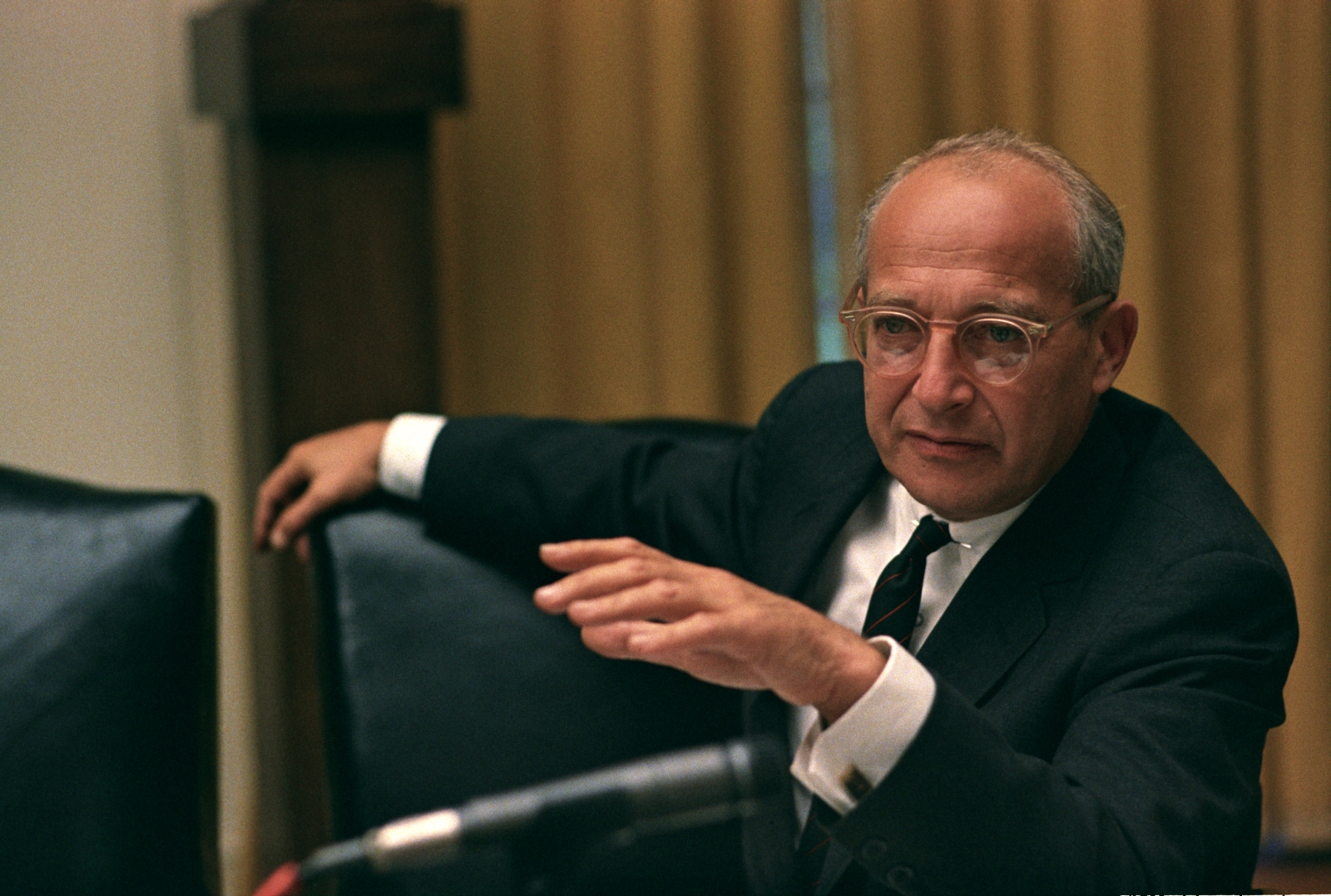
A Yale and Oxford-educated economist, Walt Rostow (pictured here in 1968) served as Deputy National Security Advisor under McGeorge Bundy and in a variety of high-level State Department positions before succeeding Bundy in 1966. His Stages of Economic Growth: A Non-Communist Manifesto (Cambridge, 1960) greatly impressed John Kennedy while anticipating America's enhanced involvement in Vietnam and the emergence of neoliberal policies (Wikimedia Commons).
Where North Vietnam was concerned, Mr. Rostow had evolved another theory—that a credible threat to bomb the industry Hanoi had so painstakingly constructed out of the ruins of the French Indochina War would be enough to frighten the country's leaders into ordering the Vietcong to halt their activities in the South.
'No Longer a Guerrilla Fighter'
In a memorandum on Feb. 13, 1964, Mr. Rostow told Secretary of State Rusk that President Ho Chi Minh "has an industrial complex to protect: he, is no longer a guerrilla fighter with nothing to lose."
The Administration was firmly convinced from interceptions of radio traffic between North Vietnam and the guerrillas in the South that Hanoi controlled and directed the Vietcong. Intelligence analyses of the time stated, howeVer, that "the primary sources of Communist strength in South Vietnam are indigenous," arising out of the revolutionary social aims of the Communists and their identification with the nationalist cause during the independence struggle against France in the nineteen-fifties.
The study shows that President Johnson and most of his key advisers would not accept this intelligence analysis that bombing the North would have no lasting effect on the situation in the South, although there was division 1—even among those who favored a bombing campaign if necessary—over the extent to which Vietcong fortunes were dependent on the infiltration of men and arms from North Vietnam.
William Bundy and Mr. Rusk mentioned on several occasions the need to obtain more evidence of this infiltration to build a case publicly for stronger actions against North Vietnam.
The New York Times
June 13, 1971
As the Vietcong rebellion gathered strength, so did interest in bombing the North as a substitute for successful prosecution of the counterinsurgency campaign in the South, or at least as an effort to force Hanoi to reduce guerrilla activity to a level where the feeble Saigon Government could handle it.
This progression in Administration thinking was reflected in Mr. McNamara's reports to President Johnson after the Secretary's trips to Vietnam in December and March. In his December memorandum recommending initiation of the covert 34A raids, Mr. McNamara painted a "gloomy picture" of South Vietnam, with the Vietcong controlling most of the rice and population heartland of the Mekong Delta south and west of Saigon. "We should watch the situation very carefully," he concluded, "running scared, hoping for the best, but preparing for more forceful moves if the situation does not show early signs of improvement."
Then, in his memorandum of March 16 on his latest trip, Mr. McNamara reported that "the situation has unquestionably been growing worse" and recommended military planning for two programs of "new and significant pressures upon North Vietnam."
The first, to be launched on 72 hours' notice, was described as "Border Control and Retaliatory Actions." These would include assaults by Saigon's army against infiltration routes along the Ho Chi Minh Trail network of supply lines through southeastern Laos, "hot pursuit" of the guerrillas into Cambodia, "retaliatory bombing strikes" into North Vietnam by the South Vietnamese Air Force "on a tit-for-tat basis" in response to guerrilla attacks, and "aerial mining… (possibly with United States assistance) of the major... ports in North Vietnam." The words in parentheses are Mr. McNamara's.
Beyond a Tit-for-Tat Basis
The second program, called "Graduated Overt Military Pressure," was to be readied to begin on 30 days' notice. "This program would go beyond reacting on a tit-for-tat basis," Mr. McNamara told the President. "It would include air attacks against military and possibly industrial targets." The raids would be carried out by Saigon’s air force and by an American air commando squadron code-named Farmgate, then operating in South Vietnam with planes carrying South Vietnamese markings. To conduct the air strikes, they would be reinforced by three squadrons of United States Air Force B-57 jet bombers flown in from Japan.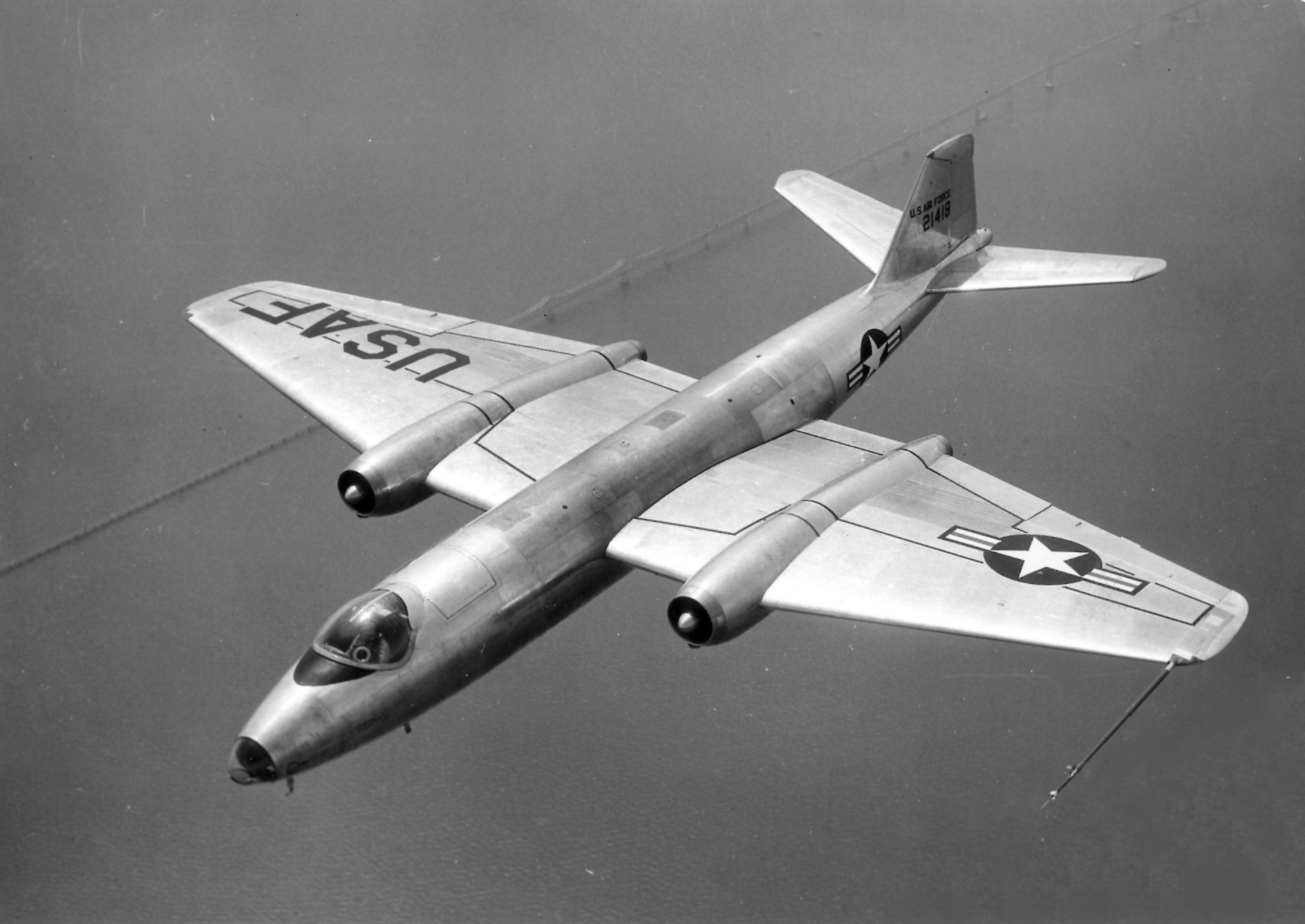
The B-57 Canberra in 1953 (Wikimedia Commons). A licensed iteration of the English Electric Camberra, the B-57 was known for its versatility.
President Johnson approved Mr. McNamara's recommendations at a National Security Council meeting on March 17, 1964, directing that planning "proceed energetically."
Mr. McNamara had advocated trying a number of measures to improve the Saigon Government's performance first, before resorting to overt escalation. “There would be the problem of marshaling the case to justify such action, the problem of Communist escalation and the problem of dealing with pressures for premature or 'stacked' negotiations," he remarked in his March memorandum.
His description of negotiations echoed a belief in the Administration that the Government of General Khanh was incapable of competing politically with the Communists. Therefore, any attempt to negotiate a compromise political settlement of the war between the Vietnamese themselves was to be avoided because it would result in a Communist take-over and the destruction of the American position in South Vietnam.
Similarly, any internal accommodation between the opposing Vietnamese forces under the vague "neutralization" formula for Vietnam that had been proposed by President de Gaulle of France that June was seen as tantamount to the same thing, a Communist victory. In his March memorandum. Mr. McNamara mentioned the dangerous growth of "neutralist sentiment in Saigon and the possibility of a coup by neutralist forces who might form a coalition government with the Communists and invite the United States to leave.”
A 'Solution' in Disfavor
William Bundy would later refer to this possibility as a "Vietnam solution" that must be prevented.
In a glimpse into the President's thoughts at this time, the study shows he was concerned with the problem. Mr. Johnson told Ambassador Henry Cabot Lodge in a cablegram to Saigon on March 20, 1964, that he was intent on "knocking down the idea of neutralization wherever it rears its ugly head, and on this point I think nothing is more important than to stop neutralist talk wherever we can by whatever means we can."
Mr. Lodge was opposed to planning "massive destruction actions" before trying what he described as "an essentially diplomatic carrot and stick approach, backed by covert military means."
This plan, which Mr. Lodge had been proposing since the previous October, involved sending a secret non-American envoy to Hanoi with an offer of economic aid, such as food imports to relieve the rice shortages in North Vietnam, in return for calling off the Vietcong. If the North Vietnamese did not respond favorably, the stick—unpublicized and unacknowledged air strikes, apparently with unmarked planes—would be applied until they did.
The President's message of March 20 shared Mr. Lodge's opinion that it was still too early for open assaults on the North.
"As we agreed in our previous messages to each other," Mr. Johnson cabled, "judgment is reserved for the present on overt military action in view of the consensus from Saigon conversations of McNamara mission with General Khanh and you on judgment that movement against the North at the present would be premature. We... share General Khanh's judgment that the immediate and essential task is to strengthen the southern base. For this reason, our planning for action against the North is on a contingency basis at present, and immediate problem in this area is to develop the strongest possible military and political base for possible later action."
Mr. Johnson added that the Administration also expected a "showdown" soon in the Chinese-Soviet dispute ''and action against the North will be more practicable" then.
Pushing, Yet Hesitating
This and the other sporadic insights the study gives into Mr. Johnson's thoughts and motivations during these months leading up to the Tonkin Gulf incident in August indicate a President who was, on the one hand, pushing his Administration to plan energetically for escalation while, on the other, continually hesitating to translate these plans into military action.
The glimpses are of a Chief Executive who was determined to achieve the goal of an "independent, non-Communist South Vietnam" he had enunciated in a national security action memorandum in March, yet who was holding back on actions to achieve that goal until he believed they were abso-lutely necessary.
Above all, the narrative indicates a President who was carefully calculating international and domestic political conditions before making any of his moves in public.
By the latter half of April, 1964, accordingly, planning for further attacks against the North had matured sufficiently through several scenarios for Secretary Rusk, William Bundy and Gen. Earle G. Wheeler, the Army Chief of Staff, to review the plans with Ambassador Lodge at a Saigon strategy meeting on April 19 and 20.
The scenario envisioned escalation in three stages from intensification of the Current Clandestine 34A raids, to "covert U.S. support of overt... aerial mining and air strike operations" by Saigon to "overt joint aerial reconnaissance, naval displays, naval bombardments and air attacks" by the United States and South Vietnam.
The analyst does not mention any provision in the April planning scenario for a Congressional resolution that would constitute authority to wage war; he refers instead to "Presidential consultations with key Congressional leaders." But the idea of a resolution was already, current by then. The author reports its first emergence in discussions in the State Department in mid-February, 1964, "on the desirability of the President's requesting a Congressional resolution, drawing a line at the borders of South Vietnam." He cites a Feb. 13 letter to Secretary Rusk to this effect from Mr. Rostow, then chairman of the State Department's Policy Planning Council.
At the April Saigon meeting and in the weeks immediately afterward, the author says, "a deliberate, cautious pacing of our actions" prevailed over a near-term escalation approach being pressed by the Joint Chiefs and Mr. Rostow.
One reason for this, the study explains, was that the Administration recognized that it "lacked adequate information concerning the nature and magnitude" of infiltration of trained guerrilla leaders and arms from the North and was beginning a major effort to try to gather enough concrete evidence to justify escalation if this became necessary.
"For example," the study reports, "citing the 'lack of clarity' on the 'role of external intrusion' in South Vietnam, Walt Rostow urged William Sullivan [chairman of the interagency Vietnam coordinating committee] on the eve of [a] March visit to attempt to 'come back from Saigon with as lucid and agreed a picture' as possible on the extent of the infiltration and its influence on the Vietcong."
The direct outcome of Mr. Rusk's April visit to Saigon was his agreement to try Ambassador Lodge's carrot-and-stick approach. On April 30, 1964, the Secretary flew to Ottawa and arranged with the Canadian Government for J. Blair Seaborn, Canada's new representative on the International Control Commission, to convey the offer of United States economic aid to Premier Dong when Mr. Seaborn visited Hanoi in June.
On May 4 General Khanh, sensing a decline in his fortunes and beginning to abandon the idea of strengthening his government to the point where it could defeat the Vietcong in the South, told Ambassador. Lodge that he wanted to declare war quickly on North Vietnam, have the United States start bombing and send 10,000 Special Forces troops of the United States Army into the South "to cover the whole Cambodian-Laotian border." Mr. Lodge deflected the suggestions.
Secretary McNamara, on a visit to Saigon May 13, was instructed to tell General Khanh that while the United States did not "rule out" bombing' the North, "such actions must be supplementary to and not a substitute for successful counter-insurgency in the South" and that "we do not intend to provide military support nor undertake the military objective of 'rolling back' Communist control in North Vietnam."
But on May 17, when the Pathet Lao launched an offensive on the Plaine des Jarres that threatened to collapse the pro-American Government of Premier Souvanna Phouma and with it "the political underpinning of United States-Laotian policy," the study declares, this "deliberate, cautious approach" to escalation planning was suddenly thrown into "crisis management."
The Administration immediately turned the Laotian air operations up a notch by intensifying the T-28 strikes and, on May 23, by starting low-altitude target reconnaissance by United States Navy and Air Force jets over areas held by the Pathet Lao and the North Vietnamese.
30-Day Program Is Worked Up
In Washington, the chief planner, William Bundy, assisted by Mr. McNaughton and Mr. Sullivan, worked up a 30-day program culminating in full-scale bombing of the North. He submitted it as a formal draft Presidential memorandum for consideration by an executive committee of the National Security Council.
For a number of reasons, this May 23 scenario was never carried out as written. The President, in fact, delayed another nine months the scenario's denouement in an air war. But the document is important because it reveals how far the Administration had progressed in its planning by this point and because a number of the steps in the scenario were carried out piecemeal through June and July and then very rapidly under the political climate of the Tonkin Gulf clash.
For the military side of the scenario, the President's order of March 17 to plan for retaliatory air strikes on 72 hours' notice and for full-scale air raids on 30 days' notice had borne fruit in Operation Plan 37-64.
This plan had been prepared in the Honolulu headquarters of Adm. Harry D. Felt, commander in chief of Pacific forces, or CINCPAC, and had been approved by the Joint Chiefs on April 17. It tabulated how many planes and what bomb tonnages would be required for each phase of the strikes, listed the targets in North Vietnam with damage to be achieved, and programed the necessary positioning of air forces for the raids. A follow-up operation plan, designated 32-64, calculated the possible reactions of China and North Vietnam and the American ground forces that might be necessary to meet them.
The Joint Staff had refined the bombing plan with more target studies. These estimated that an initial category of targets associated with infiltration, such as bridges and depots of ammunition and petroleum, could be destroyed in only 12 days if all the air power in the western Pacific were used.
For the political side of the scenario, recommendations from William Bundy and Mr. Rusk had produced more evidence of infiltration by the North for public release to justify escalation. William J. Jorden, a former correspondent of The New York Times who had become a State Department official, had gone to South Vietnam and had pulled together the data available there for a possible new State Department white paper.
Pentagon Version of Scenario
Here is the scenario as the Pentagon analyst quotes it. The words in parentheses—and the numbers designating the length of time to "D-day"—were in the original scenario and the words in brackets were inserted by the analyst for clarification:
"1. Stall off any 'conference [Laos or] Vietnam until D-Day.'
"2. Intermediary (Canadian?) tell North Vietnam in general terms that U.S. does not want to destroy the North Vietnam regime (and indeed is willing `to provide a carrot') but is determined to protect South Vietnam from North Vietnam.
"3. (D-30) Presidential speech in general terms launching Joint Resolution.
"4. (D-20) Obtain joint resolution approving past actions and authorizing whatever is necessary with respect to Vietnam.
"Concurrently: An effort should be made to strengthen the posture in South Vietnam. Integrating (interlarding in a single chain of command) the South Vietnamese and U.S. military and civilian elements critical to pacification, down at least to the district level, might be undertaken.
"5. (D-16) Direct CINCPAC to take all prepositioning and logistic actions that can be taken 'quietly' for the D-Day forces…
"6. (D45) Get Khanh's agreement to start overt South Vietnamese air attacks against targets in the North (see D-Day item 15 below), and inform him of U.S. guarantee to protect South Vietnam in the event of North Vietnamese and/or Chinese retaliation.
"7. (D-14) Consult with Thailand, and the Philippines to get permission for U.S. deployments; and consult with them plus U.K., Australia, New Zealand and Pakistan, asking for their open political support for the undertaking and for their participation in the re-enforcing action to be undertaken in anticipation of North Vietnamese and/or Chinese retaliation.
"8. (D-13) Release an expanded 'Alden Report,' including recent photography and evidence of the communication nets, giving full documentation of North Vietnamese supply and direction of the Vietcong.
"9. (D-12) Direct CINCPAC to begin moving forces and making specific plans on the assumption that strikes will be made on D-Day (See Attachment backup materials for deployments).
"10. (D-10) Khanh makes speech demanding that North Vietnam stop. aggression, threatening unspecified military action if he does not. (He could refer to a "carrot.')
"11. (D-3) Discussions with allies not covered in Item above.
"12. (D-3) President informs U.S. public (and thereby North Vietnam) that action may come, referring to Khanh speech (Item 10 above) and declaring support for South Vietnam.
"13. (D-1) Khanh announces that' all efforts have failed and that attacks are imminent. (Again he refers to limited goal and possibly to 'carrot.')
"14. (D-Day) Remove U.S. dependents.
"15. (D-Day) Launch first strikes... Initially, mine their ports and strike North Vietnam's transport and related ability (bridge, trains) to move south; and then against targets which have maximum psychological effect on the North's willingness to stop insurgency—POL (petroleum, oil and lubricants) storage, selected airfields, barracks/training areas, bridges, railroad yards, port facilities, communications, and industries. Initially, these strikes would be by South Vietnamese aircraft; they could then be expanded by adding Farmgate, or U.S. aircraft, or any combination of them.
16. (D-Day) Call for conference on Vietnam (and go to U.N.). State the limited objective: Not to overthrow the North Vietnam regime nor to destroy the country, but to stop D.R.V.-directed efforts in the South. Essential that it be made clear that attacks on the North will continue (i.e., no cease-fire) until (a) terrorism, armed attacks, and armed resistance to pacification efforts in the South stop, and (b) communications on the networks out of the North are conducted entirely in uncoded form."
The Analyst's Definition
The last paragraph was to provide a capsule definition of what the Administration meant when it later spoke publicly about "negotiations," a definition the analyst describes as "tantamount to unconditional surrender" for the other side.
The covering memorandum on the scenario pointed out that military action would not begin until after "favorable action" on the joint Congressional resolution. William Bundy drafted the resolution on May 25.
Attached to the scenario were assessments of possible Soviet, Chinese and North Vietnamese reactions. These included a provision for reinforcing the South Vietnamese Army "by U.S. ground forces prepositioned in South Vietnam or on board ship nearby" if Hanoi reacted by intensifying Vietcong activity in the South.
After meetings on May 24 and 25, the Executive Committee of the National Security Council—including Secretaries Rusk and McNamara, John A. McCone, Director of Central Intelligence, and McGeorge Bundy, Presidential assistant for national security—decided to recommend to the President only piecemeal elements of the scenario. Among these were the sending of the Canadian emissary to Hanoi and the move for a joint Congressional resolution.
The documents do not provide a clear explanation for their decision, the analyst says, although an important factor scorns to, have been concern that "our limited objectives might have been obscured" if the Administration had begun a chain of actions to step up the war at this point.
Whether political considerations in an election year also prompted the President to limit the proposed escalation is a question that is not addressed by the study here. The narrative does attribute such motives to Mr. Johnson's similar hesitation to take major overt actions in the following month, June.
In any case, the account explains, the urgency was taken out of the Laos crisis by a Polish diplomatic initiative on May 27 for a new Laces conference that would not include discussions of Vietnam, a major fear of the Administration. The President instructed his senior advisers to convene another strategy conference in Honolulu at the beginning of June "to review for… final approval a series of plans for effective action."
On his way to the conference, after attending the funeral of Prime Minister Jawaharlal Nehru in New Delhi, Secretary Rusk stopped off in Saigon for conversations with General Khanh and Ambassador Lodge.
Strategy Session in Honolulu
The Ambassador and Gen. William C. Westmoreland, who was replacing General Harkins as chief of the Military Assistance Command in Saigon, flew to Honolulu with Secretary Rusk for the strategy session at Admiral Felt's headquarters there on June 1 and 2, 1964. They were joined by William Bundy, Mr. McNamara, General Taylor, Mr. McCone and Mr. Sullivan.
While he had previously counseled patience, Mr. Lodge's chief recommendation at Honolulu reflected his growing nervousness over the shakiness of the Saigon regime. He argued for bombing the North soon.
The analyst writes: "In answer to Secretary Rusk's query about South Vietnamese popular attitudes, which supported Hanoi's revolutionary aims, the Ambassador stated his conviction that most support for the VC would fade as soon as some 'counterterrorism measures' were begun against the D.R.V."—the Democratic Republic of (North) Vietnam.
Admiral Felt’s record of the first day's session quotes Mr. Lodge as predicting that "a selective bombing campaign against military targets in the North" would "bolster morale and give the population in the South a feeling of unity."
The Honolulu discussions concentrated on an air war, ranging over its entire implications, down to such details as the kind of antiaircraft guns North Vietnam had and how difficult these defenses might make attacks on particular targets. By now the Joint Chiefs had improved on Admiral Felt's Operation Plan 37-64 to the point of producing the first version of a comprehensive list of 94 targets, from bridges to industries, that Mr. McNamara and President Johnson would use to select the actual sites to be struck when sustained air raids began in the coming year.
Obtaining a Congressional resolution "prior to wider U.S. action in Southeast Asia" was a major topic. The analyst paraphrases and quotes from William Bundy's memorandum of record on the second day's talks to summarize the discussion concerning the resolution:
"Ambassador Lodge questioned the need for it if we were to confine our actions to 'tit-for-tat' air attacks against North Vietnam. However, Secretaries McNamara and Rusk and C.I.A. Director McCone all argued in favor of the resolution. In support, McNamara pointed to the need to guarantee South Vietnam's defense against retaliatory air attacks and against more drastic reactions by North Vietnam and Communist China. He added that it might be necessary, as the action unfolded… to deploy as many as seven divisions. Rusk noted that some of the military requirements might involve the calling up of reserves, always a touchy Congressional issue. He also. stated that public opinion on our Southeast Asia policy was badly divided in the United States at -the moment and that, therefore, the President needed 'an affirmation of support."
"General Taylor noted that there was a danger of reasoning ourselves into inaction,” the memorandum goes on. "From a military point of view, he said the U.S. could function In Southeast Asia about as well as anywhere in the world except Cuba."
The upshot of the conference, however, was that major actions "should be delayed for some time yet," the historian says. A separate briefing paper that William Bundy prepared for Secretary Rusk to use in communicating the conference's findings to the President at a White House meeting late on the afternoon of June 3 counseled more time "to refine our plans and estimates." Mr. Bundy emphasized the need for an "urgent" public relations campaign at home to "get at the basic doubts of the value of Southeast Asia and the importance of our stake there."
Secretary McNamara, General Taylor and Mr. McCone joined Secretary Rusk in making the June 3 report to the President on the Honolulu conference. A documentary record of this White House meeting is not available, but the study deduces the President's reaction and decisions from the subsequent actions taken by his senior advisers.
Where decisive military actions were concerned, "the President apparently recognized the need for more and better information, but did not convey a sense of urgency regarding its acquisition," the analyst says. He notes that on the same day as the White House meeting, "possibly just following," Secretary McNamara told the Joint Chiefs that he wanted to meet with them on June 8, five days later, "to discuss North Vietnamese targets and troop movement capabilities."
But one element of the May 23 scenario, the positioning of forces for later action, began to fall into place right after the White House meeting. The Pentagon study says that "noncommitting military actions… were given immediate approval."
On June 4 Mr. McNamara directed the Army to take "immediate action . . . to improve the effectiveness and readiness status of its materiel prestocked for possible use in Southeast Asia."
The Secretary's directive, specifically ordered the Army to augment stocks previously placed with Thailand's agreement at Korat, a town south of the Laotian border, to support potential combat operations by a United States Army infantry brigade and to give "first priority at the Okinawa Army Forward Depot to stocking non-air-transportable equipment" that would be required by another Army infantry brigade flown to the island staging base on sudden notice.
The President also "apparently encouraged" the intensified public-relations campaign recommended by William Bundy and the other Honolulu conference participants, the study asserts.
"In June, State and Defense Department sources made repeated leaks to the press affirming U.S. intentions to support its allies and uphold its treaty commitments in Southeast Asia," the analyst explains, citing several articles that month in The New York Times. The Administration also focused publicity through June and into July on its military prepositioning moves. The augmentation of the Melly war stocks at Karat in Thailand was given "extensive press coverage," the account says, citing a dispatch in The Times on June 21, 1964.
And what the analyst calls "the broad purpose" of these positioning moves—'to serve as steps in the operation plans—was not explained to the public.
Downing of Two Navy Jets
The Administration did openly step up its air operations in Laos in mid-June, after the enemy provided it with a rationale of self-defense. On June 6 and 7 two Navy jets on low-altitude target reconnaissance flights were shot down by enemy ground fire. Washington immediately added armed escort jets to the reconnaissance flights and on June 9 the escort jets struck Pathet Lao gun positions and attacked a Pathet Lao headquarters.
A similar escalation of the T-28 operations and the involvement of Thai pilots was unofficially acknowledged in Washington, although the responsibility for these operations was laid to the Laotian Government. And subsequent strikes by the American escort jets against enemy positions were not made public.
At the end of June the Royal Laotian Air Force was secretly strengthened with more T-28s, and American planes began conducting troop transport operations and night reconnaissance flights for a successful counteroffensive by the Laotian Army to protect the key position of Muong Soul.
The New York Times
June 13, 1971
Only the Joint Chiefs, Mr. Rostow and General Taylor appear to have accepted the domino theory in its literal sense—that all of the countries of Southeast Asia... would tumble automatically into the Communist camp if the linchpin, South Vietnam, were knocked out.
President Johnson was projecting an image of firmness but moderation, the study notes. In early June, he first requested and then rejected a draft from Mr. Rostow for a major policy speech on Southeast Asia that took an "aggressive approach," and instead relied "on news conferences and speeches by other officials to state the official view," the account continues. "In contrast to the Rostow approach, [the President's] news conference on 23 June and Secretary Rusk's speech at Williams College, 14 June, emphasized the U.S. determination to support its Southeast Asian allies, but avoided any direct challenge to Hanoi and Peking or any hint of intent to increase our military commitment."
A formal question the President submitted to the C.I.A. in June also indicated what was on his mind. "Would the rest of Southeast Asia necessarily fall if Laos and South Vietnam came under North Vietnamese control?" he asked. The agency's reply on June 9 challenged the domino theory, widely believed in one form or another within the Administration.
"With the possible exception of Cambodia," the C.I.A. memorandum said, "it is likely that no nation in the area would quickly succumb to Communism as a result of the fall of Laos and South Vietnam. Furthermore, a continuation of the spread of Communism in the area would not be inexorable, and any spread which did occur would take time—time in which the total situation might change in any number of ways unfavorable to the Communist cause."
The C.I.A. analysis conceded that the loss of South Vietnam and Laos "would be profoundly damaging to the U.S. position in the Far East" and would raise the prestige of China "as a leader of world Communism" at the expense of a more moderate Soviet Union. But the analysis argued that so long as the United States could retain its island bases, such as those on Okinawa, Guam, the Philippines and Japan, it could wield enough military power in Asia to deter China and North Vietnam from overt military aggression against Southeast Asia in general.
Some Leverage Available
Even in the "worst case," if South Vietnam and Laos were to fall through "a clear-cut Communist victory," the United States would still retain some leverage to affect the final outcome in Southeast Asia, according to the analysis.
It said that "the extent to which individual countries would move away from the U.S. towards the Communists would be significantly affected by the substance and manner of U.S. policy in the period following the loss of Laos and South Vietnam."
As in the case of the earlier C.I.A. analysis stating that the real roots of Vietcong strength lay in South Vietnam, the study shows that the 'President and his senior officials were not inclined to adjust policy along the lines of this analysis challenging the domino theory.
Only the Joint Chiefs, Mr. Rostow and General Taylor appear to have accepted the domino theory in its literal sense—that all of the countries of Southeast Asia, from Cambodia to Malaysia, would tumble automatically into the Communist camp if the linchpin, South Vietnam, were knocked out, and that the United States position in the rest of the Far East, from Indonesia through the Philippines to Japan and Korea, would also be irrevocably harmed.
Yet the President and most of his closet civilian advisers—Mr. Rusk, Mr. McNamara and McGeorge Bundy—seem to have regarded the struggle over South Vietnam in more or less these terms.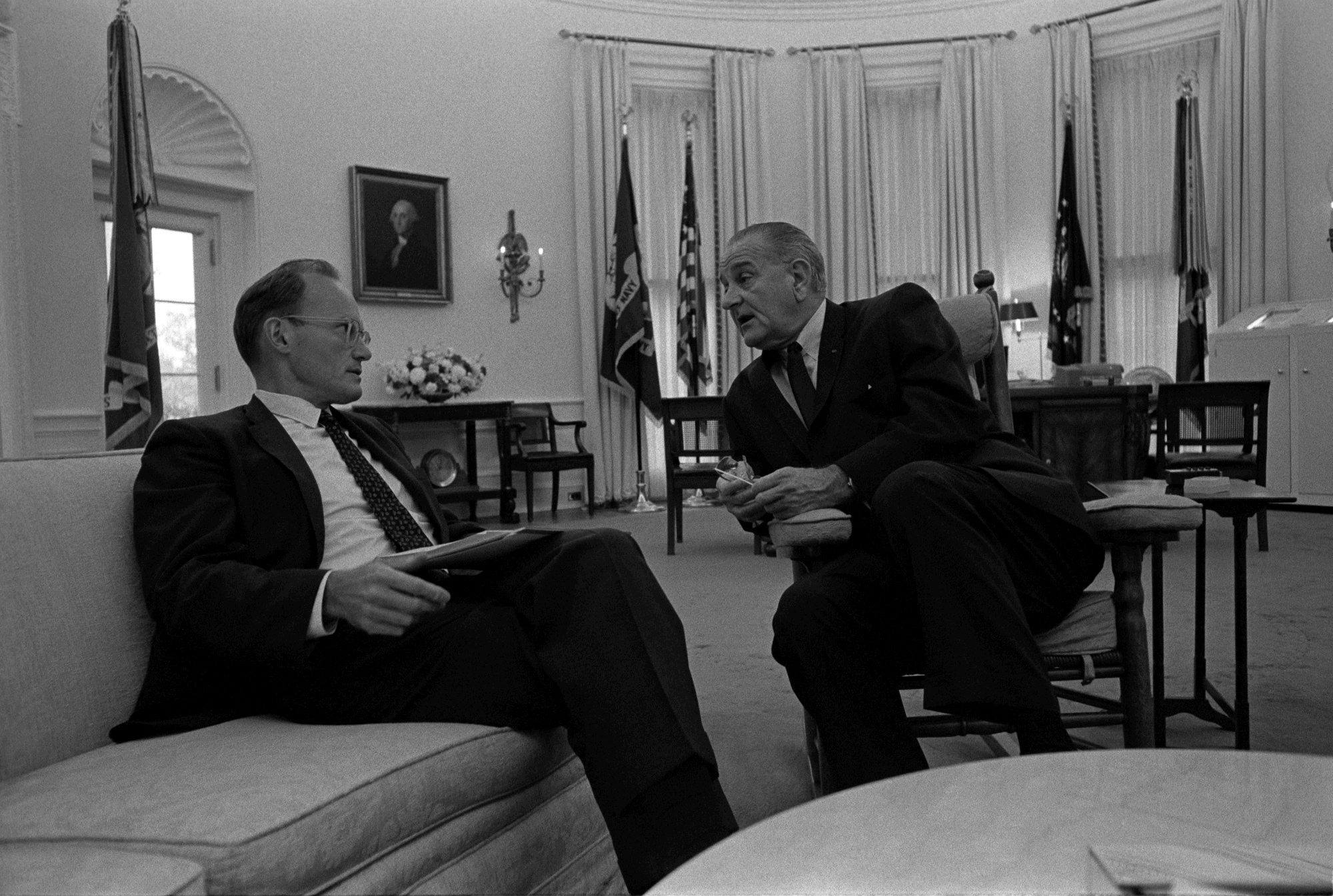
National Security Advisor McGeorge Bundy in conference with President Johnson (Wikimedia Commons). A quintessential exemplar of the "Eastern liberal establishment" as one of JFK's "wise men," Bundy had risen to the rank of captain in World War II as an Army intelligence officer and was an alumnus of both Yale and Harvard University's Society of Fellows, then conceived as a freewheeling alternative to the doctorate. Notably, Bundy ascended to the deanship of Harvard's Faculty of Arts and Sciences and a full professorship in government at the age of 34—achievements that rankled future colleague Henry Kissinger, who chafed at Bundy's privileged background, lack of advanced degree and spotty publication record. Nevertheless, Bundy strove to make the University a more egalitarian and meritocratic institution during his tenure. Unlike successor and "true believer" Walt Rostow, Bundy largely viewed the war as a necessary political expediency that would secure Johnson's ambitious domestic agenda. He left the administration in 1966 to become president of the Ford Foundation.
In 1964, the Administration also feared an outbreak of other "wars of national liberation" in the Asian, African and Latin American countries, and, Mr. McNamara wrote in his March 16 memorandum to the President, "the South Vietnam conflict is regarded as a test case."
The Threat of China
The struggle in South Vietnam was likewise bound up with the idea of "containing China," whose potential shadow over Southeast Asia was viewed as a palpable threat by Mr. Rusk because of his World War II experience in Asia and the victory of Mao Tse-tung's revolution in China.
But behind these foreign-policy axioms about domino effects, wars of liberation and the containment of China, the study reveals a deeper perception among the President and his aides that the United States was now the most powerful nation in the world and that the outcome in South Vietnam would demonstrate the will and the ability of the United States to have its way in world affairs.
The study conveys an impression that the war was thus considered less important for what it meant to the South Vietnamese people than for what it meant to the position of the United States in the world.
Mr. McNaughton would later capsulize this perception in a memorandum to Mr. McNamara seeking to apportion American aims in South Vietnam:
“70 pct.—To avoid a humiliating U.S. defeat (to our reputation as a guarantor).
"20 pct.—To keep SVN (and then adjacent) territory from Chinese hands.
"10 pct.—To permit the people of SVN to enjoy a better, freer way of life.
"Also—To emerge from crisis with-ut unacceptable taint from methods used.
"NOT—To 'help a friend,' although it would be hard to stay in if asked out."
The words in parentheses are Mr. McNaughton's.
Thus, he had reasoned in another memorandum, even if bombing. North Vietnam did not force Hanoi to call off the Vietcong, "it would demonstrate that U. S. was a 'good doctor' willing to keep promises, be tough, take risks, get bloodied and hurt the enemy badly."
Confidence at the Top
And while the study shows doubt and worry in the Administration, it also reveals an underlying confidence among the decision makers at the top, whose attitude would count, that if this mightiest nation resolved to use its vast power, the other side would buckle.
Mr. Rostow would articulate this confidence in a memorandum to Secretary Rusk that fall: "I know well the anxieties and complications on our side of the line. But there may be a tendency to underestimate both the anxieties and complications on the other side and also to underestimate that limited but real margin of influence on the outcome that flows from the simple fact that we are the greatest power in the world—if we behave like it."
[....]
By Hedrick Smith
The New York Times
June 13, 1971
"The feeling is that we are trying to impose some U.S. image on distant peoples we cannot understand (any more than we can the younger generation here at home), and that we are carrying the thing to absurd lengths. Related to this feeling is the increased polarization that is taking place in the United States with seeds of the worst split in our people in more than a century."
In June, 1967, at a time of great personal disenchantment with the Indochina war and rising frustration among his colleagues at the Pentagon, Secretary of Defense Robert S. McNamara commissioned a major study of how and why the United States had become so deeply involved in Vietnam.
The project took a year to complete and yielded a vast and highly unusual report of Government self-analysis. It was compiled by a team of 30 to 40 Government officials, civilian and military, many of whom had helped to develop or carry out the policies that they were asked to evaluate and some of whom were simultaneously active in the debates that changed the course of those policies.
While Mr. McNamara turned over his job to Clark M. Clifford, while the war reached a military peak in the 1968 Lunar New Year offensive, while President Johnson cut back the bombing of North Vietnam and announced his plan to retire, and while the peace talks began in Paris, the study group burrowed through Government files.
The members sought to probe American policy toward Southeast Asia from the World War II pronouncements of President Franklin D. Roosevelt into the start of Vietnam peace talks in the summer of 1968. They wrote nearly 40 book-length volumes backed up by annexes of cablegrams, memorandums, draft proposals, dissents and other documents.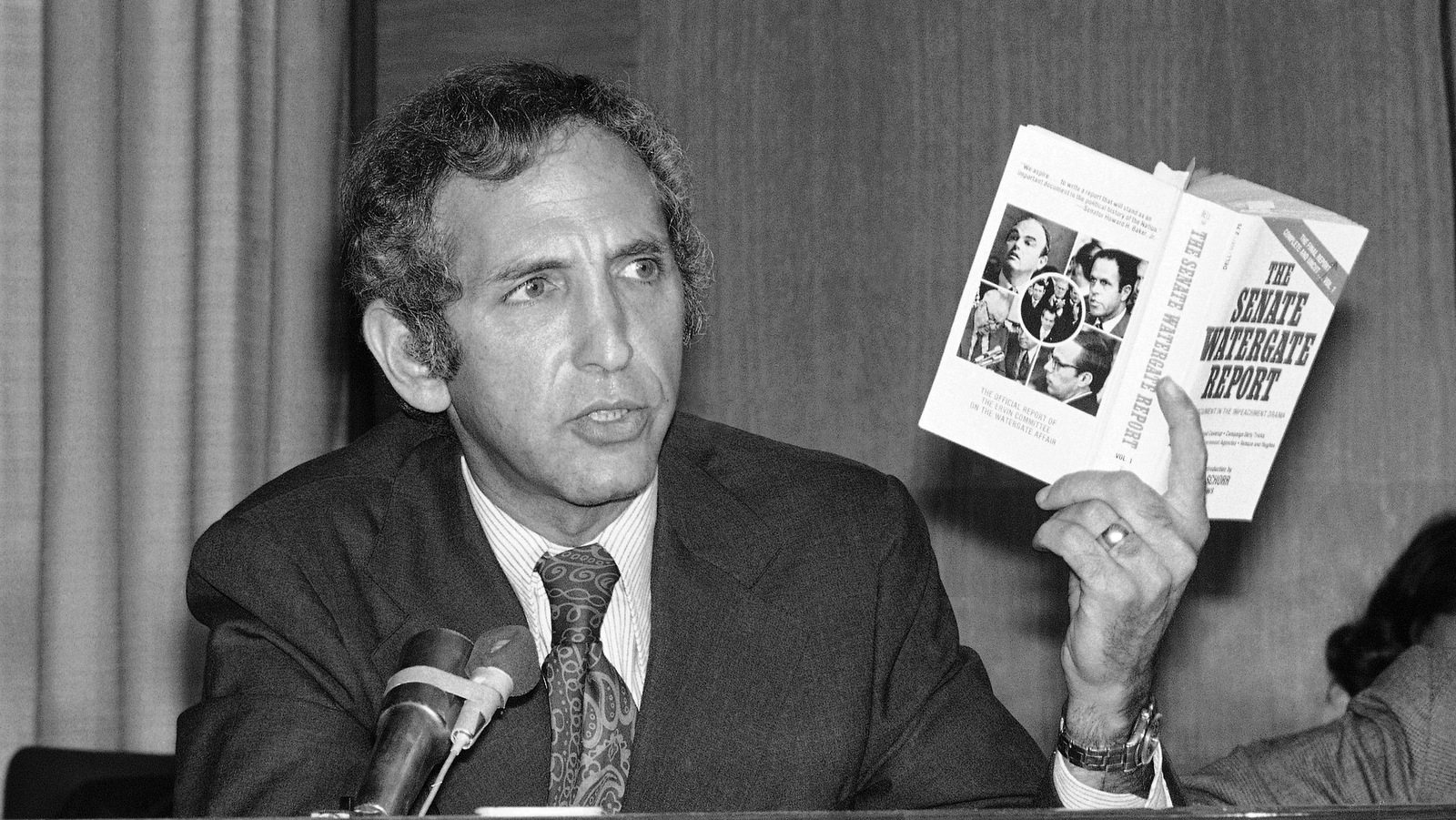
Daniel Ellsberg circa 1974 (Associated Press). A former assistant to John McNaughton (with authority commensurate to that of a lieutenant general), the Harvard PhD, RAND Corporation strategic analyst and experienced Vietnam hand was recruited to work on the project in 1967 by McNaughton's deputy, Morton Halperin. According to biographer Tom Wells, very little of Ellsberg's contributions appeared in the final study, with some colleagues going so far as to deprecate him as little more than a "kibitzer"; however, he retained access to one of the only copies of the classified report through RAND.
Many Inconsistencies
Their report runs to more than 7,000 pages—1.5 million words of historical narratives plus a million words of documents—enough to fill a small crate.
Even so, it is not a complete or polished history. It displays many inconsistencies and lacks a single all-embracing summary. It is an extended internal critique based on the documentary record; which the researchers did not supplement with personal interviews, partly because they were pressed for time.
The study emerged as a middle-echelon and official view of the war, incorporating material from the top-level files of the Defense Department into which flow papers from the White House, the State Department, the Central Intelligence Agency and the Joint Chiefs of Staff.
Some important gaps appear in the study. The researchers did not have access to the complete files of Presidents or to all the memorandums of their conversations and decisions.
Moreover, there is another important gap in the copy of the Pentagon study obtained by The New York Times: It lacks the section on the secret diplomacy of the Johnson period. But whatever its limitations, the Pentagon's study discloses a vast amount of new information about the unfolding American commitment to South Vietnam and the way in which the United States engaged itself in that conflict. It is also rich in insights into the workings of government and the reasoning of the men who ran it.
Throughout the narrative there Is ample evidence of vigorous, even acrimonious, debate within the Government —far more than Congress, the press and the public were permitted to discover from official pronouncements. But the Pentagon account and its accompanying documents also reveal that once the basic objective of policy was set, the internal debate on Vietnam from 1950 until mid-1967 dealt almost entirely with how to reach those objectives rather than with the basic direction of policy.
The study related that American governments from the Truman Administration onward felt it necessary to take action to prevent Communist control of South Vietnam. As a rationale for policy, the domino theory—that if South Vietnam fell, other countries would inevitably follow—was repeated in endless variations for nearly two decades.
Confidence and Apprehensions
Especially during the nineteen-sixties, the Pentagon study discloses, the Government was confident that Ameri-can power—or even the threat of its use—would bring the war under control.
But the study reveals that high officials in the Johnson Administration were troubled by the potential dangers of Chinese Communist intervention and felt the need for self-restraint to avoid provoking Peking, or the Soviet Union, into combat involvement.
As some top policy makers came to question the effectiveness of the American effort in mid-1967, the report shows, their policy papers began not only to seek to limit the military strategies on the ground and in the air but also to worry about the impact of the war on American society.
"A feeling is widely and strongly held that 'the Establishment' is out of its mind," wrote John T. McNaughton, Assistant Secretary of Defense, in a note to Secretary McNamara in early May, 1967. Mr. McNaughton, who three years earlier had been one of the principal planners of the air war against North Vietnam, went on to say: "The feeling is that we are trying to impose some U.S. image on distant peoples we cannot understand (any more than we can the younger generation here at home), and that we are carrying the thing to absurd lengths. Related to this feeling is the increased polarization that is taking place in the United States with seeds of the worst split in our people in more than a century."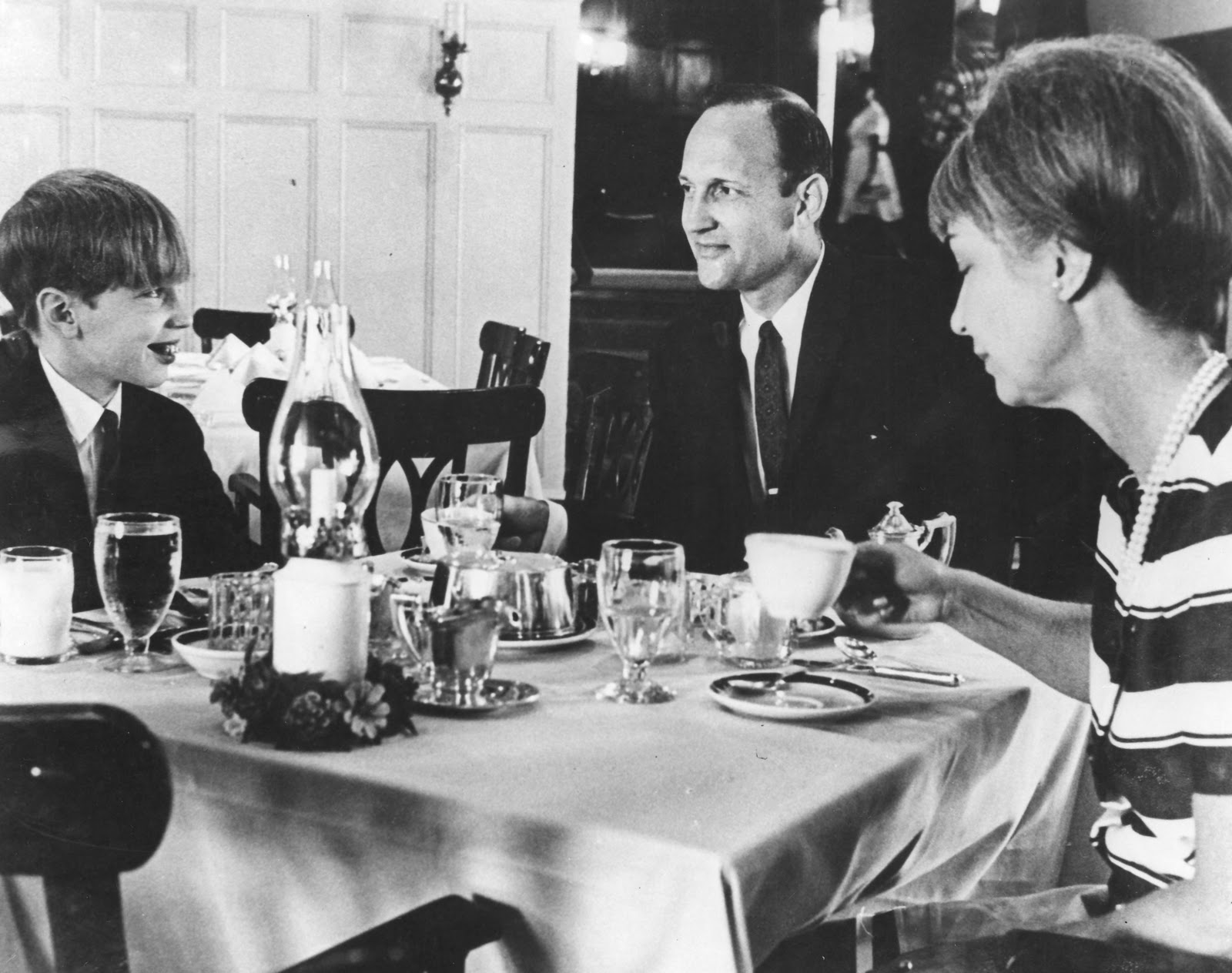
Assistant Secretary of Defense for International Security Affairs and Secretary-designate of the Navy John McNaughton at breakfast with his family on the day of the fatal plane crash that would take their lives, July 19, 1967 (Tom Paullin). A close confidante of McNamara (who considered him to be a potential successor) and a prospective 1968 Illinois gubenatorial candidate, the erstwhile Harvard Law School professor considered resigning his position due to his opposition to the war shortly after the May 1967 memo was circulated. Thereafter, immediately after Johns Hopkins University president Lincoln Gordon convinced him that staying in government was the more effective choice, McNaughton was promoted to the Navy post by President Johnson.
At the end of June, 1967, Mr. McNamara—deeply disillusioned with the war—decided to commission the Pentagon study of Vietnam policy that Mr. McNaughton and other high officials had encouraged him to undertake. Mr. McNamara's instructions, conveyed orally and evidently in writing as well, were for the researcher to pull together the Pentagon's documentary record and, according to one well-placed former official, to produce an "objective and encyclopedic" study of the American involvement.
Broadest Possible Interpretation
The Pentagon researchers aimed at the broadest possible interpretation of events. They examined not only the policies and motives of American administrations, but also the effectiveness of intelligence, the mechanics and consequences of bureaucratic compromises, the difficulties of imposing American tactics on the South Vietnamese, the governmental uses of the American press, and many other tributaries of their main story.
The authors reveal, for example, that the American intelligence community repeatedly provided the policy makers with what proved to be accurate warnings that desired goals were either unattainable or likely to provoke costly reactions from the enemy. They cite some lapses in the accuracy of reporting and intelligence, but give a generally favorable assessment of the C.I.A. and other intelligence units.
The Pentagon researchers relate many examples of bureaucratic compromise forged by Presidents from the conflicting proposals of their advisers. In the mid-fifties, they found the Joint Chiefs of Staff were a restraining force, warning that successful defense of South Vietnam could not be guaranteed under the limits imposed by the 1954 Geneva accords and agreeing to send in American military advisers only on the insistence of Secretary of State John Foster Dulles.
Mr. Johnson operated a split-level Government. Only his most intimate advisers were aware of the policy moves he was contemplating, and some of the most important officials at the second level of government—Assistant Secretaries of State and Defense—were late to learn the drift of the President's thinking.
In the nineteen-sixties, the report found, both Presidents Kennedy and Johnson chose partial measures, over-riding advice that some military proposals were valid only as packages and could not be adopted piecemeal.
In examining Washington's constant difficulties with the governments in Saigon, the study found the United States so heavily committed to the regime of the moment and so fearful of instability that it was unable to persuade the South Vietnamese to make the political and economic reforms that Americans deemed necessary to win the allegiance of the people.
Though it ranges widely to explain events, the Pentagon report makes no summary effort to put the blame for the war on any single administration or to find fault with individual officials.
The writers appear to have stood at the political and bureaucratic center of the period, directing their criticisms toward both left and right.
In one section, Senator Eugene J. McCarthy, the antiwar candidate for the 1968 Democratic Presidential nomination, is characterized as "impudent and dovish," and as an "upstart challenger." At another point in the same section the demands of Adm. U.S. Grant Sharp, commander of Pacific forces, for all-out bombing of North Vietnam, are characterized as "fulminations."
For the most part, the writers assumed a calm and unemotional tone, dissecting their materials in detached and academic manner. They ventured to answer key questions only when the evidence was at hand. They found no conclusive answers to some of the most widely asked questions about the war, including these:
Precisely how was Ngo Dinh Diem returned to South Vietnam in 1954 from exile and helped to power?
Who took the lead in preventing the 1956 Vietnam elections required under the Geneva accords of 1954—Mr. Diem or the Americans?
If President Kennedy had lived, would he have led the United States into a full-scale ground war in South Vietnam and an air war against North Vietnam as President Johnson did?
Was Secretary of Defense McNamara dismissed for opposing the Johnson strategy in mid-1967 or did he ask to be relieved because of disenchantment with Administration policy?
Did President Johnson's cutback of the bombing to the 20th Parallel in 1968 signal a lowering of American objectives for the war or was it merely an effort to buy more time and patience from a war-weary American public?
The research project was organized in the Pentagon's Office of International Security Affairs—I.S.A., as it is known to Government insiders—the politico-military affairs branch, whose head is the third-ranking official in the Defense Department. This was Assistant Secretary McNaughton when the study was commissioned and Assistant Secretary Paul C. Warnke when the study was completed.
'It Remained McNamara's Study'
In the fall of 1968, it was transmitted to Mr. Warnke, who reportedly "signed off" on it. Former officials say this meant that he acknowledged completion of the work without endorsing its contents and forwarded it to Mr. Clifford.
Although it had been completed during Mr. Clifford's tenure, "in everyone's mind it always remained Mr. McNamara's study," one official said.
Because of its extreme sensitivity, very few copies were reproduced—from 6 to 15, by various accounts. One copy was delivered by hand to Mr. McNamara, then president of the World Bank. His reaction is not known, but at least one other former policy maker was reportedly displeased by the study's candor.
Other copies were said to have been provided to President Johnson, the State Department and President Nixon's staff, as well as to have been kept for Pentagon files.
The authors, mostly working part-time over several months, were middle-level officials drawn from I.S.A., Systems Analysis, and the military staffs in the Pentagon, or lent by the State Department or White House staff. Probably two-thirds of the group had worked on Vietnam for the Government at one time or another.
Both the writing and editing were described as group efforts, through individuals with academic qualifications as historians, political scientists and the like were in charge of various sections.
For their research, the Pentagon depended primarily on the files of Secretary McNamara and Mr. McNaughton. William P. Bundy, former Assistant Secretary of State for Far Eastern Affairs, provided some of his files.
For extended periods, probably the most serious limitation of the Pentagon study is the lack of access to White House archives. The researchers did possess the Presidential decision papers that normally circulated to high Pentagon officials, plus White House messages to commanders or ambassadors in Saigon. These provide insight into Presidential moods and motives, but only intermittently.
An equally important handicap is that the Pentagon researchers generally lacked records of the oral discussions of the National Security Council or the most intimate gatherings of Presidents with their closest advisers, where decisions were often reached.
As the authors themselves remark, it is common practice for the final recommendations drafted before a key Presidential decision to be written to the President's spoken specifications on the basis of his reactions to earlier proposals. The missing link is often the meeting of the Administration's inner circle.
Also, because the Pentagon study draws almost entirely on internal Government papers, and primarily papers that circulated through the Defense Department, the picture of so important a figure as Secretary of State Dean Rusk remains shadowy. Mr. Rusk was known as a man who rarely committed himself to paper and who, especially during the Johnson Administration, saved his most sensitive advice for solitary talks with the President.
In the late months of the Johnson Administration, the lack of records of such meetings is a considerable weakness because, as the survey comments, Mr. Johnson operated a split-level Government. Only his most intimate advisers were aware of the policy moves he was contemplating, and some of the most important officials at the second level of government—Assistant Secretaries of State and Defense—were late to learn the drift of the President's thinking.
The Pentagon account notes that at times the highest Administration officials not only kept information about their real intentions from the press and Congress but also kept secret from the Government bureaucracy the real motives for their written recommendations or actions.
"The lesson in this," one Pentagon analyst observes, "is that the rationales given in such pieces of paper (intended for fairly wide circulation among 'the bureaucracy, as opposed to tightly 11.0.1d memoranda limited to those closest, to the decision maker), do not reliably in-dicate why recommendations sxiere made the way they were." The words in parentheses are the analyst's.
Another omission is the absence of any extended discussion of military or political responsibility for such matters as civilian casualties or the restraints imposed by the rules of land warfare. .
Necessarily Fragmented Account
The approach of the writers varies markedly from section to section. Some of the writers are analytical and incisive. Others offer narrative compendiums of the most important available documents for their periods, with little comment or interpretation.
As a bureaucratic history, this account is necessarily fragmented. The writers either lacked time or did not choose to provide a coherent, integrated summary analysis for each of 'the four administrations that became involved in Vietnam from 1950 to 1968.
The Pentagon account divides the Kennedy period, for example, into five sections—dealing with the key decisions of 1961, the strategic-hamlet programs, the buildup of the American advisory mission in Vietnam, the development of plans for phased American withdrawal, and the coup that ousted President Diem.
In the Johnson era, four simultaneous stories are told in separate sections—the land war in South Vietnam, the air war against the North, political relations with successive South Vietnamese governments and the secret diplomatic search for negotiations. There is some overlapping, but no single section tries to summarize or draw together the various strands.
The overall effect of the study, nonetheless, is to provide a vast storehouse of new information—the most complete and informative central archive available thus far on the Vietnam era.
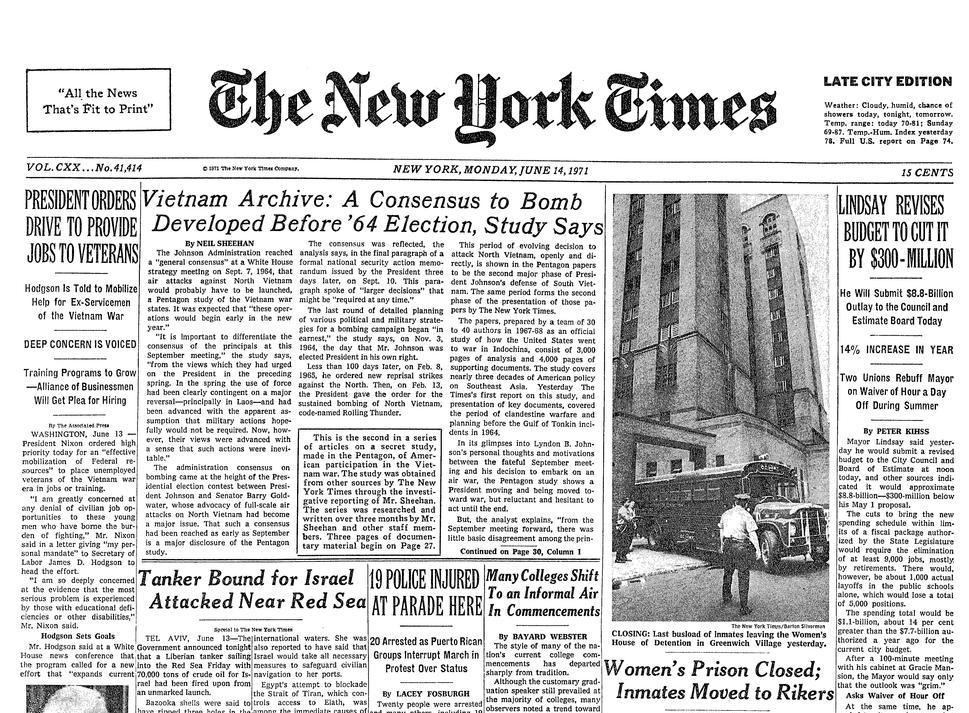
June 14, 1971 edition of The New York Times.
By Neil Sheehan
The New York Times
June 14, 1971
The Johnson Administration reached a "general consensus" at a White House strategy meeting on Sept. 7, 1964, that air attacks against North Vietnam would probably have to be launched, a Pentagon study of the Vietnam war states. It was expected that "these operations would begin early in the new year."
"It is important to differentiate the consensus of the principals at this September meeting," the study says, "from the views which they had urged on the President in the preceding spring. In the spring the use of force had been clearly contingent on a major reversal—principally in Laos—and had been advanced with the apparent assumption that military actions hopefully would not be required. Now, however, their views were advanced with a sense that such actions were inevitable."
The administration consensus on bombing came at the height of the Presidential election contest between President Johnson and Senator Barry Goldwater, whose advocacy of full-scale air attacks on North Vietnam had become a major issue. That such a consensus had been reached as early as September is a major disclosure of the Pentagon study.
The consensus was reflected, the analysis says, in the final paragraph of a formal national security action memorandum issued by the President three days later, on Sept. 10. This paragraph spoke of "larger decisions" that might be "required at any time."
The last round of detailed planning of various political and military strategies for a bombing campaign began "in earnest," the study says, on Nov. 3, 1964, the day that Mr. Johnson was elected President in his own right. Less than 100 days later, on Feb. 8, 1965, he ordered new reprisal strikes against the North. Then, on Feb. 13, the President gave the order for the sustained bombing of North Vietnam, code-named Rolling Thunder.
This period of evolving decision to attack North Vietnam, openly and directly, is shown in the Pentagon papers to be the second major phase of President Johnson's defense of South Viet-nam. The same period forms the second phase of the presentation of those papers by The New York Times.
The papers, prepared by a team of 30 to 40 authors in 1967-68 as an official study of how the United States went to war in Indochina, consist of 3,000 pages of analysis and 4,000 pages of supporting documents. The study covers nearly three decades of American policy on Southeast Asia. Yesterday The Times's first report on this study, and presentation of key documents, covered the period of clandestine warfare and planning before the Gulf of Tonkin incidents in 1964.
In its glimpses into Lyndon B. Johnson's personal thoughts and motivations between the fateful September meeting and his decision to embark on an air war, the Pentagon study shows a President moving and being moved toward war, but reluctant and hesitant to act until the end.
But, the analyst explains, "from the September meeting forward, there was little basic disagreement among the principals [the term the study uses for the senior policy makers] on the need for military operations against the North. What prevented action for the time being was a set of tactical considerations."
The first tactical consideration, the analyst says, was that "the President was in the midst of an election campaign in which he was presenting himself as the candidate of reason and restraint as opposed to the quixotic Barry Goldwater," who was publicly advocating full-scale bombing of North Vietnam. The historian also mentions other “temporary reasons of tactics":
The "shakiness" of the Saigon Government.
A wish to hold the line militarily and diplomatically in Laos.
The "need to design whatever actions were taken so as to achieve maximum public and Congressional support…”
The “implicit belief that overt actions at this time might bring pressure for premature negotiations—that is negotiations before the D.R.V. [Democratic Republic of (North) Vietnam] was hurting."
Assistant Secretary of Defense John T. McNaughton, the head of the Pentagon's Office of International Security Affairs, summed up these tactical considerations in the final paragraph of a Sept. 3 memorandum to Secretary of Defense Robert S. McNamara, in preparation for the crucial White House strategy session four days later:
"Special considerations during the next two months. The relevant audiences of U. S. actions are the Communists (who must feel strong pressures), the South Vietnamese (whose morale must be buoyed), our allies (who must trust us as 'underwriters'), and the U.S. public (which must support our risk-taking with U. S. lives and pres-tige). During the next two months, because of the lack of 'rebuttal time' before election to justify particular actions which may be distorted to the U. S. public, we must act with special care—signaling to the D.R.V. that initiatives are being taken, to the G.V.N. [Government of (South) Vietnam] that we are behaving energetically despite the restraints of our political season, and to the U. S. public that we are behaving with good purpose and restraint." The words in parentheses are Mr. McNaughton's.
The New York Times
June 14, 1971
The memorandum itself is not this explicit, although it does seem to suggest attempting to repeat the Tonkin Gulf clashes as a pretext for escalation.
The President was already communicating this sense of restraint to the voters. On the night of Aug. 29, in an address to a crowd at an outdoor barbecue a few miles from his ranch in Texas, when two tons of beef were served in a belated celebration of his 56th birthday, he made a statement that he was to repeat in numerous election speeches.
“I have had advice to load our planes with bombs," the President said, "and to drop them on certain areas that I think would enlarge the war and escalate the war, and result in our committing a good many American boys to fighting a war that I think ought to be fought by the boys of Asia to help protect their own land."
The policy of the United States toward Vietnam, the President explained later in his speech, was "to furnish advice, give counsel, express good judgment, give them trained counselors, and help them with equipment to help themselves."
'It Is a War and a Big War'
“We are doing that," he said. "We have lost less than 200 men in the last several years, but to each one of those 200 men—and we lost about that many in Texas on accidents on the Fourth of July—to each of those 200 men who have given their life to preserve freedom, it is a war and a big war and we recognize it.
"But we think it is better to lose 200 than to lose 200,000. For that reason we have tried very carefully to restrain ourselves and not to enlarge the war."
Eleven days earlier, on Aug. 18, Ambassador Maxwell D. Taylor had cabled from Saigon that he agreed with an "assumption" now held in the Administration in Washington that the Vietcong guerrillas—the VC, as they were usually termed—could not be defeated and the Saigon Government preserved by a counterguerrilla war confined to South Vietnam itself.
"Something must be added in the coming months," the Ambassador said in his message. What General Taylor proposed to add was "a carefully orchestrated bombing attack on NVN [North Vietnam], directed primarily at infiltration and other military targets" with "Jan. 1, 1965, as a target D-Day."
The bombing should be undertaken under either of two courses of action, the Ambassador said. The first course would entail using the promise of the air attacks as an inducement to persuade the regime of Gen. Nguyen Khanh to achieve some political stability and get on seriously with the pacification program. Under the second course, the United States would bomb the North, regardless of whatever progress General Khanh made, to prevent "a collapse of national morale" in Saigon.
For the Ambassador cautioned that "it is far from clear at the present moment that the Khanh Government can last until Jan. 1, 1965." The Ambassador said that before bombing the North the United States would also have to send Army Hawk antiaircraft missile units to the Saigon and Danang areas to protect the airfields there against retaliatory Communist air attacks—assumed possible from China or North Vietnam—and to land a force of American Marines at Danang to protect the air base there against possible ground assaults.
His cable was designated a joint United States mission message, meaning that Deputy Ambassador U. Alexis Johnson and Gen. William C. Westmoreland, chief of the United States Military Assistance Command, had concurred with the Ambassador's views.
On Aug. 26, three days before the President's speech at the barbecue in Stonewall, Tex., the Joint Chiefs of Staff submitted a memorandum to Secretary McNamara agreeing with Ambassador Taylor. They said that bombing under his second criterion, to stave off a breakdown in Saigon, was "more in accord with the current situation" in their view and added that an air war against the North was now "essential to prevent a complete collapse of the U.S. position in Southeast Asia."
The Joint Chiefs' memorandum was the first appearance, the account says, of a "provocation strategy" that was to be discussed at the Sept. 7 White House session—in the words of the nar-rative, "deliberate attempts to provoke the D.R.V. into taking actions which could then be answered by a systematic U.S. air campaign."
The memorandum itself is not this explicit, although it does seem to suggest attempting to repeat the Tonkin Gulf clashes as a pretext for escalation.
In a Sept. 3 memorandum to Secretary McNamara, however, Mr. McNaughton was specific. He outlined several means of provocation that could culminate in a sustained air war. In the meantime, they could be employed to conduct reprisal air strikes that would help hold the situation in South Vietnam together and, the analyst notes, permit postponing "probably until November or December any decision as to serious escalation."
Defines Serious Escalation
This serious escalation Mr. McNaughton defined as "a crescendo of GVN-U.S. military actions against the D.R.V.," such as mining harbors and gradually escalating air raids.
He described his provocation program to Mr. McNamara as "an orchestration of three classes of actions, all designed to meet these five desiderata—(1) From the U.S., GVN and hopefully allied points of view they should be legitimate things to do under the circumstances, (2) they should cause apprehension, ideally in-creasing apprehension, in the D.R.V., (3) they should be likely at some point to provoke a military D.R.V. response, (4) the provoked response should be likely to provide good grounds for us to escalate if we wished, and (5) the timing and crescendo should be under our control, with the scenario capable of being turned off at any time."
The classes of actions were:
South Vietnamese air strikes at enemy infiltration routes through southeastern Laos that would "begin in Laos near the South Vietnamese border and slowly 'march' up the trails and eventually across the North Vietnamese border."
A resumption of the covert coastal raids on North Vietnam under Operation Plan 34A, which President Johnson had temporarily suspended since the Tonkin Gulf incident. The South Vietnamese Government would announce them publicly, declaring them "fully justified as necessary to assist in interdiction of infiltration by sea."
A resumption of patrols in the Gulf of Tonkin by United States destroyers, code-named De Soto patrols, although these would still be physically "disassociated" from the 34A attacks. Mr. McNaughton noted that "the U.S. public is sympathetic to reasonable insistence on the right of the U.S. Navy to ply international waters."
Majority in Disagreement
But a majority of the officials at the Sept. 7 White House strategy meeting disagreed. They decided for the present against adopting a provocation strategy for reprisal air attacks, precisely be-cause the Khanh regime was so weak and vulnerable and the morale-lifting benefits of such strikes might be offset by possible Communist retaliation, the analyst says, The meeting was attended by the President; Secretary of State Dean Rusk; Secretary McNamara; Gen. Earle G. Wheeler, the new Chairman of the Joint Chiefs; Ambassador Taylor, who had flown in from Saigon, and John A. McCone, the Director of Central Intelligence.
"We believe such deliberately provocative elements should not be added in the immediate future while the GVN is still struggling to its feet," Assistant Secretary of State William P. Bundy wrote in a memorandum recording the consensus recommendations formally made to the President after the meeting. "By early October, however, we may recommend such actions depending on GVN progress and Communist reaction in the meantime, especially to U.S. naval patrols." A resumption of the destroyer patrols was one outcome of the Sept. 7 meeting.
The analyst says that a similar reason was given for the decision against beginning a sustained bombing campaign against the North, with or without a provocation strategy, in the near future. "The GVN over the next 2-3 months will be too weak for us to take any major deliberate. risks of escalation that would involve a major role for, or threat to, South Vietnam," the Bundy memorandum states.
Ambassador Taylor had acknowledged in his cable of Aug. 18 that bombing the North to prevent a collapse in the South if the Khanh regime continued to decline "increases the likelihood of U.S. involvement in ground action since Khanh will have almost no available ground forces which can be released from pacification employment to mobile resistance of D.R.V. attacks."
'A Base for Wider Action'
The Pentagon account concludes from the Sept. 7 strategy discussions that by now the Saigon regime was being regarded less and less as a government capable of defeating the Vietcong insurgency than "in terms of its suitability as a base for wider action."
Despite the pessimistic analyses of Ambassador Taylor and the Joint Chiefs for future escalation, some of those at the White House meeting hoped the Khanh regime could be somewhat stabilized. Citing handwritten notes of the meeting in the Pentagon files, the analyst quotes Mr. McNamara as saying that he understood "we are not acting more strongly because there is a clear hope of strengthening the GVN."
"But he went on," the account continues, "to urge that the way be kept open for stronger actions even if the GVN did not improve or in the event the war were widened by the Communists."
The handwritten notes of the meeting quote the President as asking, "Can we really strengthen the GVN?" And in his memorandum of the consensus, William Bundy wrote: "Khanh will probably stay in control and may make some headway in the next 2-3 months in strengthening the Government (GVN). The best we can expect is that he and the GVN will be able to maintain order, keep the pacification program ticking over (but not progressing markedly), and give the appearance of a valid government."
On Sept. 10, therefore, the President ordered a number of interim measures in National Security Action Memorandum 314, issued over the signature of his special assistant, McGeorge Bundy. These were intended, in the words of William Bundy's memorandum of consensus, "to assist morale in SVN and show the Communists we still mean business, while at the same time seeking to keep the risks low and under our control at each stage."
A Reflection of Consensus
The most important orders Mr. Johnson gave dealt with covert measures. The final paragraph in the President's memorandum also reflected the consensus, the analyst finds, of the Sept. 7 meeting and other strategy discussions of the time—"the extent to which the new year was anticipated as the occa-sion for beginning overt military operations against North Vietnam."
This final paragraph read: "These decisions are governed by a prevailing judgment that the first order of business at present is to take actions which will help to strengthen the fabric of the Government of South Vietnam; to the extent that the situation permits, such action should precede larger decisions. If such larger decisions are required at any time by a change in the situation, they will be taken."
The interim measures Mr. Johnson ordered included these:
Resumption of the De Soto patrols by American destroyers in the Tonkin Gulf. They would "operate initially well beyond the 12-mile limit and be clearly disassociated from 34A maritime operations," but the destroyers "would have air cover from carriers."
Reactivation of the 34A coastal raids, this time after completion of the first De Soto patrol. The directive added that "we should have the GVN ready to admit they are taking place and to justify and legitimize them on the basis of the facts of VC infiltration by sea." The account explains, "It was believed that this step would be useful in establishing a climate of opinion more receptive to expanded (air) operations against North Vietnam when they became necessary." The word in parentheses is the study's.
An arrangement with the Laotian Government of Premier Souvanna Phouma to permit "limited GVN air and ground operations into the corridor areas of [southeastern] Laos, together with Lao air strikes and possible use of U.S. armed aerial reconnaissance." Armed aerial reconnaissance is a military operation in which the pilot has authority to attack unprogrammed targets, such as gun installations or trucks, at his own discretion.
The United States "should be prepared" to launch "tit for tat" reprisal air strikes like those during the Tonkin Gulf incident "as appropriate against the D.R.V. in the event of any attack on U.S. units or any special D.R.V.-VC ac-tion against SVN."
The President also ordered "economic and political actions" in South Vietnam, such as pay raises for Vietnamese civil servants out of American funds, to try to strengthen the Saigon regime.
The United States destroyers Morton and Edwards resumed the De Soto patrols in the Tonkin Gulf on Sept. 12, two days after Mr. Johnson's directive. They were attacked in a third Tonkin incident on the night of Sept. 18, and the President glossed over it.
However, he went ahead with his decision to resume the 34A coastal raids, still covertly, the account says. The order to reactivate them was issued by Mr. Johnson on Oct. 4, with the specification that they were to be con-ducted under tightened American controls.
Each operation on the monthly schedules now had to be "approved in advance" by Deputy Secretary of Defense Cyrus R. Vance for Secretary McNamara, Llewellyn A. Thompson, acting Deputy Under Secretary of State for Political Affairs, for Secretary Rusk, and McGeorge Bundy at the White House for the President. During October, a subsequent report to William Bundy on covert activities said, the 34A coastal raids consisted of two shallow probes of North Vietnamese defenses, an attempt to capture a junk, and successful shellings of the radar station at Vinhson and the observation post at Muidao.
2 Sabotage Actions
Two of the sabotage teams that had previously been parachuted into the North also "carried out successful actions during October," the report said. "One demolished a bridge, the other ambushed a North Vietnamese patrol. Both teams suffered casualties, the tit-for-tat sufficient to cast doubt on the wisdom of the action."
The U-2 spy plane flights over North Vietnam and the parachuting of supplies and reinforcements to sabotage and psychological warfare teams in the North continued throughout this period and had not been affected by the President's suspension of the coastal raids after the original Tonkin Gulf incident.
The covert step-up in the air operations in Laos ordered by the President did not take place until mid-October. The Pentagon account says that one reason for the delay was the Administration's need to "await the uncertain outcome" of negotiations then taking place in Paris between the right-wing, neutralist and pro-Communist factions in Laos. The objective of the talks was to arrange a cease-fire that might lead to a new 14-nation Geneva conference to end the Laotian civil war.
"However, a Laotian cease-fire was not compatible with current perceptions of U.S. interest," the analyst writes.
The Administration feared that during an ensuing Geneva conference on Laos, international pressures, particularly from the Communist countries, might force the discussions onto the subject of Vietnam. Negotiations in the present circumstances were considered certain to unravel the shaky anti-Communist regime in Saigon.
The Administration also believed that even the convening of a conference on Laos might create an impression in Saigon that Washington was going to seek a negotiated withdrawal from South Vietnam and set off a political collapse there and the emergence of a neutralist coalition regime that would ask the United States to leave.
Breakdown in Negotiations
The account notes that in his Aug. 11 high-level policy memorandum on Southeast Asia, William Bundy had "characterized U. S. strategy" toward the Paris talks with the statement that "we should wish to slow down any progress toward a conference and to hold Souvanna to the firmest possible position." Mr. Bundy had referred to a suggestion by Ambassador Leonard Unger that Prince Souvanna Phouma insist on three-faction administration of the Plaine des Jarres as "a useful delaying gambit."
"Significantly," the analyst says, "this proposal was advanced at Paris by Sow/alma Phouma on 1 September—illustrating the fact that Souvanna was carefully advised by U.S. diplomats both prior to and during the Paris meetings. Other features of Souvanna's negotiating posture which apparently were encouraged as likely to have the effect of drawing out the discussions were insistence on Communist acceptance of (1) Souvanna's political status as Premier and (2) unhampered operations by the I.C.C. [International Control Commission]."
"Insistence on Souvanna's position is another point on which he should insist, and there would also be play in the hand on the question of free I.C.C. operations," Mr. Bundy wrote in his Aug. 11 memorandum.
"It will be recalled that the latter point was the issue on which progress toward a cease-fire became stalled," the analyst remarks. The negotiations broke clown in Paris late in September. American mission representatives from Bangkok and Vientiane met in Saigon on Sept. 11 under Ambassador Taylor's auspices, however, and decided that the South Vietnamese Air Force should not participate in the stepped-up air action in Laos authorized by the President in his directive of Sept. 10.
A list of 22 targets in the Laotian panhandle had been drawn up during the summer for the possibility of such raids, including one on a, control point at the Mugia Pass, just across the North Vietnamese border.
South Vietnamese air strikes would offend Premier Souvanna Phouma by complicating his political position, the meeting determined, so the air attacks would be confined to clandestine raids by the T-28s in Laos and the United States Navy and Air Force jets—code-named Yankee Team—operating over Laos. Accord was also reached that South Vietnamese troops, possibly accompanied by American advisers, would also make ground forays into Laos up to a depth of 20 kilometers, or 12 miles.
"The mission representatives agreed that, once the [air and ground] operations began, they should not be acknowledged publicly," the analyst writes. "In effect, then, they would supplement the other covert pressures being exerted against North Vietnam. Moreover, while the Lao Government would of course know about the operations of their T-28s, Souvanna was not to be informed of the GVN/U.S. [ground] operations. The unacknowledged nature of these operations would thus be easier to maintain."
Joint Departmental Message
On Oct. 6, a joint State and Defense Department message authorized Ambassador Unger in Laos to obtain Premier Souvanna Phouma's approval for the T-28 strikes "as soon as possible."
But as the analyst points out, the message showed that the President had decided to postpone the accompanying strikes by Yankee Team jets, the "U. S. armed aerial reconnaissance" mentioned in Mr. Johnson's National Security Action Memorandum 314.
Five of the targets in the Laotian panhandle, well-defended bridges, had been specifically marked for the American jets, and fire by the Yankee Team planes would also be required against antiaircraft batteries defending the Mugia Pass. The message from Washing-ton excluded these targets from the list of 22.
"You are further authorized to in-form Lao that Yankee Team suppressive-fire strikes against certain difficult targets in panhandle, interspersing with further T-28 strikes, are part of the overall concept and are to be anticipated later, but that such U. S. strikes are not repeat not authorized at this time," the cable said.
Ambassadors Unger and Taylor both warned that the Laotian Government, without some participation by the American jets, would not persevere in attacking targets on the Communist infiltration routes. Accordingly, the day before the T-28 strikes began on Oct. 14 with Premier Souvanna Phouma's approval, Washington authorized the Yankee Team jets to fly combat air patrol over the T-28s to raise morale and protect them from any interference by North Vietnamese MIGs.
'Minor Extension' Only
Ambassador Taylor said in his cable that the combat air patrol missions could be achieved by "a relatively minor extension" of the current rules of engagement for American aircraft in Indochina.
The President also postponed for the present the planned ground forays into Laos by the South Vietnamese. Ambassador Taylor pointed out in a cable on Oct. 9 that these would not be possible "in foreseeable future" in any case because the South Vietnamese Army was so tied down fighting the guerrillas in its own country.
Several eight-man South Vietnamese reconnaissance teams were parachuted into Laos in an operation called Leaping Lena, but the Nov. 7 report to William Bundy on covert operations would note that "all of these teams were located by the enemy and only four survivors returned…”
On Nov. 1, two days before the election, the Vietcong struck with a devastating mortar barrage on American planes and facilities at Bienhoa airfield near Saigon. The attack put the President under great internal pressure, the analyst says, to strike back openly, as he had said in his directive of Sept. 10 that he was prepared to do In the event of any attack on U.S. units or any special D.R.V./VC action against SVN."
In the enemy's barrage, four Americans were killed, five B-57 bombers were destroyed and eight damaged. These were some of the B-57s that had earlier been sent from Japan to the Philippines at Mr. McNamara's suggestion as part of the preparations for possible bombing of the North. They had since been moved into South Vietnam, however, to try to shore up the Khanh Government's military position by bringing more air power to bear upon the Vietcong.
"As of the end of October (in anticipation of resumed De Soto patrols), elements of our Pacific forces were reported as 'poised and ready' to execute reprisals for any D.R.V. attacks on our naval vessels. Thus, there was a rather large expectancy among Administration officials that the United States would do something in retaliation," the analyst writes. The words in parentheses are his.
'Change of Ground Rules'
The Joint Chiefs told Mr. McNamara that the Bienhoa attack had been "a deliberate act of escalation and a change of the ground rules under which the VC had operated up to now." Asserting that "a prompt and strong response is clearly justified," they proposed, on the same day as the incident, "that the following specific actions be taken" (the words in parentheses are those of the Joint Chiefs; words in brackets have been inserted by The Times for clarification):
"a. Within 24.36 hours Pacific Command (PACOM) forces take initial U.S. military actions as follows:
(1) Conduct air strikes in Laos against targets No. 3 (Thhepone bar-racks, northwest), No. 4 (Tchepone military area), No. 19 (Banthay military area), No. 8 (Nape highway bridge), and the Banken bridge on Route 7.
"(2) Conduct low-level air reconnais-sance of infiltration routes and of targets in North Vietnam south of Latitude 19 degrees.
"b. Prior to air attacks on the D.R.V., land the Marine special landing forces at Danang and airlift Army or Marine units from Okinawa to the Saigon-Tansonnhut-Bienhoa area to provide increased security for US personnel and installations.
"c. Use aircraft engaged in airlift (subparagraph b, above) to assist in evacuation of U.S. dependents from Saigon, to, commence concurrently with the daylight air strikes against the D.R.V. (subparagraph d, below).
"d. Assemble and prepare necessary forces so that:
"(1) Within 60 to 72 hours, 30 B-52s from Guam conduct a night strike on D.R.V. target No. 6 (Phucyen airfield). [Phucyen, 13 miles from Hanoi, is the principal North Vietnamese air base].
"(2) Commencing at first light on the day following subparagraph (1) above, PACOM air and naval forces conduct air strikes against D.R.V. targets No. 6 (Phucyen airfield) (daylight follow-up on the above. night strike), No. 3 (Hanoi Gialam airfield), No. 8 (Haiphong. Catbi airfield), No. 48 (Haiphong POL), and No. 49 (Hanoi POL). [POL is a military abbreviation for petroleum, oil and lubricants.]
"(3) Concurrently with subparagraph (2) above the Vietnamese Air Force (VNAF) will strike DRV target No. 36 (Vitthulu barracks).
"(4) Combat air patrols (CAP), flak suppressive, fire, strike photographic reconnaissance, and search and rescue operations (S.A.R.) are conducted as appropriate.
"(5) The above actions are followed by "(a) Armed reconnaissance on infiltration routes in Laos.
"(b) Air strikes against infiltration routes and targets in the D.R.V.
"(c) Progressive PACOM and SAC [Strategic Air Command] strikes against the targets listed in 94 Target Study.
"(e) Thai bases be used as necessary in connection with the foregoing, with authority to be obtained through appropriate channels….
"Recognizing that security of this plan is of critical importance, they [the Joint Chiefs] consider that external agencies, such as the VNAF, should be apprised only of those parts of the plan, neces-sary to insure proper and effective co-ordination. The same limited revelation of plans should govern discussions with the Thais in securing authority for unlimited use of Thai bases."
Caution From Saigon
From Saigon, Ambassador Taylor cabled for a more restrained response consisting of "retaliation bombing attacks on selected D.R.V. targets" using both American and South Vietnamese planes and for a "policy statement that we will act similarly in. like cases in the future."
But the President felt otherwise for the moment. "Apparently, the decision was made to do nothing," the analyst says, adding that the documentary evidence does not provide an adequate explanation.
At a White House meeting the same day, the account continued, the President expressed concern that United States retaliatory strikes might bring counter-retaliation by North Vietnam or China against American bases and civilian dependents in the South.
In briefing the press, Administration officials, unidentified in the study, drew a contrast "between this incident and the Tonkin Gulf attacks where our destroyers were ‘on United States business.’"
"A second [White House] meeting to discuss possible U.S. actions was 'tentatively scheduled' for 2 November, but the available materials contain no evidence that it was held," the account continues. "President Johnson was scheduled to appear in Houston that afternoon, for his final pre-election address, and it may be that the second White House meeting was called off."
“One thing is certain," the writer concludes. "There were no retaliatory strikes authorized following the attack on the U.S. bomber base.”
A Panel Under Bundy
But the President had not altogether declined to act on Nov. 1. He had appointed an interagency working group under William Bundy to draw up various political and military options for direct action against North Vietnam. This was the one "concrete result" of the Nov. 1 mortar raid on Bienhoa, the account reports.
The Bundy working group, as it would be unofficially called in the Government, held its first meeting at 9:30 A.M. on Nov. 3, the day that Mr. Johnson was elected to the Presidency in his own right by a huge landslide.
"Bienhoa may be repeated at any time," Mr. Bundy wrote in a memorandum to the group on Nov. 5. "This would tend to force nur hand, but would also give us a good springboard for any decision for stronger action. The President is clearly thinking in terms of maximum use of a Gulf of Tonkin rationale, either for an action that would show toughness and hold the line. till we can decide the big issue, or as a basis for starting a clear course of action under the broad options."
Ostensibly, the Bundy group had a mandate to re-examine the entire American policy toward Vietnam and to recommend to the National Security Council a broad range of options. Its membership represented the entire foreign-policy-making machine of the Government—Mr. Bundy; Marshall Green; Michael V. Forrestal, head of the inter-agency Vietnam coordinating committee; and Robert Johnson of the State Department; Mr. McNaughton from the civilian hierarchy of the Pentagon; Vice Adm. Lloyd M. Mustin from the Joint Chiefs' staff and Harold Ford of the Central Intelligence Agency.
But, the account says, "there appears to have been, in fact, remarkably little latitude for reopening the basic question about U.S. involvement in the Vietnam struggle."
The basic national objective of "an independent, non-Communist South Vietnam," established by the President's National Security Action Memorandum 288 of the previous March, "did not seem open to question.”
The New York Times
June 14, 1971
The September discussions had established a consensus that bombing of the North "would be required at some proximate future date for a variety of reasons" and individual and institutional pressures all tended to harden the options toward this end as they were finally presented to the National Security Council and then the President.
The analyst gives a number of examples of this stiffening process from the successive draft papers developed by the group during its three weeks of deliberations. "The extreme withdrawal option was rejected almost without surfacing for consideration" because of its conflict with the policy memorandums. "Fallback positions" outlined in an original working-group draft suffered a similar fate.
First Fallback Position
The first fallback position, the study says, "would have meant holding the line—placing an immediate, low ceiling on the number of U.S. personnel in SVN, and taking vigorous efforts to build on a stronger base elsewhere, possibly Thailand."
"The second alternative would have been to undertake some spectacular, highly visible supporting action like a limited-duration selective bombing campaign as a last effort to save the South; to have accompanied it with a propaganda campaign about the unwinnability of the war given the GVN's ineptness and, then, to have sought negotiations through compromise and neutralization when the bombing failed."
But because of "forceful objections" by Admiral Mustin, the Joint Chiefs representative, both of these possibilities were downgraded in the final paper presented to the National Security Council on Nov. 21. In effect they were "rejected before they were fully explored," the study says.
Thus all three options, labeled A, B and C, entailed some form of bombing, with "the distinctions between them" tending to blur as they evolved during the group's three weeks of deliberations, the analyst says. Mr. McNaughton and William Bundy collaborated closely on their formulation.
A similar convergence occurred on the question of negotiations.
The Minimum Position
Here the minimum United States position was defined as forcing Hanoi to halt the insurgency in the South and to agree to the establishment of a secure, non-Communist state there, a position the analyst defines as "acceptance or else." Moreover, talks of any kind with :lanai were to be avoided until the effects of bombing had put the United States into a position to obtain this minimum goal in negotiations.
"The only option that provided for bargaining in the usual sense of the word was Option C," the study says. Here the United States would be willing to bargain away international supervisory machinery to verify Hanoi's agreement.
"The policy climate in Washington simply was not receptive to any suggestion that U.S. veils might have to be compromised," the study comments.
These are the options in their final form as the study summarizes them:
OPTION A—Conduct U.S. reprisal air strikes on North Vietnam "not only against any recurrence of VC 'spectaculars' such as Bienhoa," intensify the coastal raids of Operation Plan 34A, resume the destroyer patrols in the gulf, step up the air strikes by T-28s against infiltration targets in Laos and seek reforms in South Vietnam.
OPTION B—What Mr. McNaughton called "a fast/full squeeze." Bomb the North "at a fairly rapid pace and without interruption," including early air raids on Phucyen. Airfield near Hanoi and key bridges along the road and rail links with China until full American demands are met. "Should pressures for negotiations become too formidable to resist and discussion begin before a Communist agreement to comply," the analyst writes "it was stressed that the United States should define its negotiating position in a way which makes Communist acceptance unlikely. In this manner it would be 'very likely that the conference would break up rather rapidly,' thus enabling our military pressures to be resumed.”
OPTION C—Mr., McNaughton's "slow squeeze"; the option he and William Bundy favored. Gradually increasing air strikes "against infiltration targets, first in Laos and then in the D.R.V., and then against other. targets in North Vietnam" intended to "give the impression of a steady deliberate approach… designed to give the United States the option at any time to proceed or not, to escalate or not and to 'quicken the pace or not." This option also included the possibility of a "significant ground deployment to the northern part of South Vietnam" as an additional bargaining counter.
A Select Committee Meets
On Nov. 24, a select committee of the National Security Council met to discuss the option papers formally. presented to the council three days earlier. This group comprised Secretaries Rusk and McNamara, Mr. McCone, General Wheeler, McGeorge Bundy and Under Secretary of State George W. Ball. William Bundy attended to keep a record and to represent the working group.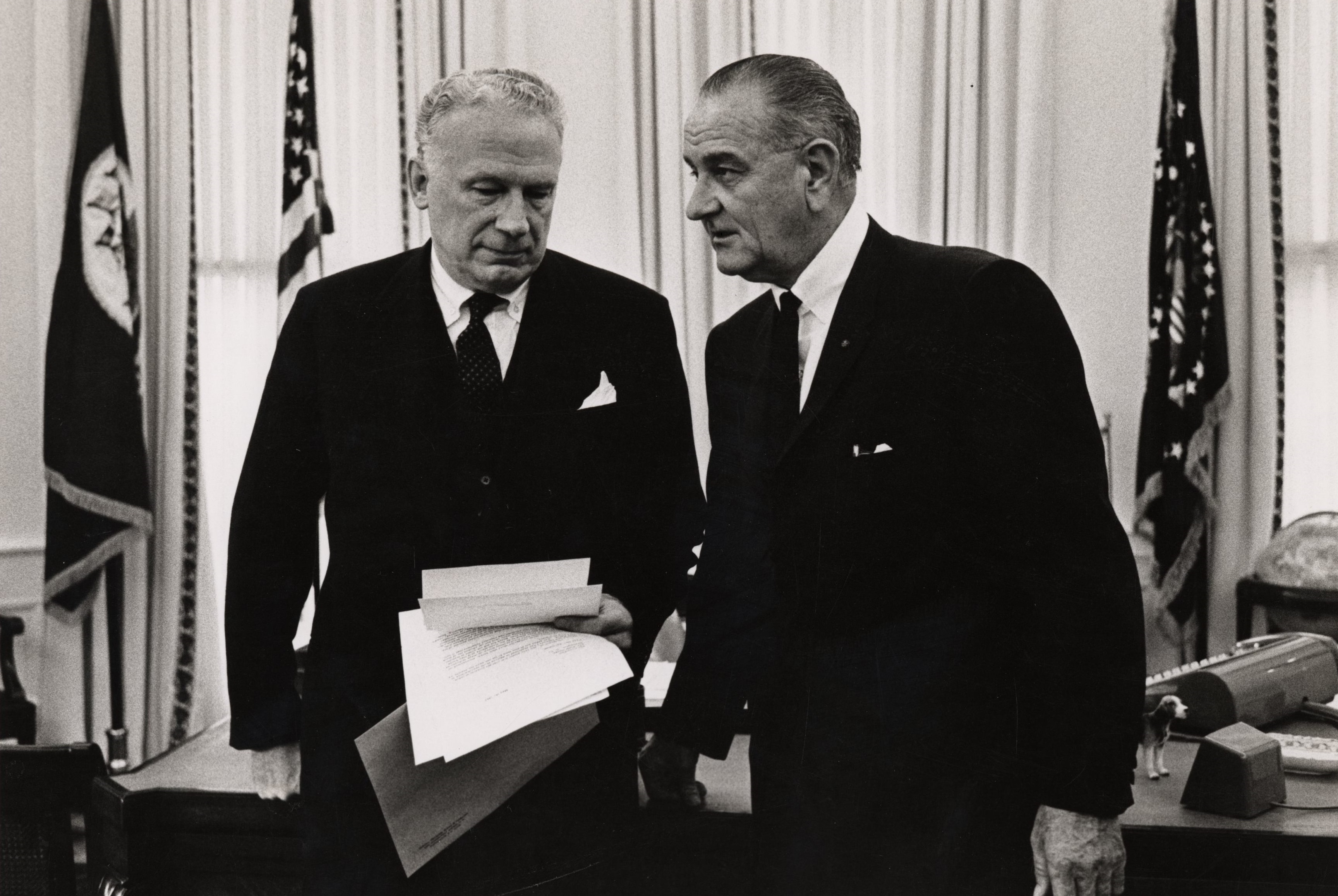
Under Secretary of State (equivalent to today's post of Deputy Secretary of State) George W. Ball with President Johnson (File). According to Robert D. McFadden, Ball's "opposition to the Vietnam War was based on his belief that Europe, not Southeast Asia, was the central political arena and that the key to East-West rapprochement and world peace lay in a strong, unified Western Europe." He lambasted antiwar activists "who declar[ed] in sanctimonious tones that American policy is thoroughly in the wrong and that we as a nation are as brutal and viciously ambitious as the other side."
In the account of this meeting, Mr. Ball makes his first appearance in the Pentagon history as the Administration dissenter on Vietnam. William Bundy's memorandum of record says Mr. Ball "indicated doubt" that bombing the North in any fashion would improve the situation in South Vietnam and "argued against" a judgment that a Vietcong victory in South Vietnam would have a falling-domino effect on the rest of Asia.
While the working-group sessions had been in progress, the study discloses, Mr. Ball had been writing a quite different policy paper "suggesting a U.S diplomatic strategy in the event of an imminent GVN collapse."
"In it, he advocated working through the U.K. [United Kingdom, or Britain] who would in turn seek cooperation from the U.S.S.R., in arranging an international conference (of smaller proportions than these at Geneva) which would work out out a compromise political settlement for South Vietnam," the analyst says. The words in parentheses are the analyst's.
Of those present at the November 4 meeting, the memorandum of record indicates, only Mr. Ball favored Option, A. The study gives the impression this was conceived as a throwaway option by the Working Group: The, group's analysis labeled it "an indefinite course of action" whose "sole advantages" were these:
"(a) Defeat would be clearly due to GVN failure, and we ourselves would be less implicated than if we tried Option B or Option C, and failed.
"(b) The most likely result would be a Vietnamese negotiated deal, under which an eventually unified Communist Vietnam would reassert its traditional hostility to Communist China and limit its own ambitions to Laos and Cambodia."
Secretary Rusk Disagrees
At the Nov. 24 meeting, however, Mr. Rusk said that while he favored bombing North Vietnam, he did not accept an analysis by Mr. McNaughton and William Bundy that if the bombing failed to save South Vietnam "we would obtain inter-national credit merely for trying."
"In his view," the analyst writes, "the harder we tried and then failed, the worse our situation would be."
McGeorge Bundy demurred to some extent, the account goes on, but Mr. Ball "expressed strong agreement with the last Rusk point." General Wheeler, reflecting the viewpoint of the Joint Chiefs, argued that the hard, fast bombing campaign of Option B actually entailed "less risk of a major conflict before achieving success," in words of the study, than the gradually rising air strikes of Option C.
The study adds that Mr. Bundy and Mr. McNaughton may have deliberately loaded the language of Option B to try to frighten the President out of adopting it lest it create severe inter-national pressure for quick negotiations.
General Wheeler's argument presaged a running controversy between the Joint Chiefs and the civilian leadership after the bombing campaign began. in the coming year.
The meeting on Nov. 24 ended without a clear majority decision on which option should be recommended to the President. The principals resumed when Ambassador Taylor reached Washington to join the strategy talks on Nov. 27, 1964.
Taylor's Three Purposes
In a written briefing paper, he told the conferees: "If, as the evidence shows, we are playing a losing game in South Vietnam it is high-time we change and find a better way." He proposed grad-ually increasing air strikes against the North for a threefold purpose:
"First, establish an adequate government in SVN; second, improve the conduct of the counterinsurgency campaign; finally persuade or force the D.R.V., to stop its aid to the Vietcong and to use its directive powers to make the Vietcong desist from their efforts to overthrow the Government of South Vietnam."
To improve anti-Communist prospects in the South, the Ambassador proposed using the lever of American airstrikes against the North to obtain promises from the Saigon leaders that they would achieve political stability, strengthen the army and police, suppress dissident Buddhist and student factions, replace incompetent officials and get on with the war effort.
The analyst says that the Ambassador had thus revised his earlier view that Washington should bomb the North merely to prevent "a collapse of national morale" in Saigon. He still favored some form of bombing in an emergency, but now he wanted something solid from the Saigon leaders in exchange for a coherent program of rising air war.
In the course of discussions on Nov: 27; however, the Ambassador acknowledged that while bombing "would definitely have a favorable effect" in South Vietnam, "...he was not sure this would be enough really to improve the situation," the analyst reports, again quoting from William Bundy's memorandum of record.
"Others, including McNamara, agreed with Taylor's evaluation, but the Secretary [Mr. McNamara] added that the strengthening effect of Option C could at least buy time, possibly measured in years.' "
Ambassador Taylor proposed that the Administration therefore adopt a two-phase program culminating in the bombing of infiltration facilities south of 19th Parallel in North Vietnam, in effect Option A plus the first stages of Option C. Phase I would consist of 30 days of the Option A type of actions, such as intensification of the coastal raids on the North, airstrikes by American jets at infiltration routes and one or two reprisal raids against the North. Meanwhile, Ambassador Taylor would obtain the promises of improvement from the Saigon leadership.
'When You Crawl Out...'
At the end of the 30 days, with the promises in hand, the United States would then move into Phase II, the air war. The air raids were to last two to six months, during which Hanoi was apparently expected to yield. The others agreed, and the proposal was redefined further at a meeting on Nov. 28. William Bundy was assigned the task of drafting up a formal policy paper outlining the proposal. The Cabinet-level officials agreed to recommend it to the President at a White House meeting scheduled for Dec. 1, right after Mr. Johnson's Thanksgiving holiday at his ranch.
On Nov. 28, the same day that his closest advisers made their decision to advise him to bomb North Vietnam, Mr. Johnson was asked at a news conference at the ranch: "Mr. President, is expansion of the Vietnam war into Laos or North Vietnam a live possibility at this moment?"
"I don't want to give you any particular guideposts as to your conduct in the matter," Mr., Johnson told the news-men about their articles. "But when you crawl out on a limb, you always have to find another one to crawl back on.
"I have just been sitting here, in this serene atmosphere of the Pedernales for the last few days reading about the wars that you [speculating newsmen] have involved us in and the additional undertakings that I have made decisions on or that General Taylor has recommended or that Mr. McNamara plans or Secretary Rusk envisages. I would say, generally speaking, that some people are speculating and taking positions that I think are somewhat premature."
"At the moment," he concluded, "General Taylor will report to us on developments. We will carefully consider these reports… I will meet with him in the early part of the week. I anticipate there will be no dramatic announcement to come out of these meetings except in the form of your speculation.
William Bundy's draft policy paper, written the next day, said the bombing campaign "would consist Principally of progressively more serious air strikes, of a weight and tempo adjusted to the situation as it develops (possibly running from two to six months)." The words in parentheses are Mr. Bundy's.
The draft paper added: "Targets in the D.R.V. would start with infiltration targets south of the 19th Parallel and work up to targets north of that point. This could eventually lead to such measures as air strikes on all major military-related targets, aerial mining of D.R.V. ports and a U.S. naval blockade of the D.R.V.
"Concurrently," it continued, "the U.S. would be alert to any sign of yielding by Hanoi, and would be prepared to explore negotiated solutions that attain U.S. objectives in an acceptable.manner."
Apparently at Mr. McNamara's suggestion, the analyst says, a final sentence in this paragraph was deleted; it read, "The U.S. would seek to control any negotiations and would oppose any independent South Vietnamese efforts to negotiate." Also removed, possibly during a final meeting of the top officials on Nov. 30 to review the policy paper and "apparently on the advice of McGeorge Bundy," was a proposal that the President make a major speech indicating the new direction that Washington's policy was taking.
Likewise deleted was a provision to brief "available Congressional leaders (no special leadership meeting will be convened for this purpose)". on new evidence being compiled on North Vietnamese infiltration into the South, as a public justification of the bombing.
A separate recommendation from the Joint Chiefs for a series of major raids —like those in 'their retaliation proposal for the Vietcong mortar strike at Bienhoa air base on Nov. 1—was deleted for unspecified reasons, the analyst says, "in effect, presenting a united front to. the President."
The paper that was sent to the President made no mention of American ground troops to provide security to airfields in the South when the bombing began, as General Wheeler had reminded the conferees on Nov. 24 would be necessary.
The writer notes the "gap" between the drastic concessions expected from Hanoi and the relatively modest bombing campaign that was expected to break Hanoi's will. He puts forward "two by no means contradictory explanations of this gap." This is the first:
Calculated 'Doses of Force'
"There is some reason to believe that the principals thought that carefully calculated doses of force could bring about predictable and desirable responses from Hanoi. Underlying this optimistic view was a significant underestimate, of the level of the D.R.V. commitment to victory, in the South and an overestimate of the effectiveness of U.S. pressures in weakening that resolve.
“A related factor, the account says, "which, no doubt, commended the proposal to the Administration was the relatively low cost—in political terms of such action." The context here indicates that the Administration thought the public would find an air war less repugnant than a ground war. The President seems to have shared the view of his chief advisers, the analyst writes, that "the threat implicit in minimum but increasing amounts of force ('slow squeeze') would… ultimately bring Hanoi to the table on terms favorable to the U.S.
"McGeorge Bundy, as the President's assistant for national security affairs, was in a position to convey President Johnson's mood to the group," the account goes on. It adds that notes taken at a White House meeting on Dec. 1 when the senior officials met with Mr. Johnson to present the bombing plan "tend to confirm that the President's mood was more closely akin to the measures recommended" than to other, harsher bombing plans.
“A second explanation of the gap between ends and means is a more simple one," the account comments. "In a phrase, we had run out of alternatives other than pressures."
A memorandum by Assistant Secretary McNaughton on Nov. 6, 1964, made the point succinctly: "Action against North Vietnam is to some extent a substitute for strengthening the Government in South Vietnam. That is, a less active VC (on orders from D.R.V.) can be matched by a less efficient GVN. We therefore should consider squeezing North Vietnam." The words in parentheses are Mr. McNaughton's.
The New York Times
June 14, 1971
The two dissenters from the view that "calculated doses of force" would bring Hanoi around were at opposite poles, the Joint Chiefs and the intelligence agencies.
The J.C.S. differed from this view on the grounds that if we were really interested in affecting Hanoi's will, we would have to hit hard at its capabilities," the account says. The Joint Chiefs wanted the United States to demonstrate a willingness to apply un-limited force.
Their bombing plan, deleted from the position paper before it was presented to the President, asserted that the destruction of all of North Vietnam's major airfields and its petroleum supplies "in the first three days" was intended to "clearly establish the fact that the U.S. intends to use military force to the full limits of what military force can contribute to achieving U.S. objectives in Southeast Asia . . . The follow-on military program—involving armed reconnaissance of infiltration routes in Laos, air strikes on infiltration targets in the D.R.V. and then progressive Strikes throughout North Vietnam—could be suspended short of full destruction of the D.R.V. if our' objectives were achieved earlier."
The analyst remarks that the Joint Chiefs' plan was "shunted aside be-cause both its risks and costs were too high," but the author does not attempt to evaluate the possible effect of his plan on Hanoi's will.”
Analysis of Enemy Policy
Like Mr. Ball, the account says, the intelligence community "tended toward a pessimistic view" of the effect of bombing on the Hanoi leaders.
The intelligence panel within the Bundy working group, composed of representatives from the three leading intelligence agencies—the C.I.A., the State Department's Bureau of Intelligence and Research and the Pentagon's Defense Intelligence Agency—"did not concede very strong chances for breaking the will of Hanoi," the author writes.
"The course of actions the Communists have pursued in South Vietnam over past few years implies a fundamental estimate on their part that the difficulties facing the U.S. are so great that U.S. will and ability to maintain resistance in that area can be gradually eroded—without running high risks that this would wreak heavy destruction on the D.R.V. or Communist China," the panel's report said.
If the United States now began bombing, the panel said, the Hanoi leadership would have to ask itself "a basic question" about how far the United States was willing to step up the war "regardless of, the danger of war with Communist China and regardless of the international pressures, that could be brought to bear. . . ." The decision of the Hanoi leadership was thus uncertain for a number of reasons, the panel cautioned, and "in any event, comprehension of the other's intentions would almost certainly be difficult on both sides,' and especially as the scale of hostilities mounted."
The panel then cast doubt on the so-called Rostow thesis of how much Hanoi feared destruction of its industry. This thesis, named for its proponent, Walt W. Rostow, chairman of the State Department's Policy Planning Council, underlay much of the Administration's hope for the success of a bombing campaign. The panel said: "We have many indications that the Hanoi leadership is acutely and nervously aware of the extent to which North Vietnam's transportation system and industrial plant is vulnerable to attack. On the other hand, North Vietnam's economy is overwhelmingly agricultural and, to a large extent, decentralized in a myriad of more or less economically self-sufficient villages. Interdiction of imports and extensive destruction of transportation facilities and industrial plants would cripple D.R.V. industry. These actions would also seriously restrict D.R.V. military capabilities, and would degrade, though to a lesser extent, Hanoi's capabilities to support guerrilla warfare in South Vietnam and Laos. We do not believe that such actions would have a crucial, effect on the daily lives of the overwhelming majority of the North Vietnam population. We do not believe that attacks on industrial targets would so greatly exacerbate current economic difficulties as to create unmanageable con-trol problems. It is reasonable to infer that the D.R.V. leaders have a psychological investment in the work of reconstruction they have accomplished over the last decade. Nevertheless, they would probably be willing to suffer some damage to the country in the course of a test of wills with the U.S. over the course of events in South Vietnam."
No Change of Policy
As in the case of earlier intelligence findings that contradicted policy intentions, the study indicates no effort on the part of the President or his most trusted advisers to reshape their policy along the lines of this analysis.
One part of the intelligence panel's report that the Administration did accept was a prediction that China would not react in any major way to a bombing campaign unless American or South Vietnamese troops invaded North Vietnam or northern Laos. The study indicates that this analysis eased Administration fears on this point.
Chinese reaction to systematic bombing of North Vietnam was expected to be limited to providing Hanoi with anti-aircraft artillery, jet fighters and naval patrol craft. The panel predicted that the Soviet role was "likely to remain a minor one," even where military equipment was concerned. However, the Russians subsequently sent large-scale shipments of formidable antiaircraft equipment to North Vietnam.
The New York Times
June 14, 1971
"Do all of you understand English? I told you all clearly at General Westmoreland's dinner we Americans were tired of coups. Apparently I wasted my words. Maybe this is because something is wrong with my French because you evidently didn't understand. I made it clear that all the military plans which I know you would like to carry out are dependent on government stability. Now you have made a real mess. We cannot carry you forever if you do things like this."
Now that a decision to bomb North Vietnam was drawing near, the study says, Mr. Johnson became "cautious and equivocal" in approaching it. Two analysts of this period, in fact, differ in their characterization of his decision at the two-and-a-half-hour White House meeting on Dec. 1, 1964, a month after the election, when the bombing plan was presented to him.
One analyst says that at this meeting the President "made a tentative decision" to bomb, ordering the preparatory Phase I put into effect and approving Phase II, the air war Itself, "in principle."
The second analyst says that while the President approved the entire bombing plan "in general outline at least it is also clear that he gave his approval to implement only the first phase of the concept."
The President tied the actual waging of air war to reforms by the Saigon Government, this analyst says, and left an impression by the end of the meeting that he was "considerably less than certain that future U. S. actions against North Vietnam [the air war] would be taken; or that they would be desirable."
No Following Memorandum
The study notes that "the precise nature of the President's decisions" at the meeting is not known because a national security action memorandum was not issued afterward.
"However," the study continues, "from handwritten notes of the meeting, from instructions issued to action. agencies and from later reports of diplomatic and military actions taken, it is possible to reconstruct the approximate nature of the discussion and the decisions reached." The footnotes do not indicate who made the handwritten notes found in the Pentagon files, although the indication is that it was Mr. McNaughton or Mr. McNamara.
After a briefing by Ambassador Taylor on the situation in South Vietnam, the discussion turned to a draft statement, prepared by William Bundy, that the Ambassador was to deliver to the Saigon leaders. The statement explained the two-phase bombing plan and tied Phase 11 to a serious attempt by the Saigon leadership to achieve some political stability and get on with the war effort against the Vietcong.
In Saigon, General Khanh had nominally surrendered authority to a civilian cabinet headed by Premier Tran Van Huong. The general was. intriguing against the Huong Cabinet, however, as the ostensible commander in chief of the armed forces and head of a Military Revolutionary Committee of South Vietnamese generals. Within this council, a group headed by Air Vice Marshal Nguyen Cao Ky, the chief of the air force, was intriguing both with and against General Khanh.
Against this background, the study says of the White House meeting:
"The President made it clear that he considered that pulling the South Vietnamese together was basic to anything else the United States might do. He asked the Ambassador specifically which groups he (Ambassador Taylor) might talk to and what more we might do to help bring unity among South Vietnam's leaders. He asked whether we could not say to them 'we just can't go on' unless they pulled together. To this, Taylor replied that we must temper our insistence somewhat…”
Which Ones to Brief
The meeting then moved into a discussion of which allied countries were to be briefed on the proposed air war. The President said he wanted "new, dramatic effective" forms of assistance from several, specifically mentioning Australia, New Zealand, Canada and the Philippines. These briefings by special envoys were included in the draft position paper laying out the bombing plan as the important diplomatic element in Phase I.
"In each case," the study says, "the representative was to explain our concept and proposed actions and request additional contributions by way of forces in the event the second phase of U.S. actions were entered."
The plan made no provision for similar consultations with Congressional leaders and there is no evidence in the study that Mr. Johnson conducted any.
In approving the statement General Taylor was to make to the Saigon leaders, the President also gave his assent to ready the military signal that was formally to sound the beginning of the 30 days of Phase I—Operation Barrel Roll, air strikes by United States Air Force and Navy jets of Yankee Team against infiltration routes and facilities in the Laotian panhandle, which was to be the final step-up in the Laos air operations.
At the end of the meeting, the account continues, Ambassador Taylor "slipped out the White House rear entrance" to avoid the press and "only a brief, formal statement" was issued. The analyst remarks that the White House press statement released immediately afterward "contained only two comments regarding any determinations that had been reached.”
Instructions for Taylor
One said, "The President instructed Ambassador Taylor to consult urgently with the South Vietnamese Government as to measures that should be taken to improve the situation in all its aspects."
The other, the concluding paragraph, said the President had "reaffirmed the basic U.S. policy of providing all possible and useful assistance to the South Vietnamese people and Government in their struggle to defeat the externally supported insurgency and aggression being conducted against them."
The final sentence in this paragraph, the analyst notes, was one "specifically linking this policy" with Congress's Tonkin Gulf resolution. The sentence read: "It was noted that this policy accords with the terms of the Congressional joint resolution of Aug. 10, 1964, which remains in full force and effect."
Then, on Dec. 3, emerging from a second meeting with Mr. Johnson, "presumably having received the final version of his instructions," the account goes on, Ambassador Taylor told reporters assembled at the White House "that he was going to hold 'across-the-board' discussions with the GVN."
Asserting that U.S. policy for South Vietnam remained the same, he stated that his aim would be to improve the deteriorating situation in South Vietnam. Although he hinted of changes 'in tactics and method,' he quite naturally did not disclose the kind of operations in which the United States was about to engage or any future actions to which immediate activity could lead."
The Administration now moved quickly. William Bundy left for Australia and New Zealand the next day, Dec. 4, to brief their governments on both phases of the bombing plan, the writer says.
Wilson Visits Washington
Prime Minister Harold Wilson of Britain was "thoroughly briefed on the forthcoming U.S. actions" during a state visit to Washington Dec. 7 to 9, the narrative continues, while other envoys briefed the Canadians and the Asian allies. The writer notes that while Britain, Australia and New Zealand were given "the full picture," the Canadians were "told slightly less" and the Philippines, South Korea and the Chinese Nationalist Government on Taiwan were "briefed on Phase I only."
What the Thais and the Laotians were told is not made explicit.
The New Zealand Government "expressed grave doubts" that the bombing would break Hanoi's will, the writer says, and predicted that it might increase infiltration to South Vietnam.
In meetings in Saigon on Dec. 7 and 9 with General Khanh and Premier Huong, Ambassador Taylor exacted the desired promises in exchange for the bombing. At the second meeting, the Ambassador presented them with a draft press re-lease describing the desired improvements, including strengthening of the army and the police, which the Saigon Government released in its own name, at the United States' request, on Dec. 11.
William H. Sullivan, newly appointed as Ambassador to Laos, obtained Premier Souvanna Phouma's agreement on Dec. 10 to the American air strikes at infiltration routes along the Ho Chi Minh Trail supply network through the Laotian panhandle, and Operation Barrel Roll got under way on Dec. 14 with attacks by American jets on "targets of opportunity"—that is, unprogrammed targets sighted by the pilots.
A career Foreign Service officer, William H. Sullivan (center; pictured here in 1972 with Henry Kissinger and Mrs. Tram Kim Phuong, wife of the South Vietnamese Ambassador to the United States) served as Ambassador to Laos from 1964 to 1969 and coordinated the Paris Peace Talks through 1973. Two decades later, he was an integral back-channel as the normalization of American-Vietnamese relations commenced. (Larry Morris/The Washington Post)
At a meeting of the National Security Council on Dec. 12, when the final details for Barrel Roll were reviewed and approved, the study reports, it was "agreed that there would be no public operations statements about armed reconnaissance in Laos unless a plane were lost.”
"In such an event, the principals stated, the Government should continue to insist that we were merely escorting reconnaissance fights as requested by the Laotian Government."
Level of Attacks Set
McGeorge Bundy was quoted in the memorandum of record as stating that the agreed plan "fulfilled precisely the President's wishes."
On Dec. 18 Secretary McNamara set the level of Barrel Roll attacks for the 30 days of Phase. 1—the analyst indicates that he did so at the President's wishes—at two missions of four aircraft apiece each week.
The Administration also stepped up the raids by T-28 fighter planes in Laos with a joint message on Dec. 8 from Secretaries McNamara and Rusk to Ambassador Sullivan. The cable instructed him to have the Laotians intensify bombing "in the corridor areas and close to the D.R.V. border."
The analyst reports that in the three months between the beginning of October and the end of December there were 77 sorties by the T-28's in the panhandle area—a sortie is a strike by a single plane—and that by early December the air raids had "already precipitated several complaints from the D.R.V." to the International Control Commission "alleging U.S.-sponsored air attacks on North Vietnamese territory."
Events in Saigon had meanwhile gone awry. Political turmoil broke out there again with Buddhist and student demonstrations against Premier Huong's Cabinet.
On Dec. 20, in defiance of Ambassador Taylor's wishes, General Khanh, in a temporary alliance with the so-called Young Turks—the young generals led by Marshal Ky—announced the dissolution of the High National Council, a body that was supposed to be functioning as a temporary legislature to draw up a constitution for a permanent civilian government. They also made a large number of political arrests by night, seizing several members of the High National Council.
That day, Ambassador Taylor summoned the Young Turks to the embassy and, in the writer's words, read them "the riot act." They included Gen. Nguyen Van Thieu, now President of South Vietnam.
According to the embassy's cable to Washington, the conversation began like this:
Ambassador Taylor: Do all of you understand English? (Vietnamese officers indicated they did.) I told you all clearly at General Westmoreland's dinner we Americans were tired of coups. Apparently I wasted my words. Maybe this is because something is wrong with my French because you evidently didn't understand. I made it clear that all the military plans which I know you would like to carry out are dependent on government stability. Now you have made a real mess. We cannot carry you forever if you do things like this.
Marshal Ky and other Vietnamese generals denied that they had staged a coup and said they were trying to achieve unity by getting rid of divisive elements, the account goes on.
The Ambassador tried to persuade them to support the civilian regime of Premier Huong and apparently to restore the High National Council. The Vietnamese officers would not agree.
The embassy cable describes the end of the conversation: "In taking a friendly leave, Ambassador Taylor said: 'You people have broken a lot of dishes and now we have to see how we can straighten out this mess.'"
By the end of the month, Ambassador Taylor, Deputy Ambassador Johnson and General Westmoreland had apparently despaired of trading a bombing campaign against the North for a stable Saigon Government that would prosecute the war in the South. On Dec. 31, the account continues, they sent a joint message to Washington saying, in effect, that the United States should go ahead with the air campaign against the North "under any conceivable alliance condition short of complete abandonment of South Vietnam."
A Firmer Base Sought
The account indicates, however, that the President was reluctant to proceed into Phase without at least the appearance of a firmer base in Saigon since the turmoil there was making it more difficult for him to justify escalation to the American public.
The writer remarks that at the meeting of the senior National Security Council Members on Dec. 24, Secretary Rusk "raised an issue that was high among Administration concerns—namely that the American public was worried about the chaos in the GVN, and particularly with respect to its viability as an object of increased U. S. commitment."
On Christmas Eve, the Vietcong planted a bomb in the Brinks, an officer’s billet in Saigon, killing two Americans in the blast and wounding 58 others; the President declined to authorize reprisal air strikes against the North, despite vigorous recommendations from Ambassador Taylor, Admiral Sharp in Honolulu and the Joint Chiefs, who were now pressing hard for escalation.
"Highest levels today reached negative decision on proposal for reprisal action," Mr. Rusk cabled the Ambassador on Dec. 29.
Five days earlier, Mr. Rusk had also instructed Ambassador Taylor to halt until the turmoil in Saigon subsided, the planned, piecemeal release to the press of evidence of a major increase in infiltration from the North during 1964, the writer says. The Ambassador had first reported the increase to Washington in October, along with a report of the appearance of individual North Vietnamese Army regulars, and the Administration began leaking the information in November through back-ground briefings.
The New York Times
June 14, 1971
By this time, the Administration felt that it had sufficient information on infiltration to make a public case for bombing the North. The intelligence community had obtained evidence that a minimum of 19,000 and a maximum of 34,000 infiltrators, mostly former southerners who had fought against the French in the Vietminh, had entered the South since 1959. Chester L. Cooper, a former intelligence officer, had put together a major report on Hanoi's support and direction of the guerrillas, "but the Administration had decided earlier in December against public disclosure 'of the document itself because this might create "undesirable speculation," and had instead instructed the Ambassador to continue the piecemeal approach. Now, the analyst says, Mr. Rusk wanted this halted as well for fear that more publicity might create pressure for action prematurely.
Debate Grows in Congress
The political upheaval in Saigon, the writer continues, was fueling a Viet-nam debate in Congress, which, while it did not exhibit much antiwar sentiment, did show considerable confusion and dismay, the writer says.
Secretary Rusk, on television on Jan. 3, 1965, felt it necessary to defend the Administration "in the context of a year-end foreign policy report," the account adds.
Mr. Rusk did not hint at the Administration's plans for possible bombing of the North. "Ruling out either a U. S. withdrawal or a major expansion of the war," the writer says, "Rusk gave assurances that with internal unity, and our aid and persistence the South Vietnamese could themselves defeat the insurgency."
On Jan. 14, however, as a result of the loss of two American jets over Laos in Operation Barrel Roll, "accounts of U.S. air operations against Laotian infiltration routes gained wide circulation for the first time," the writer says. A dispatch from Laos by United Press International, he adds, "in effect blew the lid on the entire Yankee Team operation in Laos since May of 1964."
"Despite official State or Defense refusal to comment on the nature of the Laotian air missions, these disclosures added new fuel to the public policy debate," the writer continues. The disclosures were complicating matters for the President by giving ammunition to the very small minority of anti-war senators who were taking seriously the press speculation that the United States might be getting ready to bomb the North.
In a Senate speech on Jan. 19, the account goes on, Senator Wayne Morse of Oregon charged that the Yankee Team air strikes had ignored the 1962 Geneva accords on Laos and "violated the nation's belief in 'substituting the rule of law for the jungle law of military might.' Broadening his attack, he warned, that 'there is no hope of avoiding a massive war in Asia' if U. S. policy towards Southeast Asia were to continue without change."
Within the Administration in Washington, key policy makers were coming to the same conclusion that Ambassador Taylor and his colleagues had reached in Saigon—that it was desirable to bomb the North regardless of what state of government existed in the South.
The political turmoil in Saigon, the narrative says, appears "to have been interpreted in Washington as an im-pending sellout" to the National Liberation Front. Fear increased that a neutralist coalition government would emerge and invite the United States to leave.
Victory for the Vietcong
Washington's sense of crumbling in the military situation was heightened when Saigon's army suffered a "highly visible" setback in a ferocious battle at Binhgia, southeast of the capital, be-tween Dec. 26 and Jan. 2.
Vietcong guerrillas nearly destroyed two South Vietnamese Marine battalions. "All evidence pointed to a situation in which a final collapse of the GVN appeared probable and a victorious consolidation of VC power a distinct possibility," the narrative says.
The New York Times
June 14, 1971
William Bundy communicated the feeling in a memorandum he wrote to Secretary Rusk on Jan. 6 for a meeting Mr. Rusk was to have with the President that afternoon. Mr. Bundy explained that the memorandum encompassed, besides his own thoughts, those of Mr. Forrestal, head of the interagency committee, and Ambassador Unger, who had recently been transferred back to Washington from Vientiane.
"I think we must accept that Saigon morale in all quarters is now very shaky indeed," he said in part, "and that this relates directly to a widespread feeling that the U.S. is not ready for stronger action and indeed is possibly looking for a way out. We may regard this feeling as irrational and contradicted by our repeated statements, but Bill Sullivan was very vivid in describing the existence of such feelings in October, and we must honestly concede that our actions and statements since the election have not done anything to offset it. The blunt fact is that we have appeared to the Vietnamese (and to wide circles in Asia and even in Europe) to be insisting on a more perfect government than can reasonably be expected, before we consider any additional action—and that we might even pull out our support unless such a government emerges.
"In key parts of the rest of Asia, notably Thailand, our present posture also appears weak. As such key parts of Asia see us, we looked strong in May and early June, weaker in later June and July, and then appeared to be taking a quite firm line in August with the Gulf of Tonkin. Since then we must have seemed to be gradually weakening—and, again, insisting on perfectionism in the Saigon Government before we moved.
"The sum total of the above seems to us to point—together with almost certainly stepped-up Vietcong actions in the current favorable weather — to a prognosis that the situation in Viet-nam is now likely to come apart more rapidly than we had anticipated in November. We would still stick to the estimate that the most likely form of coming apart would be a government of key groups starting to negotiate covertly with the Liberation Front or Hanoi, perhaps not asking in the first instance that we get out, but with that necessarily following at a fairly early stage. In one sense this would be a 'Vietnam solution,' with some hope that it would produce a Communist Vietnam that would assert its own degree of independence from Peiping and that would produce a pause in Communist pressure in Southeast Asia. On the other hand, it would still be virtually certain than [sic] Laos would then become untenable and that Cambodia would accommodate in some way. Most seriously, there is grave question whether the Thai in these circumstances would retain any confidence at all in our continued support. In short, the outcome would be regarded in Asia, and particularly among our friends, as just as humiliating a defeat as any other form. As events have developed, the American public would probably not be too sharply critical, but the real question would be whether Thailand and other nations were weakened and taken over thereafter.
'Grave Difficulties' Are Foreseen
"The alternative of stronger action obviously has grave difficulties. It commits the U.S. more deeply, at a time when the picture of South Vietnamese will is extremely weak. To the extent that it included actions against North Vietnam, it would be vigorously attacked by many nations and disapproved initially even by such nations as Japan and India, on present indications. Most basically, its stiffening effect o the Saigon political situation would not be at all sure to bring about a more effective government, nor would limited actions against the southern D.R.V. in fact sharply reduce infiltration or, in present circumstances, be at all likely to induce Hanoi to call it off.
"Nonetheless, on balance we believe that such action would have some faint hope of really improving the Vietnamese situation, and, above all, would put us in a much stronger position to hold the next line of defense, namely Thailand. Accepting the present situation—or any negotiation on the basis of it—would be far weaker from this latter key standpoint. If we moved into stronger actions, we should have in mind that negotiations would be likely to emerge from some quarter in any event, and that under existing circum-stances, even with the additional element of pressure, we could not expect to get an outcome that would really secure an independent South Vietnam. Yet even on an outcome that produced a progressive deterioration in South Vietnam and an eventual Communist takeover, we would still have appeared to Asians to have done a lot more about it.
"In specific terms, the kinds of action we might take in the near future would be:
"a. An early occasion for reprisal action against the D.R.V.
"b. Possibly beginning low-level reconnaissance of the D.R.V. at once.
"Concurrently with a or b, an early orderly withdrawal of our dependents [from Saigon, but only if] stronger action [is contemplated]. If we are to clear our decks in this way—and we are more and more inclined to think we should—it simply must be, for this reason alone, in the context of some stronger action....
"Introduction of limited U.S. ground forces into the northern area of South Vietnam still has great appeal to many of us, concurrently with the first air attacks into the D.R.V. It would have a real stiffening effect in Saigon, and a strong signal effect to Hanoi. On the disadvantage side, such forces would be possible attrition targets for the Vietcong."
A Similar Memorandum
Mr. McNaughton, Mr. Bundy's counterpart at the Pentagon, had given Mr. McNamara a similar memorandum three days earlier.
"The impact of these views can be seen in the policy guidance emanating from Washington in mid and late January, 1965," the Pentagon's narrative says.
In a cablegram to Saigon on Jan. 11, the writer goes on, Secretary Rusk instructed Ambassador Taylor "to avoid actions that would further commit the United States to any particular form of political solution" to the turmoil there. If another military regime emerged froth the squabbling "we might well have to swallow our pride and work with it," Mr. Rusk said.
Another memorandum to Mr. McNamara from Mr. McNaughton, on Jan. 27, along with Mr. McNamara's penciled comments on it, "adds perspective to this viewpoint," the historian says. Mr. McNaughton stated "and Mr. McNamara agreed" that the United States objective in South Vietnam was "not to 'help friend' but to contain China," and "both favored initiating strikes against North Vietnam."
Paraphrasing the memorandum and Mr. McNamara's comments, the writer says, "At first they believed these [air attacks] should take the form of reprisals; beyond that, the Administration would have to 'feel its way' into stronger, graduated pressures. McNaughton doubted that such strikes would actually help the situation in South Vietnam, but thought they should be carried out anyway. McNamara believed they probably would help the situation, in addition to their broader impacts on the U. S. position in Southeast Asia."
"Clear indication that the Administration was contemplating some kind of increased military activity" had gone out to Saigon two days earlier in another cablegram from Mr. Rusk, the account goes on. "Ambassador Taylor was asked to comment on the 'departmental view' that U.S. dependents should be withdrawn to 'clear the decks' in Saigon and enable better concentration of U.S. efforts on behalf of South Vietnam."
The Signal for 'D-Day’
Ever since the original bombing scenario of May 23, 1964, the evacuation of American women and children had been the signal for "D-Day."
"The Rusk cable made specific reference to a current interest in reprisal actions," the analyst says.
The initial blow came in about two weeks. The Vietcong attacked the United States military advisers compound at Pleiku in the Central Highlands and an Army helicopter base at Camp Holloway, four miles away. Nine Americans were killed and 76 wounded.
"The first flash from Saigon about the assault came on the ticker at the National Military Command Center at the Pentagon at 2:38 P.M. Saturday, Feb. 6, Washington time," the narrative says. "It triggered a swift, though long-contemplated Presidential decision to give an 'appropriate and fitting' response. Within less than 14 hours, by 4 P.M.; Sunday, Vietnam time, 49 U.S. Navy jets—A-4 Skyhawks and F-8 Crusaders from the Seventh Fleet carriers U.S.S. Coral Sea and U. S. S. Hancock—had, penetrated a heavy layer of monsoon• clouds to deliver their bombs and rockets upon North Vietnamese barracks and staging areas at Donghoi, a guerrilla training garrison 40 miles north of the 17th Parallel.
"Though conceived and executed as a limited one-shot tit-for-tat reprisal, the drastic U. S. action, long on the military planners' drawing boards under the operational code name Flaming Dart precipitated a rapidly moving sequence of events that transformed the character of the Vietnam war and the U. S. role in it."
Then the guerrillas attacked an American barracks at Quinhon, on the central coast, and on Feb. 11, the President launched a second and heavier reprisal raid, Flaming Dart II. Two days later, on Feb. 13, he decided to begin Operation Rolling Thunder, the sustained air war against North Vietnam.
"As is readily apparent," the analyst concludes, "there was no dearth of reasons for striking North. Indeed, one al most has the impression that there were more reasons than were required. But in the end, the decision to go ahead with the strikes seems to have resulted as much from the lack of alternative proposals as from any compelling logic in their favor."
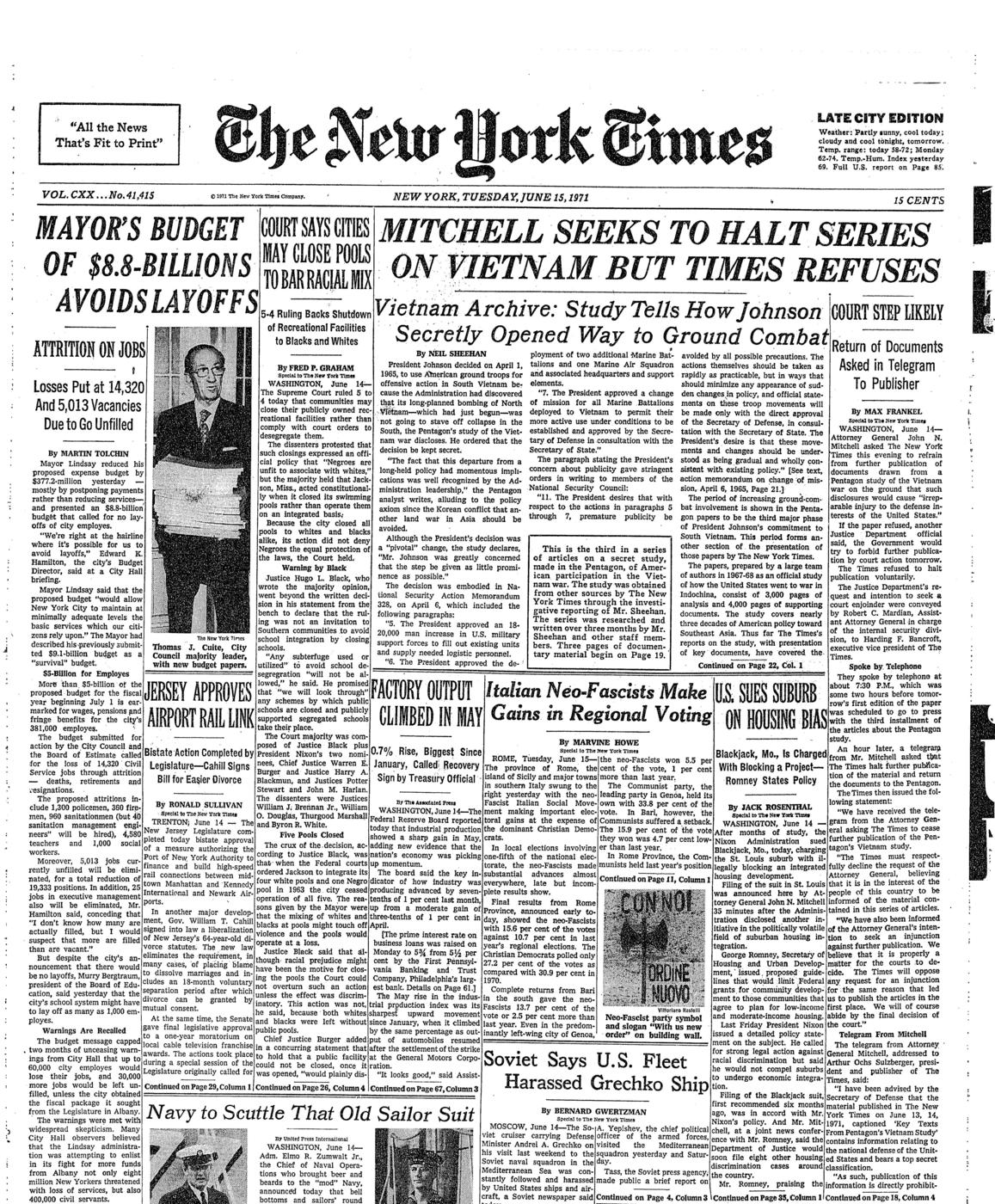
June 15, 1971 edition of The New York Times.
By Neil Sheehan
The New York Times
June 15, 1971
President Johnson decided on April 1, 1965, to use American ground troops for offensive action in South Vietnam because the Administration had discovered that its long-planned bombing of North Vietnam—which had just begun—was not going to stave off collapse in the South, the Pentagon's study of the Vietnam war discloses. He ordered that the decision be kept secret.
The fact that this departure from a long-held policy had momentous implications was well recognized by the Administration leadership," the Pentagon analyst writes, alluding to the policy axiom since the Korean conflict that another land war in Asia should be avoided.
Although the President's decision was a "pivotal" change, the study declares, "Mr. Johnson was greatly concerned that the step be given as little prominence as possible."
The decision was embodied in National Security Action Memorandum 328, on April 6, which included the following paragraphs: "5. The President approved an 18-20,000 man increase in U.S. military support forces to fill out existing units and supply needed logistic personnel.
“6. The President approved the deployment of two additional Marine Battalions and one Marine Air Squadron and associated headquarters and support elements.
"7. The President approved a change of mission for all Marine Battalions deployed to Vietnam to permit their more active use under conditions to be established and approved by the Secretary of Defense in consultation with the Secretary of State."
The paragraph stating the President's concern about publicity gave stringent orders in writing to members of the National Security Council:
"11. The President desires that with respect to the actions in paragraphs 5 through 7, premature publicity be avoided by all possible precautions. The actions themselves should be taken as rapidly as practicable, but in ways that should minimize any appearance of sudden changes in policy, and official statements on these troop movements will be made only with the direct approval of the Secretary of Defense, in consultation with the Secretary of State. The President's desire is that these movements and changes should be understood as being gradual and wholly consistent with existing policy."
The period of increasing ground-combat involvement is shown in the Pentagon papers to be the third major phase of President Johnson's commitment to South Vietnam. This period forms another section of the presentation of those papers by The New York Times.
The papers, prepared by a large team of authors in 1967-68 as an official study of how the United States went to war in Indochina, consist of 3,000 pages of analysis and 4,000 pages of supporting documents. The study covers nearly three decades of American policy toward Southeast Asia. Thus far The Times's reports on the study, with presentation of key documents, have covered the period of clandestine warfare before the Tonkin Gulf incidents in 1964 and the planning for sustained bombing of North Vietnam to begin early the next year.
In the spring of 1965, the study discloses, the Johnson Administration pinned its hopes on air assaults against the North to break the enemy's will and persuade Hanoi to stop the Vietcong insurgency in the South. The air assaults began on a sustained basis on March 2. "Once set in motion, however, the bombing effort seemed to stiffen rather than soften Hanoi's backbone, as well as the willingness of Hanoi's allies, particularly the Soviet Union, to work toward compromise," the study continues.
"Official hopes were high that the Rolling Thunder program . . . would rapidly convince Hanoi that it should agree to negotiate a settlement to the war in the South. After a month of bombing with no response from the North Vietnamese, optimism began to wane," the study remarks.
The U.S. was presented essentially with two options: (1) to withdraw unilaterally from Vietnam leaving the South Vietnamese to fend for themselves, or (2) to commit ground forces in pursuit of its objectives. A third option, that of drastically increasing the scope and scale of the bombing, was rejected because of the concomitant high risk of inviting Chinese intervention."
And so within a month, the account continues, with the Administration recognizing that the bombing would not work quickly enough, the crucial decision was made to put the two Marine battalions already in South Vietnam on the offensive. The 3,500 marines had landed at Danang on March 8—bringing the total United States force in South Vietnam to 27,000 —with their mission restricted to the static defense of the Danang airfield.
Orders Put In Writing
As a result of the President's wish to keep the shift of mission from defense to offense imperceptible to the public, the April 1 decision received no publicity "until it crept out almost by accident in a State Department release on 8 June," in the words of the Pentagon study. The day before, the hastily improvised static security and enclave strategies of the spring were overtaken by a request from Gen. William C. Westmoreland, the American commander in Saigon, for nearly 200,000 troops. He wanted these forces, the Pentagon study relates, to hold off defeat long enough to make possible a further build-up of American troops.
"Swiftly and in an atmosphere of crisis," the study says, President Johnson gave his approval to General Westmoreland's request a little more than a month later, in mid-July. And once again, the study adds, Mr. Johnson concealed his decision.
But the President, the narrative continues, was now heeding the counsel of General Westmoreland to embark on a full-scale ground war. The study for this period concludes that Mr. Johnson and most of his Administration were in no mood for compromise on Vietnam.
As an indication of the Administration's mood during this period, the study cites "a marathon public-information campaign" conducted by Secretary of State Dean Rusk late in February and early in March as sustained bombing was getting under way. Mr. Rusk, the study says, sought "to signal a seemingly reasonable but in fact quite tough U.S. position on negotiations, demanding that Hanoi 'stop doing what it is doing against its neighbors' before any negotiations could prove fruitful.
"Rusk's disinterest in negotiations at this time was in concert with the view of virtually all of the President's key advisers, that the path to peace was not then open," the Pentagon account continues. "Hanoi held sway over more than half of South Vietnam and could see the Saigon Government crumbling before her very eyes. The balance of power at this time simply did not furnish the U.S. with a basis for bargaining and Hanoi had no reason to accede to the hard terms that the U.S. had in mind. Until military pressures on North Vietnam could tilt the balance of forces the other way, talk of negotiation could be little more than a hollow exercise."
A Position of Compromise
The study also says that two of the President's major moves involving the bombing campaign in the spring of 1965 were designed, among other aims, to quiet critics and obtain public support for the air war by striking a position of compromise. But in fact, the account goes on, the moves masked publicly unstated conditions for peace that "were not 'compromise' terms, but more akin to a 'cease and desist' order that, from the D.R.V./VC point of view, was tantamount to a demand for their surrender." "D.R.V." denotes the Democratic Republic of Vietnam; "VC" the Vietcong.
In Mr. Johnson's first action, his speech at the Johns Hopkins University in Baltimore on April 7, he offered to negotiate "without posing any pre-conditions" and also held out what the study calls a "billion-dollar carrot" in the form of an economic-development program for the Mekong River Basin financed by the United States, in which North Vietnam might participate.
The second action was the unannounced five-day pause in bombing in May, during which the President called upon Hanoi to accept a "political solution" in the South. This "seemed to he aimed more at clearing the decks for a subsequent intensified resumption than it was at evoking a reciprocal act of de-escalation by Hanoi," the study says. Admiral Reborn, in his May 6 memorandum, had suggested a pause for this purpose and as an opportunity for Hanoi “to make concessions with some grace.”
The air attacks had begun Feb. 8 and Feb. 11 with reprisal raids, code-named Operations Flaming Dart I and II, announced as retaliation for Vietcong attacks on American installations at Pleiku and Quinhon.
In public Administration statements on the air assaults, the study goes on, President Johnson broadened "the reprisal concept as gradually and imperceptibly as possible" into sustained air raids against the North, in the same fashion that the analyst describes him blurring the shift from defensive to offensive action on the ground during the spring and summer of 1965. The study declares that the two February strikes—unlike the Tonkin Gulf reprisals in August, 1964, which were tied directly to a North Vietnamese attack on American ships—were publicly associated with a "larger pattern of aggression" by North Vietnam.
Flaming Dart II, for example, was characterized as "a generalized response to 'continued acts of aggression,'" the account notes.
"Although discussed publicly in very muted tones," it goes on, "the second Flaming Dart operation constituted a sharp break with past U.S. policy and set the stage for the continuing bombing program that was now to be launched in earnest."
In another section of the study, a Pentagon analyst remarks that "the change in ground rules… posed serious public-information and stage-managing problems for the President."
It was on Feb. 13, two days after this second reprisal, that Mr. Johnson ordered Operation Rolling Thunder. An important influence on his unpublicized decision was a memorandum from his special assistant for national security affairs, McGeorge Bundy, who was heading a fact-finding mission in Vietnam when the Vietcong attack at Pleiku occurred on Feb. 7. With Mr. Bundy were Assistant Secretary of Defense John T. McNaughton and Deputy Assistant Secretary of State Leonard Unger.
"A policy of sustained reprisal against North Vietnam" was the strategy advocated by Mr. Bundy in his memorandum, drafted on the President's personal Boeing 707, Air Force One, while returning from Saigon the same day." [See text, Bundy memorandum, Feb, 7, 1965.]
The memorandum explained that the justification for the air attacks against the North, and their intensity, would be keyed to the level of Vietcong activity in the South.
'Sustained Pressure' Sought
"We are convinced that the political values of reprisal require a continuous operation," Mr. Bundy wrote. "Episodic responses geared on a one-for-one basis to 'spectacular' outrages would lack the persuasive force of sustained pressure. More important still, they would leave it open to the Communists to avoid reprisals entirely by giving up only a small element of their own program… It is the great merit of the proposed scheme that to stop it the Communists would have to stop enough of their activity in the South to permit the probable success of a determined pacification effort."
The analyst notes, however, that Mr. Bundy's memorandum was a "unique articulation of a rationale for the Rolling Thunder policy" because Mr. Bundy held out as the immediate benefit an opportunity to rally the anti-Communist elements in the South and achieve some political stability and progress in pacification. "Once such a policy is put in force," Mr. Bundy wrote, in summary conclusions to his memorandum, “we shall be able to speak in Vietnam on many topics and in many ways, with growing force and effectiveness."
It was also plausible, he said, that bombing in the North, "even in a low key, would have a substantial depressing effect upon the morale of Vietcong cadres in South Vietnam."
Mr. Bundy, the study remarks, thus differed from most other proponents of bombing. These included Ambassador Maxwell D. Taylor, who despaired of improving the Saigon Government's effectiveness and who wanted bombing primarily as a will-breaking device "to inflict such pain or threat of pain upon the D.R.V. that it would be compelled to order a stand-down of Vietcong violence," in the study's words.
As several chapters of the Pentagon study show, a number of Administration strategists—particularly Walt W. Rostow, chairman of the State Department's Policy Planning Council—had assumed for years that "calculated doses" of American air power would accomplish this end.
Mr. Bundy, while not underrating the bombing's "impact on Hanoi" and its use "as a means of affecting the will of Hanoi," saw this as a "longer-range purpose."
'This Program Seems Cheap'
The bombing might not work, Mr. Bundy acknowledged. "Yet measured against the costs of defeat in Vietnam," he wrote, "this program seems cheap. And even if it fails to turn the tide--as it may—the value of the effort seems to us to exceed its cost."
President Johnson informed Ambassador Taylor of his Rolling Thunder decision in a cablegram drafted in the White House and transmitted to Saigon late in the afternoon of Sunday, Feb. 13.
The cable told the Ambassador that "we will execute a program of measured and limited air action jointly with the GVN [the Government of Vietnam] against selected military targets in D.R.V., remaining south of the 19th Parallel until further notice."
"Our current expectation," the message added, "is that these attacks might come about once or twice a week and involve two or three targets on each day of operation." [See text, White House cable, Feb. 13, 1965.]
Mr. Johnson said he hoped "to have appropriate GVN concurrence by Monday if possible…”
The study recounts that "Ambassador Taylor received the news of the President's new program with enthusiasm. In his response, however, he explained the difficulties he faced in obtaining authentic GVN concurrence 'in the condition of virtual nongovernment' which existed in Saigon at that moment."
Gen. Nguyen Khanh, the nominal commander of the South Vietnamese armed forces, had ousted the civilian cabinet of Premier Tran Van Huong on Jan. 27. Led by Air Vice Marshal Nguyen Cao Ky, a group of young generals—the so-called Young Turks—were in turn intriguing against General Khanh.
(A footnote in the account of the first reprisal strikes, on Feb. 8, says that Marshal Ky, who led the South Vietnamese planes participating in the raid, caused "consternation" among American target controllers by dropping his bombs on the wrong targets. "In a last minute switch," the footnote says, Marshal Ky "dumped his flight's bomb loads on an unassigned target in the Vinhlinh area, in order, as he later explained, to avoid colliding with U.S.A.F. aircraft which, he claimed, were striking his originally assigned target when his flight arrived over the target area." Adm. U.S. Grant Sharp, commander of United States forces in the Pacific, reported the incident to the Joint Chiefs.)
Cables to the Embassies
Referring to the political situation in Saigon, the account says: "This Alice-in-Wonderland atmosphere notwithstanding, Taylor was undaunted."
"It will be interesting to observe the effect of our proposal on the internal political situation here," the Ambassador cabled back to Mr. Johnson in Washington about the bombing. “I will use the occasion to emphasize that a dramatic change is occurring in U.S. policy, one highly favorable to GVN interests but demanding a parallel dramatic change of attitude on the part of the GVN. Now is the time to install the best possible Government as we are clearly approaching a climax in the next few months."
Ambassador Taylor apparently obtained what concurrence was possible and on Feb. 8 another cable went out from the State Department to London and eight United States Embassies in the Far East besides the one in Saigon. The message told the ambassadors of the forthcoming bombing campaign and instructed them to "inform head of government or State (as appropriate) of above in strictest confidence and report reactions."
Both McGeorge Bundy and Ambassador Taylor had recommended playing down publicity on the details of the raids. "Careful public statements of U.S.G. [United States Government], combined with fact of continuing air actions, are expected to make it clear that military action will continue while aggression continues," the cable said. "But focus of public attention will be kept as far as possible on D.R.V. aggression; not on joint GVN/US military operations.”
The President had scheduled the first of the sustained raids, Rolling Thunder I, for Feb. 20. Five hours after the State Department transmitted that cable, a perennial Saigon plotter, Col. Pham Noe Thao, staged an unsuccessful "semi-coup" against General Khanh and "pandemonium reigned in Saigon," the study recounts. "Ambassador Taylor promptly recommended cancellation of the Feb. 20 air strikes and his recommendation was equally promptly accepted" by Washington, the Pentagon study says.
The State Department sent a cablegram to the various embassies rescinding the instructions to notify heads of government or state of the planned air war until further notice "in view of the disturbed situation in Saigon."
The situation there, the study says, remained "disturbed" for nearly a week while the Young Turks also sought to get rid of General Khanh.
"The latter made frantic but unsuccessful efforts to rally his supporters," the study says, and finally took off in his plane to avoid having to resign as commander in chief. "Literally running out of gas in Nhatrang shortly before dawn on Feb. 21. he submitted his resignation, claiming that a 'foreign hand' was behind the coup. No one, however, could be quite certain that Khanh might not 're-coup' once again, unless he were physically removed from the scene." This took three more days to accomplish, and on Feb. 25 General Khanh finally went into permanent exile as an ambassador at large, with Ambassador Taylor seeing him off at the airport, "glassily polite," in the study's words.
"It was only then that Taylor was able to issue, and Washington could accept, clearance for the long-postponed and frequently rescheduled first Rolling Thunder strike." Less than three weeks earlier, in his memorandum to the President predicting that "a policy of sustained reprisal" might bring a better government in Saigon. McGeorge Bundy had said he did not agree with Ambassador Taylor that General Khanh "must somehow be removed from the... scene."
"We see no one else in sight with anything like his ability to combine military authority with some sense of politics," the account quotes Mr. Bundy as having written.
In the meantime two more Rolling Thunder strikes—II and III—had also been scheduled and then canceled because, the study says, the South Vietnamese Air Force was on "coup alert," in Saigon.
During part of this period, air strikes against North Vietnam were also inhibited by a diplomatic initiative from the Soviet Union and Britain. They moved to reactivate their co-chairmanship of the 1954 Geneva conference on Indochina to consider the current Vietnam crisis. Secretary Rusk cabled Ambassador Taylor that the diplomatic initiative would not affect Washington's decision to begin the air war, merely its timing.
According to the Pentagon study, the Administration regarded the possibility of reviving the Geneva conference of 1954, which had ended the French Indochina War, "not as a potential negotiating opportunity, but as a convenient vehicle for public expression of a tough U.S. position."
But, the account adds, this "diplomatic gambit" had "languished" by the time.General Khanh left Saigon, and the day of his departure Mr. Johnson scheduled a strike, Rolling Thunder IV, for Feb. 26. The pilots had been standing by, for nearly a week, with the orders to execute a strike being canceled every 24 hours.
But the order to begin the raid was again canceled, a last time, by monsoon weather for four more days. Rolling Thunder finally rolled on March 2, 1965, when F-100 Super Sabre and F-105 Thunderchief jets of the United States Air Force bombed an ammunition depot at Xombang while 19 propeller-driven A-1H fighter-bombers of South Vietnam struck the Quangkhe naval base.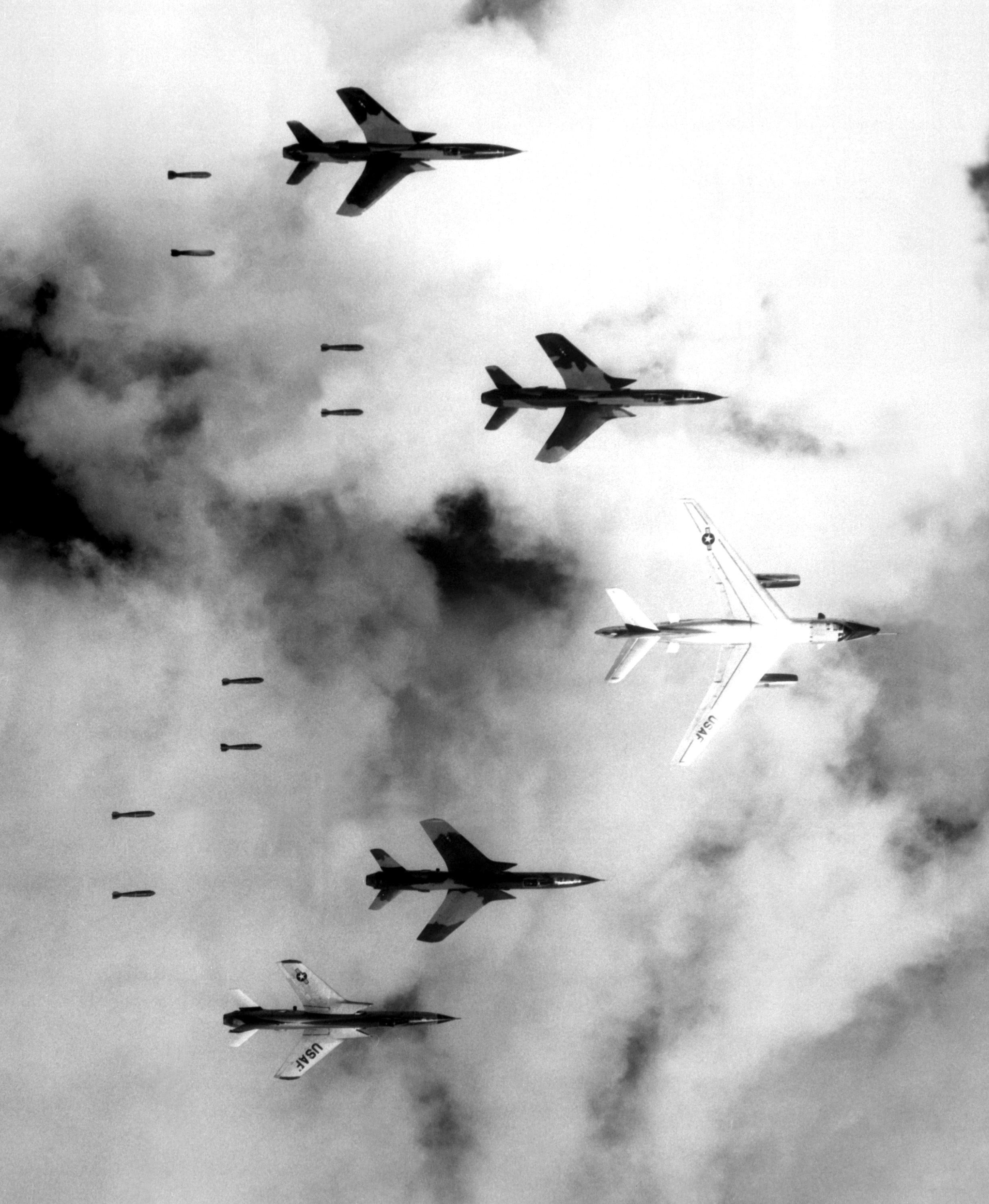
F-105 bombing run, June 1966 (Wikimedia Commons)
The various arguments in the Administration over how the raids ought to be conducted, which had developed during the planning stages, were now revived in sharper form by the opening blow in the actual air war.
Secretary McNamara, whose attention to management of resources and cost-effectiveness is cited repeatedly by the study, was concerned about improving the military efficacy of the bombing even before the sustained air war got under way.
He had received bomb damage assessments on the two reprisal strikes in February, reporting that of 491 buildings attacked, only 47 had been destroyed and 22 damaged. The information "caused McNamara to fire off a rather blunt memorandum" to Gen. Earle G. Wheeler, Chairman of the Joint Chiefs of Staff, on Feb. 17, the account says.
'I Am Quite Satisfied'
"Although the four missions [flown during the two raids] left the operations at the targets relatively unimpaired, I am quite satisfied with the results," Mr. McNamara began. "Our primary objective, of course, was to communicate our political resolve. This I believe we did. Future communications or resolve, however, will carry a hollow ring unless we accomplish more military damage than we have to date… Surely we cannot continue for months accomplishing no more with 267 sorties than we did on these four missions." A sortie is a flight by a single plane.
General Wheeler replied that measures were being taken to heighten the destructiveness of the strikes and said that one way to accomplish this was to give the operational commander on the scene "adequate latitude" to attack the target as he saw fit, rather than seeking to control the details from Washington.
One measure approved by the President on March 9 was the use of napalm in North Vietnam.
And the day before, the day that 3,500 marines came ashore at Danang to protect the airfield there, Ambassador Taylor had already expressed, in two cables to Washington, what the historian describes as "sharp annoyance" with the "unnecessarily timid and ambivalent" way in which the air war was being conducted.
No air strikes had been authorized by the President beyond the initial Rolling Thunder raids that began on March 2, and, according to the study, the Ambassador was irritated at "the long delays between strikes, the marginal weight of the attacks and the great ado about behind-the-scenes diplomatic feelers."
General Westmoreland Concurs
With the concurrence of General Westmoreland, Ambassador Taylor proposed "a more dynamic schedule of strikes, a several week program relentlessly marching north" beyond the 19th Parallel, which President Johnson had so far set as a limit, "to break the will of the D.R.V."
Ambassador Taylor cabled: "Current feverish diplomatic activity particularly by French and British" was interfering with the ability of the United States to "progressively turn the screws on D.R.V."
"It appears to me evident that to date D.R.V. leaders believe airstrikes at present levels on their territory are meaningless and that we are more susceptible to international pressure for negotiations than they are," the Ambassador said. He cited as evidence a report from J. Blair Seaborn, the Canadian member of the International Control Commission, who, in Hanoi earlier that month, had performed one of a series of secret diplomatic missions for the United States.
Mr. Seaborn had been sent back to convey directly to the Hanoi leaders an American policy statement on Vietnam that had been delivered to China on Feb. 24 through its embassy in Warsaw.
`No Designs' on the D.R.V.
In essence, the Pentagon study reports, the policy statement said that while the United States was determined to take whatever measures were necessary to maintain South Vietnam, it "had no designs on the territory of North Vietnam, nor any desire to destroy the D.R.V."
The delivery of the message to the Chinese was apparently aimed at helping to stave off any Chinese intervention as a result of the forthcoming bombing campaign.
But the purpose in sending Mr. Seaborn back, the study makes clear, was to convey the obvious threat that Hanoi now faced "extensive future destruction of… military and economic investments" if it did not call off the Vietcong guerrillas and accept a separate, non-Communist South.
Premier Pham Van Dong of North Vietnam, who had seen Mr. Seaborn on two earlier visits, declined this time, and the Canadian had to settle for the chief North Vietnamese liaison officer for the commission, to whom he read Washington's statement.
The North Vietnamese officer, the account says, commented that the message "contained nothing new and that the North Vietnamese had already received a briefing on the Warsaw meeting" from the Chinese Communists.
This treatment led the Canadian to sense "a mood of confidence" among the Hanoi leaders, Ambassador Taylor told Washington in a cablegram, and Mr. Seaborn felt "that Hanoi has the impression that our air strikes are a limited attempt to improve our bargaining position and hence are no great cause for immediate concern."
"Our objective should be to induce in D.R.V. leadership an attitude favorable to U.S. objectives in as short a time as possible in order to avoid a build-up of international pressure to negotiate," the Ambassador said.
To Dispel Any Illusions
Therefore, he went on, it was necessary to "begin at once a progression of U.S. strikes north of 19th Parallel in a slow but steadily ascending movement" to dispel any illusions in Hanoi.
"If we tarry too long In the south [below the 19th Parallel], we will give Hanoi a weak and misleading signal which will work against our ultimate purpose," he said.
The next Rolling Thunder strikes, on March 14 and 15, were the heaviest of the air war so far, involving 100 Ameri-can and 24 South Vietnamese planes against barracks and depots on Tiger Island off the North Vietnamese coast and the ammunition dump near Phuqui, 100 miles southwest of Hanoi.
For the first time, the planes used napalm against the North, a measure approved by Mr. Johnson on March 9 to achieve the more efficient destruction of the targets that Mr. McNamara was seeking and to give the pilots protection from antiaircraft batteries.
But the Ambassador regarded these, too, as an "isolated, stage-managed joint U.S./GVN operation," the Pentagon study says, He sent Washington another cable, saying that "through repeated delays we are failing to give the mounting crescendo to Rolling Thunder which is necessary to get the desired results."
Meanwhile, Admiral Sharp in Honolulu and the Joint Chiefs in Washington were quickly devising a number of other programs to broaden and intensify the air war now that it had begun.
On March 21, Admiral Sharp proposed a "radar busting day" to knock out the North Vietnamese early-warning system, and a program "to attrite harass and interdict the D.R.V south" of the 20th Parallel by cutting lines of communication, "LOC" in official terminology.
The "LOC cut program" would choke off traffic along all roads and rail lines through southern North Vietnam by bombing strikes and would thus squeeze the flow of supplies into the South.
"All targets selected are extremely difficult or impossible to bypass," the admiral said in a cable to the Joint Chiefs. "LOC network cutting in this depth will degrade tonnage arrivals at the main 'funnels' and will develop a broad series of new targets such as backed-up convoys, offloaded materiel dumps and personnel staging areas at one or both sides of cuts."
These probable effects might in turn "force major D.R.V. log flow to sea-carry and into surveillance and attack by our SVN [South Vietnamese] coastal sanitization forces," the admiral added.
In Washington at this time, the narrative goes on, the Joint Chiefs were engaged in an "interservice division" over potential ground-troop deployments to Vietnam and over the air war itself.
Gen. John P. McConnell, Chief of Staff of the Air Force adopted a "maverick position" and was arguing for a short and violent 28-day bombing campaign. All of the targets on the original 94-target list drawn up in May 1964, from bridges to industries, would be progressively destroyed.
"He proposed beginning the air strikes in the southern part of North Vietnam and continuing at two-to six-day intervals until Hanoi was attacked," the study continues.
The raids would be along the lines of the mighty strikes, including the use of B-52 bombers, that the Joint Chiefs had proposed in retaliation for the Vietcong mortar attack in Beinhoa airfield on Nov. 1, 1964, the narrative says. General McConnell contended that his plan was consistent with previous bombing proposals by the Joint Chiefs.
The general abandoned his proposal, however, when the other members of the Joint Chiefs decided to incorporate Admiral Sharp's "LOC cut program" and some of General McConnell's individual target concepts into a bomb-ing program of several weeks. They proposed this to Mr. McNamara on March 27.
This plan proposed an intense bombing campaign that would start on road and rail lines south of the 20th Parallel and then "march north" week by week to isolate North Vietnam from China gradually by cutting road and rail lines above Hanoi. In later phases upon which the Joint Chiefs had not yet fully decided, the port facilities were to be destroyed to isolate North Vietnam from the sea. Then. industries outside populated areas would be attacked "leading tip to a situation where the enemy will realize that the Hanoi and Haiphong areas will be the next logical targets in our continued air campaign."
But the President and Mr. McNamara declined to approve any multiweek program, the study relates. "They clearly preferred to retain continual personal control over attack concepts and individual target selection."
Alternate Targets Approved
In mid-March, after a Presidential fact-finding trip to Vietnam by Gen. Harold K. Johnson, the Army Chief of Staff, the President did regularize the bombing campaign and relaxed some of the restrictions. Among the innovations was the selection of the targets in weekly packages with the precise timing of the individual attacks left to the commanders on the scene. Also, "the strikes were no longer to be specifically related to VC atrocities" and "publicity on the strikes was to be progressively reduced," the study says.
The President did not accept two recommendations from General Johnson relating to a possible ground war. They were to dispatch a division of American troops to South Vietnam to hold coastal enclaves or defend the Central Highlands in order to free Saigon Government forces for offensive action against the Vietcong. The second proposal was to create a four-division force of American and Southeast Asia Treaty Organization troops, who, to interdict infiltration, would patrol both the demilitarized zone along the border separating North and South Vietnam and the Laotian border region.
Better organization for the air war meant that concepts such as Admiral Sharp's "LOC cut program" and his "radar busting" were now incorporated into the weekly target packages. But President Johnson and Secretary McNamara continued to select the targets and to communicate them to the Joint Chiefs—and thus, eventually, to the operating strike forces—in weekly Rolling Thunder planning messages issued by the Secretary of Defense.
Hopes Were Waning
Operation Rolling Thunder was thus being shifted from an exercise in air power "dominated by political and psychological considerations" to a "militarily more significant, sustained bombing program" aimed at destroying the capabilities of North Vietnam to support a war in the South.
But the shift also meant that "early hopes that Rolling Thunder could succeed by itself" in persuading Hanoi to call off the Vietcong were also waning. "The underlying question that was being posed for the Administration at this time was well formulated," the study says, by Mr. McNaughton in a memorandum drafted on March 24 for Secretary McNamara in preparation for the April 1-2 National Security Council meetings.
"Can the situation inside SVN be bottomed out (a) without extreme measures against the DRV and/or (b) with-out deployment of large numbers of U.S. (and other) combat troops in-side SVN?" Mr. McNaughton's answer was "perhaps, but probably no."
General Westmoreland stated his conclusions in a half-inch-thick report labeled "Commander's Estimate of the situation in SVN." The document, "a classic Leavenworth-style analysis," the analyst remarks, referring to the Command and General Staff College, was completed in Saigon on March 26 and delivered to Washington in time for the April 12 strategy meeting.
The Saigon military commander and his staff had begun working on this voluminous report on March 13, the day after General Johnson left Vietnam with his ground war proposals of an American division to hold enclaves and a four-division American and SEATO force along the borders, the study notes.
General Westmoreland predicted that the bombing campaign against the North would not show tangible results until June at the earliest, and that in the meantime the South Vietnamese Army needed American reinforcements to hold the line against growing Vietcong strength and to carry out an "orderly" expansion of Its own ranks.
And, paraphrasing the report, the study says that the general warned that the Saigon troops, "although at the moment performing fairly well, would not be able in the face of a VC summer offensive to hold in the South long, enough for the bombing to become effective."
General Westmoreland asked for reinforcements equivalent to two American divisions, a total of about 70,000 troops, counting those already in Vietnam.
They included 17 maneuver battalions. The general proposed adding two more Marine battalion landing teams to the two battalions already at Danang in order to establish another base at the airfield at Phubai to the north; putting an Army brigade into the Bienhoa-Vungtau area near Saigon, and using two more Army battalions to garrison the central coastal ports of Quinhon and Nhatrang as logistics bases. These bases would sustain an army division that General Westmoreland proposed to send into active combat in the strategic central highlands in-land to "defeat" the Vietcong who were seizing control there.
General Westmoreland said that he wanted the 17 battalions and their initial supporting elements in South Vietnam by June and indicated that more troops might be required thereafter if the bombing failed to achieve results.
The Saigon military commander and General Johnson were not alone in pressing for American ground combat troops to forestall a Vietcong victory, the study points out.
On March 20, the Joint Chiefs as a body had proposed sending two American divisions and one South Korean division to South Vietnam for offensive combat operations against the guerrillas.
Secretary McNamara, the Joint Chiefs and Ambassador Taylor all discussed the three-division proposal on March 29, the study relates, while the Ambassador was in Washington for the forthcoming White House strategy conference.
The Ambassador opposed the plan, the study says, because he felt the South Vietnamese might resent the presence of so many foreign troops—upwards of 100,000 men—and also because he believed there was still no military necessity for them.
The Joint Chiefs "had the qualified support of McNamara," however, the study continues, and was one of the topics discussed at the national security council meeting.
Concern With Deployment
Thus, the study says, at the White House strategy session of April 12, "the principal concern of Administration policy makers at this time was with the prospect of major deployment of U.S. and third-country combat forces to SVN."
A memorandum written by McGeorge Bundy before the meeting, which set forth the key issues for discussion and decision by the President, "gave only the most superficial treatment to the complex matter of future air pressure policy," the Pentagon analyst remarks.
The morning that Ambassador Taylor left Saigon to attend the meeting, March 29, the Vietcong guerrillas blew up the American Embassy in Saigon in what the study calls "the boldest and most direct Communist action against the U.S. since the attacks at Pleiku and Quinhon which had precipitated the Flaming Dart reprisal airstrikes."
Admiral Sharp requested permission to launch a "spectacular" air raid on North Vietnam in retaliation, the narrative continues, but the "plea... did not fall on responsive ears" at the White House.
"At this point, the President preferred to maneuver quietly to help the nation get used to living with the Vietnam crisis. He played down any drama intrinsic in Taylor's arrival and refused to permit a retaliation raid for the embassy bombing.
"After his first meeting with Taylor and other officials on March 31, the President responded to press inquiries concerning dramatic new developments by saying: "I know of no far-reaching strategy that is being suggested or promulgated."
"But the President was being less than candid," the study observes. "The proposals that were at that moment being promulgated, and on which he reached significant decision the following day, did involve a far-reaching strategy change: acceptance of the concept of U.S. troops engaged in offensive ground operations against Asian insurgents. This issue greatly overshadowed all other Vietnam questions then being reconsidered."
The analyst is referring to the President's decision at the White House strategy conference on April 1-2 to change the mission of the Marine battalions at Danang from defense to offense.
McGeorge Bundy embodied the decision in National Security Action Memorandum 328, which he drafted and signed on behalf of the President on April 6. The analyst says that this "pivotal document" followed almost "verbatim" the text of another memorandum that Mr. Bundy had written before the N.S.C. meeting to outline the proposals for discussion and decision by the President.
The Pentagon study notes that the actual landing of 3,500 marines at Danang the previous month had "caused surprisingly little outcry."
Secretary of State Rusk had explained on a television program the day before the marines came ashore that their mission was solely to provide security for the air base and "not to kill the Vietcong," in the words of the study. This initial mission for the marines was later to be referred to as the short-lived strategy of security that would apply only to this American troop movement into South Vietnam.
'A Dead Letter' Quickly
The President's decision to change their mission to offense now made the strategy of base security "a dead letter," the study says, when it was less than a month old.
At the April 12 meeting, Mr. Johnson had also decided to send ashore two more Marine battalions, which General Westmoreland had asked for in a separate request on March 17. Mr. Johnson further decided to increase support forces in South Vietnam by 18,000 to 20,000 men.
The President was "doubtless aware" of the general's additional request for the equivalent of two divisions, and of the Joint Chiefs' for three divisions, the Pentagon account says, but Mr. Johnson took no action on them.
"The initial steps in ground build-up appear to have been grudgingly taken," the study says, "indicating that the President… and his advisers recognized the tremendous inertial complications of ground troop deployments. Halting ground involvement was seen to be a manifestly greater problem than halting air or naval activity.
"It is pretty clear, then, that the President intended, after the early April N.S.C. meetings, to cautiously and carefully experiment with the U. S. forces in offensive roles," the analyst concludes.
National Security Action Memorandum 328 did not precisely define or limit the offensive role it authorized, and Ambassador Taylor, who had attended the National Security Council meeting during his visit to Washington, was not satisfied with the guidance he received from the State Department. Therefore, on his way back to Saigon on April 4, the Ambassador, formerly President John F. Kennedy's military adviser and Chairman of the Joint Chiefs, sent a cable from the Honolulu headquarters of the commander of Pacific forces to the State Department, saying: “I propose to describe the new mission to [Premier Pham Huy] Quat as the use of marines in a mobile counter-insurgency role in the vicinity of Danang for the improved protection of that base and also in a strike role as a reserve in support of ARVN operations anywhere within 50 miles of the base.
This latter employment would follow acquisition of experience on local counter-insurgency missions." Ambassador Taylor's 50-mile limit apparently became an accepted rule-of-thumb boundary for counterinsurgency strikes.
And so, the analyst sums up, with the promulgation of National Security Action Memorandum 328, "the strategy of security effectively becomes a dead letter on the first of April," and the strategy of enclave begins.
The New York Times
June 15, 1971
"In effect, we will find ourselves mired down in combat in the jungle in a military effort that we cannot win and from which we will have extreme difficulty extracting ourselves."
Before the opening of the air war in the spring warnings were sounded high in the Administration that it would not succeed. Now there were warnings that a ground war in the South might prove' fruitless. The warnings came not only from Under Secretary of State George W. Ball, long known as a dissenter on Vietnam, but also from John A. McCone, Director of Central Intelligence, who felt the actions planned were not strong enough.
On April 2 Mr. McCone circulated a memorandum within the National Security Council asserting that unless the United States was willing to bomb the North "with minimum restraint" to break Hanoi's will, it was unwise to commit ground troops to battle.
"In effect," he said, "we will find ourselves mired down in combat in the jungle in a military effort that we cannot win and from which we will have extreme difficulty extracting ourselves."
It is not clear from the documentary record whether President Johnson read this particular memorandum, but the Pentagon study says Mr. McCone expressed these same views in a personal memorandum to the President on April 28.
In a separate intelligence estimate for the President on May 6, Vice Adm. William F. Raborn Jr., Mr. McCone's successor, indicated agreement with Mr. McCone.
Mr. Ball's dissent came from the opposite side. He believed that neither bombing the North nor fighting the guerrillas in the South nor any combination of the two offered a solution and said so in a memorandum circulated on June 28, the study reports.
"Convinced that the U.S. was pouring its resources down the drain in the wrong place," the account goes on, Mr. Ball proposed that the United States "cut its losses" and withdraw from South Vietnam.
Ball Offers 'a Compromise'
"Ball was cold-blooded in his analysis," the study continues, describing the memorandum. "He recognized that the U.S. would not he able to avoid losing face before its Asian allies if it staged some form of conference leading to withdrawal of U.S. forces. The losses would be of short-term duration, however, and the U.S. could emerge from this period of travail as a 'wiser and more mature nation.'"
On July 1, the analyst says, Mr. Ball reiterated his proposal for withdrawal in a memorandum to the President entitled "A Compromise Solution for South Vietnam."
The New York Times
June 15, 1971
There was some confusion, suspicion and controversy about the President's approval of an 18,000-20,000 increase in support troops, which, he explained, was meant "to fill out existing units and supply needed logistic personnel."
On April 21, Secretary McNamara told the President that 11,000 of these new men would augment various existing forces, while 7,000 were logistic troops to support "previously approved forces."
"It isn't entirely clear from the documents exactly what the President did have in mind for the support troop add-ons," the study comments. "What is clear, however, . . . was that the J.C.S. were continuing to plan for the earliest possible introduction of two to three divisions into RVN."
The analyst cites a memorandum from Mr. McNamara to General Wheeler on April 6 as evidence of this planning.
Later, on May 5, the study continues, Assistant Secretary of Defense McNaughton would send a memorandum to Deputy Secretary of Defense Cyrus R. Vance, saying that "the J.C.S. misconstrued the [support] add-ons to mean logistic build-up for coastal enclaves and the possible later introduction of two to three divisions." (These were the divisions the Joint Chiefs had requested on March 20.)
'Relatively Low Risk'
The enclave strategy had as its object the involvement of United States combat units at "relatively low risk." It proposed "that U. S. troops occupy coastal enclaves, accept full responsibility for enclave security, and be prepared to go to the rescue of the RVNF as far as 59 miles outside the enclave… The intent was not to take the war to the enemy but rather to deny him certain critical areas," the study says.
To prove the viability of its "reserve reaction," the analyst goes on, the enclave strategy required testing, but the rules for committing United States troops under it had not been worked out by the time it was overtaken by events—a series of major military victories by the Vietcong in May and June that led to the adoption of the search-and destroy strategy.
Search and destroy, the account says, was "articulated by Westmoreland and the J.C.S. in keeping with sound military principles garnered by men accustomed to winning. The basic idea… was the desire to take the war to the enemy, denying him freedom of movement anywhere in the country… and deal him the heaviest possible blows." In the meantime, the South Vietnamese Army "would be free to concentrate their efforts in populated areas."
From April 11 through April 14, the additional two Marine battalions were deployed at Hue-Phubai and at Danang, bringing the total maneuver battalions to four.
"The marines set about consolidating and developing their two coastal base areas, and, although they pushed their patrol perimeters out beyond their tactical wire and thereby conducted active rather than passive defense, they did not engage in any offensive operations in support of AIWN for the next few months," the study says.
At this point, the Defense Department, the Joint Chiefs and General Westmoreland collaborated—as it turned out, successfully—in what the study calls "a little cart-before-horsemanship." It involved the deployment to South Vietnam of the 173d Airborne Brigade, two battalions that were then situated on Okinawa in a reserve role.
General Westmoreland had had his eye on the 173d for some time. On March 26, in his "Commander's Esti-mate of the Situation," in which he requested the equivalent of two divisions, he also recommended that the 173d Airborne Brigade be deployed to the Bienhoa-Vungtau areas "to secure vital U.S. installations." This recommendation, like that for two divisions, was not acted upon by the National Security Council in the April 1-2 meeting.
On April 11, General Westmoreland cabled Admiral Sharp, the Pacific commander, that he understood from the National Security Council's meetings and Ambassador Taylor's discussions in Washington at the beginning of the month that his requested divisions were not in prospect. But, he said, he still wanted the 173d Airborne Brigade.
Ahead in Two Areas
This message, the study says, set in motion "a series of cables, proposals and false starts which indicated that Washington was well ahead of Saigon in its planning and in its anxiety."
The upshot of all this communication was that at a meeting in Honolulu of representatives of the Joint Chiefs and the Pacific command from April 10 to April 12, the deployment of the 173d Airborne Brigade was recommended. On April 14, the Joint Chiefs of Staff ordered the deployment to Bienhoa-Vungtau, and the replacement of the brigade by one from the United States. "This decision to deploy the 173d apparently caught the Ambassador flat-footed," the study says, "for he had quite obviously not been privy to it."
On the day of the Joint Chiefs' decision, Ambassador Taylor cabled the State Department that "this [decision on the deploying the brigade] conies as a complete surprise in view of the under-standing reached in Washington [during his visit] that we would experiment with the marines in a counterinsurgency role before bringing in other U.S. contingents." He asked that deployment of the brigade be held up until matters were sorted out.
However, the study notes, Ambassador Taylor "held the trump card" because the proposed action had to he cleared with Premier Quat, and the Ambassador told his superiors on April 17 that he did not intend to tell the Premier "without clearer guidance explaining Washington's intentions."
"That Washington was determined, with the President's sanction, to go beyond what had been agreed to and formalized in NSAM 328 was manifested unmistakably in a cable under joint Defense/State auspices by Mr. McNaughton to the Ambassador on 15 April," the Pentagon study says.
In the cablegram, Mr. McNaughton said: "Highest authority [the President] believes the situation in South Vietnam has been deteriorating and that, in addition to actions against the North, something new must be added in the South to achieve victory." He then listed seven recommended actions, including the introduction of military-civil affairs personnel into the air effort and the deployment of the 173d Airborne Brigade to Bienhoa-Vungtau "as a security force for our installations and also to participate in counterinsurgency combat operations" according to General Westmoreland's plans.
Reacting to that cable on April 17, Ambassador Taylor protested to McGeorge Bundy in the White House against the introduction of military-civilian affairs personnel into the aid effort. The Ambassador's cablegram continued by saying that the McNaughton message "shows a far greater willingness to get into the ground war than I had discerned in Washington during my recent trip." "Mac, can't we be better protected from our friends?" the Ambassador asked. "I know that everyone wants to help, but there's such a thing as killing with kindness."
Exact Date Is Uncertain
Discussing the contretemps between the Pentagon and General Taylor, the study says: "The documents do not reveal just exactly when Presidential sanction was obtained for the expanded scope of the above [McNaughton] proposals. It is possible that [on the approval for deploying the brigade] the Ambassador may have caught the Defense Department and the J.C.S. in a little cart-before-horsemanship."
In any event, on April 15, the day after it had ordered the deployment of the brigade, the J.C.S. sent a memorandum to Secretary McNamara dealing with the Ambassador's objections and still insisting that the brigade was needed. "Whether or not the J.C.S. wrote that memorandum with red faces," the study remarks, "the Secretary of Defense dates approval for final deployment of the 173d as of the 30th of April."
The New York Times
June 15, 1971
The strategy of base security having been ended by National Security Action Memorandum 328, a high-level meeting began in Honolulu on April 20 to "sanctify" and "structure", as the Pentagon analyst puts it, an expanded enclave strategy."
Present at the meeting were Secretary of Defense McNamara; William Bundy, Assistant Secretary of State for Far Eastern Affairs; Assistant Secretary of Defense McNaughton; Ambassador Taylor; Admiral Sharp; General Wheeler and General Westmoreland.
Some of these men bad helped produce the current optimism in situation reports and cables," the Pentagon study says, "and yet the consensus of their meeting was that the then-present level of Vietcong activity was nothing but the lull before the storm.
The situation which presented itself to the Honolulu conferees was in many ways the whole Vietnam problem in microcosm. What was needed to galvanize everyone to action was some sort of dramatic event within South Vietnam itself. Unfortunately, the very nature of the war precluded the abrupt collapse of a front or the loss of large chunks of territory in lightning strokes by the enemy. The enemy in this war was spreading his control and influence slowly and inexorably but without drama. The political infrastructure from which he derived his strength took years to create, and in most areas the expansion of control was hardly felt until it was a fait accompli."
In a Rear-Guard Action
Of the conferees, the study says, by far the most dogged protagonist of the enclave strategy was Ambassador Taylor." It had already become apparent, however, and was to become manifestly clear at Honolulu, that the Ambassador was fighting a rear-guard action against both civilian and military officials in the Pentagon who were bent on expansion of U.S. forces in South Vietnam and an enlargement of their combat mission.
On March 18, in a message to Washington, Ambassador Taylor had suggested that if a division were sent to South Vietnam as had been proposed by the Army Chief of Staff, General Johnson, then consideration should be given to deploying it in either a high-land or coastal enclave.
When he got no response, Ambassador Taylor sent another message on March 27, stating that if United States forces were to come, his preference was, as the study says, that they be used in a combination of defensive or offensive enclave plus reserve for an emergency, rather than in "territorial clear and hold" operations.
The Ambassador, the study notes, interpreted the pivotal National Security Action Memorandum as supporting his position, because in it the President seemed to make plain that he "wanted to experiment very carefully with a small amount of force before deciding whether or not to accept any kind of ground war commitment."
For Guerrillas, Tanks
Therefore, the study says, "the Ambassador was surprised to discover that the marines 'the two additional battalions that landed April 11-14] had come ashore with tanks, self-propelled artillery, and various other items of weighty equipment not 'appropriate for counterinsurgency operations.'"
In his April 17 cable to McGeorge Bundy, Ambassador Taylor had also protested the "hasty and ill-conceived" proposals for the deployment of more forces with which he was being flooded.
"Thus was the Ambassador propelled into the conference of 20 April 1965, only one step ahead of the Washington juggernaut, which was itself fueled by encouragement from Westmoreland in Saigon," the study comments. "Taylor was not opposed to the U.S. build-up per se, but rather was concerned to move slowly with combat troop deployments . . . He was overtaken in Honolulu."
According to Mr. McNaughton's minutes, the conference in preliminary discussions on April 20 agreed that:
"(1) The D.R.Y. was not likely to quit within the next six months; and in any case, they were more likely to give up because of VC failure in the South than because of bomb-induced 'pain' in the North. It could take up to two years to demonstrate VC failure.
"(2) The level of air activity through Rolling Thunder was about right. The U.S. did not, in Ambassador Taylor's words, want 'to kill the hostage.' Therefore, Hanoi and environs remained on the restricted list. It was recognized that air activity would not do the job alone.
"(3) Progress in the South would be slow, and great care should be taken to avoid dramatic defeat. The current lull in Vietcong activity was merely the quiet before a storm.
"(4) The victory strategy was to 'break the will of the D.R.V./VC by denying them victory. Impotence would lead eventually to a political solution."
At the time of the Honolulu conference, the study notes, "the level of approved U.S. forces for Vietnam was 40,200," but 33,500 were actually in the country at that time.
"To accomplish the 'victory strategy' described above," the study continues, the conferees agreed that U.S. ground forces should be increased from 4 to 13 maneuver battalions and to 82,000 men. The United States, they agreed, should also seek to get additional troops from Australia and South Korea that would bring the so- called third country strength to four maneuver battalions and 7,250 men.
Detailed Deployment Plan
Thus, the Honolulu conferees proposed raising the recommended United Stales-third country strength to 17 battalions.
The conferees also mentioned but did not recommend a possible later deployment of 11 U.S. and 6 South Korean battalions, which, when added to the approved totals, would bring the United States-third country combat capability to 34 battalions. In this later possible deployment was included an Army air-mobile division.
Secretary McNamara forwarded the Honolulu recommendations to the President on April 21, together with a notation on possible later deployment of the airmobile division and the Third Marine Expeditionary Force.
On April 30 the Joint Chiefs pre-sented a detailed program for deployment of some 48,000 American and 5,250 third-country soldiers. "Included were all the units mentioned in the Honolulu recommendations plus a healthy support package," the study says.
The Joint Chiefs said that these additional forces were "to bolster GVN forces during their continued build-up, secure bases and installations, conduct counterinsurgency combat operations in coordination with the RVNAF, and prepare for the later introduction of an air-mobile division to the central plateau, the remainder of the third M.E.F. [the marine force] to the Danang area, and the remainder of a ROK [Republic of Korea] division to Quangngai."
From the thrust of this memorandum by the Joint Chiefs, the analyst comments, "it is apparent that the enclave strategy was no stopping place as far as the Chiefs were concerned. They continued to push hard for the earliest possible input of three full divisions of troops. They were still well ahead of the pack in that regard."
The New York Times
June 15, 1971
The question of final Presidential approval of the 17 battalion recommendations now became academic as the enemy started attacks that provided the Pentagon and General Westmoreland with a battlefield rationale for their campaign to have American troops take over the major share of the ground war.
As the manpower debates continued in March and April, the study portrays the military situation: "The Vietcong were unusually inactive throughout March and April. There had been no major defeat of the enemy's forces and no signs of any major shift in strategy on his part, Hence it was assumed that he was merely pausing to regroup and to assess the effect of the changed American participation in the war embodied in air strikes and in the marines," the first two battalions deployed at Danang on March 8.
"There were, however, plenty of indications in the early spring of 1965 of what was to come," the study continues. "From throughout the country came reports that Vietcong troops and cadres were moving into central Vietnam and into areas adjacent to the ring of provinces… around Saigon."
'A Sobering Harbinger'
"Finally and most ominous of all," the study says, a memorandum by the Central Intelligence Agency and the Defense Intelligence Agency on April 21, 1965, "reflected the acceptance into the enemy order of battle of one regiment of the 325th PAVN [People's Army of Vietnam] division said to be located in Kontum province. The presence of this regular North Vietnamese unit, which had been first reported as early as February, was a sobering harbinger...."
On May 11, when the Vietcong attacked Songbe, the capital of Phuoclong Province, using more than a regiment of troops, "the storm broke in earnest," the study says. The enemy overran the town and the American advisers' compound, causing heavy casualties. After holding the town for a day, the Vietcong withdrew, the study relates.
Later in May, in Quangngai Province in the northern part of South Vietnam, a battalion of Government troops—the Army of the Republic of Vietnam—was ambushed and overrun near Bagia, west of Quangngai. Reinforcements were also ambushed, "The battle," the study says, "dragged on for several days and ended in total defeat for the ARVN. Two battalions were completely decimated… From Bagia came a sense of urgency, at least among some of the senior U.S. officers who had been witness to the battle."
Two Regiments Attack
Then in June, two Vietcong regiments attacked an outpost at Dongxoai and when Government reinforcements were committed "piecemeal" they were "devoured by the enemy" the Pentagon study says.
"By mid-June, 1965," it asserts, "the Vietcong summer offensive was in full stride." By mid-July, the Vietcong were "systematically forcing the GVN to yield what little control it still exercised in rural areas outside the Mekong Delta."
On June 7, after the attack on Bagia, General Westmoreland sent a long message on the military situation and his needs to the Pacific Commander for relay to the Joint Chiefs. "In pressing their campaign," the general said, "the Vietcong are capable of mounting regimental-size operations in all four ARVN corps areas, and at least battalion-sized attack in virtually all provinces….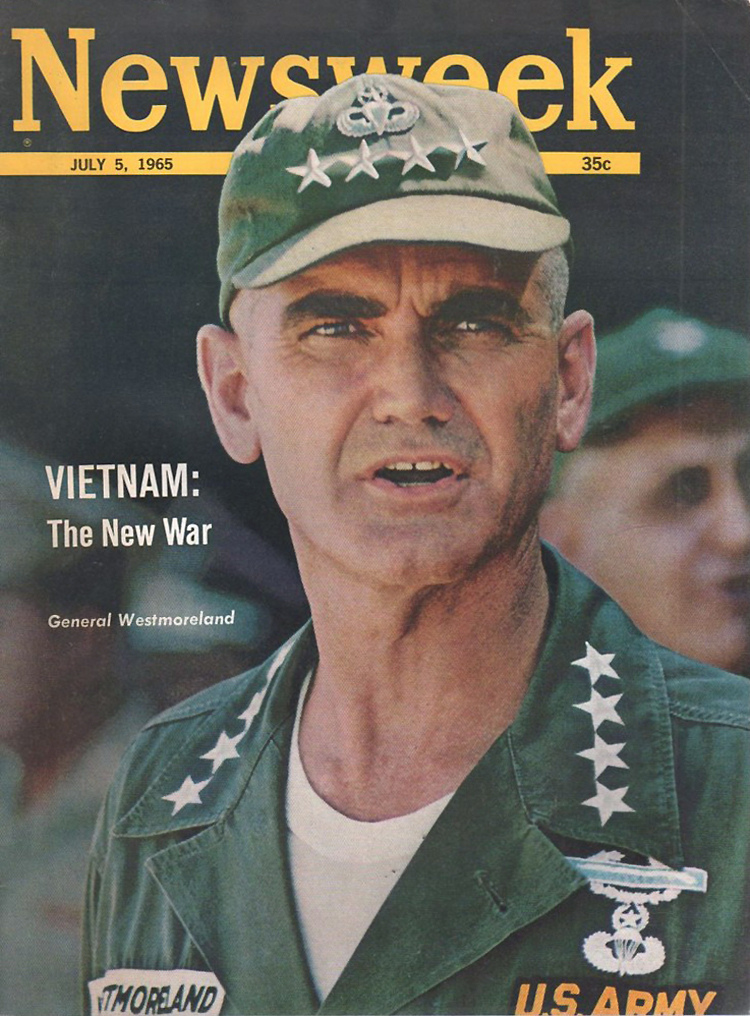
General Westmoreland on the cover of Newsweek, July 5, 1965 (File). Vietnam War historian Stanley Karnow famously opined that "Westy was a corporation executive in uniform."
"ARVN forces on the other hand are already experiencing difficulty in coping with this increased VC capability. Desertion rates are inordinately high. Battle losses have been higher than expected; in fact, four ARVN battalions have been rendered ineffective by VC action in the I and IT Corps zones....
"Thus, the GVN/VC force ratios upon which we based our estimate of the situation in March have taken an adverse trend. You will recall that I recommended the deployment of a U.S. division in II Corps to cover the period of the RVNAF build-up and to weight the force ratios in that important area. We assumed at that time that the ARVN battalions would be brought to full strength by now and that the force build-up would proceed on schedule. Neither of these assumptions has materialized….
"In order to cope with the situation outlined above, I see no course of action open to us except to reinforce our efforts in SVN with additional U.S. or third country forces as rapidly as is practical during the critical weeks ahead."
The '44-Battalion Request'
What General Westmoreland asked for added up to a total force of 44 battalions and the June 7 message became known as the "44-battalion request."
Just as intense internal debate was beginning on the request, there was a "credibility" flare-up deriving from President Johnson's injunction of secrecy on the change of missions for the marines authorized on April 1 in National Security Action Memorandum 328.
"The long official silence between the sanction for U.S. offensive operations contained in NSAM 328 and the final approval [in negotiations with Saigon] of the conditions under which U.S. troops could be committed was not without cost," the study asserts. "The President had admonished each of the N.S.C. members not to allow re-lease of provisions of the NSAM, but the unduly long interregnum inevitably led to leaks." In addition, the marines had 200 casualties, including 18 killed, as they went about "tidying up," as the study puts it, their newly assigned area in April and May.
"The Commandant of the Marine Corps," the study continues, "raised the tempo of speculation by saying to the press during an inspection trip to Vietnam in April that the marines were not in Vietnam to 'sit on their dittyboxes— and they were there to 'kill Vietcong.'
"An honest and superficially innocuous statement by Department of State Press Officer Robert McCloskey on 8 June to the effect that 'American forces would be available for combat support together with Vietnamese forces when and if necessary' produced an immediate response [in the press].
'By Its Own Petard'
"The White House was hoisted by its own petard. In an attempt to quell the outcry, a statement was issued on the 9th of June which, because of its ambiguity, only served to exacerbate the situation and to widen what was being described as 'the credibility gap'."
The White House statement said: "There has been no change in the mission of United States ground combat units in Vietnam in recent days or weeks. The President has issued no order of any kind in this regard to General Westmoreland recently or at any other time. The primary mission of these troops is to secure and safe-guard important military installations like the air base at Danang. They have the associated mission of… patrolling and securing actions in and near the areas thus safeguarded.
"If help is requested by the appropriate Vietnamese commander, General Westmoreland also has authority within the assigned mission to employ those troops in support of Vietnamese forces faced with aggressive attack when other effective reserves are not available and when, in his judgment, the general military situation urgently requires it."
Discussing this statement, the Pentagon analyst says: "The documents do not reveal whether or not the ground rules for engagement of U.S. forces had actually been worked out to everyone's satisfaction at the time of the White House statement. There is good indication that they had not." The analyst also notes that during the battles of Bagia and Dongxoai, the Government forces "were desperately in need of assistance," but that United States forces were not committed although the marines were available for Bagia and the 173d Airborne Brigade for Dongxoai.
The study reports that the first major ground action by United States forces took place northwest of Saigon from June 27 to June 30, and involved the 173d Airborne Brigade, an Australian battalion and South Vietnamese forces.
"The operation could by no stretch of definition have been described as a reserve reaction," the study says. "It was a search and destroy operation into Vietcong base areas…. The excursion was a direct result of the sanction given to General Westmoreland…. [as a result of National Security Action Memorandum 328 and the enemy offensive] to commit U.S. troops to combat, independent of or in conjunction with GVN forces in any situation in which the use of such troops is requested by an appropriate GVN commander and when in [General Westmoreland's] judgment, their use is necessary to strengthen the relative position of GVN forces'." The wording of this sanction came in a State Department message.
'Overcome by Events'
However, as the study notes, "At that juncture the 44-battalion debate was in full swing and the enclave strategy, as a means to limit the amount and use of U.S. combat force in Vietnam, was certainly overcome by events" and by "a much more ambitious strategy sanctioned by the President."
Recapitulating the situation just before the debate, the study gives this picture of deployment: At the beginning of June, the enclave strategy was in its first stages with Marine Corps forces at Phubai, Danang and Chulai, and Army forces in Vungtau. Other enclaves were under consideration. Approved for deployment—but not all arrived in South Vietnam yet—were approximately 70,-000 troops in 13 maneuver battalions; with third-country forces the total came to 77,250 men and 17 maneuver battalions.
This was the situation when, on June 7, General Westmoreland asked for reinforcements "as rapidly as possible."
General Westmoreland's message, the Pentagon study says, "stirred up a veritable hornet's nest in Washington," because his request for large reinforcements and his proposed strategy to go on the offensive "did not contain any of the comfortable restrictions and safeguards which had been part of every strategy debated to date."
"In such a move," the study continues, "the specter of U.S, involvement in a major Asian ground war was there for all to see."
Just as Ambassador Taylor had consistently resisted involvement of United States forces, the study says, so General Westmoreland had been equally determined to get the troops into the war and have "a free hand" in using them.
At the time of his message, the general had available in Vietnam seven Marine and 2 Army maneuver battalions, plus an Australian battalion. Now, he was asking for a total of 33 battalions, and if the 173d Airborne Brigade's two battalions—which were on temporary assignment—were added, the total came to 35. But in a subparagraph, General Westmoreland also identified nine other United States battalions that he might request at a later date. Thus the total of 44 battalions, and hence the name given the request. In the total was included an airmobile division of nine battalions to be formed later.
Admiral Sharp favored the request in a message to the Joint Chiefs on June 7, saying, "We will lose by staying in enclaves defending coastal areas."
The Chiefs in Favor
The Joint Chiefs, the Pentagon analyst says, favored bolstering the United States troop commitment. As far back as March 20, the Joint Chiefs had advocated sending three divisions—two American and one Korean—with the objective of "destroying the Vietcong."
Now, the study states, General Westmoreland's request altered drastically the role of the J.C.S. in the build-up debate.
"Up to that time," the study continues, "the J.C.S. had, if anything, been ahead of General Westmoreland in advocating allied forces for Vietnam. The 27 battalions of their three-division plan were in themselves more than Westmoreland ever requested until 7 June. After that date, the big push came from Westmoreland in Saigon, and the J.C.S were caught in the middle between the latter and the powerful and strident opposition his latest request for forces had surfaced in Washington."
On June 11, the Joint Chiefs cabled Admiral Sharp that something less than General Westmoreland's request was close to approval, but they wanted to know, the study says, "where Westmoreland intended to put this force in Vietnam." He replied on June 13 in detail and the study comments: "This message was extremely important, for in it [he] spelled out the concept of keeping U.S. forces away from the people. The search and destroy strategy for U.S. and third country forces which continues to this day and the primary focus of RVNAF on pacification both stem from that concept. In addition, Westmoreland made a big pitch in this cable for a free hand to maneuver the troops around inside the country. . ."
Confirmation by Taylor
Ambassador Taylor, in a report on June 17, "confirmed the seriousness of the military situation as reported by General Westmoreland and also pointed up the very tenuous hold the new government had on the country." This was the Government of President Nguyen Van Thieu and Premier Nguyen Cao Ky.
"This report apparently helped to remove the last obstacles to consideration of all of the forces mentioned in Westmoreland's request of 7 June," the analyst says.
On June 22, General Wheeler cabled General Westmoreland and asked if the 44 battalions were enough to convince the enemy forces that they could not win. General Westmoreland replied, the study says, "that there was no evidence the VC/DRV would alter their plans regardless of what the U.S. did in the next six months."
"The 44-battalion force should, however, establish a favorable balance of power by the end of the year," the study quotes the general as having said. "If the U.S. was to seize the initiative from the enemy, then further forces would be required into 1966 and beyond….”
On June 26, the general had been given authority to commit United States forces to battle when he decided they were necessary "to strengthen the relative position to GVN forces."
"This was about as close to a free hand in managing the forces as General Westmoreland was likely to get," the analyst says. "The strategy was finished, and the debate from then on centered on how much force and to what end."
The New York Times
June 15, 1971
The opposition to General Westmoreland had "its day in court," late in June and early in July, the study says. The embassy in Saigon, "while recognizing the seriousness of the situation in South Vietnam, was less than sanguine about the prospects for success if large numbers of foreign troops were brought in."
Another critic of General Westmoreland's recommendations, the account reports, was Under Secretary of State Ball who was "convinced that the U.S. was pouring its resources down the drain in the wrong place." "In Ball's view," the account continues, "there was absolutely no assurance that the U.S. could with the provision of more ground forces achieve its political objectives in Vietnam. Instead, the U.S. risked involving itself in a costly and indeterminate struggle. To further complicate matters, it would be equally impossible to achieve political objectives by expanding the bombing of the North….”
William Bundy in the Middle
Assistant Secretary William Bundy, the study says, "like so many others found himself in between Westmoreland and Ball."
In a memorandum to the President on July 1, Mr. Bundy gave his position, as summarized in the Pentagon study: "The U.S. needed to avoid the ultimatum aspects of the 44 battalions and also the Ball withdrawal proposal…. The U.S. should adopt a policy which would allow it to hold on without risking disasters of scale if the war were lost despite deployment of the full 44 battalions. For the moment, according to Bundy, the U.S. should complete planned deployments to bring in-country forces to 18 maneuver battalions and 85,000 men…. The forces in Vietnam, which Bundy assumed would be enough to prevent collapse, would be restricted to reserve reaction in support of RVNAF. This would allow for some experimentation without taking over the war effort—a familiar theme."
As for Secretary McNamara's views, the study comments: "It is difficult to be precise about the position of the Secretary of Defense during the build-up debate because there is so little of him in the files."
"There are plenty of other indications in the files that the Secretary was very carefully and personally insuring that the Defense Establishment was ready to provide efficient and sufficient support to the fighting elements in Vietnam," the study continues. "From the records, the Secretary comes out much more clearly for good management than he does for any particular strategy."
The Secretary went to South Vietnam for a four-day inspection starting July 16. The study says that while he was in Saigon on July 17, he received a cable from Deputy Secretary of Defense Vance informing him that the President had decided to go ahead with the plan to deploy 34 battalions.
"The debate was over," the analyst says. "McNamara left Saigon bearing Westmoreland recommendations for an even greater increase in forces….”
The study says 34 battalions. This is not entirely clear, because in his request General Westmoreland had asked for a total of 33, and if the battalions of the 173rd Airborne Brigade were added, the total would be 35. The explanation apparently is that when the Airmobile Division was finally organized, it had eight rather than nine battalions. The 34 battalions were, of course, to be supplied immediately. The nine others were to be requested later if needed.
The Pentagon analyst apparently did not have access to White House memoranda, so he is able to give only a sketchy account of Mr. Johnson's role. But he says: "There is no question that the key figure in the early 1965 build-up was the President."
On May 4, the President asked Congress for a $700-million supplemental appropriation "to meet mounting military requirements in Vietnam."
"Nor can I guarantee this will be the last request," he said in a message. "If our need expands I will turn again to the Congress. For we will do whatever must be done to insure the safety of South Vietnam from aggression. This is the firm and irrevocable commitment of our people and nation."
On July 28, the President held a press conference in which he said, "The lesson of history dictated that the U.S. commit its strength to resist aggression in South Vietnam."
As for the troop increases, the President said:
"I have asked the commanding general, General Westmoreland, what more he needs to meet this mounting aggression. He has told me. We will meet his needs.
"I have today ordered to Vietnam the Airmobile Division and certain other forces which will raise our fighting strength from 75,000 to 125,000 men almost immediately. Additional forces will be needed later, and they will be sent as requested….
"I have concluded that it is not essential to order Reserve units into service now."
'It Does Not Imply Change'
During the questioning after the announcement, this exchange took place:
"Q. Mr. President, does the fact that you are sending additional forces to Vietnam imply any change in the existing policy of relying mainly on the South Vietnamese to carry out offensive operations and using American forces to guard installations and to act as emergency back-up?
"A. It does not imply any change in policy whatever. It does not imply change of objective."
On July 30, the Joint Chiefs approved 44 maneuver battalions for deployment, involving a total of 193,887 United States troops. By the end of the year, United States forces in South Vietnam numbered 184,314.
"The major participants in the decision knew the choices and understood the consequences," the study says in summation. The decision taken in mid-July to commit 44 battalions of troops to battle in South Vietnam "was perceived as a threshold—entrance into an Asian land war. The conflict was seen to be long, with further U.S. deployments to follow. The choice at that time was not whether or not to negotiate, it was not whether to hold on for a while or let go—the choice was viewed as winning or losing South Vietnam."
Accompanying this decision to give General Westmoreland enough troops to embark on the first phase of his search-and-destroy strategy "was a subtle change of emphasis," the study says, adding:
"Instead of simply denying the enemy victory and convincing him that he could not win, the thrust became defeating the enemy in the South. This was sanctioned implicitly as the only way to achieve the U.S. objective of a non-Communist South Vietnam.
"The acceptance of the search-and-destroy strategy… left the U.S. commitment to Vietnam open-ended. The implications in terms of manpower and money are inescapable.
"Final acceptance of the desirability of inflicting defeat on the enemy rather than merely denying him victory opened the door to an indeterminate amount of additional force."
Precisely what President Johnson and Secretary of Defense McNamara expected their decisions of July to bring within the near term "is not clear," the study says, "but there are manifold indications that they were prepared for a long war."
A full layperson's account of the Pentagon Papers case may be read at Douglas O. Linder's comprehensive microsite on the subject. Linder is a professor of law at the University of Missouri-Kansas City.
Under the aegis of Neil Sheehan, The New York Times published excerpts from the study from June 13-15 and, after the resolution of New York Times Co. vs. United States, from July 1-5, 1971. Although short headline articles were ascribed to Sheehan, Hedrick Smith, E.W. Kentworthy and Fox Butterfield, most of the coverage was comprised of summaries of the leaked excerpts attributed to the four reporters.
The Times's voluminous Public Service entry contained all of the reportage and data published during these timeframes, making it essentially analogous to the paperback edition of the series published by Times Books in July 1971. Remarkably, the Times only published about 5% of the study, which remained formally classified until 2011. Much of the remaining content was published at the instigation of Senator Mike Gravel in the Beacon Press edition of 1971 and by George C. Herring in The Secret Diplomacy of the Vietnam War (University of Texas Press, 1983).
For the sake of brevity, we have only included the most important disclosures published from June 13-15. These have been augmented by relevant photos, videos, and links to relevant Wikipedia biographies. The Papers constitute a totemic chapter in American history that continues to resonate in the myriad "data dumps" of today, including the Prize-winning work of The Washington Post and Edward Snowden in 2014; we can only hope that this taste will elicit further interest in the subject from younger generations, people who may find a sort of anamnesis in these stories.
The complete Pentagon Papers study may be perused at the National Archives.
Ephemera related to the Pentagon Papers entry from our office archive and beyond will be available at our History Project site (TBA).