Babbitt's Special Citation is for his life's work in music. This composition, Philomel, is one of his most influential compositions. Listen to it here:
Babbitt's Special Citation is for his life's work in music. This composition, Philomel, is one of his most influential compositions. Listen to it here:
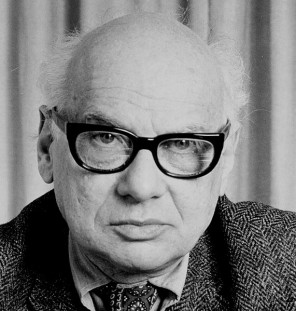
Although he retained an encyclopedic knowledge of the popular music of his youth and even trained Stephen Sondheim in a private tutorial, Milton Babbitt reveled in a unique kind of modernistic complexity.
Having befriended many of the luminaries of the prewar avant-garde—including Arnold Schoenberg and Edgard Varèse—as an undergraduate music student at New York University in the early 1930s, Babbitt fused Schoenberg's dodecaphonic or "twelve-tone" serialism (in which all twelve notes of the octave are articulated before repeating through various combinatorial processes, resulting in a piece that is functionally arrythmic and atonal) with the mathematical rigor of set theory. This allows the composer to derive other facets of the piece (such as duration) in a serialistic manner.
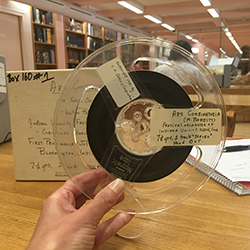
Ars Combinatoria on tape as submitted for Pulitzer Special Award consideration
Babbitt's theoretical innovations became grouped under the rubric of "total serialism." In addition to spearheading the formation of university departments of music theory and composition (most notably at Princeton University, his graduate alma mater and institutional home for much of his career), he influenced a generation of European composers, including Pierre Boulez and Karlheinz Stockhausen.
While he never enjoyed the crossover appeal of minimalists like Terry Riley in the popular sphere, Babbitt's need for musical precision yielded an important dividend: the prototypical modern synthesizer. As co-director of the Columbia-Princeton Electronic Music Center, he played an integral role in the development of the RCA Mark II Electronic Music Synthesizer in 1957. Babbitt initially envisioned the need for the instrument in correspondence with the company in 1938.
A collaboration with avant-garde soprano Bethany Beardslee and poet-scholar John Hollander, Philomel (1964; inspired by the minor Greek myth) is regarded as a watershed in Babbitt's career. Well before the pop mainstream utilized such methods, it juxtaposes live and processed studio recordings of Beardslee against a serialistic backdrop created with the Mark II. According to Elaine Barkin and Martin Brody, this facilitates a number of improbable "word-music puns" in the piece. Even as he broke through the tonal barrier, Babbitt—who remained a beloved member of the Princeton community until his death in 2011—was very much a humanist at heart.
Sources:
Allan Kozinn, "Milton Babbitt, a Composer Who Gloried in Complexity, Dies at 94," The New York Times, January 29, 2011; John Hollander, "Notes on the Text of Philomel," Perspectives of New Music, Vol. 6, No. 1 (Autumn - Winter, 1967), pp. 134-141; "RCA Mark I and Mark II Synthesizers," Engineering and Technology Wiki