Newsday, by Laurie Garrett
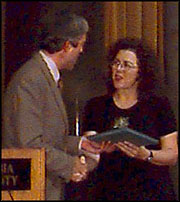
Laurie Garrett is awarded the 1996 Pulitzer Prize by George Rupp, Columbia University President.
Winning Work
By Laurie Garrett
A mysterious lethal virus has broken out in Zaire, killing at least 56 people and prompting government officials to place parts of the country under quarantine, health officials said yesterday.
The most likely cause is Ebola -- a highly contagious disease that can be fatal in 90 percent of cases, causing its victims to bleed through their pores and bodily orifices -- or a related hemorrhagic fever virus, officials with the Centers for Disease Control and Prevention said yesterday.
As of Sunday, Zaire told the World Health Organization, it has 172 cases of the ailment in Kikwit, a city of 600,000 which is about 250 miles from the Zairean capital of Kinshasa. Among the ailing are 24 health-care workers, including four Italian nurse-nuns. Reports from Kinshasa to WHO suggest that two of the nuns may have died.
The CDC's Special Pathogens Laboratory in Atlanta, the world's highest security medical facility, received blood and tissue samples drawn from victims of the outbreak yesterday at 10 a.m. It hopes to provide a definitive identification this morning.
"If it is Ebola, this [disease] is the big one -- this is what we're always thinking about when we talk about serious, dangerous disease threats," said Dr. James Le Duc, head of the World Health Organization's special virus group.
Ebola has received a tremendous amount of popular attention lately, having been the focus of two books, "The Hot Zone" and "The Coming Plague," a motion picture, "Outbreak," and an NBC-TV movie special that aired Monday night, "Virus".
Ebola outbreaks have only been known to occur three previous times, all in Africa: in Yambuku, Zaire, in 1976, where it killed 274 people, and in Nzara, Sudan, in 1976 and 1979. In those epidemics, mortality rates among the infected villagers and medical personnel ranged from 70 to 95 percent.
Information on the current epidemic is scarce. According to Le Duc, his organization didn't learn of the outbreak until Sunday. At that time, Zairean officials told him that the epidemic began on April 10.
Word of the outbreak was delayed by civil war conditions in Zaire, and because the virus samples were sent first to Belgium -- even though Belgium no longer funds a Biosafety Level 4 laboratory, designed to contain the most dangerous viruses. The samples were then sent on to Atlanta.
The Zairean government has requested international assistance, and the WHO's Dr. David Heymann, who was a member of the scientific team that investigated the 1976 Yambuku epidemic, arrived there last night. The CDC is also assembling a crew in Atlanta that will be dispatched "within two to three days," said Dr. Ruth Berkelman of the emerging diseases division.
The scramble is now on to find equipment that will allow the scientists to work safely in the field with the super-lethal virus.
The Ebola virus belongs to a class of organisms called filoviruses, which destroy the linings of capillaries and blood vessels, prompting fluids to drain out of the circulatory system. The viruses' course is painful, and victims typically become deranged and manic before dying of shock.
Whether the virus can be spread in the air is a point of great controversy for Ebola. Though some scientists believe that there is evidence that airborne transmission has occurred, at least between monkeys infected with a strain called Ebola Reston, the WHO considers blood contact to be the primary mode of spread.
© 1995, Newsday
By Laurie Garrett
A deadly virus outbreak in Zaire apparently has spread to a second city, according to international relief workers in the central African country.
The identity of the virus has not been announced. Officially, scientists at the Centers for Disease Control and Prevention in Atlanta say they have not yet identified it.
But government officials in Sweden reported last night that they had been informed by U.S. officials that the epidemic of hemorrhagic fever was caused by a strain of the Ebola virus, which can be 90 percent fatal. At the World Health Organization headquarters in Geneva, officials who asked that they not be identified also confirmed that the CDC had identified an "Ebola-type virus" in samples sent to them.
The independent medical relief organization Doctors Without Borders announced yesterday that a team of their physicians -- all European volunteers -- had identified a second Ebola-like outbreak in the town of Musango, located between Zaire's capital, Kinshasa, and Kikwit, where the initial cases were reported.
The Ebola virus is highly communicable; it apparently spreads by direct human contact, especially through blood contact. It attacks the linings of blood vessels and capillaries, leading to severe bleeding from all orifices, and eventually death due to shock or heart attack. A classic symptom -- which the Doctors Without Borders team observed in Musango -- is uncontrolled bleeding from punctures from injections.
The organization said its team reported from Kinshasa, 250 miles west of Kikwit, that there were 30 confirmed deaths of hemorrhagic fever in the Zairean outbreak, out of a total toll of 170. The cause or causes of the other 140 deaths had not been verified, the group said.
According to WHO, the Kikwit outbreak began sometime in early February but wasn't recognized by local doctors until April 10 because the city already was plagued by a separate epidemic of bloody diarrhea.
The outbreak appears to have grown significantly after April 10, when substandard sterile techniques in the operating room of Kikwit's Catholic hospital allowed the deadly virus to spread from an infected surgical patient to medical personnel.
WHO officials reported that among those who have died of the suspected Ebola virus in Kikwit are 10 health care workers. Two of the dead were nursing nuns from the Poverelle order, based in Bergamo, Italy. Two other nuns were also reportedly infected, one of whom was transferred to Musango.
And there, according to Doctors Without Borders, at least 10 more people have contracted the disease in the hospital that received the ailing nun. The team is expected to return to the organization's headquarters in Brussels tomorrow, bringing patient blood samples from Musango for analysis.
Authorities in Zaire have had the city of Kikwit, population 600,000, under quarantine since Tuesday, and three teams of scientists from WHO and the CDC have either arrived in the country or are scheduled to leave the United States shortly. The agencies were not notified of the epidemic until Sunday.
Ebola veteran Dr. Joseph McCormick is the only scientist to have witnessed all three previous known Ebola epidemics, all in Africa. Now chief of infectious diseases at the Aga Khan University in Karachi, Pakistan, McCormick said it is impossible to know when or where Ebola will strike, because it's not known what animal or insect carries the virus. "Without knowing in what species of African animal or insect the virus lurks, it's anybody's guess when or where it will surface," he said.
"One thing I'm sure of," McCormick said, "is that sporadic isolated cases of Ebola hemorrhagic fever are occurring all the time in that part of Africa. And what is clear is that unsound hospital practices are essential to this thing developing into a full-scale epidemic."
All three previous Ebola outbreaks were associated with poor hospital hygiene, particularly reuse of syringes.
"Those dammed needles, I'm telling you, we're seeing epidemics all over the place because of them," McCormick said. He said a 1992 Nigeria outbreak of Lassa fever, a similar hemorrhagic disease, was spread by needles, and in Pakistan "we're experiencing a horrendous hepatitis C epidemic that can be traced directly to reused medical needles." According to McCormick's latest research, 30 percent of all Pakistani adults living in the Punjab region of the country are infected with once-rare Hepatitis C, a virus that causes liver failure or cancer.
"We're seeing rehearsals for something here," Dr. Jonathan Mann of the Harvard School of Public Health said in an interview. "And the rehearsal is for a really big one that won't be limited to Zaire."
By Laurie Garrett
The Ebola epidemic in Zaire appears to have spread from the quarantined city of Kikwit to at least two other locations.
Sources in the World Health Organization and the Centers for Disease Control and Prevention told New York Newsday yesterday that there are indications the deadly Ebola virus, which first surfaced in Kikwit sometime in February, has spread to two small villages located closer to the Zairian capital, Kinshasa.
In one town, Musango, at least 10 hospital patients and workers reportedly became infected following the arrival of a nun from Kikwit who later died of Ebola.
The disease, which can be 90 percent fatal, is primarily spread by direct contact with contaminated blood or syringes.
Kikwit is the largest urban center for the province of Bandundu, which is inhabited by some 6 million people. Dozens of people in the Bandundu region have died, but reports of the number of deaths due to Ebola vary wildly. Yesterday Reuter reported that Kinshasa authorities were ordering a quarantine of the entire province out of concern that the virus might reach the capital, Kinshasa, where about 4 million to 6 million people live.
"If the disease penetrates to Kinshasa that will be a catastrophe," said the capital's governor, Bernadin Mungul Diaka. The city's mortuary, he added, had room for only 150 corpses.
WHO's Dr. David Heymann is in Zaire to help confirm and control the spread of Ebola, along with volunteers from the Brussels-based group Doctors Without Borders. Heymann's small team was augmented last night by three American CDC experts.
According to Veerle Eygenramm, a Doctors Without Borders spokeswoman, 20 deaths from Ebola were confirmed as of Tuesday, and 61 others have died from bloody diarrhea, which tests may show to have been caused by Ebola or the bacteria shigella. Other reports had more than 170 deaths in Kikwit.
© 1995, Newsday
By Laurie Garrett
The Ebola epidemic in Zaire appears to have spread from the quarantined city of Kikwit to at least two other locations.
Sources in the World Health Organization and the Centers for Disease Control and Prevention told Newsday yesterday that there are indications that the deadly Ebola virus, which first surfaced in Kikwit sometime in February, has spread to two small villages located closer to the Zairian capital, Kinshasa.
In one town, Musango, at least 10 hospital patients and workers reportedly became infected following the arrival of a nun from Kikwit, who later died of Ebola.
The disease, which is 90 percent fatal, is primarily spread by direct contact with contaminated blood or syringes.
Kikwit is the largest urban center for the province of Bandundu, which is inhabited by some 6 million people. Dozens of people in the Bandundu region have died, but reports of the number of deaths due to Ebola vary wildly.
Yesterday Reuter reported that Kinshasa authorities were ordering a quarantine of the entire province out of concern that the virus might reach the capital, where an estimated 4 million to 6 million people live.
"If the disease penetrates to Kinshasa, that will be a catastrophe," said the capital's governor, Bernadin Mungul Diaka.
WHO's Dr. David Heymann is in Zaire to help confirm and control the spread of Ebola, along with volunteers from the Brussels-based group Doctors Without Borders. Heymann's small team was augmented last night by three American experts from the CDC.
"I suspect we're going to soon be hearing that that's not enough people," said Dr. Jim Hughes, director of the CDC's division of infectious diseases.
To contain the virus, the 350-bed Kikwit hospital was cleared out except for about 20 infected patients and hospital staffers who had been exposed to the virus, said Doctors Without Borders spokeswoman Veerle Eygenraam.
"It is quite serious because it is a very infectious virus. But we have found out about it very early and in hospitals, and we have taken all the necessary measures to decrease transmission," Eygenraam said.
She said 20 deaths from Ebola were confirmed as of Tuesday and 61 others have died from bloody diarrhea, which tests may show to have been caused by Ebola or the bacteria shigella. Other reports had more than 170 deaths in Kikwit.
Meanwhile, the CDC Special Pathogens Laboratory, which confirmed the outbreak was Ebola, has analyzed the DNA of the viral samples sent earlier this week from Kikwit. The lab has found extremely close DNA identity between the Kikwit virus and the strain of Ebola that was recovered from patients in the previous Zairian outbreak -- 19 years ago in Yambuku, hundreds of miles away -- in which 274 people died.
© 1995, Newsday
By Laurie Garrett
Because of a simultaneous outbreak of another disease, the extent of the Zairian Ebola epidemic may have been slightly overestimated, physicians working with Doctors Without Borders said yesterday.
The doctors with the Brussels-based independent relief group said that the other disease is caused by shigella bacteria. Both the bacteria and the Ebola virus cause bloody diarrhea, so some shigella cases were misdiagnosed as Ebola.
The physicians were back in Brussels after working in Kikwit, where both epidemics began. Of the 172 reported cases of illness in that city, 50 Ebola cases have been confirmed, with 29 deaths, they said.
© 1995, Newsday
By Laurie Garrett
The Ebola virus now striking Zaire is deadly, but its spread can be controlled because it kills its victims far more quickly and easily than it spreads to new ones.
Most scientists believe that the three known strains of human Ebola spread from one person to another through contact with bodily fluids -- primarily blood -- and not through air, water or casual contact.
"I've been inside huts, surrounded by people who were dying of this disease, where there was no air exchange at all, and I've never gotten Ebola," said Dr. Joseph McCormick, the only scientist who has witnessed all three human outbreaks of the virus.
Unlike the scientists depicted in the movie "Outbreak," who examined patients while wearing full body respirator "space suits," McCormick's protection has been simple: a surgical mask, eyeglasses, a surgical cotton gown and two layers of latex gloves.
"That's enough," McCormick says. "And it's just silly to talk about wearing a mask while walking down the street. This virus isn't going to fly into your face."
As a result, the spread of Ebola can be controlled through relatively simple means, such as disinfecting medical equipment and not touching or shaking hands with anyone who may be infected in case they have bodily fluids on their skin.
"We must wash our hands with soap before we eat, avoid other people's blood and body fluids," Vincent Mapuko, a businessman in Kinshasa, told the Associated Press. "As soon as we have symptoms, we must go to the hospital."
Once people are infected, they usually get sick quickly - within an average of seven to 10 days, although symptoms, which include headaches, bloody diarrhea and fever, can occur as early two days from infection.
In addition, the disease is easiest to spread when patients are at their sickest and the virus begins to destroy the linings of blood vessels and capillaries, and blood oozes from every opening on the body.
"We are, in a sense, fortunate that this is a remote and fairly poor area," said Ruth Berkelman, an expert on emerging diseases for the Centers for Disease Control and Prevention. "It's unlikely these people will be moving around, particularly outside the country."
But unlike previous outbreaks, this one occurred in a large city, not a small village, creating a greater chance that it will spread outside the immediate area.
Ebola outbreaks have been identified only three times before -- in Yambuku, Zaire in 1976, and in Nzara, Sudan, in 1976 and 1979 -- where up to 90 percent of those who were infected died. There is no vaccine for Ebola and no treatment.
Because of its scanty history, the virus remains mysterious in many ways. It's not known, for instance, what animal or insect may carry it and where it hides in between outbreaks.
Some scientists also suspect the virus might be transmitted by air in unusual circumstances. When a monkey form of Ebola broke out in an animal facility in Reston, Va., in 1989, some monkeys seem to have become infected that way. Fortunately, that strain, dubbed Ebola Reston, was not capable of causing disease in human beings.
Nevertheless, McCormick and other scientists who have witnessed these epidemics are convinced the virus primarily spreads in the following ways:
Needles. As in the current case, hospitals fostered the outbreaks by spreading it, primarily through reuse of contaminated syringes. McCormick said it is likely that isolated cases of Ebola happen frequently, but go unnoticed until hospital practices spread it quickly.
Surgery. Wherever sterile techniques are ignored, there is the danger of Ebola transmission from patient to health provider, and vice-versa.
Sexual intercourse. Spouses of Ebola carriers -- individuals who were unknowingly infected and incubating the virus were infected, presumably through blood passage during intercourse.
Funerary rites. In Nzara, the Sudanese village that has seen two outbreaks, women are exposed to blood and other fluids of the dead when they prepare bodies for burial.
© 1995, Newsday
By Laurie Garrett
Kinshasa, Zaire -- With authorities searching for at least two individuals suspected of having the disease here in the capital, Zaire's chief health official warned yesterday that the quarantine of disease-stricken areas was being violated, and "if the quarantine cannot be held, the country will be closed.
The death toll in Zaire's Ebola outbreak has risen to 77, the World Health Organization reported, out of 84 confirmed cases of the virus.
In Kikwit, the center of the outbreak, authorities acknowledged that more than 100 additional deaths had probably occurred, but had gone uncounted, because the victims died at home. "People do not want to go to hospitals, knowing that the epidemic started there," a WHO statement said.
"Here in Kikwit, the problem is bigger than in Yambuku," where the Ebola virus first broke out in 1976, Zairean microbiologist Jean-Jacques Muyembe told reporters Sunday. "Because the town has more than 400,000 people. It is a very big city. Yambuku was just a village."
In Kinshasa, Ministry of Health officials confirmed that two individuals -- a nurse and a Congo River boat worker -- were being sought by police. The nurse, who was exposed to Ebola in Kikwit, reportedly fled to the capital and disappeared. Reports on her status varied wildly -- from rumors that she had gotten ill but recovered, to claims that she had died on the street in Kinshasa. The riverboat worker, said to have shown symptoms of the disease, was being sought last night on transports along the Congo, a major transportation link between Kinshasa and the interior of Zaire.
Loyangela Bompenda, Zaire's secretary general of health, said yesterday that people are evading roadblocks and violating the quarantine imposed on Kikwit and neighboring villages. "If the quarantine cannot be held, the country will be closed," Bompenda said at a briefing.
Air France, Sabena and other international air carriers have already announced plans to limit flights to the Central African nation.
Bompenda pleaded with citizens and the press corps to abide by the quarantines. And he warned that "control of the Cordon Sanitaire [the quarantine line] is the responsibility of the police. If measures are to be taken, they will be police measures."
Precisely what steps the feared Zairian police might take to enforce the quarantine were not said.
The epidemic has struck Zaire at a time when the country is in near chaos. Throngs of unemployed workers stand idle on the streets of the capital, begging and often trying to steal. Inflation is wildly out of control: The Zaire, the unit of currency, is valued at 5,020 per dollar compared with 90 per dollar just four years ago.
Meanwhile, work continued for the small team of international experts who have gathered to understand and control the outbreak.
Among those now on the ground only two -- Muyembe and South Africa's Dr. Margarethe Isaacson -- have ever seen an Ebola epidemic before.
There is no cure or vaccine for Ebola, which kills up to 90 percent of those it infects. No one knows where the virus hides between epidemics -- in some animal or insect population, for instance. There have been three previous outbreaks, in Zaire in 1976 and in Sudan in 1976 and 1979.
So far, scientists have no idea how and why the virus struck in Kikwit. Muyembe said that a 36-year-old hospital laboratory technician named Kimfumu was the first one struck down in Kikwit's hospital earlier this month. Thirteen hospital staff members who had contact with Kimfumu got the disease, and the epidemic broke out.
But Kimfumu clearly was not the first person to get Ebola in Kikwit. Muyembe said that the unfortunate lab technician had not traveled or participated in any unusual activities. Rather, someone else must have brought the deadly microbe into the hospital.
Though scientists don't yet know who that person was, immediately before taking ill the lab technician had drawn blood samples from dozens of patients suffering from Shigella.
Shigella is an extremely potent bacteria that causes bloody diarrhea. Physicians in Kikwit noted in January that the region was in the grips of a terrible Shigella epidemic. And experts were called in from Kinshasa when the doctors noticed that some of the Shigella patients did not respond to antiobiotic treatment.
Shigella infections usually are easily cured with antibiotics. Those who didn't respond to the drugs, as it turned out, had Ebola.
© 1995, Newsday
By Laurie Garrett
Kinshasa, Zaire -- With authorities searching for at least two individuals believed to be at large here in the capital, Zaire's chief health official warned yesterday that the quarantine of disease-stricken areas was being violated, and "if the quarantine cannot be held, the country will be closed."
The death toll in Zaire's Ebola outbreak has risen to 77, the World Health Organization reported, out of 84 confirmed cases of the virus.
In Kikwit, the center of the outbreak, authorities acknowledged that more than 100 additional deaths had probably occurred, but had gone uncounted, because the victims died at home. "People do not want to go to hospitals, knowing that the epidemic started there," a WHO statement said.
"Here in Kikwit, the problem is bigger than in Yambuku," where the Ebola virus first broke out in 1976, Zairean microbiologist Jean-Jacques Muyembe told reporters Sunday, "because the town has more than 400,000 people. It is a very big city. Yambuku was just a village."
In Kinshasa, Ministryof Health officials confirmed that two individuals -- a nurse and a Congo River boat worker -- were being sought by police. The nurse, who was exposed to Ebola in Kikwit, reportedly fled to the capital and disappeared.
Loyangela Bompenda, Zaire's secretary general of health, said yesterday that people are evading roadblocks and violating the quarantine imposed on Kikwit and neighboring villages. "If the quarantine cannot be held, the country will be closed," he said at a briefing.
Air France, Sabena and other international air carriers have already announced plans to limit flights to the Central African nation.
There is no cure or vaccine for Ebola, which kills up to 90 percent of those it infects. No one knows where the virus hides between epidemics -- in some animal or insect population, for instance. There have been three previous outbreaks, in Zaire in 1976 and in Sudan in 1976 and 1979.
© 1995, Newsday
By Laurie Garrett
Kinshasa, Zaire -- News that two suspected Ebola carriers sought by authorities had been found -- and probably were not infected with the virus -- left few people here relieved yesterday as the national death toll from the disease reached 86.
"This place is crawling with people from Kikwit," the officially quarantined city where the epidemic began, according to a young Zairean official who asked not to be identified. "Go to LeCite [Kinshasa's sprawling slum] and you will see. People are coming right in."
Another man, a physician who refused to give his name out of fear of government reprisals, said he had cared for a Swedish pilot who had violated the quarantine, flying several times in and out of Kikwit. Though the pilot does not have Ebola, the doctor said, "It just shows this [the government's quarantine effort] is all a big lie!"
Street vendors, meanwhile, say they have had no trouble obtaining fruits and vegetables from Bandundu Province. The entire province was ordered quarantined last week after Ebola virus cases were first reported in several villages there, as well as in its main city of Kikwit, 250 miles southeast of Kinshasa.
In their questions at a news conference yesterday, Zairean journalists for the first time voiced concerns that many people on the streets of Kinshasa -- and even in western embassies -- have been whispering for days. "Are there really enough scientists [in Kikwit]?" the reporters asked. "Do they know what they are doing?"
The international relief and research team in Kikwit comprises 10 specialists, nearly all of whom are either virologists or epidemiologists.
According to high-level Zairean sources, the specialists from the U.S. Centers for Disease Control and Prevention have been pressured by circumstances into devoting most of their time to treating Ebola sufferers. And none of the scientists has the kind of animal ecology expertise that might lead to the source of the deadly microbe.
In Atlanta, C.J. Peters, who heads the Special Pathogens branch of the CDC, said a much larger and more diverse team is needed.
Meanwhile, World Health Organization officials yesterday insisted that the epidemic has entered a controlled phase with the new cases reaching a plateau.
Officially, 93 people have contracted the hemorrhagic fever. The virus causes uncontrolled bleeding throughout the body and kills up to 90 percent of those infected; there is no cure or vaccine.
No cases have been reported in Kinshasa, but officials say that new cases are surfacing in four neighboring towns and villages.
Yesterday, Kinshasa police found the two suspected Ebola carriers who had been at large in the capital.
The first, a Congo River boat captain, was examined by Ministry of Public Health officials and found free of Ebola infection. The second, a nurse who had fled the Kikwit hospital as the virus swept through the medical staff earlier this month, is now being held under observation.
The nurse is said to be running a high fever, but Lonyangela Bompenda, secretary general of the Ministry of Public Health, said in a news conference last night that government doctors weren't sure "what is ailing her." However, Agence France Press reported last night that doctors suspect the cause is typhoid.
© 1995, Newsday
By Laurie Garrett
Kikwit, Zaire -- Under a canopy of bright stars, in a building surrounded by bushes that glowed with the lights of millions of fireflies, the Ebola epidemic control team compared notes on yesterday's battle against the deadly disease, and planned their efforts for today.
Their conclusions were grim.
"There may be another wave yet to come," said the team's leader, Dr. David Heymann of the World Health Organization. The number of cases is quadrupling every three to four days, he said, "and now transmission is occurring further and further out" from Kikwit's major medical facility, where the original cases occured.
The city and the province around it have been under a quarantine order since last week as the Kinshasa government seeks to contain the outbreak, the first in Zaire since 1976.
Many residents in Kikwit yesterday said the situation was made worse by the fact that people had come to associate the hospital with death, and were refusing to take their sick relatives there.
"There are people dying in the city. People are dying in the community," Dr. Mungala Kipasa, director of Kikwit General Hospital, told reporters.
"I can't even take a taxi," he said. "People won't let me in. They are afraid of medical staff."
The 326-bed hospital, considered by many to be the best in the region, is all but empty, with volunteer staff and international experts there preoccupied mainly with observing those in quarantine.
Perhaps for lack of data, doctors in Kinshasa said for the second day that the death toll was 86. The World Health Organization in Geneva said yesterday its experts in Zaire had registered 101 Ebola cases, of whom 77 had died. It said it expected a considerable increase by week's end.
The virus is passed through contact with blood or bodily fluids, and kills by causing uncontrollable bleeding. Because the incubation time for Ebola can in some cases be as long as three weeks, Heymann said there still may be many undiscovered carriers in Kikwit and surrounding villages.
There is widespread concern in Kinshasa that the Ebola quarantine is being violated by large numbers of merchants, truckers and other travelers from Kikwit. But a low-level flight over the 250 miles of vast and largely unpopulated countryside between the two cities revealed virtually no vehicles on either main arteries or side roads.
And the city of Kikwit, which is home to some 400,000 people, has few paved roads and an obvious lack of motorized vehicles. Though the epidemic has left rows of fresh white crosses in the Catholic cemetary, the city continues to buzz with commerce, and most of its residents are compelled by economic circumstances to go on with their normal lives.
Zaire's President Mobutu Sese Seko yesterday issued his first comments on the epidemic that began in February and became the focus of global attention on May 10. Appearing before reporters in Kinshasa, Mobutu said he was concerned about the people of Kikwit but would not travel there because his doctors "have forbidden me to go in that area."
© 1995, Newsday
Epidemic Breeding Anger, Fear In Kikwit
By Laurie Garrett
Despite the advice, the dead and dying are becoming harder to find, according to investigators.
Kikwit, Zaire -- The young woman rocked, shell-shocked, on her porch, nursing her baby as she described the events that left her the sole caretaker of 16 children and her own teenage sister.
In April her niece had a Caesarean section at Kikwit General Hospital. Nine days later the niece was dead. A few days after that the niece's newborn died. Then her own mother, who had tended to the niece, came down with a piercing headache at the funeral. When she went to the local dispensary, a health-care worker examined her and determined that her uterus was out of place. He reached in to adjust it.
Within the week both her mother and the health-care worker were dead. The family members who had tended to the dying women and then helped prepare them for burial fell ill soon afterward, dying one after another: the woman's father, a sister, a second sister.
All suffered similar symptoms: high fevers, headaches, nausea, diarrhea, muscle pains, prolonged hiccoughing from spasms of the diaphragm and hemorrhagic bleeding. All, the woman would learn later, had died of Ebola, a mysterious virus that kills up to 90 percent of the people it infects.
Then, on a blazing hot early afternoon, as the woman rocked on her porch, several doctors approached. They needed her help to study the disease, they said, and they asked her for blood.
The response was quick and fearful.
"My sisters got needles in their arms. Afwaka," she said, using the local KiCongo word for "they died." "My mother got needles. Afwaka! My father -- afwaka . . .
"I will not!" she said. "No!"
Kikwit, a community of between 250,000 and 400,000 people that is really no more than a huge village without running water, a sewage system or electricity, is full of fear. It is the epicenter of an Ebola outbreak that health officials said yesterday has infected 155 people and killed 97. Yesterday's report includes 31 more infections and eight more deaths than the day before.
Most of the fear in Kikwit is directed at the hospital, where the gruesome illness with mysterious origins spread slowly, doctors believe, unnoticed for months until magnified by non-sterile practices.
It's a community full of anger, as well -- largely against journalists who have dropped in from around the world, intruding on funerals, photographing patients and using their names without permission.
It's a community full of heroism. Red Cross volunteers and others collect the dying and bury the dead. Before the international relief effort began, they didit without protective clothing, masks or gloves. Now, three volunteers have died of Ebola, and a fourth is struggling for his life in Kikwit General Hospital.
* * *
The day began with astonishingly loud claps of thunder, followed by intense tropical rain. Kikwit's dirt roads were rendered impassable mires, hindering efforts to control the city's Ebola epidemic.
When the rain stopped, the heat and humidity rose, baking the rutted roads into troughs interspersed with ponds. It is rough going for the multinational team of experts studying the mysterious microbe named Ebola, after a small Zairean river.
Nonetheless, they help gather the dead, draw blood samples from people and pet monkeys, treat the hemorrhaging patients and scour the hills of this enormous community in search of victims of the virus. The plan to end the outbreak is a fairly simple one: Isolate it by persuading residents not to touch the infected, and supplying health-care workers with infection-control equipment.
At day's end the leaders of the team of scientists and doctors are gathered in one of Kikwit's few restaurants, drinking cold Primus beer, chewing on tough goat meat spiced with hot peppers and ruminating over the day's discoveries.
It is known that the virus is spread by contact with blood and bodily fluids, but other routes of transmission are suspected. The World Health Organization's Dr. Guenael Rodier poses the question: If the virus is in a well or a glass of water, is it safe to use that water? Just how tough is this virus?
He recalls the first outbreak of Ebola, in Yambuku, Zaire, in 1976, when samples of the suspected virus were shipped to Paris inside glass tubes that floated at room temperature amid liquid nitrogen. Despite days under such conditions, the viruses inside those tubes remained deadly.
So, concludes Rodier, we must assume that the virus can thrive in water, especially here in the tropical heat. The leader of the team, Zaire's Dr. Tamfu Muyembe worries out loud about the panic that has driven the people away from the hospital at a time when a new wave of cases is expected. No one can give him an answer about how to address the panic.
There also is no answer to how and why the epidemic came to Kikwit.
The international team believes that the first infection probably occurred in January. Suspicion centers on a family in which six people died, suffering symptoms reminiscent of the Ebola outbreak in 1976.
Because no one is left alive from the devastated family, it is the job of Dr. Ali Khan, of the U.S. Centers for Disease Control and Prevention in Atlanta, to scour the family's neighborhood for clues.
The scientists are convinced that the deadly virus then wended its way through isolated groups in Kikwit for two more months, being recognized as an outbreak -- and even then not immediately -- only when it reached the hospital.
Doctors there were overwhelmed at the time battling another pathogen: shigella, an extremely contagious disease that causes bloody diarrhea. Among hospitalized patients, fatality rates can approach 20 percent even when treated with antibiotics.
Thus, scientists theorize, Ebola slipped in among the chaos unnoticed, its signature bleeding obscured by a companion disease. Evidence collected by the multinational team points to a man who was admitted to the hospital March 25 as the initial carrier. He died two days later.
By the first week of April, team members say, Kimfumu, a 36-year-old laboratory technician who was responsible for collecting blood samples from suspected shigella cases, fell ill. His belly was distended, and the physicians thought he had an intestinal perforation caused by typhus.
They operated twice, the scientists say. Unable to find the suspected perforation, the surgeons removed his inflamed appendix on April 10. When Kimfumu's stomach remained severely distended, they operated again.
This time when they opened the abdomen, they were horrified to see huge pools of blood -- uncontrollable hemorrhaging from every organ. Kimfumu died, and soon -- one after another -- members of the two surgical teams that had operated on the man also died. The dead included four anesthesiologists, four doctors, two Zairean nurses and two Italian nuns.
By May 5, when Muyembe arrived to begin his investigation into the deaths, the staff of Kikwit's hospital were in a panic. A virologist from the Universityof Kinshasa, Muyembe said he knew almost immediately that he was dealing with much more than a shigella outbreak.
"These people were given plenty of antibiotics," he recalls. "If it was shigella, they should have been well."
But the symptoms were horribly familiar to Muyembe. He had seen it before, in Yambuku in 1976, as a member of the team that investigated that outbreak. He made a list of the symptoms and mapped the connections between the hospital's cases. Muyembe could not escape the conclusion that his old nemesis -- Ebola -- had resurfaced in Zaire after a 19-year hiatus.
On May 7 Muyembe sent word to the World Health Organization in Geneva that Ebola was back, this time hundreds of miles to the south of the remote village area struck in 1976.
He also began mapping the outbreak with Kimfumu as Patient No. 1, with arrows pointing to the 12 people who got Ebola after treating him.
Within three days the world had heard the news, and the job of stopping the outbreak began. A team of experts was quickly gathered from the World Health Organization; the Zairean Ministry of Public Health; the Centers for Disease Control; the National Virology Institute of South Africa; Doctors Without Borders, in Amsterdam and in Brussels; and the Pasteur Institute in Paris.
Where Red Cross volunteers had to bury people in the past month without proper supplies, they now were given masks, plastic aprons, rubber boots, goggles, latex gloves and bright green gowns.
Local merchants have also now spent $10,000 to educate the people of Kikwit about how to protect themselves from Ebola. Don't touch anyone who is sick, the signs and pamphlets say. Don't wash bodies.
Nonetheless, the experts say it remains a difficult battle. When their advice conflicts with local customs, the customs often win out.
One woman was infected after helping a neighbor wash the body of his dead wife, a funeral ritual. The neighbor also got Ebola, according to Dr. David Heymann, of the World Health Organization, but he is one of the few who have survived.
Even so, when the second woman died her husband could not restrain himself from washing her body and preparing it for burial.
As the Red Cross truck bearing his wife's body disappeared over a hill, the man asked, in KiCongo, "Why did you spray my home with disinfectant? If the disinfectant can kill the virus, why don't you spray me?"
Medical student Titan Moloway explained that the spray could not kill viruses inside his body. And the man solemnly offered a vein on his forearm so medical technician Norbert Lafulu could withdrew a vial of blood.
Despite the advice, the dead and dying are becoming harder to find, according to investigators. Because they fear the hospital, many have fled Kikwit for nearby villages. In the local market in Kikwit, Kieshilamga, who sells smoked fish, says that she doesn't trust either the hospital or the doctors investigating the outbreak.
"Those persons were poisoned," she says of the Eebola fatalities. "I don't know who poisoned them, but this kind of disease came so suddenly. I pray most of the time for protection . . ."
* * *
While the people of Kikwit remain fearful of the hospital, they are angry with the journalists who have converged from throughout the world.
On Friday, WHO's Heymann and the CDC's Khan sat inside a dirt courtyard ringed by a cluster of wattle homes in Kikwit. They had come to talk to the widow of Kimfumu, the technician identified in the outbreak map as the first hospital-based infection.
But a man who identified himself as Kimfumu's brother-in-law turned angrily upon the scientists, demanding to know, "Why is all the world saying that Kimfumu started this epidemic? I heard it on the radio! On Voice of America and Radio France! Why are you putting the blame on Kimfumu?"
Heymann tried to explain that the report was inaccurate, but the family would not be mollified. Their loved one had been shamed internationally, they said, and they would cooperate no further.
"We asked these reporters not to use the patients' names, to respect their dignity and confidentiality," Heymann said angrily. "They all say `Okay,^ but then turn right around and do it."
Khan said the team posts the names of victims on the wall in the clinic so that the team can keep track of the patients, "but I have actually seen reporters come up and photograph the list. It's outrageous!"
* * *
As dusk set one night last week, a woman fell on a roadside in front of the abbey where a Catholic monsignor lives.
The neighbors gathered, speaking urgently to the ailing woman. She had come from Mosango, a village of 300 people to the south. Her husband had died of Ebola and the villagers abandoned her out of fear. She made her way to Kikwit in search of her brother-in-law. But she could not find his house and the taxi driver left her on the roadside.
A local official sent a child to alert the Red Cross, and as the green-suited crew arrived in their truck, some of the neighbors cried out in protest.
"Most of the time, when someone is taken from here to the hospital, he dies!" yelled a woman who wouldn't give her name. "Maybe they give him the disease in the hospital. Why are you taking her away? Leave her here. We will protect her. She will never return if you take her to the clinic."
The sick woman was so weak she could barely talk. As fireflies filled the blackened sky, the Red Cross workers lifted her into their truck and drove away.
© 1995, Newsday
By Laurie Garrett
Kikwit, Zaire -- The international team investigating the epidemic of Ebola in Zaire has discovered a family that suffered a devastating loss to the disease in December: Seven of 12 family members died, all within a period of roughly two weeks around Christmas.
The family, according to scientists here working with the World Health Organization, are Jehovah's Witnesses. As such, they do not believe in consuming meat that is perfused with blood. Here, that translates into draining the blood from an animal while it is still alive.
Investigations are ongoing, but the scientists speculate that members of the family may have become exposed while preparing a meal of whatever animal actually carries the Ebola virus.
Scientists will now scour the areas of Kikwit from which the family's meat supply reportedly came in search of the until now mysterious source of the deadly hemorrhagic virus.
Another puzzle researchers will now focus upon concerns transmissions outside the family. So far, it seems the Jehovah's Witnesses group had few outside contacts, and that their Ebola episode was a dead end, not a contributor to the overall epidemic. But the search is on for connections between that family disaster and Kikwit's larger crisis.
Yesterday the epidemic reached a grim milestone, with more than 100 deaths having been reported since its onset.
The World Health Organization said that another four people died of Ebola in the Kikwit area, the epicenter of the epidemic, bringing the death toll to 101. They said another 36 people were infected.
A planeload of face masks, gloves and other protective clothing was rushed here.
Meanwhile, 250 miles away in the capital of Kinshasa, about 250 trucks loaded with produce rolled into city markets after the lifting of a 10-day quarantine on the region surrounding Kikwit.
The government ended the blockade of the entire Bandundu region Saturday after admitting that the quarantine was impossible to enforce.
By Laurie Garrett
Kikwit, Zaire -- The international team investigating the epidemic of Ebola has discovered a family that suffered a devastating loss to the disease in December: Seven of 12 family members died, all within a period of roughly two weeks around Christmas.
The family, according to scientists here working with the World Health Organization, are Jehovah's Witnesses. As such, they do not believe in consuming meat that is perfused with blood. Here, that translates into draining the blood from live animals.
The scientists speculate that members of the family may have become exposed while preparing a meal of whatever animal actually carries the Ebola virus. Scientists will now scour the areas of Kikwit from which the family's meat supply reportedly came in search of the source of the deadly virus.
Another puzzle researchers will now focus on concerns transmissions outside the family. So far, it seems, the Jehovah's Witnesses group had few outside contacts, and that their Ebola episode likely was not a contributor to the overall epidemic. But the search is on for connections between that family disaster and the larger crisis. More than 100 people reportedly have died since the epidemic began.
© 1995, Newsday
Ebola Seems to Be Weakening
By Laurie Garrett
Kikwit, Zaire -- The deadly Ebola epidemic appears to be slowing amid evidence that the virus itself is weakening as it passes from person to person.
Although scientists in Kikwit warn that the virus remains unpredictable, they are cautiously expressing hope that Ebola may be burning itself out.
"We're settling in for a long haul here, . . . but it does seem like the epidemic is winding down," Dr. David Heymann of the World Health Organization said yesterday.
Virologists searching for the origins of the outbreak are also feeling hopeful. They now are focusing on a rainforest outside Kikwit, where the man believed to be the outbreak's first case worked as a farmer and charcoal gatherer. The forest is rife with bats, rats and mice, which the scientists are now trapping in hopes of finding the elusive Ebola carrier.
New scientific teams will soon be arriving in Kikwit, to scour the Bandundu province in search of other cases and clues as to the origin of the hemorrhagic fever virus. They will replace those who have been focused mostly on stopping the deadly epidemic.
When Heymann and the rest of the international team arrived in Kikwit 2 1/2 weeks ago, Ebola was spreading at a terrifying pace, the number of cases quadrupling every three days. But even as the toll went over 100 this week, there has been a slowdown. Only two deaths and no more than a handful of new cases have been reported.
Prevention efforts, such as persuading Kikwit residents to stop washing the bodies of their dead and thus touching contaminated body fluids, have clearly played a role.
But researchers say it also seems that the virus is becoming less virulent as it passes through more people.
The charcoal gatherer, for instance, fell ill Jan. 6 and died of Ebola in Kikwit that month. Seven out of 12 family members also died of the disease, having touched his body. The people who cared for that second generation of Ebola cases in the family also became infected and died.
But by the time the virus had been passed through four generations of transmission, it simply stopped, the team said. This occurred in March, well before the world knew that there was Ebola in Kikwit.
The virus seemed, as scientists here put it, to have "burned itself out."
Time will tell whether a similar pattern will manifest itself throughout Zaire. But scientists are now guardedly optimistic, noting that at least three more recent trails of transmission also seem to have ground to a halt.
There is also some excitement among the virologists who are focusing on a rainforest area some 30 kilometers outside Kikwit where the charcoal gatherer worked. He burned forest wood to make charcoal, which he sold as fuel in Kikwit.
Close examination of the area, known as Foret Pont Mwembe, revealed that "the forest seems virtually lifeless," said Dr. Robert Swanepoel of the National Institute of Virology in Johannesburg, South Africa. Mammals such as monkeys and antelopes have been hunted to extinction. But Swanepoel has found the area full of bats, rats, mice and snakes. They are now trapping the animals and analyzing their blood and tissues in hopes of finding where the Ebola virus resides between human outbreaks.
© 1995, Newsday
A Still Forest May Hold Deadly Secret
By Laurie Garrett
Kikwit, Zaire -- The Foret Pont Mwembe is a curious bit of forest.
Densely packed with tiers of lush greenery, it flickers with a rainbow of breathtaking butterflies. But it has none of the sounds typically heard in African forests -- the cooing and screeching of monkeys, chimpanzees or gorillas. No antelope lap at the streams. Few tropical birds dart among the verdant trees.
"It's a jungle," says Robert Swanepoel, the virologist leading the search for the animal source of the Ebola virus. "Nobody lives there. And the forest seems virtually lifeless," all large animals having long since been hunted to extinction.
Local hunters "must now satisfy themselves with catching mice, rats, mongoose, hedgehogs and snakes," says Christophe Giseszele, a Kikwit biology student who showed the area to a visitor 10 days ago. "Everything else is gone."
To this forest, Gaspard Menga came each day, traveling 18 miles from his small Kikwit home to gather wood, burn it into charcoal and sell the blackened strips as fuel back in the city of Kikwit. His journeys ended in January when he died -- the first case, it is thought, of Ebola in the Kikwit epidemic.
And it is here that scientists have come to trap mice, rats and bats so their blood and tissues can be analyzed for Ebola infection. By figuring out how Menga got Ebola, Swanepoel and his colleague are hoping to find the answer to a 19-year-old mystery: Where does the Ebola virus reside when it is not killing humans?
Probably not in insects. They are abundant everywhere in the Kikwit region, but if they carried Ebola, the disease would be far more common.
Some residents of Kikwit keep pet monkeys, chimps and gorillas. But careful investigation by Dr. Oyewale Tomori of the World Health Organization and Dr. Scott Dowell of the U.S. Centers for Disease Control and Prevention in Atlanta has found no Ebola cases connected to the pets.
Still, the scientists have drawn blood samples from the angrily protesting animals, which are being analyzed in Swanepoel's makeshift virology lab, in the former tuberculosis clinic of Kikwit General Hospital. Any samples found positive on to the CDC for confirmation.
It would make sense if the culprit turned out to be a rodent, experts say. Most of the other hemorrhagic fever viruses are carried by rats, bats or mice, possibly because rodents^ blood clotting mechanisms may render them less likely to suffer uncontrolled bleeding from the viruses. Bolivian hemorrhagic fever, for instance, is caused by the Machupo virus, which lives inside wild mice.
On a recent day, working inside a respirator bodysuit to protect himself from the deadly virus, Swanepoel analyzed blood samples drawn from bats captured in Kikwit's largest Catholic church. He mixes antibodies against Ebola -- drawn from surviving patients -- with chemicals that emit fluorescent light and adds them to the blood samples. If Ebola is there, the fluorescent antibodies will latch onto the viruses, creating an image Swanepoel can see with a microscope.
Swanepoel and his collegues sense that they are closer to learning what animal carries Ebola than any previous research team. And nothing -- certainly not the sweltering discomfort of his spacesuit -- can keep him from the hunt.
© 1995, Newsday
By Laurie Garrett
Kikwit, Zaire -- The Foret Pont Mwembe is a curious bit of forest.
Densely packed with tiers of lush greenery, it flickers with a rainbow of breathtaking butterflies. But it has none of the sounds typically heard in African forests -- the cooing and screeching of monkeys, chimpanzees or gorillas. No antelopes lap at the streams. Few tropical birds dart among the verdant trees.
"It's a jungle," says Robert Swanepoel, the virologist leading the search for the animal source of the Ebola virus. "Nobody lives there. And the forest seems virtually lifeless," all large animals having long since been hunted to extinction.
Local hunters "must now satisfy themselves with catching mice, rats, mongoose, hedgehogs, and snakes," says Christophe Giseszele, a Kikwit biology student who showed the area to a visitor ten days ago. "Everything else is gone."
To this forest, Gaspard Menga came each day, traveling 18 miles, from his small Kikwit home to gather wood, burn it into charcoal and sell the blackened strips as fuel back in the city of Kikwit. His journeys ended in January when he died -- the first case, it is thought, of Ebola in the Kikwit epidemic.
And it is here that scientists have come to trap mice, rats and bats so their blood and tissues can be analyzed for Ebola infection. By figuring out how Menga got Ebola, Swanepoel and his colleague are hoping to find the answer to a 19-year-old mystery: Where does the Ebola virus reside when it is not killing humans?
Probably not in insects. They are abundant everywhere in the Kikwit region, but if they carried Ebola, the disease would be far more common and less clearly confined to person-to-person transmission.
Some residents of Kikwit keep pet monkeys, chimps and gorillas. But careful investigation by Dr. Oyewale Tomori of the World Health Organization and Dr. Scott Dowell of the U.S. Centers for Disease Control and Prevention has found no Ebola cases among the pet owners, their neighbors or families.
Still, the scientists have drawn blood from the angrily protesting animals, which are being analyzed in Swanepoel's makeshift virology lab, in the former tuberculosis clinic of Kikwit General Hospital.
It would make sense if the culprit turned out to be a rodent, experts say. Most of the other hemorrhagic fever viruses are carried by rats, bats or mice, possibly because rodents^ blood-clotting mechanisms may render them less likely to suffer uncontrolled bleeding from the viruses. Bolivian hemorrhagic fever, for instance, is caused by the Machupo virus, from wild mice. The deadly Lassa virus found in west Africa lives in rats. And rats or mice carry all the hantaviruses -- including the strains that struck the American Southwest in 1993 and killed two people on Long Island since then.
On a recent day, working inside a respirator bodysuit to protect himself from the deadly virus, Swanepoel analyzed blood samples drawn from bats captured in Kikwit's largest Catholic church. He mixes antibodies against Ebola -- drawn from surviving patients -- with chemicals that emit florescent light and adds them to the blood samples. If Ebola is there, the fluorescent antibodies will latch onto the viruses, creating an image Swanepoel can clearly see with a standard microscope -- except when the hood of his overheated plastic suit fogs up in the heat.
"A bit like being wrapped in Saran Wrap," Swanepoel says of the gray plastic gear.
Swanepoel and his colleagues sense that they are closer to learning what animal carries Ebola than any previous research team has been. And nothing -- certainly not the sweltering discomfort of his spacesuit -- can keep him from the hunt.
© 1995, Newsday
Ebola Victim's Funeral a Clue to Origin of Epidemic
By Laurie Garrett
Kikwit, Zaire -- There are four photographs in all, carefully recording a family's loss. They show Gaspard Menga's funeral, with his open wooden coffin, wrapped in colorful contact paper, flanked by more than a dozen grieving relatives.
Bebe Menga is there, of course. She clutches the youngest of her six children, 2-year-old Michael Jackson Menga, while weeping over her husband's face. Philemond Nseke, the uncle who years ago had been so enraged at Gaspard for leaving the Catholic faith that he changed his family name, is standing stiffly to the side. Philemond's wife, Marie-Jose, cradles Gaspard's head in her hands and cries out in grief.
As is the custom among the KiCongo people of Zaire, those closest to the coffin have their hands on Gaspard's body -- a final gesture of goodbye to a beloved and hardworking father, husband, brother and son.
Last week, outside his thatched roof home in Kikwit, Pierre Menga, Gaspard's 26-year-old brother, offered his help and his photos to one of the foreign doctors who had come to seek the origins of the deadly Ebola outbreak in Zaire. Under a sun so strong it bleached the faces in the photos into ghostliness, Pierre pointed with a ballpoint pen to one person after another.
"Lui: decede," he said speaking French. ["Him: deceased."] "Lui: decede. Elle: decedee. Lui . . ."
By the time he was done, he had jabbed at about half the mourners in the picture.
The Menga family photos are more than just reminders of one family's loss. They may show the moment when a single sorrow turned into an outbreak that would grab the attention of public health officials worldwide and kill more than 120 people before apparently coming under control last week.
Gaspard Menga probably was the first human infected in the Kikwit outbreak, say the scientists on the international team that has come to contain and study the outbreak. And his funeral rites, their finale so carefully recorded on film, may have helped pass it to the general population.
Four major chains of transmission have been found so far in the Zairean epidemic: the Menga chain was the earliest, the World Health Organization's Dr. Guenael Rodier said last week.
Of 23 members of the extended Menga-Nseke family, 13 perished of Ebola between Jan. 6 and March 9. Four of them died in Kikwit General Hospital. That means the deadly virus probably lurked in the hospital for more than two months -- perhaps mistaken for shigella, a common bacterial disease -- before erupting in mid-April when surgery on an infected laboratory technician named Kimfumu spread Ebola to a dozen doctors and nurses.
If Menga was first, he probably got the virus from whatever animal normally carries Ebola. And that means the 19-year quest for the virus^ reservoir -- its animal home between human outbreaks -- soon may end.
For somewhere in the small plot of corn and manioc that the 35-year-old farmer cultivated in Kikwit, or in the nearby forest where he gathered wood to make charcoal fuel, may lurk the beast that carries Ebola.
But even if it turns out that Menga got Ebola from another human being -- still possible, doctors say -- understanding what happened to the Menga family could shed important light on a virus that has remained rare and mysterious since it first erupted in 1976 in Zaire. The virus can spread readily through contact with infected blood or bodily fluids. But can it spread other ways? How many, like Pierre Menga, are exposed to the virus but escape illness -- and why? How does the virus change as it passes from person to person? The answers to questions like these might help prevent or contain outbreaks in the future.
The doctors were not the only ones who wanted to know. Pierre and his father, Innocent, a frail man who looks older than his 65 years, were eager, desperate, to share their story with the researchers and the world in hopes of learning why such grand tragedy has befallen their family.
"This has been most difficult," Innocent murmured.
A week ago, Pierre Menga eagerly agreed to guide medical investigators to the villages where Menga family members had lived and died, in search of further clues. The search party would include Belgian physician Robert Colebunders and Jean Bosco Katshunga, a local accounting student hired to assist the doctors, accompanied by this reporter.
The journey would span two days, covering about 240 miles of rough dirt road. It would be typical of the Kikwit investigation, using the time-honored techniques of epidemiology: detailed questioning, close examination and the search for overlapping clues that might connect one case to another. In each of a dozen villages, the questioning would begin with the search for active cases of Ebola, followed by detective work aimed at determining where the Menga family clan went after Gaspard's funeral and whom, if anyone, they may have infected.
The basics were simple:
Gaspard Menga died Jan. 13 in Kikwit General Hospital. For a week, he struggled against some unknown enemy, suffering a soaring fever, headaches, horrible stomach pains, uncontrollable hiccups and massive bleeding -- bloody vomit, bloody diarrhea, bloody nose, blood from his ears . . .
Bebe, Philemond and Bibolo all died within weeks of preparing Gaspard's body for burial -- the preparation being a traditional procedure that involved washing the corpse. Philemond's 19-year-old daughter Veronique also died, having helped care for her ailing father.
In each case, the family was told the killer was shigella, which also causes bloody diarrhea and kills thousands of Africans each year. When the Ebola epidemic hit the hospital two months later, no one made the connection to the Mengas, not even the doctor who had treated four of the family members and still sees Innocent, the father, for his tuberculosis.
The link might have gone hidden far longer, or forever, if not for Katshunga, the accounting student.
Katshunga happens to live just up the hill from Pierre Menga. In January and February, he had heard the wailing of the Menga family funerals again and again. Later, when Ebola struck, he was one of about 40 local college students hired and trained to assist the international medical team in ferreting out cases. Then, about three weeks ago, he walked down the hill, asked Pierre about all the family illnesses and recognized the symptoms of Ebola.
Now he and Colebunders would try to determine how far the Menga chain of transmission had spread.
For Colebunders, the journey would prove an error. Two weeks earlier, he had received word of the Ebola outbreak from a colleague at the Institute of Tropical Medicine in Antwerp. The 46-year-old physician, who studied AIDS in Africa, was preparing to attend the funeral that day of a medical school colleague, and was still grieving the death of his father-in-law three months earlier.
"But I said, `Oh! Ebola! I'm interested. I want to help. I knew there would be many people interested in Ebola, and there would be a rush, a sort of competition, to get there [Kikwit] as soon as possible," Colebunders said.
As the surveillance team's mud-encased white Land Cruiser bumped its way north out of Kikwit on May 22, Colebunders talked incessantly, oblivious to the extraordinary changing scenery of grassy knolls, jungle, plains and small wattle-and-thatch villages.
"I am not feeling well," Colebunders announced at last, as he fought back tears and what he described as a deep wave of almost paralyzing depression.
Since his May 14 arrival in Kikwit, Colebunders had been in charge of the hospital's emergency room. As the hemorrhaging bodies poured in, Colebunders fought back his personal fears and, dressed in protective mask, gloves, goggles and gown, examined the patients.
His staff of Zairean doctors and nurses had gone unpaid since 1991, when Zaire's government fell apart amid a military uprising. Virtually all the basics of medicine -- sterile syringes and instruments, washable hospital beds, functioning latrines, clean water and electricity -- were missing from Kikwit General Hospital.
"Six of the ER nurses died of Ebola," Colebunders said gazing out the window at nothing in particular. "I have begged the [WHO] laboratory for something to protect me. But even now I am not protected . . .," he added, his voice trailing off.
"I do my best. I do my best. But I am not well," Colebunders mumbed, referring to his emotional condition.
For the rest of the journey, much of the investigation fell to Katshunga and this reporter, with assistance from Pierre.
The first stop was Kimputu-Nseke, an orderly collection of wattle homes and small shops clustered loosely around the road from Kikwit. A cool breeze blows from the south, carrying tantalizing botanical odors from the nearby tropical woods. A group of pretty women, dressed in brightly colored kanga wrap-around skirts, clustered around the handsome Pierre, quietly exchanging news and gossip.
After Bebe's funeral, Romainie Mawita, age 35, returned to this quiet village, the women said, where she had lived for several years. Bebe Menga was her sister, and Mawita had cared for her dying sibling.
Two weeks after Bebe's funeral, Mawita, four months pregnant, miscarried. The stillborn fetus was, according to the villagers, "abnormal," though they offered no details. By Feb. 19, Mawita was horribly ill, another victim of Ebola. She died in one of the wattle huts of Kimputu-Nseke on Feb. 20.
The next day Mawita's year-old daughter, Jolie, also fell ill, dying of Ebola on Feb. 23. Mawita's younger sister, Elisa Ando, came to Kimputu-Nseke, preparing Mawita and Jolie's bodies for burial. Ando did not have Ebola even six weeks after she had returned to her home of Ndobo, and no other residents of the village have come down with the disease.
The search continued from Kimputu-Nseke through about a dozen smaller villages, where none of the elders recalled any illnesses that sounded like Ebola.
As a moonless night descended, the weary team settled into the abandoned former home of an American Baptist missionary, at the Nkara Mission. By the light of kerosene lamps the team compared notes on the day's findings, ate canned sardines and bread, and planned the following day's work. Exhausted, they quickly fell to sleep under mosquito nets, in rooms lit only by the pinpoint glows of dancing fireflies.
In the morning 21-year-old Asinki Maleki, a Mission School student, introduced herself as Romainie Mawita's sister, Pierre's cousin. She urged the group to push on another 60 kilometers to Ndobo, where she had helped care for other dying members of the Menga-Nseke family. Well past the incubation time, Maleki was free of Ebola.
Ndobo proved to be a chaotic horror of a ramshackle village. The elderly Chief Santu wielded little control over the scores of ragged children who swarmed through the village shouting and begging for money. Instead, village men occasionally hit and herded the children with the same sticks they use to drive livestock. By an informal head count, children under 12 outnumbered adults 15 to 1.
It was here that Gaspard and Bebe's six orphaned children were sent, to be cared for by their 45-year-old grandmother, Jeannette Bekene. The six youngsters merged into a household that already contained eight other children and at least three other adults, all crowded into a one-room rectangular hut about 10-feet by 12-feet in size.
Shortly after their arrival, 2-year-old Michael Jackson Menga - named after Bebe's favorite musician -- fell ill, dying Feb. 11 of Ebola. His 7-year-old brother, Judo, died five days later of the disease, village sub-chief Mbelo said.
Three weeks later their grandmother, Bekene, died of the disease. Then her brother, Hogui Pisambo, who had tended her in her illness and had helped prepare the little boys' bodies, died of Ebola March 9.
And, remarkably, the Ndobo chain of transmission died with him. None of Michael Jackson and Judo's siblings -- Asinta, Gizelle, Bilolo and Lenza -- took ill, despite having touched the ailing family members. Not one member of the Bekene household, except Jeannette, got Ebola, though they were all certainly exposed to the virus. And a neighboring family, the Mbelos, remained healthy despite having prepared Pisambo and Bekene's bodies for burial.
Now, along the footpath that Ndobo residents travel daily to reach their corn and manioc fields lay four fresh graves, tended to by four small children, the orphaned offspring of Gaspard and Bebe Menga.
The children, now cared for by the Mbelo family, were wide-eyed and silent. They seemed overwhelmed, as much by the screaming swirl of youngsters around them as by the tragedy that had transformed their lives.
From Ndobo, three hours^ backbreaking drive brought the team to Mukolo, a village whose background music was the peaceful thud of girls pounding manioc into flour with wooden pestles taller than they were. Here Philemond Nseke's widow, Marie-Jose, arrived on Feb. 5.
With the grieving 31-year-old was her sister, Sidonie Ando, 21. By Feb. 15 both women were dead of Ebola. As in Kimputu-Nseke and Ndobo, transmission never spread beyond the family.
Back in Kikwit, Pierre expressed relief that his family's tragedy hadn't sparked epidemics in the far-flung villages. And the scientists had a few more clues to add to the Ebola puzzle.
First of all, the Mengas^ experience, like the other chains of transmission, seem to show that Ebola initially simmered in Kikwit, spreading within families for two to three months. It exploded into an epidemic in mid-April in the hospital. In all chains of transmission the virus seems to have hit hardest in the first rounds of spread, waning in transmissibility and virulence over time, eventually burning itself out.
For example, early in the epidemic a nurse at the Mosango Mission Hospital became infected tending a patient who had fled Kikwit, a 90-minute drive away. The nurse died after particularly acute hemorrhaging. The terrified staff disinfected and scrubbed the room, burned the bed linens and sealed the chamber for two weeks. Fifteen days after the nurse died, a young woman with an unrelated problem was placed in the room, Mosango physicians said. She contracted Ebola, and died. Her only contact with the virus, scientists say, was the mattress upon which she lay.
But the nurses who cared for her never contracted the disease.
The pattern is similar to that seen in the three previous Ebola outbreaks, in Zaire and Sudan in the 1970s, when the virus struck with initial ferocity but faded within months.
To biologist Robert Swanepoel, who is leading efforts in Kikwit to track down the natural source of Ebola, the burnout implies that Ebola rarely infects human beings. Thus, when it does, it must reduce its virulence to adapt to the human host. If a virus is too deadly, he explains, it has less chance to reproduce itself and spread.
"After all," said Swanepoel, of the National Institute of Virology in Johannesburg, "it's not in a virus's interest to kill off all its hosts."
A new team of scientists is now arriving in Kikwit, replacing those who have helped stop the epidemic. They will retrace the steps of the disease detectives. They will draw blood from all the healthy individuals, like Pierre Menga, who touched the dead and cared for the ailing. They may even learn enough to tell Pierre and Innocent Menga why their family was the first and most grievously struck in Zaire's 1995 Ebola epidemic.
© 1995, Newsday
By Laurie Garrett
Kikwit, Zaire -- AS THE SUN HIT its mid-day zenith, a mustard-colored truck slowly made its way up a dirt road just outside the city to a hilltop where a 15-foot-deep trench, 20 feet long by 10 feet wide, awaited.
Standing on the truckbed were seven figures dressed uniformly in white hard hats, goggles, heavy-duty bioprotection masks, emerald green long-sleeved gowns, long and thick yellow rubber gloves, plastic aprons and industrial-strength black galoshes.
Soon, the truck was close enough so that an observer could see the Croix Rouge on each of their helmets, identifying them as members of the local Red Cross. And, finally, their cargo became evident -- six cadavers wrapped in white.
The burial trip observed by a reporter last week has been made daily by Red Cross volunteers for many weeks in a row -- volunteers who, when the outbreak began, made similar trips without protective gear, without real knowledge of the disease they were dealing with and against the wishes of many of the families of the victims they gathered.
Nonetheless, the volunteers work on, mindful, their leaders say, of both the community's inability to completely understand this curse that has come over the city and of the need for modern responses to a fightening virus.
"These people are volunteers doing this of their own free will," said Kadiata Vunga, who serves as secretary-general for the local Red Cross, whose office is a converted schoolroom. "No one from government has told them to do this. They are willing to die for others."
And, indeed, they have died.
As of May 26, four of 98 Red Cross volunteers assigned to cadaver removal have died. Still, local officials say, another 350 Kikwit residents remain on a volunteer waiting list, willing to relieve physically and emotionally exhausted crew members.
The Kikwit government cannot pay the Red Cross volunteers and it hasn't the resources to perform the tasks of delivering the ailing to the hospital and the dead to their graves, according to the city's mayor, Ignace Gata Mavita said.
"The government has nothing. I mean, literally, nothing," Mavita said. "And it is impossible for us to help everybody. That's why we have issued a call to other countries to help us. Our people are suffering, and we have no money to assist them. As I am in charge of the city, I have said to everyone to spread information about the disease so that people can understand, pay attention and follow the advice of the doctors. It is difficult in such a milieu where we don't have radio, TV or telephones. We just have to go house-to-house to spread the word."
And that responsibility also has fallen to the Croix Rouge volunteers.
At 7 each morning, team leaders of the Croix Rouge volunteers gather in a college classroom and, seated at cramped student desks, go over the list of reported bodies that need to be picked up, neighborhoods that should be targeted for Ebola education and other plans for the day.
When a reporter asks members of the group why they have been willing to take on such risks, the answers are immediate, voiced with certain conviction.
"It is God's will," several say at once.
"We have no government," one man points out. "If we don't do it, who will? The people of Kikwit must take the situation in hand; nobody else will."
"I am honored to accept these reponsibilities," says another. I am prepared to die, if that is the Lord's will."
Meanwhile, officials said that as of May 26, they had received very little help from the international community in keeping their efforts going.
"Some members of Croix Rouge have given their cars and bicycles to help the effort," Vunga said, while others pay out of their own pockets for the gasoline needed to propel Red Cross trucks on their grim missions.
"We receive help from no one," Vunga said. "If the Red Cross of America can see our situation here -- we are suffering a lot. We need money and resources. They should see the conditions we are working under."
On Friday, an official with the International Federation of the Red Cross said that their group had begun sending money into the area to help feed Red Cross volunteers.
Reidar Schaanning, desk officer for the federation's Central Africa efforts, said that money was sent out last Tuesday and that more protective clothing and money is on the way. He said he spoke with American Red Cross representatives on Friday, and they promised to send more protective equipment as well as $10,000 in U.S. currency.
The agreement will be finalized this week, he said.
© 1995, Newsday
By Laurie Garrett
KIKWIT, Zaire -- After 2 1/2 grueling weeks, David Heymann let a momentary ear-to-ear grin transform his usually stern face, grabbed a glass of ice cold Primus beer and, after a long, noisy gulp, let out a sigh of deep satisfaction. "We did it. We beat the virus," Heymann chuckled, pulling back another long draught of the first genuinely cold liquid he had had since he arrived in Zaire 16 days earlier to lead the World Health Organization's Ebola control effort.
On that day, May 10, people who saw Heymann say his face was a strained, emotionless mask, a mask he now admits hid a growing feeling of horror as he surveyed the hospital where an outbreak of Ebola would grow and be nurtured under medical conditions that most countries would consider intolerable.
Heymann arrived at the hospital accompanied by a WHO colleague, Mark Szczeniowski, and Dr. Tamfun Muyembe -- three men who were about as qualified for this job as any three people could possibly be.
Heymann, an American epidemiologist trained by the U.S. Centers for Disease Control, and Muyembe, a leading virologist at the University of Kinshasa, both had been members of a medical team that fought a 1976 Ebola outbreak that had left more than 300 dead and given the world its first knowledge of the incurable disease. Szczeniowski, a technical officer, had spent 19 years in Zaire in the '60s and '70s battling smallpox.
All three knew, going in, that Zaire presented tremendous infrastructural obstacles, but the two Americans would soon learn that the Zaire they remembered, the Zaire of the 1970s, had taken a turn for the worse.
The scene that greeted the men at Kikwit General Hospital, the epicenter of the breakout, was more horrific than anything the WHO scientists had imagined during their flight from Geneva.
"There was blood everywhere," Heymann recalled last week."Blood on the mattresses, the floors, the walls. Vomit, diarrhea . . . wards were full of Ebola cases. [Non-Ebola] patients and their families were milling around, wandering in and out. There was lots of exposure."
And lots of death. From mid-January to the end of May, the Ebola virus had infected at least 160 people in Zaire, killing 121. Passed through bodily fluids, the virus became an overachiever in a country in which many of the most basic services -- running water, sewage control, electricity -- had been damaged or lost during running outbreaks of civil strife.
"The women mourners sat right here," Heymann recalled, pointing to a slab of concrete walkway that led from the wards full of Ebola patients to the morgue. "And you'd see family after family rocking and wailing, facing that building."
When Heymann and Szczeniowski walked into the hospital on May 10, it had no running water, only sporadic electricity and virtually no supplies. There were no bed linens; few of the coiled springs and bed frames had mattresses. Most patients, in fact, preferred to lie on the floor, their blood leaving obvious stains on the concrete.
The staff, all civil servants, had gone unpaid for four years and all of them worked odd jobs on the side, sold pilfered hospital supplies or had other hustles that provided them with funds for food and housing.
"There were people dying everywhere," he added, "and the women were wailing. It was surreal. They were filling all the graves -- these Red Cross volunteers who had absolutely no protection. And there was this amazing good will, with the doctors and nurses working without any protective gear whatsoever. Incredible good will.
"And we realized," he said, "that this was not like Yambuku, where the epidemic was pretty much over by the time we got there. We were right in the middle of it."
Heymann and Szczeniowski felt excited and, Heymann confessed, "terribly inadequate in the face of the problem."
Known among his colleagues as a cool-headed and focused thinker, Heymann speaks fluent French and possesses the ability to juggle numerous reponsibilities and personnel at once. Szczeniowski is, in WHO parlance, a technical officer whose job is logistics.
That first day, the two WHO workers sat with Muyembe, pooling their considerable experience to plot a strategy for what Heymann would call task number one: Stop the epidemic.
The Zairean Muyembe would become the touchpoint for all of the international efforts in Kikwit -- an effort that would bring together a community of infectious disease experts from around the world, many of whom knew each other, had faced similar situations in the past, and comfortably moved into pre-ordained roles as if they had worked there all their lives.
In fact, many had worked in places much like this for much of their professional lives.
A good-humored, occasionally bombastic man, Muyembe is fluent in English, French and three Zairean languages -- and is polite and kind in all of them. It was, many of the scientists agreed, a personality strength that would make him the perfect leader for what was to come.
Muyembe wanted a passive surveillance operation set up in the hospital and local clinics to screen Ebola cases. He wanted all non-Ebola treatment at the general hospital shut down and a system of sanitary isolated care established for Ebola victims.
In Kikwit and the nearby villages, he called for a much more active surveillance program to be put in place to seek out contageous cases. And he wanted to find out how the virus was transmitted, and to immediately begin setting up improved sanitation and public education to stop the virus.
The leadership role was a natural one for Muyembe for a second reason, as well. He had been the one, in fact, that first raised the cry that eventually resulted in international teams of doctors and scientists responding.
In mid-April, Muyembe had left Kinshasa to investigate an alleged epidemic of bloody diarrhea in Kikwit, a city of between 300,000 and 500,000 people some 300 miles from the capital. When he reached Kikwit hospital, he was appalled by the death toll and despair the diarrhea epidemic had wrought.
Physicians in Kikwit General Hospital were in a state of panic. Not only were their patients dying despite antibiotic therapy, but the medical staff and nuns were falling victim to the mysterious ailment. A tentative diagnosis of Shigella -- a bacterial disease that was normally 30 percent fatal, but should have been curable with antibiotics -- was assigned to the crisis.
But Muyembe wasn't so sure.
He radioed an urgent message to Sister Agnes, an octogenerian former Kikwit nun and pharmacist living in retirement in Brussels, asking for help: It may be a Shigella strain, he wrote, that is resistant to first-line antibiotics. He asked her to send ciprofloxacin, one of the most powerful and expensive antibiotics on the market.
He also mentioned that the cases reminded him of an epidemic he had seen in 1976 in Yambuku, the country's first Ebola breakout.
Unable to quickly raise the cash for enough ciprofloxacin to handle such an outbreak, Sister Agnes contacted Dr. Simon van Nieuwenhove, of Antwerp's Institute of Tropical Medicine, reading him Muyembe's plea.
The word Ebola stood out for van Nieuwenhove. He, too, had been involved in the 1976 Yambuku outbreak, his task being to drive all over central Zaire in search of other cases of the then-mysterious disease. It seemed incredible to van Nieuwenhove that the virus would re-emerge hundreds of miles from Yambuku after a 19-year hiatus. But the possibility was there.
His response to Sister Agnes was blunt: Tell Muyembe to send blood and tissue samples. Immediately.
The samples arrived in Antwerp on May 6, but were quickly sent to the American Centers for Disease Control and Prevention in Atlanta. If it was Ebola, van Niewenhove and officials from the World Health Organization agreed, then it should be handled in the most secure facility available.
By May 9, Dr. C.J. Peters, chief of the CDC's Special Pathogens branch, was on the phone to Dr. James LeDuc in Geneva, head of the WHO's infectious disease branch, telling him that their worse nightmares were coming to fruition -- Ebola was on the loose again in Zaire.
Heymann and Szczeniowski were immediately dispatched. With the broad outlines of the battle sketched in, other volunteers began to arrive soon afterward -- including Dr. Barbara Kiersteins and her team of two volunteers from Medecins sans Frontieres (Doctors Without Borders).
MSF is a private, nonprofit organization of voluntary physicians and a small corps of paid staff with headquarters in Amsterdam and Brussels. Because it is not affiliated with any government or UN organization, MSF has been able to operate in politically precarious situations, and has alerted the world to numerous epidemics and famines that had been kept secret by the respective governments.
Kiersteins' responsibility was to bring order to the chaos at Kikwit Hospital. A veteran commander of such medical horrors as Rwanda's refugee camps, Kiersteins was accustomed to making quick, deliberate decisions.
"The hospital was in a sorry state," she told a reporter who had arrived just four days after she had. "The patients were in a sorrier state. The staff had no protection and they hadn't been paid for risking their lives. So we decided to focus on hospital sanitation and establishment of an isolation ward."
On Thursday, May 11, Kierstein's crew began hooking up the hospital's ancient water system, but gave up after realizing that all the pipes were blocked and rusted. Instead, they set up a plastic rainwater collection and filtration system. A plastic cordons sanitaire -- a thin, plastic wall, really -- was set up, isolating a ward for Ebola patients. And they dispersed gloves and masks to the hospital staff.
By Friday night, Kiersteins decided to seek additional help. Her team spent Saturday morning listing essential supplies, using a satellite telephone to pass the list onto Brussels: "Send respirator masks, latex gloves, protective gowns, disinfectant, hospital linens and plastic mattress covers, plastic aprons, basic cleaning supplies and cleansers, water pumps and filters, galoshes, tents . . . "
"I have seen many African countries, and even compared to others, this was shocking," Kiersteins said. "So when you see how they [the hospital staff] coped -- well, the only thing they had to work with was their brains."
For 26 days, however, the brains, guile and dedication of the on-site rescue teams -- as well as the numerous Zairean volunteers and medical workers -- continued to be their main weapon. The supplies did not begin arriving in suitable supply until May 27.
One thing Kiersteins did have, however, was cash. To provide incentive to keep them on the job -- despite the obvious and considerable risks -- Kiersteins team began paying the hospital staff.
While Kiersteins' crew was working around the clock at the hospital, Heymann, Szczeniowski and Muyembe gathered college and medical students to train in the techniques of active surveillance. Teams of students were organized and, by Friday, were combing Kikwit for cases with Ebola symptoms.
One member of that team, an accounting student named Jean Bosco Katshunga, has since been credited with discovering what may be the first chain of transmission for the disease when he noticed a series of funerals being held by one of his neighbors. He interviewed the neighbors and passed the information along to the international team.
They have since made investigation of this chain one of the key elements of their overall probe.
From this point on, the international team would quickly swell in size, with more than 30 experts pouring in from all over Europe, the United States and Africa. Each new arrival would be assigned to an appropriate team and most were absorbed into the effort with remarkable ease.
On Friday, for instance, Pierre Rollin of the American CDC and Dr. Phillipe Calain of the French Institut Pasteur arrived in Kikwit. Calain immediately took over all Ebola patient care in Pavilion No. 3, the isolation ward, while Rollin became part of the active surveillance team.
In 1989-90, Rollin worked with the U.S. Army's pathogen group at Fort Detrick, where he helped investigate the outbreak of Ebola among monkeys at a commercial primate center in Reston, Va.
Belgian physician Robert Colebenders of the Institute of Tropical Medicine in Antwerp arrived soon afterward and took over the hospital's emergency room. The CDC's Dr. Ali Khan and WHO's Dr. Guenael Rodier commanded the active surveillance effort. Dr. Robert Swanepoel of the National Virology Institute in Johannesburg and veteranarian Oyewale Timori of WHO's office in Harare, Zimbabwe, began the search for the animal source of the virus.
Khan, a deadly serious, Brooklyn-born epidemiologist, slogged through the tedious detective work of trying to identify who passed the virus to whom. Despite the sweltering heat, Khan always wore an ironed shirt and tie.
"I always wear a tie, no matter where I am," Khan explained. "I want to show respect for the people I interview." The only non-French speaker on the team, Khan had a medical student by his side at all times, translating his orders and explaining what people were saying.
On May 20, Heymann satellite-phoned Geneva to say he was concerned a new wave of cases -- a fourth wave -- could emerge if the medical community did not keep the pressure on. In response, a team of Swedish doctors quickly arrived to support those already working in the field and replace those who needed to leave.
Finally, on May 27 -- just hours after Heymann left Kikwit, destined for Geneva -- a Hercules military transport jet, loaded with the requested supplies from Sweden, landed at Kikwit airport.
With the pace of the disease nearing a standstill, Heymann finally kicked back and drank his beer. The effort would go on without him, with new teams of CDC and WHO investigators continuing to track the epidemic backwards in time, trying to find the exact moment when the virus jumped from its original host -- perhaps an animal deep in the jungle -- into man.
Yesterday in Geneva, Heymann greeted the European press corps, reiterating the good news that the epidemic was over.
The numbers of cases had reached 205, with 153 deaths, and would appear to keep rising over coming days, Heymann said. But the higher numbers wouldn't reflect new active cases of the disease in and around Kikwit: rather, they would represent historic cases, dating back to January, that scientists are now finding through painstaking examination of hospital records and family interviews.
But even as Heymann prepared the long-term investigation strategy that will hopefully reveal the entire history of Kikwit's epidemic, officials in Zaire said that bloody diarrhea has broken out elsewhere in Kikwit's province of Bandundu.
In an area 470 miles north of Kikwit, a town called Tendjua, 25 people have died from the ailment, according to Zaire's Health Ministry spokesman Dr. Bompenda Bonkumo.
As was the case in Kikwit, experts are tentatively assigning a diagnosis of Shigella to the illnesses, and WHO did not express concern that they might be due to Ebola.
According to wire service accounts yesterday out of Kinshasa, WHO's representative in the country, Dr. Abdou Moudi, said that there was an "alarming" number of epidemics in Zaire, and his office was having trouble getting accurate information on any of them.
"There are epidemics everywhere," Moudi told Reuters. "The system of reporting epidemics is not good. You have trained people but they don't have the means [to communicate]. If you don't have the information, you will intervene only when the fire has caught and that is too late."
The scientists and doctors have beaten the threat in Kikwit, they know, but other threats remain hidden in the secret jungle, diseases that could -- at any point -- re-emerge in ways that man could not yet understand.
Jamie Talan contributed to this story.
© 1995, Newsday
By Laurie Garrett
One moonless night in Kikwit, I looked up at the pitch black sky, trying to spot a familiar constellation. I was on the other side of the world, looking at stars that can't be seen from New York. I finally found the Southern Cross, got my bearings, and started off on my short walk from the Ebola epidemic control center to a Catholic mission, where I would spend the night.
Hotels are scarce in impoverished Kikwit. The one reasonable facility had run out of fuel to power its generator, so there was no electricity. It seemed preferable to stay at the mission, where solar cells gathered energy during the day, powering up batteries to light my room at night.
My walk was through blackness, lit only by the pinpoint glows of dancing fireflies. About halfway to my destination, I heard a by-then familiar sound: A woman's voice called from a distance, crying out in the local language, KiCongo. Though I can't speak KiCongo, I had heard such cries enough by then to recognize their nature.
``Someone has died! Someone has died!'' she wailed, shouting to the dark heavens the name and description of another victim of the mysterious Ebola virus. (Since January, it has killed more than 120 people in Zaire.)
I paused a moment and listened as other voices, including the soprano wails of children, joined the woman's grief, loudly telling all the world of their great loss. Word of deaths and news of the epidemic spread from one voice to another. There are no televisions in Kikwit. No newspaper. No local radio station. No telephones. There is also no running water, electrical power or sewage system.
People in this city, with its estimated 250,000 to 500,000 population, survive by their wits; young children walk 10 miles to the forest, where they cut huge loads of bananas off the trees and arrange the fruit in carefully balanced towers up to 2 feet high. They then put those towers atop their heads and walk all the way back into Kikwit, where they sell the fruit for cash that their parents will use to buy milk, rice, flour and -- if they are lucky -- meat.
It is out of such a desperate place that the Ebola virus emerged. For 19 years, the virus had been hidden away, causing no epidemics, while it quietly lived inside some as yet unidentified animal. And somewhere in the forests, in which the people of Kikwit search for food and wood to burn, is the animal that carried the deadly virus. No one yet knows which animal it is or how the organism gets from the animal to people.
As a medical writer, I am accustomed to seeing people who are sick and dying. Many of my colleagues think I should have been afraid of catching the virus, but I've studied sufficient science and spent enough time in virology laboratories to know how to protect myself.
While I didn't wear any protective gear, I avoided physical contact with all people -- including the scientists studying the disease -- and any food or objects that people had just touched. I always carried my own jug of water, which I purified myself. I wasn't worried about breathing around sick or infected people because the virus is not spread through the air.
But what experience never teaches adequately is how to stay above the emotions around you. A journalist is expected to be a dispassionate observer -- a tough standard to meet when a 12-year-old girl, her face streaming with tears, beckons you to join her in wailing over a photograph of her father, who had died hours earlier of a deadly, mysterious virus.
NEWSDAY EXPLAINER
Where the Ebola Virus Was Found
Since mid-January, the Ebola virus has killed more than 150 people in the African nation of Zaire. The viral hemorrhagic fever -- named after a river in Zaire ear where a strain of the virus was first detected in 1976 -- has been centered largely in the city of Kikwit. According to the Centers for Disease Control and Prevention in Atlanta, Ebola disease was first recognized in western Sudan and Zaire 19 hears ago, and in those outbreaks over 600 people became ill and over 400 people died. The CDC believes the potential for introduction of Ebola to countries outside of Zaire is low because the area where it has arisen is remote and infrequently visited. There is no direct air service between United States and Zaire.
What the Virus Looks Like
The Ebola virus is shown in this updated electron micrograph photo, provided by the Centers for Disease Control and Prevention in Atalanta, which has sent a tem of researchers to Zaire to investigate. Ebola disease is usually fatal. It is characterized by the sudden onset of fever, malaise, muscle pain and headache followed by vomiting and diarrhea. People infected with the virus may suffer massive internal hemorrhaging, wihich can cause sever organ failure. Transmission usually occurs by direct contract with infected blood or other bodily seretions.
Where the Virus May Reside When It's Not Killing Humans
Scientists are now foraging through a forest in Kikwit, Zaire, known as the Foret Pont Mwembe. There they trap mice, rats and bats so their blood and tissues can be analyzed for Ebola infection. The are hoping to find out where the Ebola virus resides between outbreaks. Other hemorrhagic fever viruses are carried by rats, bats and mice, possibly because rodents' blood-clotting mechanisms may render them less likely to suffer uncontrolled bleeding from the viruses. In doing their work, scientists work inside respirator body suits to protect themselves from the deadly disease.
Send Messages Of Support
You might want to send letters of thanks to the brave scientists at the U.S. Centers for Disease Control who went to Zaire to stern the Ebola outbreak. You can write to their boss, C.J. Peters, chief of the CDC'S special pathogens branch at the Center, 1600, Clifton Rd., Atlanta Ga. 30333
You can call for updates on the outbreak
The Centers for Disease Control and Prevention maintains a hotline to provide you with updates on the viral disease (800) 900-0681.
© 1995, Newsday
By Laurie Garrett
Fearing that someone infected in Zaire's Ebola outbreak might land in New York, city health commissioner Dr. Margaret Hamburg declared last month that a surveillance system was in place to identify and quarantine possible cases.
Doctors and hospitals were notified that if a suspected case appeared at their facilities or at JFK International Airport, the person would be sent to a designated isolation ward in one of two selected city hospitals, which she declined to name publicly.
No suspect cases were found. But three potentially serious flaws in the plan became apparent, Hamburg said last week. First, some of the hospital workers unions threatened to strike if their members were ordered to deal with Ebola cases, Hamburg said. Representatives of three unions contacted denied they had made such threats but conceded that "other unions" might have issued such warnings.
Similar threats were made in other U.S. cities, according to Dr. Ruth Berkelman, of the U.S. Centers for Disease Control and Prevention in Atlanta.
The second issue was how to safely do laboratory tests on suspect cases.
"If a suspect case came into a New York hospital, we would obviously want to do routine tests to rule out other causes -- malaria, other viruses -- for the symptoms," Hamburg said, "but there was genuine concern that the hospital labs couldn't handle samples that might contain Ebola."
In the end, the city's public health lab was designated as the testing site. It has a BL-3 (Biohazard Level 3) lab, which is considered adequate for all but the most lethal microbes, such as Ebola. That represented a compromise between some hospital officials who felt that all suspect samples should go to the CDC and those who thought facilities such as Rockefeller University in Manhattan could handle them.
Finally, Hamburg and her counterparts in Chicago, Los Angeles and other major U.S. cities were assured that the U.S. Public Health Service had provided for screening of airline passengers from Zaire. That screening -- in which airline employees were to inspect passengers during the flights, and the U.S. Immigration and Naturalization Service was to give travelers "health alert" information about Ebola symptoms as they passed through U.S. customs -- was the linchpin of all surveillance efforts.
Yet after having flown from Zaire via Lisbon, this reporter passed freely through U.S. immigration and customs at JFK on May 27 without being examined, questioned or given a "health alert" card.
"That is very worrisome," Hamburg said.
Victor Zonana, spokesman for Health and Human Services Secretary Donna Shalala, and CDC representatives were similarly concerned.
"We can't emphasize enough how much we, at CDC, depend upon people at the INS and U.S. Customs, and the airlines, to screen people and distribute this information," CDC spokesman Tom Skinner said.
But a spokesman for the INS insisted that all notifications and examinations had proceeded according to CDC expectations.
© 1995, Newsday
By Laurie Garrett
Early last month, when a Zairean virologist suspected that patients in the city of Kikwit might have the dreaded Ebola virus, there was only one laboratory in the world he could turn to: the Centers for Disease Control and Prevention in Atlanta.
Only five labs worldwide even come close to meeting the BL-4 (Biohazard Level 4) security standards prescribed for diagnosis and study of super-lethal, incurable viruses such as Ebola.
And only one civilian lab -- the CDC's Special Pathogens Laboratory -- also has the experienced personnel, support staff and safety track record to handle Ebola and similarly dangerous microbes, officials of the World Health Organization said last week.
In a series of far-ranging interviews about lessons learned from the Ebola outbreak, public health experts applauded the swift resolution of the epidemic.
But they warned that personnel and equipment were stretched so thin that if they had been called upon to deal with another epidemic involving an incurable virus like Ebola, the CDC, World Health Organization and allied agencies would have been overwhelmed.
"We dodged a bullet on this," said a highly placed U.S. official who asked not to be identified. "There was a lot of luck involved, starting with: We were lucky the virus broke out someplace so remote and impoverished that it couldn't spread anywhere."
Dr. Ruth Berkelman, of the CDC's Infectious Diseases Division, agreed. "Yes, we did a great job controlling Ebola, once we knew it was there [four months after the epidemic started]. And we're glad that we didn't have two such outbreaks at the same time."
The CDC lab took only two days to identify Ebola in the blood and tissue samples sent in early May by Dr. Tamfun Muyembe of the University of Kinshasa. Partly because of efforts by an international medical team, and partly because of what appears to be a natural decline in virulence, the virus has been on the wane after killing more than 160 people.
At the CDC's BL-4 laboratory in Atlanta, a crew of just six scientists toiled around the clock in rotating shifts throughout the Ebola crisis. Budget cuts and congressionallymandated downsizing have left the lab seven scientists short of its staffing level in the 1980s.
Shortly after the lab confirmed on May 9 that blood samples from Kikwit contained the Ebola hemorrhagic fever virus, the lab's director, Dr. C.J. Peters, wrote memos to his superiors warning that exhaustion caused by overwork among his staff could lead to a serious accident. Because of the specialized nature of BL-4 work, the agency could not fill the gaps by simply drafting personnel from other sections of the CDC.
As a result, the lab has been severely taxed by the thousands of human and animal blood and tissue samples arriving from Zaire as investigators try to determine the full scope of the epidemic and find its animal source.
Like deep-sea divers, BL-4 researchers work encased in cumbersome protective suits, drawing air pumped in from outside. All air, water and refuse from the laboratory undergo several rounds of sterilization before leaving the facility.
Though many -- perhaps most -- of the Zaire samples may prove negative for Ebola infection, all must be handled with the same level of care and caution a scientist might exercise while working with weapons-grade plutonium. Any slipup could be swiftly lethal to the scientists and might endanger society, should the organism escape BL-4 containment.
Twenty years ago, the CDC was able to respond in such crises by shifting some of the laboratory work in two directions: Samples thought to be less dangerous, such as a new strain of influenza, could go to the CDC's next most secure facilities, the BL-3 labs, while some of the most dangerous BL-4 load could be shared by one of the four other maximum security labs in the world.
But sources at WHO said last week most of the other BL-4 options are no longer reasonable. Moscow has a BL-4 lab -- a holdover from the heyday of Soviet big science -- but its security and safety have deteriorated in recent years, along with other aspects of Russian public health and research. Britain's Porton Down biological warfare facility in Salisbury no longer meets BL-4 standards because of budget cuts.
For decades the leading backup to the CDC was the Institut Pasteur in Paris. But WHO officials are now reluctant to direct its "hot" samples to the French lab because a scientist there became sick with Ebola last fall after studying Ebola-contaminated blood. The blood sample came from Cote d'Ivoire, where a Swiss researcher performing autopsies on chimpanzees had been infected with a previously unknown strain of the virus. Both researchers survived.
That leaves only one alternative: the U.S. Army's Ft. Detrick laboratory in Maryland. There, too, downsizing and budget cuts have taken a toll, as the Defense Department seeks to reduce its share of the national debt. Though C.J. Peters formerly worked at the Ft. Detrick lab and maintains close contact with colleagus there, he was unable to persuade the Army facility to help analyze samples from Zaire, CDC sources said. Sources at Ft. Detrick could not be reached for comment.
The Army, however, will soon provide seven experienced BL-4 scientists on temporary loan to the CDC to supplement the exhausted Special Pathogens staff.
SIDEBAR
MEANWHILE, the CDC has been reluctant to pass non-Ebola work down the security tier to its two BL-3 facilities. Those 40-year-old lab buildings have so deteriorated that inspectors from outside the government urged that they be condemned more than five years ago.
Most alarming was the discovery that several of the ventilation systems designed to pull potentially contaminated air away from scientists and up through biohazard filters were actually blowing in the opposite direction. And three scientists in the last five years have become ill with the organisms they were studying. Although none died, the infections clearly indicate the dangers in these facilities, Berkelman said.
After the outside report, the U.S. Public Health Service requested funds from Congress for construction of a new BL-3 laboratory.
Since then Congress has appropriated $88 million for the lab. Of that, $1 million was spent on feasibility and design studies. The rest has been accumulating in an earmarked account, awaiting more money to purchase land and construct the lab. At least another $20 million is needed.
A few weeks ago, as part of its overall budget rescissions, the House voted to rescind $40 million of that accumulated fund, and apply it toward the national debt. The Senate voted to rescind all $87 million in the fund. President Bill Clinton has threatened to veto the budget rescission package.
Clinton hopes to salvage at least $47 million of the BL-3 funds, said Victor Zonana, spokesman for Health and Human Services Secretary Donna Shalala.
"This is not the time to be skimping on emerging infectious disease," Zonana said. "The CDC will neither be able to sustain our efforts in emerging diseases nor maintain the safety of our personnel without a new laboratory. The administration believes that the facility is absolutely critical to efforts to keep emerging infections under control, and we will fight to get it built."
Republican staffers for the Capitol Hill committees that oversee HHS and CDC budgets declined to discuss specific decisions concerning the CDC. They emphasized that the funding situation for all aspects of public health is "very fluid," both in terms of taking back money already appropriated and setting future spending. As one staffer put it: "It's all a moving target -- difficult to predict."
Foreign aid funds will be applied to some of the immediate costs of Ebola control, though they cannot be used to improve the CDC's ability to respond to new disease problems. The U.S. Agency for International Development -- itself a target for severe cuts, perhaps even dissolution -- agreed late last week to provide the CDC with $750,000 to offset the costs of its work on Ebola.
In a strange twist, the World Health Organization -- long reliant on U.S. largesse -- is now being seen as a source of funds. WHO initially faced the Ebola crisis with less than $10,000 in discretionary funds. But on May 19, European governments and foundations came up with $2 million in special aid for Ebola control. Now the CDC is praying that the United Nations agency will send it some of that money. A WHO official said such a decision would be sensitive since Zaire, one of the five poorest nations in the world, is arguing it should get the lion's share.
For Americans, an outbreak of an exotic disease in a far-off African country might seem none of their business -- particularly when political attention at home is focused on balancing the budget.
But to public health experts around the world, like Dr. James Le Duc, head of WHO's special virus division, the CDC is the world's No. 1 public health resource.
"The CDC," said Le Duc, "is the only ballgame in town."
© 1995, Newsday
By Laurie Garrett
"It's going to be months before we know anything," Peters said. "And let's face it, it's a massive undertaking."
The Ebola virus that struck Kikwit, Zaire, last spring invaded the skin cells, sweat glands and connective tissue of its victims, researchers now say, suggesting it was probably capable of infecting people through mere skin contact.
Additionally, evidence found in an ongoing probe into the outbreak suggests the virus might be transmissible through the air by coughing. Scientists said they found loads of viruses inside and on the outside of alveolar cells, which exchange carbon dioxide for oxygen in human lungs. Previously, scientists thought the only modes of transmission of Ebola involved direct contact with contaminated blood or bodily fluids.
"We see it [Ebola] in the alveoli on both sides, so that means that it's growing in the macrophages [white blood cells] around the alveoli and inside the alveolar cells," said Dr. C. J. Peters of the Special Pathogens branch of the U.S. Centers for Disease Control and Prevention in Atlanta. "That means that, theoretically, virus is available to be spread from the lungs."
But "availability" doesn't always equal actuality: the mere presence of virus in human lungs doesn't mean that it is actually spread on the air exhaled from the lungs.
"When you cough you don't cough out of your alveoli. You cough from your bronchus," Peters explained. "So it doesn't prove the virus is spread, it says it's there. It's the kind of finding that you don't like to see, but you don't know what to make of it."
The CDC is only at the beginning of a lengthy process of scrutinizing nearly 50,000 animal samples and hundreds of human blood and tissue samples gathered in Zaire during the May outbreak.
For two decades, scientists have been fine-tuning methods for finding viruses in tissue samples kept in formalin preservative, rather than in much more dangerous-to-handle blood samples. Using refined staining methods, Dr. Sherif Zaki -- a colleague of Peters at the CDC -- was able to spot large clusters of Ebola viruses in all nine sets of human samples, from individuals whose Ebola illness was previously confirmed by blood tests.
The same method confirmed the presence of viruses in their lungs.
Finding viruses in the sweat glands and skin "makes us a lot more concerned about touching the bodies [of Ebola victims]," Peters said. World Health Organization virologist Jim LeDuc agreed in a telephone interview from Geneva, adding that it seems the precautions taken by scientists and citizens in Kikwit adequately allowed for the possibility of skin transmission.
The key to stopping Kikwit's outbreak, which claimed just under 250 lives, was isolation of Ebola patients and proper disposal of their bodies.
Still unanswered is the question of where Ebola comes from -- what animal or insect it hides in when not causing human epidemics. The international team of researchers that combed the rain forest region outside Kikwit this summer sent more than 18,000 animal samples and 30,000 insects for analysis, Peters said.
So far, Peters said, the CDC has been overwhelmed by the task of cataloguing and identifying all the species, most of which are totally unfamiliar to North American scientists. Researchers from Zaire and other countries are assisting the CDC and U.S. Army scientists at Ft. Detrick, Md., in the identification effort.
"It's going to be months before we know anything," Peters said. "And let's face it, it's a massive undertaking."
Next week, experts from all over the world who worked on the ground in Kikwit or in laboratories in three countries will gather in Geneva to review their findings. No surprises are expected, but WHO officials plan to look at lessons learned by this outbreak and announce creation of a new rapid response force to react to future epidemics all over the world.
© 1995, Newsday
Biography
Laurie Garrett hadn't interrupted her science career to pursue journalism, she probably would have been a professor at a top-rate university doing AIDS research in her lab, says Lee Herzenberg, geneticist at Stanford University and a longtime mentor for Garrett.
Garrett had advanced to a doctoral candidacy in immunology at University of California at Berkeley before deciding that "journalism would be more fun and interesting." She learned the craft at a California radio station, eventually joining National Public Radio as a science correspondent. After eight years at NPR, she joined Newsday in 1986. It was an unusual hiring for Newsday; Garrett had no newspaper experience.
But Garrett, whose flamboyant personality matches her spirit of adventure, already was experienced at traveling the world reporting on new diseases, especially the emergence of AIDS in East Africa. For Newsday, she returned to Africa for further reporting on AIDS and to India where she wrote about a plague outbreak. During the Persian Gulf war, when Jordan's borders were closed, Garrett managed to get in from Israel with a Paris-based doctors' group to report on refugees. She also toted back a bag of Saddam Hussein souvenir watches and SCUD missile earrings for her colleagues. In 10 years, her accordion-like passport has 45 visa stamps from different nations.
Her book, The Coming Plague: Newly Emerging Diseases in a World Out of Balance was a paperback best-seller in 1995. The Brooklyn resident is currently president of the National Association of Science Writers. When away from science and writing, Garrett enjoys rock and roll music and the visual arts, especially the avant garde. She is also part-owner of a boutique winery, Havens, in California's Napa Valley.