United Features Syndicate, by Jack Anderson
Winning Work
By Jack Anderson
“The President is under the ‘illusion’ that he is giving instructions,” said Kissinger, “not that he is merely being kept apprised of affairs as they progress.”
A dangerous confrontation is developing between Soviet and American naval forces in the Bay of Bengal.
President Nixon has ordered a naval task force into those troubled waters as a restraint upon India. Now heading for the Bay of Bengal are the aircraft carrier Enterprise, amphibious assault ship Tripoli, guided missile frigate King, and guided missile destroyers Parsons, Decatur and Tartar Sam.
At the same time, Soviet naval ships have been spotted steaming into the Bay of Bengal ostensibly to bolster India.
Even more ominous, intelligence reports claim that Soviet technicians are aboard Indian naval craft that have attacked Pakistani harbor and shore installations. U.S., British and other foreign merchant ships have been hit in these attacks.
Rockets fired from under the ocean have also been tracked. The Pakistani Navy has urgently requested U.S. help in determining whether the rockets could have been launched from a Soviet submarine.
Inside the White House, meanwhile, the President has made no attempt to hide his favoritism for Pakistan. He has developed a close personal relationship with Pakistan’s dynamic President Yahya Khan.
Mr. Nixon, accordingly, has ordered his crisis team, known formally as the Washington Special Action Group, to find ways short of direct intervention to help Pakistan. The hush-hush group, headed by presidential policymaker Henry Kissinger, has been meeting almost daily in the White House’s fabled secret Situation Room since the Indian-Pakistani outbreak.
Nixon’s Secret Ire
At the Dec. 3 meeting, Kissinger snorted: “I’m getting hell every half-hour from the President that we are not being tough enough on India. He has just called me again. He does not believe we are carrying out his wishes. He wants to tilt in favor of Pakistan. He feels everything we do comes out otherwise.”
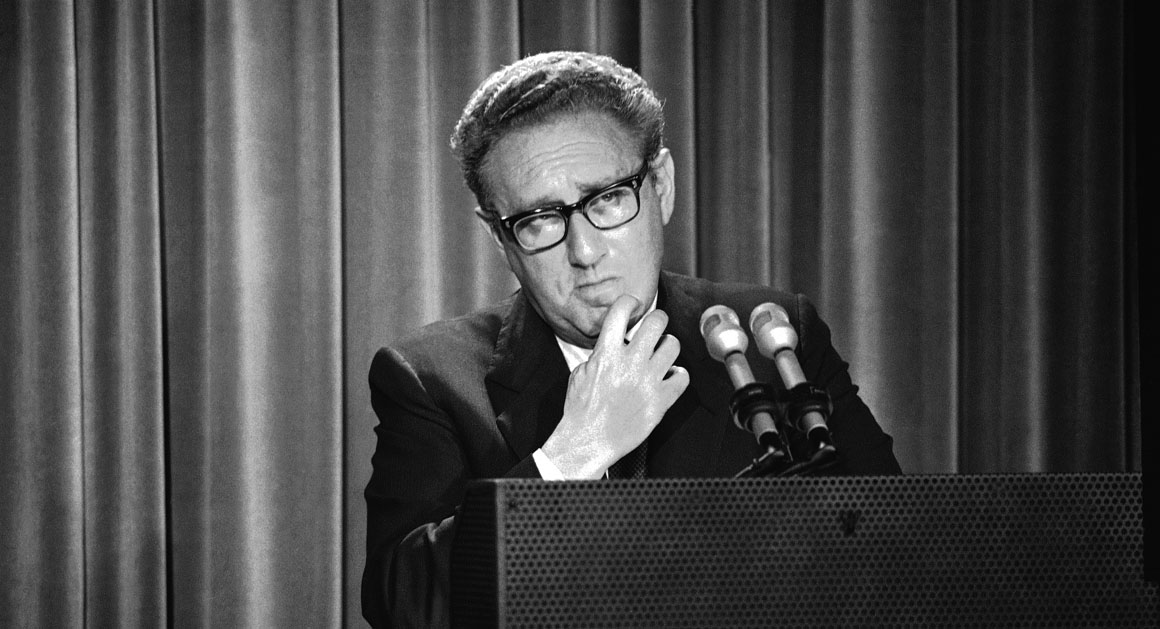
Henry Kissinger remains the only official to have served simultaneously as Secretary of State (1973-1977) and National Security Advisor (1969-1975) (File).
Adm. Thomas Moorer, chairman of the Joint Chiefs of Staff, reviewed the military situation. CIA chief Richard Helms also reported what his agents had found out about the fighting. Then Kissinger brought up the United Nations.
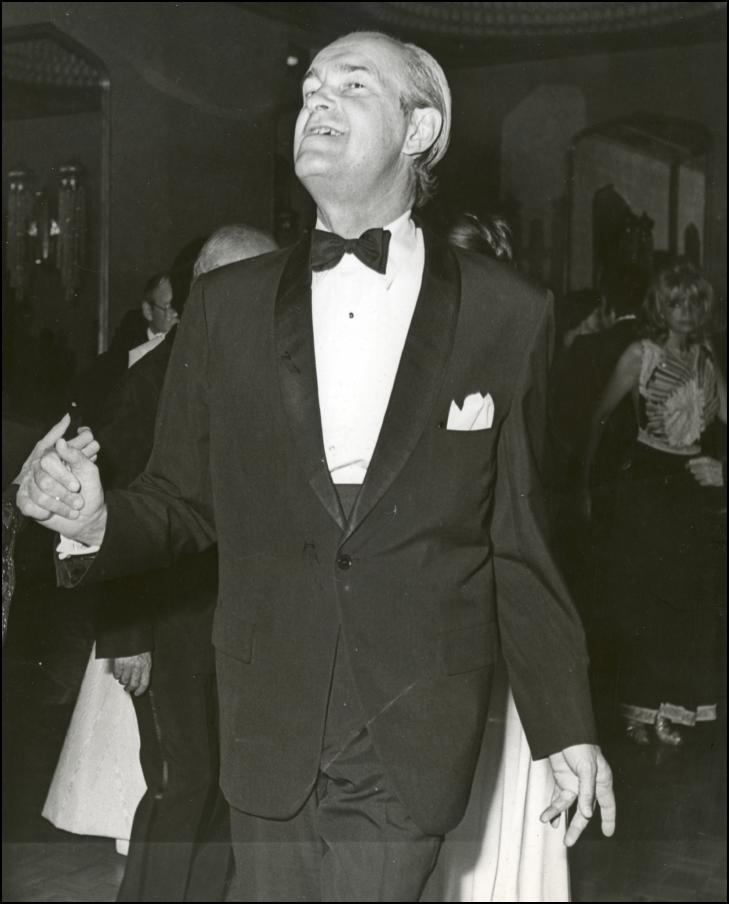
Former Director of Central Intelligence Richard Helms strikes a pose, date unknown (File). Having overseen the infamous MKULTRA mind control program and numerous CIA political interventions (most notably the Project FUBELT campaign against Salvador Allende in Chile), Helms was ultimately dismissed by Nixon in 1973 for refusing to intercede in the FBI's Watergate investigation. A nonplussed Nixon soon discovered that Helms was not a Johnson-era political appointee as he had assumed but rather a career civil servant, having been continuously employed by the federal government since serving in the World War II-era Office of Strategic Services. He appointed Helms Ambassador to Iran, where the spymaster served until resigning in early 1977 in conjunction with two misdemeanor charges related to past Senate testimony; after pleading no contest later that year, Helms was fined $2,000 and retained his pension.
“If the U.N. can't operate in this kind of situation effectively,” he growled, “its utility has come to an end, and it is useless to think of United Nations guarantees in the Middle East.”
“We’ll have a recommendation for you this afternoon,” promised Assistant State Secretary Joseph Sisco.
“We have to take action,” pressed Kissinger. “The president is blaming me, but you people are in the clear.”
There was discussion about a statement that had been prepared for Ambassador George Bush to deliver at the U.N. Kissinger thought it was “too evenhanded” and ought to be tougher on India.
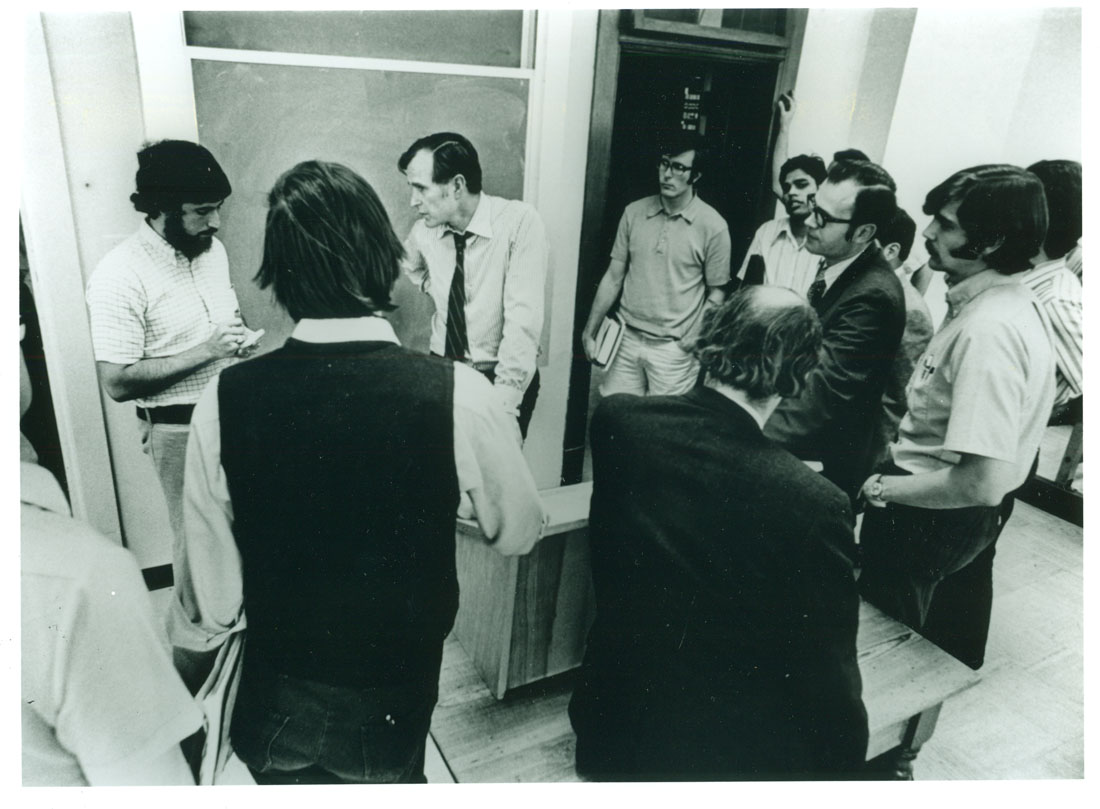
U.N. Ambassador George H.W. Bush confers with faculty and students at the University of Kansas, 1972 (University of Kansas Archives). Bush was appointed to the Cabinet-level post as a political favor in 1971 after losing his second bid for the Senate.
“It’s hard to tilt toward Pakistan,” grumped Kissinger, “if we have to match every Indian step with a Pakistani step.”
U.S. Too Gentle?
At the next secret meeting on Dec. 4, Kissinger reported that the President was still fuming over the gentle treatment U.S. spokesmen were giving India.
“The President is under the ‘illusion’ that he is giving instructions,” said Kissinger, “not that he is merely being kept apprised of affairs as they progress.”
Mr. Nixon, meanwhile, had disregarded several secret, urgent appeals from Kenneth Keating, the Ambassador in New Delhi, that the U.S. should be careful not to alienate India.
He reported he had received personal assurances from Indian Foreign Minister Swaran Singh not only that the populace welcomed the liberation of East Pakistan but that India had no intention of annexing the conquered territory. India had no wish, said Singh, to provide “even a semblance of Indian administration” but would permit the Bengalis to rule themselves.
In another secret message, Keating sharply disputed a story put out by the White House about Indian-Pakistani developments.
“I have made the foregoing comments,” he concluded, “in the full knowledge that I may not have been privy to all the important facts of this tragedy. On the basis of what I do know, I do not believe those elements of the (White House) story either add to our position or, perhaps more importantly, to our credibility.”
It would be ironic if Richard Nixon, who mounted the political soapbox in times past to accuse the Democrats of “losing” China to the Communists, should be responsible for pushing India into eager Soviet arms.
By Jack Anderson
We have dug out more evidence that President Nixon, apparently because of a personal rapport with Pakistani's President Yahya Khan, is permitting India to fall under Soviet dominance.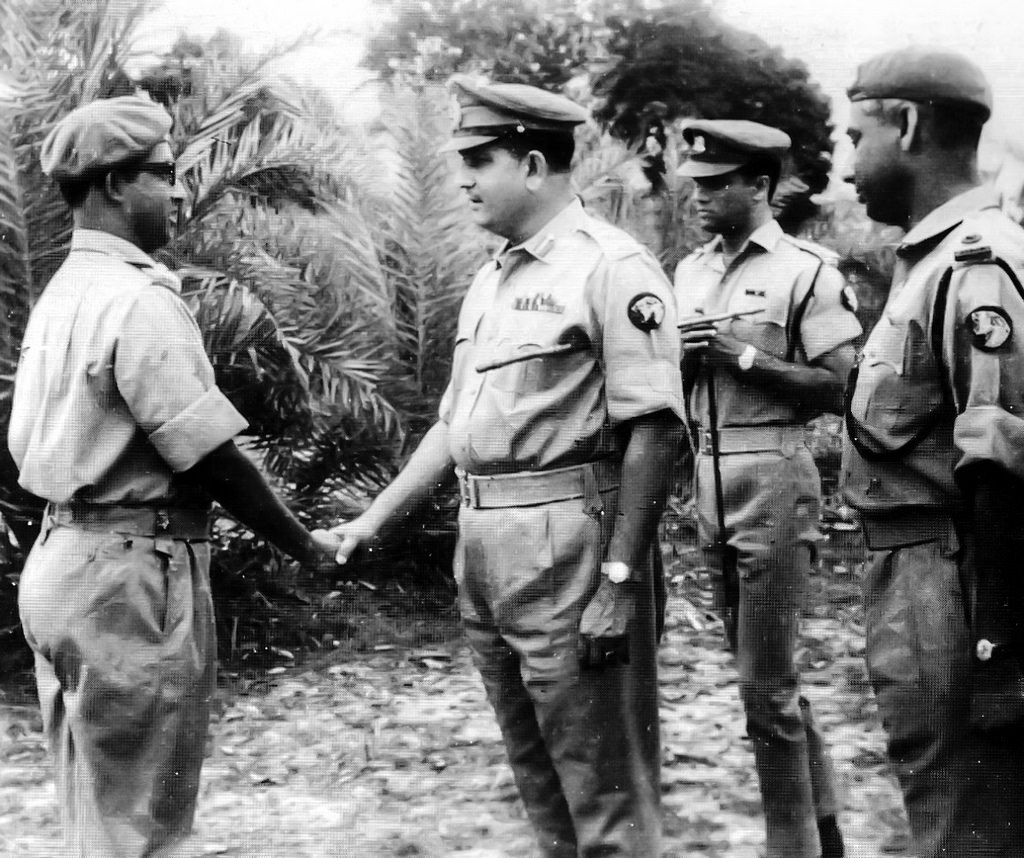
Pakistani President General Agha Muhammad Yahya Khan in East Pakistan, late 1960s (File). Nixon and Kissinger employed Khan as an intermediary in the incipient negotiations with Chinese Premier Zhou Enlai that would culminate in their 1972 state visit, effectively turning a blind eye to the murder of anywhere from 300,000 to a million Bengalis (instigated by Khan and his eventual successor, Zulfikar Ali Bhutto) in the process after East Pakistani leader Sheik Mujib-ur-Rahman won Pakistan's first free and open presidential election on an autonomy platform in 1970.
Not only is India the world's second most populous nation, whose democratic government should make it a natural U.S. ally, but Nixon's moves have opened the way for Russia to fulfill its dream of penetrating deep into Southwest Asia.
The Nixon administration has rung down the censorship curtain on the backstage developments. Since censorship isn't supposed to be tolerated in the U.S., the White House has merely swept all the awkward facts under the secrecy label.
However, we have broken the censorship and can expose Mr. Nixon's duplicity.
His private policymaker, Henry Kissinger, assured reporters during a background session last week that the administration wasn't at all biased against India. "There have been some comments," he said, "that the administration is anti-India, This is totally inaccurate."
Behind the guarded doors of the White House Situation Room, however, Kissinger sang a different tune. He told top planners, who gathered on Dec. 3 to map strategy: "I'm getting hell every half-hour from the President that we are not being tough enough on India."
Nixon's Orders
The same hush-hush group, known formally as the Washington Special Action Group, got a similar earful at their strategy session the next day. The State Department's man, Assistant Secretary Samuel DePalma, questioned presidential instructions that the U.S. should confine its criticism at the United Nations to India alone.
"The President says either the bureaucracy should put out the right statements on this, or the White House will do it," snapped Kissinger. "We will have difficulty in the U.N.," cautioned DePalma, "because most of the countries that might go with us don't want to tilt toward Pakistan to the extent we do."
"Whoever is doing the backgrounding at State is invoking the President's wrath," warned Kissinger. "Please try to follow the President's wishes." Kissinger also implied to reporters that the U.S. was treating India and Pakistan alike in regard to economic aid. But he instructed the Situation Room strategists to the contrary on Dec. 4.
"On AID matters," he said, "the President wants to proceed against India alone." Kissinger also spoke to reporters about the Nixon administration's deep concern over the suffering of the refugees and the "strain on the already scarce economic resources of (India)."
Behind the guarded doors, he reiterated that "we don't want to cut off humanitarian aid." But the State Department's Ambassador-at-large Alexis Johnson warned at the Dec. 6. strategy session that the liberated Bangla Desh territory will become "an international basket case."
"It won't necessarily be our basket case," retorted Kissinger.
During his meeting with reporters, Kissinger took pains to emphasize that the U.S had stopped all military shipments to Pakistan except for non-lethal spare parts already in the pipeline.
Planes for Pakistan
But this, too, isn't the whole truth. At the secret session on Dec. 6, the question of emergency military requests from Pakistan was raised.
"The President may want to honor those requests," declared Kissinger. He stressed that the President "isn't inclined to let the Paks be defeated." He asked whether the US. has the legal right to authorize Jordan or Saudi Arabia to transfer U.S. arms to Pakistan. Chris Van Hollen, a State Department expert, replied flatly: "The United States cannot permit a third country to transfer arms which we have provided them when we, ourselves, don't authorize sales direct to Pakistan."
Yet a secret message was flashed to L. Dean Brown, the American Ambassador in Jordan, to keep open the possibility of authorizing King Hussein to rush several U.S supplied F-104 fighter planes to Pakistan.
"Whole subject remains under intensive review at very high level of USG (US Government)," Brown was advised.
During his press back-ground, Kissinger cautiously acknowledged to reporters that Pakistan "started the process which has led to the (Indian-Pakistani conflict)."
The truth, of course, is harsher. Last March, Pakistan clamped military rule on East Bengal. Pakistani soldiers terrorized the Bengali populace, causing millions to flee across the border into India. The majority clearly want independence, not Pakistani rule. The invading Indians, though they made the first military move in war, have been welcomed as liberators.
By Jack Anderson
The dramatic appearance of a U.S. naval task force in the Bay of Bengal on the eve of the Pakistani surrender, it now appears, didn't intimidate India at all but merely strengthened her ties with Russia.
In New Delhi, Soviet Ambassador Nikolai M. Pegov gave India secret assurances that "a Soviet fleet is now in the Indian Ocean and… will not allow the Seventh Fleet to intervene."
He also promised, in case of a Chinese attack across the Himalayas, that Russia "would open a diversionary action in Sinkiang." In short, he promised Soviet military action against both the U.S. and China if they intervened on Pakistan's side.
The fascinating story of big-power intrigue during the Indian-Pakistan fighting is told in secret diplomatic dispatches and intelligence reports.
It was precisely this sort of secret maneuvering that got the U.S. deeply embroiled in the Vietnam war before the American people realized what was going on. We believe it is in the public interest, therefore, to publish excerpts from the secret documents.
In earlier columns, we told how presidential adviser Henry Kissinger assured reporters the U.S. wasn't anti-India at the same time he was instructing government policymakers to take steps against India.
"The President does not want to be evenhanded," Kissinger emphasized at their secret strategy sessions. "The President believes India is the attacker."
Wrong Side
The State Department's professionals argued that, morally, the U.S. should be on the side of the Bengalis, who wanted their independence from Pakistan. The experts also warned that President Nixon's pro-Pakistan policy would only drive India into Soviet arms.
Kissinger gruffly disputed this, saying of India's Prime Minister Indira Gandhi: "The lady is cold blooded and tough and will not turn India into a Soviet satellite merely because of pique."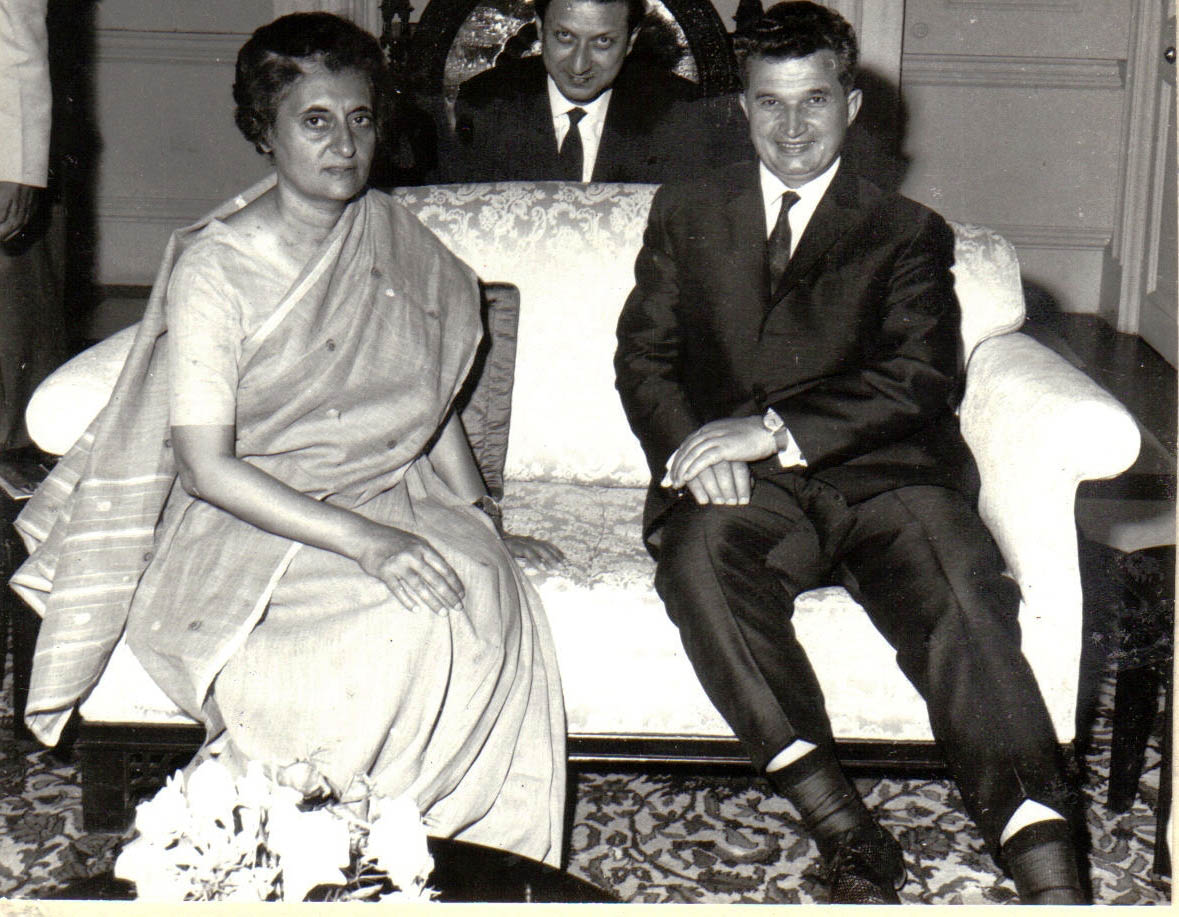
Indira Gandhi and Romanian Communist Party General Secretary Nicolae Ceausecu, 1971. The daughter of Jawaharal Nehru, Gandhi oversaw the nation's transition to a socialist economy and cultivated an amiable relationship with the Soviet Union (Wikimedia Commons).
Heeding Kissinger and disregarding the professional advice Mr. Nixon took a tough stand at the United Nations against India and ordered the Seventh Fleet to send a task force into Indian waters.
This was definitely intended as a "show of force," although the flotilla had the additional mission of evacuating stranded Americans from embattled Dacca if the need arose.
Plans were made, meanwhile, to arrange provocative leaks in such places as Djakarta, Manila and Singapore of the task force's approach. By the time the ships had assembled in the Malacca Strait, both the Indians and ets were well aware they on the way.
This, merely served to bring India and Russia closer together. A secret intelligence report, giving a "reliable" account of Soviet Ambassador Nikolai Pegov's conversations with Indian officials, declared:
"Pegov stated that Pakistan is trying to draw both the United States and China into the present conflict. The Soviet Union, however, does not believe that either country will intervene.
"According to Pegov, the movement of the U.S. Seventh Fleet is an effort by the U.S. to bully India, to discourage it from striking against West Pakistan and at the same time to boost the morale of the Pakistani forces.
"Pegov noted that a Soviet fleet is now in the Indian Ocean and that the Soviet Union will not allow the Seventh Fleet to intervene.
Soviet Threat
"If China should decide to intervene," said Pegov, "the Soviet Union would open a diversionary action in Sinkiang. Pegov also commented that after Dacca is liberated and the Bangladesh government is installed, both the U.S. and China will be unable to act and will change their current attitude toward the crisis."
Another intelligence report, giving the secret details of Soviet Deputy Foreign Minister Vasily Kuznetsov's mission to India, indicates there had been some Soviet impatience over the pace of the Indian blitzkrieg.
Kuznetsov, after his arrival in New Delhi on Dec. 12, told Indian officials that the Kremlin was impatient with the Indian armed forces for their inability to liberate Bangladesh within the ten-day time frame mentioned before the outbreak of hostilities."
Kuznetsov pointed out, according to the secret report, that Soviet opposition to a cease-fire "becomes more untenable the longer the war goes on in the east.”
While Kuznetsov said the Soviet Union will continue to use its veto to stall any effort to bring about a cease-fire for the present, he stressed the importance of quick and decisive Indian action in liberating Bangladesh in the shortest time possible.
"Kuznetsov delayed his scheduled return to Moscow because he is awaiting special instructions from Leonid Brezhnev, general secretary of the Soviet Communist Party, regarding India's request that the Soviet Union sign a defense agreement with the Bangladesh government after Soviet recognition of Bangladesh.
"According to Kuznetsov, Brezhnev was not in Moscow when Kuznetsov sent him the request for guidance."
The American people, meanwhile, are entitled to straight talk from their leaders.
By Jack Anderson
"Mr. Packard stated that the overriding consideration is the practical problem of either doing something effective or doing nothing. If you don't win, don’t get involved….”
Publication of the secret Pentagon Papers exposed, all too late, the miscalculations and misrepresentations that entangled the U.S. in a jungle war in faraway Vietnam.
Without waiting for history to overtake the Indian-Pakistani War, therefore, we have decided to publish highlights from the secret White House Papers dealing with the crisis. These papers bear a variety of stamps: "Secret Sensitive," "Eyes Only," "Specat (special category) Exclusive," "Noform" (no foreign dissemination) and other classifications even more exotic.
Yet astonishingly, the documents contain almost no information that could possibly jeopardize the national security. On the contrary. the security labels are used to hide the activities—and often the blunders—of our leaders.
We believe the public is entitled to know about these blunders. For the U.S. posture is in shambles on the Indian subcontinent, which is enormously more important than Vietnam. Every year, the births alone exceed the entire population of Vietnam.
Here are our conclusions from studying the White House papers:
Blunders Cited
1. President Nixon, apparently because he liked Pakistan's strongman Yahya Khan and disliked India's Prime Minister Indira Gandhi, placed the U.S. on the side of a minor military dictatorship against the world's largest democracy. Thereby, he aligned the U.S. against the Bengalis, whose freedom Yahya had brutally repressed. He overturned their free election, jailed their elected leader and sent troops to terrorize the populace.
2. The President gruffly overrode the advice of the-State Department's professionals who urged him to use his special influence with Yahya to stop the Pakistani persecution and to grant the Bengalis a measure of autonomy. When the Indian Army finally came. to the aid of the Bengalis, the pros pleaded with Nixon to remain. neutral if for no other reason than Pakistan looked like a sure loser. Instead, he supported the repressor and associated the U.S. with Pakistan's eventual humiliation.
3. In a fit of petulance. the President sent a naval task force to the Bay of Bengal and risked a military confrontation with Soviet warships. Russia's Ambassador to India Nikolai M. Pegov, according to "reliable" intelligence, immediately assured Indian officials that “the Soviet Union will not allow the Seventh Fleet to intervene." Nixon's derring-do served merely to increase India's dependence upon Russia.
4. As a reward, the Russians are expected to seek military bases on the subcontinent. "The Soviet military ambition in this exercise is to obtain permanent usage of the port of Visakhapatnam," suggested Admiral Elmo Zumwalt, the Navy chief, at a secret strategy session. An intelligence report also declares that Bangla Desh, the new Bengali state, has "already offered military bases in Chittagong to the Soviet Union in exchange for economic aid."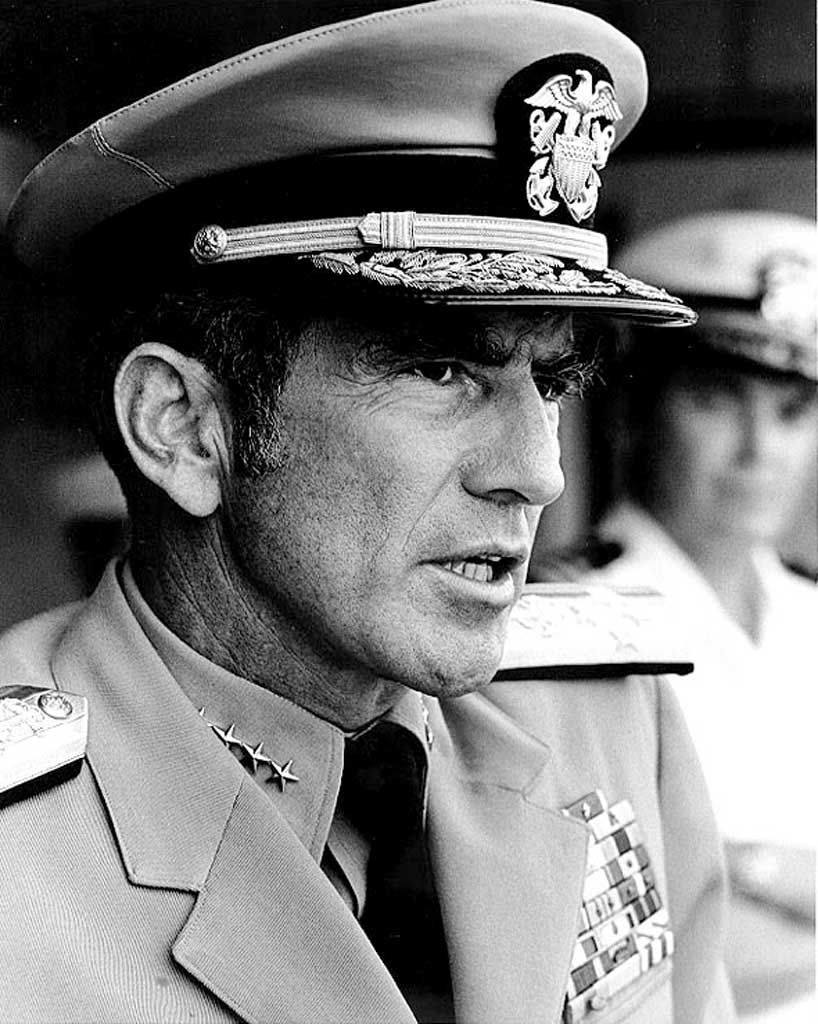
Chief of Naval Operations Admiral Elmo Zumwalt, early 1970s (File). Like many high-ranking military hardliners of the era, Zumwalt distrusted Nixon and Kissinger.
5. At the height of the two-week war. the White House scrabbled around for some way to rush arms shipments to Pakistan. This would have been a violation of our, own 1965 arms embargo against both In-dia and Pakistan. Since 1965, the U.S. has delivered only "non-lethal" supplies, chiefly spare parts, to the two antagonists. To get around the ban, Nixon's chief foreign policymaker, Henry Kissinger, explored the possibility of sneaking arms to Pakistan through third countries.
Secret Minutes
Here are excerpts from the "Secret Sensitive" minutes of Kissinger's White House strategy sessions:
"Dr. Kissinger asked whether we have the right to authorize Jordan or Saudi Arabia to transfer military equipment to Pakistan," declare the December 6 minutes: "Mr. Van Hollen (Asian expert, State Department) stated the United States cannot permit a third country to transfer arms which we have provided them when we, ourselves, do not authorize sale direct to the ultimate recipient.
"Mr. Sisco (Assistant State Secretary in charge of Asian affairs) went on to say that as the fake increasingly feel the heat, we will be getting emergency requests from them. Dr. Kissinger said that the President may want to honor those requests….
“Mr. Packard (Deputy Defense Minister [sic]) then said we should look at what could be done. Mr. Sisco agreed but said it should be done very quietly."
The December 8 minutes pick up the subject again: "Dr. Kissinger referred to an expression of interest by King Hussein relative to the provision of F-104s to Pakistan….
“Ambassador Johnson (Ambassador-at-large) said that we must examine the possible effects that additional supplies for Pakistan might have: It could be that eight F-104s might not make any difference once the real war in (West Pakistan) starts. They could be considered only a token….
"Mr. Packard stated that the overriding consideration is the practical problem of either doing something effective or doing nothing. If you don't win, don’t get involved….” 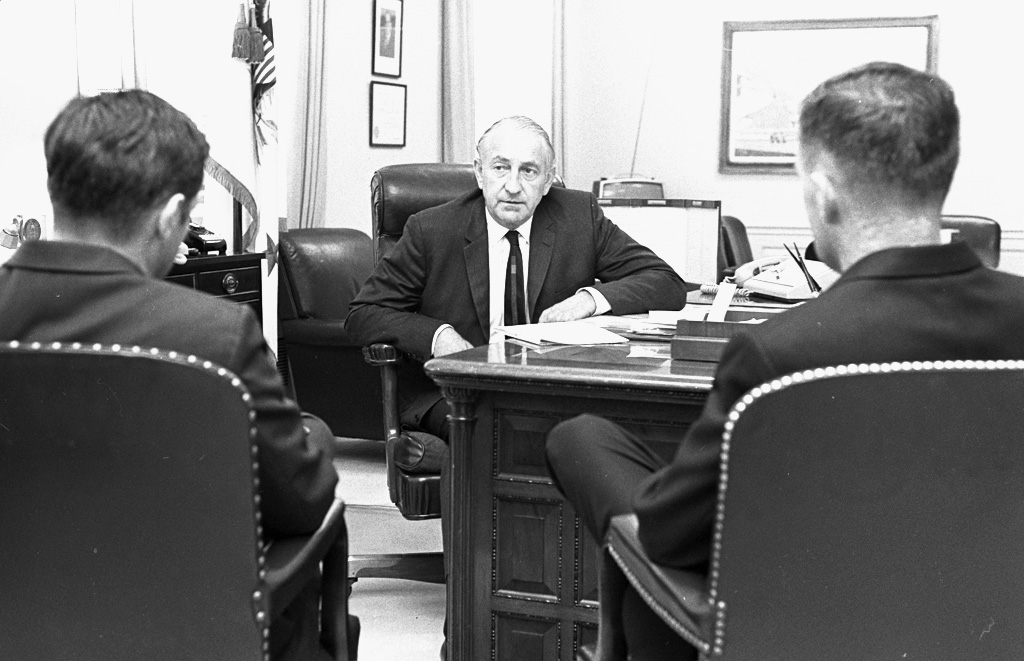
Deputy Secretary of Defense David Packard at work, c. 1970 (George Washington University National Security Archive). The co-founder of Hewlett-Packard and Agilent Technologies, Packard's appointment reflected the symbiotic relationship between defense interests and nascent high-tech industries. Although he left office in the midst of the Indian-Pakistani conflict to return to the private sector, Packard was frequently consulted by future administrations on defense procurement.
The following day, a secret message was flashed to Ambassador to Jordan L. Dean Brown: "You should tell King Hussein we fully appreciate heavy pressure he feels himself under by virtue of request from Pakistan. We are nevertheless not yet in a position to give him definite response... Whole subject remains under intensive review at very high level of USG."
In New Delhi, Ambassador to India Kenneth Keating received a copy of the secret orders to Brown. Keating sent an anguished message: to Washington. pleading: "Any action other than rejection (of the plan to ship planes to Pakistan by way of Jordan) would pose enormous further differences in Indo-U.S. relations.”
We will print additional excerpts from the White House Papers in future columns.
Throughout the Indian-Pakistan War, the American people once again were misled by their leaders.
Secret documents dispute, for example, the White House explanation for dispatching a naval task force to the Bay of Bengal.
Official spokesmen emphasized that the task force's main mission was to evacuate American citizens from embattled Dacca.
We have studied the secret White House papers dealing with the two-week war. These make clear that the task force—including the aircraft carrier Enterprise, the most powerful ship in the Navy—was sent into Indian waters as a "show of force."
This provocative naval deployment was intended (1) to compel India to divert both ships and planes to shadow the task force; (2) to weaken India's blockade against Eist Pakistan; (3) possibly to divert the Indian aircraft carrier Vikrant from its military mission, and (4) to force India to keep planes on defense alert, thus reducing their operations against Pakistani ground troops.
The evacuation of American citizens was strictly a secondary mission, adopted more as the justification than the reason for the naval move.
Here's how the "Top Secret" orders to the task force were finally worded: "Situation: U.S. citizens may have to be evacuated from the area affected by the present India-Pakistan conflict. The situation may also arise which will require the presence and utilization of a CVA (carrier) to ensure the protection of U.S. interests in the area….
"Mission: To form a contingency evacuation force capable of helo (helicopter) evacuation of civilians, of self protection, and of conducting naval air, and surface ops (operations) as directed by higher authority in order to support U.S. interests in the Indian Ocean area."
Secret Excerpts
Meanwhile, those anonymous aides, who whisper the latest word from the White House into the ears of newsmen, have stopped pretending that the task force was intended to evacuate stranded Americans.
Now the aides are leaking the story-that President Nixon had learned of the Soviet-Indian plans not only to lop off East Pakistan but to dismember West Pakistan. The task force was ordered into the Indian Ocean, according to this line as a deterrent.
But this, too, Is a distortion of the information contained in the White House papers. Here are excerpts from the "Secret Sensitive" strategy session that took place in the White House's fabled Situation Room shortly before the decision to present a "show of force" in the Bay of Bengal:
"Mr. Helms (the CIA chief) opened the meeting by briefing the current situation... It is reported that prior to terminating present hostilities, Mrs. Gandhi intends to attempt to eliminate Pakistan's armor and air force capabilities…
"Assessing the situation in the West, General Ryan (the Air Force chief) indicated that he did not see the Indians pushing too hard at this time, rather they seem to be content with a holding action…
"Dr. Kissinger (the President's chief foreign policy-maker) suggested that… if the Indians smash the Pak air force and the armored forces, we would have a deliberate Indian attempt to force the disintegration of Pakistan. The elimination of the Pak armed and air forces would make the Paks defenseless.
Scare Tactics
"It would turn West Pakistan into a client state. The possibility elicits a number of questions. Can we allow a U.S. ally to go down completely? Can we allow the Indians to scare us off?…
"Mr. Sisco (assistant State secretary in charge of Asian affairs) stated that if the situation were to evolve as Dr. Kissinger had indicated, then, of course, there was a serious risk to West Pakistan. Mr. Sisco doubted, however, that the Indians had this as their objective…
"Dr. Kissinger stated that what we may be witnessing a situation wherein a country (India), equipped and supported by the Soviets, may be turning half of Pakistan into an impotent state and the other half into a vassal… One could make a case, he argued, that we have done everything two weeks too late in the current situation.
"Mr. Packard (deputy Defense secretary) stated that perhaps the only satisfactory outcome 'would be for us to stand fast, with the expectation that the West Paks could hold their own.'
"Dr. Kissinger said that we are not trying to be even handed. The President does not want to be even handed. The President believes that India is the attacker…
"Dr. Kissinger said that we cannot afford to ease India's state of mind. The lady is cold blooded and tough and will not turn into a Soviet satellite merely because of pique. We should not ease her mind. He invited anyone who objected to this approach to take his case to the President."
[The] next day, preparations were made to send a task force into the Bay of Bengal to confront both Soviet and Indian warships.
By Benjamin Welles
The New York Times
WASHINGTON, Dec. 31—The syndicated columnist Jack Anderson reported today that Henry A. Kissinger, Presidential assistant for national security affairs, told senior Administration officials during the India-Pakistani crisis that President Nixon "does not want to be even-handed."
"We are not trying to be even-handed," Mr. Kissinger was reported as saying. "The President believes that India is the attacker."
Mr. Kissinger was also reported by the columnist to have told top Administration aides that "we cannot afford to ease India's state of mind."
Warned that United States criticism might turn India toward the U.S.S.R., Mr. Kissinger is said to have replied that Prime Minister Indira Gandhi was "cold-blooded and tough" and that her country "will not turn into a Soviet satellite merely because of pique."
"We should not ease her mind," he is reported to have said, adding that any aide who objected to this approach could "take his case to the President."
The views attributed to Mr. Kissinger were published in Mr. Anderson's column, which is syndicated to 700 newspapers, about 100 of them foreign. Mr. Anderson, a colleague of Drew Pearson, took over the column on Mr. Pearson's death in September 1969.
Throughout the India-Pakistan war, Mr. Anderson has repeatedly asserted that his disclosure of top-secret Government documents involved no threat to national security, but rather exposed the "activities and often the blunders of our leaders."
The Kissinger comments reported today came from notes of "secret sensitive" strategy sessions at the White House on Dec. 6 and 8, according to Mr. Anderson. The India-Pakistan war broke out Dec. 3 and ended Dec. 17.
Mr, Anderson's report of Mr. Kissinger's views of the Pakistan-India conflict was carried in his columns published in newspapers today. In tomorrow's column, continuing his reporting from secret meetings, he says that Mr. Kissinger exclaimed in one session over what he appeared to consider the futility of the United N-tions in the situation on the subcontinent.
According to Mr. Anderson, Mr. Kissinger said, "If the United Nations can't operate in this kind of situation effectively, its utility has come to an end, and it is useless to think of United Nations guarantees in the Middle East.”
Mr. Anderson charged that the American people "again were misled by their leaders."
Specifically, Mr. Anderson contended that the White House explanation of the reasons 'for sending the nuclear-powered aircraft carrier Enterprise, plus escorting warships from Vietnam to the Bay of Bengal during the India-Pakistani war was deceptive.
Evacuation 'Secondary'
Contrasting the official explanation "that the mission of the task force was to "evacuate American citizens from embattled Dacca," Mr. Anderson said that perusal 'of confidential documents in his, possession showed that there were in fact four primarily military reasons.
These were, he reported:
- To compel India to divert both ships and planes to shadow the United States task force.
- To weaken India's blockade against East Pakistan.
- Possibly to divert the Indian aircraft carrier Vikrant from its military mission.
- To force India to keep planes on defense alert, thus reducing their operations against Pakistani ground troops.
“The evacuation of American citizens was strictly a secondary mission," Mr. Anderson wrote, "adopted more as the justification than the reason for the naval move."
Mr. Anderson wrote that "those anonymous aides who whisper the latest word from the White House Into the ears of newsmen" had now stopped "pretending" that the task force was intended to evacuate stranded Americans.
Instead, he said they were now “leaking” the story that President Nixon learned or a Soviet-Indian plan to "dismember" West Pakistan and sent the task force into the Bay of Bengal as a "deterrent."
Earlier this week, Joseph Alsop, another internationally syndicated columnist, reported that "on the eve of the final ceasefire" the United States had "unchallengeable" information of the Indian Government's determination to "cause the dismemberment of the surviving western half of Pakistan.”
Mr. Alsop, who has had high-level sources through successive Administrations, reported that India's aim was to destroy the Pakistani Army and also to deprive the Pakistani remnant state of any common frontier with Tibet, and thus with Communist China.
Such was the situation, Mr. Alsop wrote, when President Nixon ordered elements of the United States Seventh Fleet to steam toward the Indian Ocean. In his column, Mr. Alsop attributed to Dr. Kissinger a comparison between Hitler's reoccupation of the Rhineland in 1936 and the "strong possibility" that India would become a "vast new Soviet strategic base area."
Administration officials, who declined to be named, said today that a security investigation was underway to. determine who "leaked" information to Anderson.
The New York Times
WASHINGTON, Jan. 5—Following are the texts of three secret ’documents made public today by the columnist Jack Anderson describing meetings of the National Security Council’s Washington Special Action Group oh the crisis between India and Pakistan.
Memo on Dec. 3 Meeting
Secret Sensitive
Assistant Secretary of Defense
Washihgton, D.C. 20301
International Security Affairs
Refer to 1-29643/71
Memorandum for Record
SUBJECT
WSAG meeting on India/Pakistan
PARTICIPANTS
Assistant to the President for national security affairs—Henry A. Kissinger
Under Secretary of State—John N. Irwin
Deputy Secretary of Defense—David Packard
Director, Central Intelligence Agency— Richard M. Helms
Deputy Administrator (A.I.D.)—Maurice J. Williams
Chairman, Joint Chiefs of Staff—Adm. Thomas H. Moorer
Assistant Secretary of State (N.E.E.A.R.)—Joseph J. Sisco
Assistant Secretary of Defense (I.S.A.)—G. Warren Nutter
Assistant Secretary of State (I.O.)—Samuel De Palma
Principal Deputy Assistant Secretary of Defense (I.S.A.)—Armistead I. Selden Jr.
Assistant Administrator (A.I.D/N.E.S.A.)—Donald G. MacDonald
TIME AND PLACE
3 December 1971
1100 hours, Situation Room, White House
SUMMARY
Reviewed conflicting reports about major actions in the west wing. C.I.A. agreed to produce map showing areas of East Pakistan occupied by India. The President orders hold on issuance of additional irrevocable letters of credit involving $99 million, and a hold on further action implementing the $7 million P.L. 480 credit. Convening of Security Council meeting planned contingent, on discussion with Pak Ambassador this afternoon plus further clarification of actual situation in West Pakistan. Kissinger asked for clarification of secret special interpretation of March 1959 bilateral U.S. agreement with Pakistan.
KISSiNGER: I am getting hell every half-hour from the President that we are not being tough enough on India. He has just called me again. He does not believe we are carrying out his wishes. He wants to tilt in favor of Pakistan. He feels everything we do comes out otherwise.
HELMS: Concerning the reported action in the west wing, there are conflicting reports from both sides and the only common ground is the Pak attacks on the Amritsar, Pathankat and Srinagar airports. The Paks say the Indians are attacking all along the border; but the Indian officials say this is a lie. In the east wing the action is becoming large and the Paks claim there are now seven separate fronts involved.
KISSINGER: Are the Indians seizing territory?
HELMS: Yes; small bits of territory, definitely.
SISCO: It would help if you could provide a map with a shading of the areas occupied by India. What is happening in the West—is a full-scale attack likely?
MOORER: The present pattern is puzzling in that the Paks have only struck at three small airfields which do not house significant numbers of Indian combat aircraft.
HELMS: Mrs. Gandhi's speech at 1:30 may well announce recognition of Bangladesh.
MOORER: The Pak attack is not credible. It has been made during late afternoon, which doesn’t make sense. We do not seem to have sufficient facts on this yet.
KISSINGER: Is it possible that the Indians attacked first and the Paks simply did what they could before dark in response?
MOORER: This is certainly possible.
KISSINGER: The President wants no more irrevocable letters of credit issued under the $99-million credit. He wants' the $72-miIlion P.L. 480 credit also held.
WILLIAMS: Word will soon get around when we do this. Does the President understand that?
KISSINGER: That is his order, but I will check with the President again, If asked, we can say we are reviewing our whole economic program and that the granting of fresh aid is being suspended in view of conditions on the subcontinent. The next issue is the U.N.
IRWIN: The Secretary is calling in the Pak Ambassador this afternoon, and the Secretary leans toward making a U.S. move in the U.N. soon.
KISSINGER: The President is in favor of this as soon as we have some confirmation of this large-scale new action. If the U.N. can’t operate in this kind of situation effectively, its utility has come to an end and it is useless to think of U.N. guarantees in the Middle East.
SISCO: We will have a recommendation for you this afternoon, after the meeting with the Ambassador. In order to give the Ambassador time to wire home, we could tentatively plan to convene the Security Council tomorrow.
KISSINGER: We have to take action. The President is blaming me, but you people are ,in the clear.
SISCO: That’s ideal!
KISSINGER: The earlier draft for Bush is too even-handed.
SISCO: To recapitulate, after we have seen the Pak Ambassador, the Secretary will report to you. We will update the draft speech for Bush.
KISSINGER: We can say we favor political accommodation but the real job of the Security Council is to prevent military action.
SISCO: We have never had a reply either from Kosygin or Mrs. Gandhi.
WILLIAMS: Are we to take economic steps with Pakistan also?
KISSINGER: Wait until I talk .with the President. He hasn’t addressed this problem in connection with Pakistan yet.
SISCO: If we act on the Indian side, we can say we are keeping the Pakistan situation "under review.”
KISSINGER: It’s hard to tilt toward Pakistan if we have to match every Indian step with a Pakistan step. If you wait until Monday, I can get a Presidential decision.
PACKARD: It should be easy for us to inform the banks involved to defer action inasmuch as we are so near the weekend.
KISSINGER: We need a WSAG in the morning. We need to think about our treaty obligations. I remember a letter or memo interpreting our existing treaty with a special India tilt. When I visited Pakistan in January 1962, I was briefed on a secret document or oral understanding about contingencies arising in other than the SEATO context. Perhaps it was a Presidential letter. This was a special interpretation of the March 1959 bilateral agreement.
Prepared by:
/S/ initials
JAMES M. NOYES
Deputy Assistant Secretary for Near Eastern, African and South Asian Affairs
Approved:
(illegible signature)
For G. Warren Nutter, Assistant Secretary of Defense for International Security Affairs
Distribution: Secdef, Depsecdef, CJCS, ASD(ISA), PDASD(ISA), DASD: NEASA & PPNSCA, Dep Dir: NSCC & PPNSCA, CSD files, R&C files, NESA
Account of Dec. 4 meeting
Covering Memorandum
THE JOINT CHIEFS OF STAFF
WASHINGTON, D. C. 20301
Secret-Sensitive
Memorandum for:
Chief of Staff, U.S. Army
Chief of Staff, U.S. Air Force
Chief of Naval Operations
Commandant of the Marine Corps
SUBJECT
Washington Special Action Group meeting on Indo/Pakistan hostilities; 4 December 1971
1. Attached for your information is a memorandum for record concerning subject meeting,
2. In view of the sensitivity of information in the N.S.C. system and the detailed nature of this memorandum, it is requested that access to it be limited to a strict need-to-know basis.
For the chairman, J.C.S.:
A. K. Knoizen
Captain, U.S. Navy
Executive Assistant to the Chairman, Joint Chiefs of Staff
Report on the Meeting
Secret Sensitive
THE JOINT CHIEFS OF STAFF
WASHINGTON, D. C. 20301
5 December 1971
MEMORANDUM FOR RECORD
SUBJECT
Washington Special Action Group meeting on Indo-Pakistan hostilities; 4 December 1971.
1. The N.S.C Washington Special Action Group met in the Situation Room, the White House, at 1100, Saturday, 4 December, to consider the Indo-Pakistan situation. The meeting was chaired by Dr. Kissinger.
2. Attendees
A. Principals:
Dr. Henry Kissinger
Dr. John Hannah, A.I.D.
Mr. Richard Helms, C.I.A.
Dr. G. Warren Nutter, Defense
Admiral Elmo Zumwalt, J.C.S.
Mr. Christopher Van Hollen, State
B. Others:
Mr. James Noyes, Defense
Mr. Armistead Selden, Defense
Rear Adm. Robert Welander, O.J.C.S.
Capt. Howard Kay, O.J.C.S.
Mr. Harold Saunders, N.S.C.
Col. Richard Kennedy, N.S.C.
Mr. Samuel Hoskattsori, N.S.C.
Mr. Donald MacDonald, A.I.D.
Mr. Maurice Williams, A.I.D.
Mr. John Waller, C.I.A.
Mr. Samuel De Palma, State
Mr. Bruce Lanigen, State
Mr. David Schneider, State
3. Summary. It was decided that the U. S. would request an immediate meeting of the Security Council. The U. S. resolution would be introduced in a speech, by Ambassador Bush, as soon as possible. The U.S.G.-U.N. approach would be tilted toward the Paks. Economic aid for Pakistan currently in effect will not be terminated. No requirements were levied on the J.C.S.
4. Mr. Helms opened the meeting by indicating that the Indians were currently engaged in a no holds barred attack of East Pakistan and that they had crossed the border on all sides this morning. While India had attacked eight Pak airfields there were still no indications of any ground attacks in the West. Although not decreeing a formal declaration of war, President Yahya has stated that "the final war with India is upon us,” to which Mrs. Gandhi had responded that the Pak announcement of war constituted the ultimate folly. The Indians, however, had made it a point not to declare war. The Indian attacks have hit a major P.O.L. area in Karachi resulting in a major fire which will likely, be blazing for a considerable length of time, thus providing a fine target for the India air force. Mr. Helms indicated that the Soviet assessment is that there is not much chance of a great power confrontation in the current crisis.
5. Dr. Kissinger remarked that if the Indians have announced a full scale invasion, this fact must be reflected in our U.N. statement.
6. Mr, Helms indicated that we do not know who started the current action, nor do we know why the Paks hit the four small airfields yesterday.
7: Dr. Kissinger requested that by Monday the C.I.A. prepare an account of who did what to whom and when.
8. Mr. De Palma suggested that if we refer to the India declaration in our discussion in the U.N., that we almost certainly will have to refer to remarks by Yahya.
9. Dr. Kissinger replied that he was under specific instructions from the President, and either someone in the bureaucracy would have to prepare this statement along the lines indicated or that it would be done in the White House.
10. Mr. Helms referred to the “no holds barred” remark in the official India statement and similar remarks that were being made from the Pak side.
11. Dr. Kissinger asked whether the Indians have stated anything to the effect that they were in an all-out war.
12. Mr. Helms said that the terminology was “no holds barred.”
13. Dr. Kissinger asked what the Paks have said. Mr. Helms said the terminology was “final war with India.” Dr. Kissinger suggested this was not an objectionable term. It did not seem outrageous to say. hat they (the Paks) were trying to defend themselves.
14. Dr. Kissinger then asked what was happening in the U.N., to which Mr. De Palma responded that the U.K., Belgium, Japan and possibly France were joining for a call for a Security Council meeting. The Japanese had detected some slight tilt in our letter requesting the meeting. The Japanese preferred a blander formulation,. We have not, however, reacted to the Japanese.
15. Dr. Kissinger asked to see the letter and, requested that it be promulgated in announcing our move in the U.N., to which Mr. De Palma responded affirmatively.
16. Dr. Kissinger stated that while he had no strong view on the letter, our position must be clearly stated in the Announcement.
17. Dr. Kissinger stated he did not care how third parties might react, so long as Ambassador Bush understands what he should say.
18. Dr. Kissinger said that whoever was putting out background information relative to the current situation is provoking Presidential wrath. The President is under the “illusion” that he is giving instructions; not that he is merely being kept apprised of affairs as they progress. Dr. Kissinger asked that this be kept in mind.
19. Mr. De Palma indicated that he did not yet know whether the Security Council would be convened in the afternoon or evening (this date). However, the first statements at the meeting would likely be those by the Indians and Paks. He suggested that Ambassador Bush should be one of the first speakers immediately following the presentation by the two contesting nations. He fet that the impact of our statement would be clearer if it were made early. Dr. Kissinger voiced no objections.
20. Mr. De Palma asked whether we wanted to get others lined up with our resolution before we introduced it. This, however, would take time. Dr. Kissinger suggested rather than follow this course, we had better submit the resolution as quickly as possible, alone if necessary. According to Dr. Kissinger the only move left for us at the present time is to make clear our position relative to our greater strategy. Everyone knows how all this will come out and everyone knows that India will ultimately occupy East Pakistan. We must, therefore, make clear our position, table our resolution. We want a resolution which will be introduced with a speech by Ambassador Bush. If others desire to come along with us, fine; but in any event we will table the resolution with a speech by Ambassador Bush.
21. Dr. Kissinger continued that it was important that we register our position. The exercise in the U.N. is likely to be an exercise in futility, inasmuch as the Soviets can be expected to veto. The U.N., itself, will in all probability do little to terminate the war. He summarized the foregoing by saying that he assumed that our resolution in the U.N. will be introduced by a speech and there will be no delay. We will go along in general terms with reference to political accommodation in East Pakistan but we will certainly not imply or suggest any specifics, such as the release of Mujib.
22. Dr. Kissinger asked how long the Indians could delay action in the Council. Mr. De Palma said they could make long speeches or question our purpose. Mr. Van Hollen said that they would draw out as long as possible which would allow them to concentrate on the situation in East Pakistan. Mr. De Palma said that they could shilly-shally for three or four days which, Mr. Helms stated would be long enough for them to occupy East Pakistan. Mr. De Palma stated that we could always try to force a vote. Dr. Kissinger reiterated that there was no chance in getting anything useful in the U.N.
23. Mr. De Palma suggested that in all likelihood one side or the other will veto.
24. Concerning the matter of economic aid, Dr. Kissinger stated that the President had directed that cutoff was to be directed at India only. He indicated, however, that he wanted to read the announcement to the President, so that the latter would know exactly what he might be getting into. At this point Mr. Williams asked whether some mention should be made in the statement explaining why aid for Pakistan is not being cut off. Dr. Kissinger said that information would be kept for background only.
25. Mr. Williams said that the Department of Agriculture indicated that the price of vegetable oil was weakening in the United States; thus cutting off this P.L.-480 commodity to India could have repercussions on the domestic market. He asked, therefore, whether oil could be shipped in place of wheat. Dr. Kissinger said that he will have the answer to that by the opening or business Monday.
26. Dr. Kissinger then asked for a brief rundown on the military situation. Admiral Zumwalt responded that he thought the Paks could hold the line in East Pakistan for approximately one or two weeks before the logistics problems became overriding. He expected the Soviets to cement their position in India and to push for permanent usage of the naval base at Visag. He anticipated that the Soviets’ immediate short range objective would be to gain military advantages through their current relationship with India.
27. Dr. Kissinger indicated that the next meeting will convene Monday morning (Dec. 6).
/S/ H. N. Kay
H. N. Kay
Captain, U.S.N.
South Asia/M.A.P. Branch, J5
Extension 72400
Memo on Dec. 6 meeting
THE JOINT CHIEFS OF STAFF
WASHINGTON, D. C. 20301
6 December 1971
MEMORANDUM FOR RECORD
SUBJECT
Washington Special Action Group meeting on Indo-Pakistan hostilities; 6 December 1971.
1. The N.S.C. Washington Special Action Group met in the Situation Room, the White House, at 1100, Monday, 6 December, to consider the Indo-Pakistan situation. The meeting was chaired by Dr. Kissinger.
2. Attendees
A. Principals:
Dr. Henry Kissinger
Mr. David Packard, Defense
Ambassador U. Alexis Johnson, State
Gen. William Westmoreland, J.C.S.
Mr. Richard Helms, C.I.A.
Mr; Donald MacDonald, A.I.D.
B. Others:
Mr. Christopher Van Hollen, State
Mr. Samuel De Palma, State
Mr. Bruce Lanigen, State
Mr. Joseph Sisco, State
Mr. Armistead Selden, Defense
Mr. James Noyes, Defense
Mr. John Waller, C.I.A.
Mr. Samuel Hoskanson, N.S.C.
Col. Richard Kennedy, N.S.C.
Mr. Harold Saunders, N.S.C.
Rear Adm. Robert Welander, O.J.C.S.
Capt. Howard Kay, O.J.C.S.
Mr. Maurice Williams, A.I.D.
3. Summary. Discussion was devoted to the massive problems facing Bangladesh as a nation. Dr. Kissinger indicated that the problem should be studied now. The subject of possible military aid to Pakistan is also to be examined, but on a very close hold basis. The matter of Indian redeployment from East to West was considered as was the legality of the current sea “blockade” by India.
4. Mr. Helms opened the meeting by briefing the current situation. He stated that the Indians had recognized Bangladesh and the Paks had broken diplomatic ties with India. Major fighting continued in the East but India is engaged in a holding action in the West. Mr. Helms felt that the Indians will attempt to force a decision in the East within the next 10 days. The Indians have almost total air superiority now in the East where they can employ approximately a hundred of their aircraft against Pak ground forces and logistic areas. The Indians, however, have not yet broken through on the ground in East Pakistan. Major thrust of the Indian effort in East Pakistan is in the northwest corner of the province. The airfield at Dacca is all but closed. The Indians are registering only minor gains in the Jessore area, but they claim to have taken Kamalpur. In the West, Indian activity is essentially limited to air attacks. The Paks appear to be on the offensive on the ground and have launched air strikes in Punjab. Overall, the Paks claim 61 Indian aircraft destroyed; the Indians claim 47 Pak planes. In naval action one Pak destroyer has been sunk by the Indians,and another claimed sunked [sic]. The Indians also, claim the sinking of one Pak submarine in eastern waters. Moscow is increasingly vocal In its support of India and is not supporting any U.N. moves to halt the fighting. The Chinese press made its strongest attack on India this morning.
5. Dr. Kissinger then asked for a military assessment, questioning how long the Paks might be able to hold out in the East. General Westmoreland responded that it might be as much as three weeks.
6. Dr. Kissinger asked what is to be done with Bangladesh. Mr. Helms stated that for all practical purposes it is now an independent country, recognized by India.
7. Ambassador Johnson suggested that the Pak armed forces now in East Pakistan could be held hostage. General Westmoreland re-enforced this by noting there was no means of evacuating West Pak forces from the east wing, particularly in view of Indian naval superiority.
8. Dr. Kissinger stated that the next state of play will involve determining our attitude toward the state of Bangladesh.
9. Mr. Williams referred to the one and a half million Urdu speaking (Bihari) people in East Pakistan who could also be held hostage.
10. Dr. Kissinger asked if there had already been some massacre of these people. Mr. Williams said that he certainly thinks there will be. Dr. Kissinger asked if we could do anything, to which Mr. Williams stated that perhaps an international humanitarian effort could be launched on their behalf. Dr. Kissinger asked whether we should be calling attention to the plight of these people now. Mr. Williams said; that most of these people were, in fact, centered around the rail centers; that they are urban dwellers and that some efforts on their behalf might well be started through the U.N. Dr. Kissinger suggested that this be done quickly in order to prevent a bloodbath. Mr. Sisko stated that while the U.N. cannot do anything on the ground at this time, public attention could be focused on this situation through the General Assembly.
11. Mr. Williams referred to the 300,000 Bengalis in West Pakistan, and that they too were in some jeopardy. Mr. Sisco said that this humanitarian issue could be a very attractive' one for the General Assembly and that we would begin to focus on Assembly action. Mr. MacDonald cited as a possible precedent the mass movement of population from North Vietnam in 1954.
12. Returning to the military picture, Mr. Williams stated that he felt that the primary thrust of the Indian Army would be to interdict Chittagong and cut off any supply capability still existing for the Paks in the East. He said that he felt that the major thrust of the Indian Army in the East would be to destroy the Pak regular forces. He felt that, a major job would be to restore order within the East inasmuch as it will be faced with a massacre as great as any we have faced in the 20th century.
13. General Westmoreland suggested that the Indians would probably need three or four divisions to continue, to work with the Mukti Bahini; the remainder could be pulled out to assist the Indian forces in the west.
14. Mr. Sisco opined that the Indians would pull out most of their troops once the Pak forces are disarmed, inasmuch as ihe Indians will be working with a very friendly population; thus, they will turn the military efforts over to the Mukti Bahini as quickly as possible. He felt that the extent and timing of Indian withdrawal from East Pakistan would depend to a large degree on developments in the West.
15. In response to a question, General Westmoreland stated that Indian transportation capabilities were limited from West to East, and that it would probably take at least a week to move one infantry division. It might take as much as a month to move all or most of the Indian forces from the East to the West.
16. Mr. Sisco said that the long term presence of Indian forces in Bangladesh would have to be addressed. Mr. Van Hollen remarked that should the Indian Army remain more than two or three weeks after the situation in East Pakistan is wrapped up they would, in fact, become a Hindu army of occupation in the eyes of the Bengalis.
17. Mr. Van Hollen raised the problem of the return of the refugees from India. Inasmuch as Bangladesh is predominantly Moslem, the return of 10 million refugees, most of whom are Hindu, would present another critical problem.
18. General Westmoreland suggested that the Indian position in the West was not unadvantageous. He briefly discussed the order of battle in West Pakistan and suggested that the Indians were in relatively good shape. He said that he expected the major Pak effort to be toward Kashmir and the Punjab. The Indians, he felt, will be striking toward Hyderabad so as to cut the main L.O.C. to Karachi. He did not think that the Indians necessarily plan to drive all the way to Karachi. He also suggested that the current Indian move in that direction could very well be diversionary in order to force the Paks to pull reserves back from the Kashmir area.
19. Mr. Packard asked about the P.O.L. supply situation for Pakistan. Mr, Helms said that at the present time it looked very bad. The overland L.O.C.’s from Iran, for example, were very tenuous.
20. Mr. Williams suggested that the reason for the Indian thrust to the south was essentially political. Inasmuch as the Indians do not want to fight on the border they will have to give ground in Kashmir. In order to ward off parliamentary criticism, Mrs. Gandhi may be going for some Pak real estate in the south.
21. Dr. Kissinger then asked about U.N. initiatives. Mr. Sisco said that we are now reviewing the situation with Ambassador Bush. Two Security Council resolutions have been vetoed by the Soviets. However, there is a groundswell building in New York for an emergency session by the General Assembly to be convened under the provisions of the “threat to peace” mechanism. The crisis could be moved into the Assembly through a simple majority.
22. Dr. Kissinger and Mr. Sisco agreed that any resolution introduced into the General Assembly must retain two key elements: Cease-fire, and withdrawal of military forces. Dr. Kissinger agreed that our U.N. delegation has handled the situation extremely well to date. Mr. Sisco said that although it is very likely that the crisis will be introduced in the General Assembly, we must remember that there are 136 countries represented therein and we can expect all sorts of pressure to be generated. Mr. DePalma suggested that when the resolution is introduced in the-Assembly there will be a new twist, i.e. the Indians will be no longer terribly, interested in political accommodation. By that time that issue will have ceased to be a problem.
23. Mr. DePalma said that a Council meeting was scheduled for 3:30 today and at that time we could try id get the Council to let go of the issue order to transfer it to the Assembly, it being quite obvious that we are not going to get a cease-fire through the Security Council.
24. Dr. Kissinger asked if we could expect the General Assembly to get the issue by the end of the day, to which Mr, DePalma replied that hopefully this will be the case.
25. Dr. Kissinger said that we will essentially go with the same speech in the General Assembly as was made in the Security Council,, but he would like something put in about refugees in the text of our resolution.
26. Dr. Kissinger also directed that .henceforth we show a certain coolness to the Indians; the Indian Ambassador is not to be treated at too high a level.
27. Dr. Kissinger then asked about a naval ‘‘'blockade.” Mr. Sisco stated that we have protested both incidents in which American ships have been involved. However, no formal proclamation apparently has beerujiade in terms of a declaration of a war, that it is essentially still an undeclared war, with the Indians claiming power to exercise their rights of belligerency. State would, however, prepare a paper on the legal aspects of the issue. Ambassador Johnson said that" so far as he is concerned the Indians had no legal position to assert a blockade.
28. Dr. Kissinger asked that a draft protest be drawn up. If we considered it illegal, we will make a formal/diplomatic protest. Mr. Sisco said that he would prepare such a protest.
29. Dr. Kissinger then asked whether wo have the right to authorize Jordan or Saudi Arabia to transfer military equipment to Pakistan. Mr. Van-Hollen stated the United States cannot permit a third country to transfer arms’ which we have provided them when we ourselves do not authorize sale direct to the ultimate recipient, such as Pakistan. As of last January we made a legislative decision not to sell to Pakistan. Mr. Sisco said that the Jordanians would be weakening their own position by such a transfer and would probably be grateful if we could get them off the hook. Mr. Sisco went on to say that as the Paks increasingly feel the heat we will be getting emergency requests from them.
30. Dr.. Kissinger said that the President may want to honor those requests. The matter has not been brought to Presidential attention but it is quite obvious that the President is not inclined to let the Paks be defeated. Mr. Packard then said that we should look at what could be done. Mr. Sisco agreed but said it should be done very quietly. Dr, Kissinger indicated he would like a paper by tomorrow (7-Dec.).
31. Mr. Sisco suggested that what we are really interested in are what supplies and equipment could be made available and the modes of delivery of this equipment. He stated that from a political point of view our efforts would have to be directed at keeping the Indians from “extinguishing” West Pakistan.
32. Dr. Kissinger turned to the matter of aid and requested that henceforth letters of credit not be made irrevocable. Mr. Williams stated that we have suspended general economic aid, not formally committed, to India which reduces the level to $10 million. He suggested that what we have done for Pakistan in the same category does not become contentious inasmuch as the Indians are now mobilizing all development aid for use in the war effort, whereas remaining aid for East Pakistan is essentially earmarked for fertilizer and humanitarian relief. A case can be made technically, politically and legally, that there is a difference between the aid given India and that given to Pakistan.
33. Dr. Kissinger said to make sure that when talking about cutoff of aid for India to emphasize what is cut off and not on what is being continued.
34. Dr. Kissinger then asked about evacuation. Mr. Sisco said that the Dacca evacuation had been aborted.
35. Dr. Kissinger inquired about a possible famine in East Pakistan. Mr. Williams said that we will not have a massive problem at this time, but by next Spring this will quite likely be the case. Dr. Kissinger asked whether will be appealed to bail out Bangladesh. Mr. Williams said that the problem would not be terribly great if we could continue to funnel 140 tons of food a month through Chittagong, but at this time nothing is moving. He further suggested that Bangladesh will need all kinds of help in the future, to; which Ambassador Johnson added that Bangladesh will be an “international basket case.” Dr. Kissinger said, however, it will not necessarily be our basket case. Mr. Williams said there is going to be need of massive assistance and resettling of refugees, transfers of population and feeding the population. Dr. Kissinger suggested that we ought to start studying this problem right now.
36. Mr. Williams suggested that the Indians had consistently requested refugee aid in cash. The Indians in turn will provide the food and support for the refugees. This has provided India with a reservoir of foreign currency. Dr. Kissinger also asked that this problem be looked at by tomorrow to determine whether we could provide commodities in lieu of cash. We do not want to cut off humanitarian aid. We would like to provide material rather than cash.
37. The meeting was then adjourned.
/S/- H. N. KAY
H. N. KAY
Captain, U.S.N.
South Asia/M.A.P. Branch, J5
Extension 72400
The New York Times
WASHINGTON, Jan. 5—Following are excerpts from a background briefing for news correspondents given on Dec. 7 by Henry A. Kissinger, President Nixon’s adviser on national security. Barry Goldwater of Arizona obtained the transcript from the White House and inserted it in The Congressional Record on Dec. 9. It constitutes a Nixon Administration summary of American' policy at the time of the meetings discussed in documents made public today by the columnist Jack Anderson.
OPENING STATEMENT
There have been some comments that the Administration is anti-Indian. This is totally inaccurate. India is a great country. It is the most populous free country. It is governed by democratic procedures.
Americans through all administrations in the postwar period have felt a commitment to the progress and development of India, and the American people have contributed to this to the extent of $10 billion. Therefore, when we have differed with India, as we have in recent weeks, we do so with great sadness and with great disappointment.
Now let me describe the situation as we saw it, going back to March 25. March 25 is, of course, the day when the central Government of Pakistan decided to establish military rule in East Bengal and started the process which has led to the present situation.
The United States has never supported the particular action that led to this tragic series of events, and the United States has always recognized that this action had consequences which had a considerable impact on India. We have always recognized that the influx of refugees into India produced the danger of communal strife in a country always precariously poised on the edge of communal strife. We have known that it is a strain on the already scarce economic resources of a country in the process of development.
The United States position has been to attempt two efforts simultaneously: one, to ease the human suffering and to bring about the return of the refugees; and secondly, we have attempted to bring about a political resolution of the conflict which generated the refugees in the first place.
Now the United States did not condone what happened in March 1971; on the contrary, the United States has made no new development loans to Pakistan since March 1971.
Secondly, there has been a great deal of talk about military supplies to Pakistan. The fact of the matter is that immediately after the actions in East Pakistan at the end of March of this past year, the United States suspended any new licenses. It stopped the shipment of all military supplies out of American depots or that were under American Governmental control. The only arms that were continued to be shipped to Pakistan were arms on old licenses in commercial channels, and these were spare parts. There were no lethal and end-items involved.
To give you a sense of the magnitude, the United States cut off $35 million worth of arms at the end of March of this year, or early April of this year immediately after the actions in East Bengal, and continued to ship something less than $5 million worth; whereupon, all the remainder of the pipeline was cut off.
It is true the United States did not make any public declarations on its views of the evolution, because the United States wanted to use its influence with both Delhi and Islamabad to bring about a political settlement that would enable the refugees to return.
We attempted to promote a political settlement and if I can sum up the difference that may have existed between us and the Government of India, it was this:
We told the Government of India on many occasions—the Secretary of State saw the Indian Ambassador 18 times; I saw him seven times since the end of August on behalf of the President. We all said that political autonomy for East Bengal was the inevitable outcome of political evolution and that we favored it. The difference may have been that the Government of India wanted things so rapidly that it was no longer talking about political evolution, but about political collapse.
We told the Indian Prime Minister when she was here of the Pakistan offer to withdraw their troops unilaterally from the border. There was no response.
We told the Indian Prime Minister when she was here that we would try to arrange negotiations between the Pakistanis and members of the Awami League, specifically approved by Mujibur, who is in prison. We told the Indian Ambassador shortly before his return to India that we were prepared even to discuss with them a political timetable, a precise timetable for the establishment of political autonomy in East Bengal.
When we say that there was no need for military action, we do not say that India did not suffer. We do not say that we are unsympathetic to India's problems or that we do not value India.
This country, which in many respects has had a love affair with India, can only, with enormous pain, accept the fact that military action was taken in our view without adequate cause, and if we express this opinion in the United Nations we do not do so because we want to support one particular point of view on the subcontinent, or because we want to forego our friendship with what will always be one of the great countries in the world; but because we believe that if, as some of the phrases go, the right of military attack is determined by arithmetic, if political wisdom consists of saying the attacker has 500 million and the defender has 100 million, and, therefore, the United States must always be on the side of the numerically stronger, then we are creating a situation where, in the foreseeable future, we will have international anarchy, and where the period of peace, which is the greatest desire for the President to establish, will be jeopardized; not at first for Americans, necessarily, but for peoples all over the world.
Questions and Answers
Q. Why was the first semi-public explanation of the American position one of condemning India, and why this belated explanation that you are now giving? The perception of the world is that the United States regards India as an aggressor; that it is anti-India and you make a fairly persuasive case here that that. is not the case, So why this late date?
A: We were reluctant to believe for a long time that the matter had come down to a naked recourse to force, and we were attempting for the first two weeks of the military operations to see what could be done to quiet it through personal diplomacy conducted by the Department of State.
We made two appeals to the Indian Prime Minister. We appealed also to the Pakistan President, and we appealed also to the Soviet Union.
Now, then, on Friday the situation burst into full-blown war and it was decided to put the facts before the public. Now, I cannot, of course, accept the the characterization that you made of the way these facts were put forward: that they were put forward as anti-Indian.
Q. I said the perception of the world public was that the United States was anti-Indian because of the nature of that first background briefing at the State Department on Friday.
A. We are opposed to the use of military force in this crisis; and we do not believe that it was necessary to engage in military action. We believe that what started as a tragedy in East Bengal is now becoming an attempt to dismember a sovereign state and a member of the United Nations. So the view that was expressed on Saturday is not inconsistent with the view that is expressed today. What was done today is an explanation of the background that led to the statement on Saturday, and it might have been better if we had put the whole case forward.
By Max Frankel
The New York Times
WASHINGTON, Jan. 5—The country has now caught up with the movies and received some real-life Anderson tapes, or at least minutes, and they offer a fascinating glimpse of government--a faithful account of how high-ranking officials talk to one another under stress. But to be read fairly and profitably, these revelations also need more explanation and information, only some of which is available so far.
These are not the equivalent of the massive Pentagon papers on Vietnam. In one sense, they are even more vivid: they record the crisis managers in action, barely one month after the fact, in the early days of the India-Pakistan war. In every other sense, however, they are only fragmentary: they deal with tactical discussions during a few days, without relation to the larger calculations of American interests, in South Asia and elsewhere.
The Anderson minutes do not offer conclusive proof of any major deception. The Nixon. Administration's sympathy for Pakistan and anger over what it called Indian "aggression" were obvious at the time. But they do reveal that the White House secretly toyed with the idea of giving more positive military help to Pakistan than it acknowledged.
And the further disclosure today of Ambassador Kenneth B. Keating's complaint about the Administration's public statements suggests that the judgments of the White House may have rested on a debatable reading of prewar diplomatic events.
Indeed, the new disclosures once again point up the failure of the Administration to reveal all the reasons for the President's anger at the Indians, for his willingness at every turn to give the Pakistanis the benefit of every doubt, and for his readiness to side conspicuously with Pakistan and China, thus enhancing the Soviet Union's position in India and the Indian Ocean.
Frustration and Anger
The papers also suggest a remarkable degree of frustration and anger by the President and his principal security adviser, Henry A. Kissinger, over the presumed unwillingness of the bureaucracy to follow their instructions and adopt their view of the war. And they demonstrate some of the methods — from threats to jokes — that Mr. Kissinger uses to enforce the Presidential will.
The leak of these papers to Jack Anderson, particularly so soon after the Pentagon papers, obviously troubles the White House and many other high Government officials. The hunt for the culprit is less energetic than might be imagined, apparently because the consequences are thought to be more of an embarrassment than a compromise of diplomatic or military secrets.
But a breach of confidence about discussions at such a high level may result in serious side effects. It could encourage an already secretive President to cut off even more officials from policy deliberations, thus denying them both influence and understanding. It could also further inhibit the candor of official discussions and record-keeping.
It is widely believed here, even by many reporters who delight in printing secrets, that orderly administration and fair dealings with the public as well as with other nations require a certain amount of confidentiality in Government offices. This view reflects the conviction that sound decisions depend upon energetic and free debate and often upon brutal judgments about the motives, strengths and weaknesses of individuals, groups and governments.
But secrecy is also widely employed here to mislead the public, to hide errors of judgment or calculations of personal or political profit. It has therefore become customary for reporters to try to penetrate official confidences and to receive and print as much information as they can get, from sources both sympathetic and disgruntled.
Often the reporters do not learn enough to explain events fully. Sometimes they learn more than the Government deems to be in the national interest. The Government's most effective defense against leaks from inside is an information policy of candor that satisfies public curiosity about an event and leaves officials immune to charges of duplicity or deception.
Unusually Large Audience
The audience for Mr. Anderson's disclosures was unusually large here today, clearly because the Nixon Administration's policies and conduct in South Asia over the last 10 months are not yet widely understood.
The White House minutes confirm there was a general fear that India might seek to dismember West Pakistan after she severed East Pakistan from the West. The basis for that fear has not been publicly demonstrated, and it was not discussed at the compromised meetings.
The minutes portray an unseen President driving his assistants into words and deeds that would punish India. But they reveal nothing about Mr. Nixon's apparent personal affinity for the Pakistani leaders and dislike of high Indian officials, Nor do they shed any light on the intensity of the effort the. White House says it made to find a peaceful solution.
One of Mr. Anderson's recent columns about the war—but not the documents he has released—portrayed the President as confident that the Indians would not allow themselves to become wholly dependent on the Russians and that the risks of offending them were therefore less than critics believed.
But there has been no official explanation to this effect, nor any accounting of why the United States was willing to diminish its own influence in India and in the new state proclaimed by the Bengali secessionists because of its pro-Pakistani exertions and assertions that could not alter the course of the war. If these issues were debated among high officials, the record remains secret.
The tone of the meetings now divulged suggests that Mr. Kissinger, as so often before, may simply have been enunciating policy as privately determined by the President, with no back-talk wanted, and hardly any offered.
By Bernard Gwertzman
The New York Times
WASHINGTON, Jan. 5—Kenneth B. Keating, United States Ambassador to India, complained in a secret cablegram to Washington during the Indian-Pakistani war that the Nixon Administration's justification for its pro-Pakistan policy detracted from American credibility and was inconsistent with his knowledge of events.
The secret message to the State Department was made available to The New York Times at its request by the syndicated columnist Jack Anderson, who says he has received from unidentified United States Government informants "scores" of highly classified documents relating to the conflict last month.
Today Mr. Anderson—asserting that he.was irked by a comment from Henry A. Kissinger, President Nixon's adviser on national security, disputing the accuracy of some of his recent columns—released the Defense Department's record of three top-level White House strategy sessions sessions held at the start of the two-week war.
'Secret Sensitive' Reports
The reports of the meetings of Dec. 3, 4 and 6 were classified ."secret sensitive." A low-key investigation is under way to' ascertain who leaked the documents to Mr. Anderson. He said today that he was ready, if necessary, for a battle with the Government.
The documents provide an unusual look into the thinking and actions of Mr. Nixon and his advisers on national securIty affairs at the start of the crisis, which eventually led to the Indian capture of East Pakistan and the establishment of a breakaway state there under the name Bangladesh.
Because the White House Security Action Group, known here as WSAG, did not have a formal structure, the language of Mr. Kissinger and the other participants was often looser, more piquant, and franker than that in public statements by Mr. Kissinger and other Administration spokesmen at the time.
The documents on the WSAG sessions do not clash dramatically with the Administration's publicly stated policy, which was on the side of Pakistan throughout. But Mr. Keating's cable underscored the fact that Mr. Nixon's policy was not unanimously received within his Administration.
Mr. Keating, a former Senator from New York and a political appointee of Mr. Nixon, has argued privately for a more positive American policy toward India, particularly in light of the millions of refugees India was forced to take care of.
Following the March 25 crackdown in East Pakistan, Mr. Keating reportedly urged the United States to throw its moral support behind India, contending that the actions in East Pakistan inevitably would lead to the breakup of that country and the establishment of an independent Bangladesh.
He argued that India, as the world's most populous democracy, more than ever needed American help and backing. But the Nixon Administration, seeking to retain leverage in Pakistan, refused to accept Mr. Keating's recommendations.
Dacca Consulate Agrees
Thoughts similar to Mr. Keating's were registered by the United States' Consulate in Dacca, the capital of East Pakistan. The consulate, then headed by Archer K. Blood, reported that "genocide" was taking place in that area, but the consulate's reports were not fully supported by the American Ambassador, Joseph S. Farland, who [is] based in Islamabad, West Pakistan.
His cable indicated his resentment at Washington's efforts to justify its policy. Referring to a White House briefing on Dec. 7, he said, "I feel constrained to state elements of this particular story do not coincide with my knowledge of the events of the past eight months."
Such views, he said, do not add to our position "or, perhaps more importantly, to our credibility."
On Dec. 3, the day that full-scale fighting broke out, Mr. Kissinger told the White House strategy session, according to one document:
"I am getting hell every half-hour from the President that we are not being tough enough on India. He has just called me again. He does not believe we are carrying out his wishes. He wants to tilt in favor of Pakistan. He feels everything we do comes out otherwise."
The group included John N. Irwin, Under Secretary of State; Richard Helms, Director of Central Intelligence, and, Adm. Thomas H. Moorer, Chairman of the Joint Chiefs of Staff.
The next day, Dec. 4, the United States called for a meeting of the United Nations Security Council to discuss the war and to press India for a withdrawal. Joseph J. Sisco, Assistant Secretary of State for Near Eastern and South Asian Affairs, told newsmen that the United States believed that India bore "the major responsibility" for the fighting.
The decision by the Administration to attach blame to India came as something of a surprise in Washington since most diplomats and officials had expected a more neutral stance.
Disagreed With 'Tilt'
Critics of the Administration such as Senator Edward M. Kennedy, Democrat of Massachusetts, and Senator Frank Church, Democrat of Idaho, had been complaining about Mr. Nixon's failure to criticize Pakistan for her bloody repression of the East Pakistani autonomy movement and the arrest of its leader, Sheik Mujibur Rahman.
Mr. Anderson has indicated that the documents in his possession were leaked by officials who disagreed with the Administration's "tilt" toward Pakistan, Ambassador Keating is also understood to have argued since March, when the repression began, for a statement against Pakistan.
Mr. Keating's cable, dated Dec. 8, was in response to the United States Information Agency's account of a briefing given by Mr. Kissinger at the White House on Dec. 7, setting forth the Administration's justification for its policy. Mr. Keating based his response on the U.S.I.A. article, which attributed the source of the briefing only to "White House officials." Mr. Kissinger's identity became known later.
That briefing also became a source of contention between Mr. Kissinger and Mr. Anderson. In it Mr. Kissinger said that the United States was not "anti-Indian" but was opposed to India's recent actions. Mr. Anderson, seizing on the denial, sought to prove that the Administration was "anti-Indian," and therefore lying.
In his briefing Mr. Kissinger said, among other things, that the United States had allocated $155-million to avert famine in East Pakistan at India's "specific request."
Mr. Keating said that his recollection from a conversation with Foreign Minister Swaran Singh was that India "was reluctant to see a relief program started in East Pakistan prior to a political settlement on grounds such an effort might serve to bail out." Gen. Agha Mohammad Yahya Khan, then President of Pakistan, who was displaced after the loss of East Pakistan.
The Ambassador noted that the briefing said that the Indian Ambassador in Washington, L. K. Ma, was informed on Nov. 19 that the United States and Pakistan were prepared to discuss a precise schedule for political autonomy in East Pakistan but that India had sabotaged the efforts by starting the war.
"The only message I have on record of this conversation makes no reference to this critical fact," Mr. Keating said.
Mr. Kissinger said at the briefing, that when Prime Minister Indira Gandhi was in Washington in early November, "we had no reason to believe that military action was that imminent, Mr. Keating re-have time to begin to work on a peaceful resolution."
"With vast and voluminous efforts of intelligence community, reporting from both Delhi and Islamabad, and my own decisions in Washington, I do not understand statement that `Washington was not given the slightest inkling that any mili-tary operation was in any way imminent,' " Mr. Keating responded. He said that on Nov. 12 he sent a cable "stating specifically that war is quite imminent."
The record of the White House strategy sessions indicated that intelligence information on the situation in South Asia was quite thin, at least in the early stages. Mr. Helms and the Joint Chiefs of Staff—while agreeing that India would win in East Pakistan — disagreed on the time it would take. Adm. Elmo R. Zumwalt Jr., Chief of Naval Operations, came close by saying it would take one to two weeks, but there is no sign yet that he was correct in predicting that the Russians would push for permanent use of a base at Visag, on India's east coast.
Often Mr. Helms simply read rival claims by Pakistan and India, without making any judgment on their accuracy—indicating that the United States had no independent information.
Fears for West Pakistan
By Dec. 6, when it was clear, that the Indians would win in East Pakistan, Mr. Sisco said that "from a political point of view our efforts would have to be directed at keeping the In-dians from extinguishing West Pakistan."
After the war was over Mr. Nixon said in an interview in Time magazine that the American intelligence community had reason to believe that there were forces in India pushing for total victory but that under pressure from the United States the Soviet Union convinced India to order a cease-fire once East Pakistan surrendered.
This version of events has been officially denied by New Delhi, which said it had no plans to invade West Pakistan.
But in the period covered by, the documents made public by Mr. Anderson there seemed considerable confusion in the Administration. At one point Mr. Kissinger said that Mr. Nixon might want to honor any requests from Pakistan for American arms—despite an American embargo on arms to India or Pakistan.
It was decided at the Dec. 6 session to look into the possibility of shipping arms quietly to Pakistan. But the State Department said today that no action was taken.
Carrier Sent to Region
"It is quite obvious that the President is not inclined to let the Paks be defeated," Mr. Kissinger said, apparently referring to the possibility of the loss of West Pakistan.
Later on in the crisis the United States sent the nuclear-powered aircraft carrier Enterprise into the Indian Ocean, apparently as a show of force to deter any attack on West Pakistan, sources said at the time.
Mr. Kissinger asked at the Dec. 3 meeting for clarification of a "secret special interpretation" of a March, 1959, United States-Pakistani accord by which the United States would come to Pakistan's aid in case of attack. Later, Administration officials said that the United States was bound only to come to Pakistan's aid in case of attack by a Communist country.
Much of the discussion revolved around tactics in the United Nations. Mr. Kissinger indicated some frustration with the powerlessness of the world body to take action because of the Soviet veto. "If the United Nations can't operate in this kind of situation effectively, its utility has come to an end and it is useless to think of United Nations guarantees in the Middle East," he said on Dec. 3. Today the State Department, asked about that gloomy prediction, sought to diminish its importance by saying that the United Nations could be effective in specific situations.
Many ideas were raised only to be dropped. Despite strong talk about cutting off aid to India, she only lost military aid and development loans; food products and so-called "irrevocable loans" were not stopped.
By Jack Rosenthal
The New York Times
WASHINGTON, Jan. 5—The columnist Jack Anderson said today that he was ready, if necessary, for a battle with the Government over his disclosure of secret India-Pakistan papers, but he appeared unlikely to get it.
The Justice Department conceded that the matter was under investigation but would say no more. And officials of three agencies, speaking privately, left the impression that the Administration regarded the disclosures more as an embarrassment than as a damaging security breach.
One official said that "measured, low-key analysis" might even be a more accurate description than the word "investigation," in contrast to prior extensive inquiries by the Justice Department into security leaks.
It is widely felt that these have often been undertaken more for deterrent effect than out of real hope of discovering reporters' sources. But this time an official said: "There's no banging of cymbals. Right now, we’re assessing where we are."
Reflecting the same relative calm, senior Pentagon sources said the disclosures primarily affected diplomatic sensitivity rather than military security.
Wide Access to Papers Noted
And some officials, noting that as many as 25 persons in the Pentagon alone had access to the documents, which dealt with United States policy toward the Indian-Pakistani conflict, expressed belief that Mr. Anderson's source was not a trusted senior official but possibly a junior assistant.
This was at odds with Mr. Anderson's view, expressed in an interview today. "My sources—and they are plural—are some of their own boys," he said. "And if they want to finger them, they're going to wind up with bubble gum all over their faces."
“These sources are no Ellsbergs who left the Government two years ago," he continued, referring to Dr. Daniel Ellsberg, the former Defense Department official indicted for his role in the Pentagon papers case. In fact, Mr. Anderson said, the flow of documents to him is continuing.
Today, his office distributed copies of three of the documents, secret internal accounts of White House strategy sessions during the Indian-Pakistani war, to 17 newspapers, The Associated Press and United Press International. The impression of apparent Government calm appeared to differ from the reaction Mr. Anderson said he had experienced. "I've had no overt, direct threats," he said, but he told of receiving telephone calls from two officials, also friends, saying that he risked being indicted.
"And there are more subtle, sophisticated pressures you learn to sense," the columnist said.
He said he understood that the Federal investigation of the disclosures was being coordinated by Robert C. Mardian, head of the Justice Department's Internal Security Division. "If Mr. Mardian is going to investigate me, I guess I should investigate him," Mr. Anderson declared. "I expect I'll find out more about him than he will on me. I don't think the Government has as much right to investigate reporters as they do to investigate the Government."
In any event, he added, he is sure no investigation can uncover his sources—"unless the sources themselves are careless."
The view within the Govern--ment that the disclosures were more embarrassing than damaging squared with Mr. Anderson's own assessment. "When I first starting getting them," he said, "I felt very strongly that these documents should not have been classified 'secret,' but 'censored.' The 'security stamp’ is being used as promiscuously as a stapling machine."
Column Started by Pearson
Mr. Anderson has presided over Washington Merry-Go-Round, a Washington exposé column with more than 700 newspaper subscribers, since the death in 1969 of Drew Pearson, its founder. Five other reporters work for Mr. Anderson.
Mr. Anderson today offered the following guarded chronology of how he had obtained the current set of documents. "During the India-Pakistan war, one of my sources told me we were bungling. Here was a conflict between a military dictatorship and the world's second largest democracy, and whose side did we—the largest democracy—come out on? The dictatorship."
His sources became even more troubled, he recounted, when American warships were sent into the Bay of Bengal. They feared that the Soviet Union might react. “It sounded like another Gulf of Tonkin situation, but much hairier," Mr. Anderson said. He said he had persuaded his sources that if they wanted him to write about their fears he would have to have access to documents to authenticate his reports.
"They gave me a dozen representative documents," Mr. Anderson said. But he insisted that he could not rely just on selected papers.
"In time, they let me see a whole massive file of documents," he said "Then I, not they, did the selecting,"
Ultimately, he used secret passages in a total of seven articles prior to releasing the full documents to other newspapers, he said.
In a related development, Representative F. Edward Hebert, Democrat of Louisiana, who is chairman of the House Armed Services Committee, announced plans for an investigation into the problem of classification and handling of Government information involving the national security."
He said it was a coincidence that the announcement followed Mr. Anderson's release of secret documents on American policy in the India-Pakistan war.
The investigation will be handled by a subcommittee to be headed by Representative Lucien N. Nedzi, Democrat of Michigan.
By William M. Blair
The New York Times
WASHINGTON, Jan. 5—"Sunlight is the best disinfectant." From that premise, Jack Anderson operates as a muckraker to expose what he considers wrongdoing in and out of government, with emphasis on governmental secrets. He conducts his Washington Merry-Go-Round column with "a sense of outrage" he says, because "public office is a public trust" and sunlight on government blunders is the best way to inform the voters of what their elected officials may be up to.
The column, which he took over after the death of Drew Pearson in 1969, is regarded as one of the most influential around the country because the 49-year-old, self-styled investigative reporter gives it an inside-Wash-ington flavor readily absorbed in the hinterland.
"We carry a big stick," says the columnist, who today disclosed top-secret Government reports on discussions of policy on the Indian-Pakistani crisis. Each week he and his staff of seven turn out seven columns for daily newspapers and one for weekly newspapers, plus a 10-minute radio show and television commentaries. He is also Washington editor for Parade magazine.
A Mormon Missionary
All this is a long way from his beginnings, the son of Mormons in Utah and his service as a missionary for the Church of Jesus Christ of Latter-day Saints at the age of 19. Jack Northman Anderson was born in Long Beach, Calif., on Oct. 19, 1922. His parents—his father was a postal clerk—took him to Salt Lake City, the church capital, when he was 2 years old.
When he was 12 he became the Boy Scout editor of The Deseret News, a church-owned newspaper, but after two years The Salt Lake Tribune offered him $7 a week to cover Boy Scout news. He had worked his way onto The Tribune's reportorial staff by the time he was 18.
Then came his missionary work in southern states. Mormon missionaries finance their own way, And his mother became a taxi driver to enable him to fulfill his obligation.
In World War II he entered the Merchant Marine officers' training school. He had served about seven months when The Deseret News, at his urging, got him accredited as a war correspondent. He went to the Pacific and was with Chinese guerrillas behind Japanese lines.
He recalls that the Army was horrified to find that a young civilian correspondent, in search of home-town news, had managed to get to a base operated by the Office of Strategic Services, a forerunner of the Central Intelligence Agency.
All the while his draft board was looking for him. The draft caught up with him in 1945, and he was inducted into the Army at Chungking, serving with the Quartermaster Corps.
He headed for Washington in 1947 because friends told him he should try to get a job with Drew Pearson and find out what goes on backstage in the news capital of the world. Mr. Pearson hired him immediately.
Mr. Pearson was more of a "backroom reporter," Mr. Anderson has said, while he is "more of the muckraker." The column, he added, has become "a court of last resort for the voiceless, the little people." It generates 200 to 300 letters a day, which often contain tips.
Critics of the chunky, sandy-haired columnist have charged that he pays for information. Mr. Anderson denies this, saying, "We don't use the column to blackjack anybody and we don't use the column to enrich anybody."
He also laughs at stories that he runs a "back-alley" shop. Such talk stems in part from his being caught with a Congressional investigator who was bugging a hotel room in connection with the Sherman Adams - Bernard Goldfine case in the Eisenhower Administration.
Played Role in Dodd Case
Mr. Anderson received reams of documents from aides of the late Senator Thomas J. Dodd, Democrat of Connecticut. Ensuing disclosures led to Senate censure of Mr. Dodd for having diverted to his own use funds received as campaign contributions.
Friends concede that Mr. Anderson sometimes displays an abrasive quality, particularly when dealing with officials he feels are lying.
Fellow Mormons have criticized the columnist. When Ezra Taft Benson was Secretary of Agriculture under President Dwight D. Eisenhower, Mr. Anderson aroused the ire of Mormons around Mr. Benson, a church leader, when he discussed what he regarded as shortcomings in the department.
Mr. Anderson has not held a high church position but attends regularly.
Members of his staff, who describe him as even-tempered and easy to work with, say they have never seen him really angry. In his frequent lectures he is inclined to be bombastic in the style of an evangelical preacher and laces his speeches with earthy humor.
His column, syndicated to slightly more than 700 newspapers—more than any other Washington column—grosses about $300,000 a year, which Mr. Anderson splits with Mr. Pearson's widow. His payroll is about $90,000 a year. He gets $1,000 to $1,500 for lectures and averages about one a week; he also draws $40,000 a year from Parade. In addition, he has real estate and oil investments and an interest in The Annapolis (Md.) Evening Capital.
The father of nine children, he works at home during the mornings to be with his wife, the former Olivia Farley, and family and is seldom seen on the Washington cocktail circuit.
A colleague who has known him for years commented that in "Jack's case the guys who scream the loudest are often the ones who leaked a story in the first place." He recalled an instance in which an Army general who had given Mr. Anderson a Pentagon story wound up in charge of the investigation of the leak.
By Bernard Gwertzmann
The New York Times
WASHINGTON, Jan, 9—The Nixon Administration, concerned over charges that it lied to the American public during the India-Pakistan war, denied today that any "credibility gap" existed and charged some media with libeling Henry A. Kissinger, President Nixon's adviser on national security affairs.
Herbert G. Klein, the White House communications director, said in an interview on the Columbia Broadcasting System program "Face the Nation" that charges that "imply a variance in public policy" were unfounded.
These charges—printed in some news media and ex-pressed by Senator Edmund S. Muskie of Maine, the Democratic Presidential hopeful have stemmed from revelations. about secret White House strategy sessions made public last week by Jack Anderson, the syndicated columnist.
Mr. Anderson wrote in his column today that the Administration had not told the truth about its policy toward India and Pakistan.
"If Presidential adviser Henry Kissinger had not lied to the press in his December background briefing on the Asia war, there would have been no story for us to write," Mr, Anderson declared. "The documents would simply have confirmed what the public had already been told.
"Instead, the White House chose to mislead the public flagrantly. Kissinger said the Administration was not anti-India, a misrepresentation that must have been obvious to both India, Pakistan and the allies of both. The secret papers prove that the Administration was militantly anti-India."
Mr. Anderson was referring to an hour-long briefing for the press held by Mr. Kissinger on Dec. 7 to explain the Administration's then apparent pro-Pakistan policy, underscored by its attempts in the United Nations Security Council to attain a vote forcing India to end her attack on East Pakistan. The move was thwarted by the Soviet veto.
Mr. Kissinger said at the briefing that there had been some comments that the Administration was anti-Indian. "This is totally inaccurate," he declared. He went on to list actions taken by the United States in support of India, adding: "Therefore, when we have differed with India, as we have in recent weeks, we do so with great sadness and with great disappointment."
On the fighting; in East Pakistan, Mr. Kissinger said: "This country, which in many respects has had a love affair with India, can only, with enormous pain, accept the fact that military action was taken in our view without adequate cause, and if we express this opinion in the United Nations, we do not do so because we want to .support one partiular point of view on the subcontinent.”
In the secret records of the White House sessions released by Mr. Anderson, Mr. Kissinger is often quoted as pressing the ether officials to take actions designed to show United States anger with Indian policy—to “tilt” American policy toward Pakistan.
Mr. Klein said that the secret papers, referred to meetings that took place "at the same time the Indians were going forward." Heavy fighting broke out on Dec. 3, and the meetings were held on Dec. 3, 4, and 6. "
“I've read a number of interpretations of the papers which imply that tilde is a variance in public policy," Mr. Klein said. "I have also read what I consider to be libels against Dr. Henry Kissinger, accusing him of lying. I think anyone who looks carefully at these papers will know, first of all, that he was explaining the policy, and would say it was the same publicly as privately.
"Secondly, I'd like to say that I think that it's time that we have more recognition of the fact that Dr. Kissinger is one of the outstanding people we have in this Government who renders a great public service, and if the press really felt that he was distorting things, they wouldn't use him as the principal source of trying to get additional information on any major policy."
A reading of the public record—as well as news reports from early December—would tend to support Mr. Klein's contention that the Administration was consistent in opposing India.
Mr. Kissinger's "anti-Indian" remarks, in context, were interpreted at the time to mean that while the Administration was not prejudiced against India, it nevertheless opposed what it regarded as her unjustified' attack on Pakistan.
Mr. Klein said that he did not think what he called the “libeling" of Mr. Kissinger was deliberate. "I just say that I think the people are getting the wrong impression," he said. On another television pro-gram, the National Broadcasting Company's "Meet the Press," Kurt Waldheim, the new United Nations Secretary General, said that he disagreed with a view attributed to Mr. Kissinger that because of the failure of the United Nations to act on the India-Pakistan war it would have no credibility in the Middle East crisis. But he did not go into details.
By James (Scotty) Reston
The New York Times
WASHINGTON, Jan, 13—The Nixon Administration Is now trying to fathom a mystery. Why, it wants to know, are so many more Government secrets now leaking to the press? Who is responsible for these breaches of security, and what is to be done about them? The F.B.I, and the military intelligence services are now scrambling desperately for the answer.
There are many theories. The political theory is that the Federal civil servants, most of them appointed during the long executive domination of the Democratic party, are trying to embarrass the present Republican Administration.
The philosophical theory is that the anti-war bureaucrats are handing over to the press any documents that might show the difference between what the President and his closest associates are saying in public and what they are saying in private. And if you study the disclosures of the Pentagon papers and the Anderson papers, there is obviously something to these political and philosophical theories.
Nevertheless, the guess here is that the real explanation is not primarily political or philosophical but scientific and technical. The real source of the leaks is Chester Carlson, who invented the electrostatic copying or Xerox system, which now dominates the Federal Government and influences the flow of information in every other big institution in the country. Every Government department, agency, bureau, section, subsection, secretary's office, assistant secretary's office and secretary to the assistant secretary has a copying machine, or access to one, and copying, filing, and circulating has become a rule in Washington and even a disease.
Washington is really run by intelligent women secretaries, who are constantly being asked by forgetful Cabinet members, "What about this and that?" So they keep the records, and Xerox whatever they might forget.
The Xerox system is so simple that nobody in this town can do without it. Henry Kissinger has a meeting of the principal advisers to the President in the Cabinet room of the White House to discuss what to do about the Indo-Pakistani crisis, and, naturally, he wants a record of what is said, which is recorded by the official rapporteur, and then Xeroxed for the participants and circulated.
Switch now to the Xerox or copying room in the basement of the White House. The operator, unless he is policed, can punch ten, or eleven, or fifteen copies of the secret record, and circulate them as he likes, The possibilities of leaks are obvious.
Every copy going to any authorized person in the Kissinger meeting on the Indo-Pakistani war can easily and quickly be Xeroxed and circulated to the "responsible persons" in his own department, passing through aides and secretaries, who have other Xerox machines, and while most of them merely pass the message along to its intended receiver, anybody along the line can intercept and duplicate the message and circulate it at will, or so it seems.
This complicates J. Edgar Hoover's problem of plugging the leaks. Finding the source of the Pentagon papers was easy, but getting to the leak of the Anderson papers, with all those copying machines around, is a puzzle.
Why Anderson? He has never been known to be close to any high officials in the State or Defense Departments, but what of the technicians on the Xerox machines? With all this easy copying technique around, even the F.B.I. doesn't know where to turn.
It would be hard to prove that the recent security leaks are the result of anti-Nixon, anti-war sentiments within the civil service or the Foreign Service of the United States. The tradition in both serves the President, no matter what he does; but once secrets are copied and circulated widely by Xerox, the elements of accident and disclosure are obviously far greater than ever in the past.
Quick, modern, electrostatic copying has had a much greater influence on security and diplomacy than is generally realized. The theory was that, if you could copy documents quickly, you could expand knowledge, information, and truth; and while there is a lot to be said for this, it has worked out in surprising ways.
For example, ambassadors or Foreign Service officers of the United States abroad, who used to be able to send their dissents privately to the State Department or the President, now have to calculate that their dissents will be copied and circulated, so they tend to be cautious.
Always, now, they have that Xerox machine in mind. Will they really be able to speak their minds privately, or will their views be circulated all over Washington and hurt their careers? For the men in the Foreign Service, who feel that the State Department has lost its influence and authority in the last few years, this is a serious question.
No doubt some of them still keep writing what they believe, even if they think the White House will not like their dissents, but a lot of them, maybe most of them, hold back for fear of how their judgments will look after they are copied and circulated.
So maybe the mystery is not political or philosophical but merely technical. Paradoxically, the copying machines which were intended to expand information and truth are going in the opposite direction. The Xerox is not increasing security but diminishing it. It is not encouraging honest dissent, but blocking it.
Beyond this, it is overwhelming officials here in paper work and keeping them from the definition and resolution of their main problem. The modern copying machines are not informing Washington so much as they are enslaving and confusing it, and keeping it from solving its security problems and getting at the doubts of its loyal dissenters.
By Bernard Gwertzman
The New York Times
WASHINGTON, Jan, 14—The Deputy Secretary of Defense, David Packard, disagreed with Henry A. Kissinger's efforts during the height of the Indian-Pakistani war to aid the Pakistani cause, instead of remaining neutral, according to a newly published account of a secret White House strategy session.
The minutes of the meeting, held on Dec. 8, were released by the syndicated columnist Jack Anderson today. They also showed that Joseph J. Sisco, Assistant Secretary of State for Near Eastern and South Asian Affairs, was more skeptical than Mr. Kissinger of intelligence reports that India planned to carry the war to West Pakistan after the fighting in East Pakistan ended.
Mr. Anderson, who earlier made public the minutes of White House meetings held on Dec. 3, 4 and 6, has said that he received the documents from an unidentified informant along with "scores" of other classified papers. The minutes are classified "Secret Sensitive."
Mr. Anderson has printed excerpts from these documents in his daily column over the last month and supplied to newspapers the full minutes of the strategy sessions, as well as a cablegram critical of the Administration from Kenneth B. Keating, the United States Ambassador to India.
The New York Times, as well as other papers, had printed excerpts from the Dec. 8 session culled from Mr. Anderson's columns. Mr. Anderson made the full text available today, he said, because several newspapers had asked for it.
The record of the Dec. 8 meeting, held five days after, the Indian-Pakistani war erupted into all-out fighting in East Pakistan, underscored Mr. Kissinger's deep concern that India would try to crush West Pakistan forces and seize territory in Pakistani-held parts of Kashmir, known to the Pakistanis as Azad (Free) Kashmir.
Mr. Kissinger, President Nixon's Special Assistant for National Security, often emphasized he was acting for Mr. Nixon. He sought to impress the other key officials with his view that the Indian-Pakistani war was of global significance and should not be regarded simply as a local conflict.
India Is Criticized
The minutes said that Mr. Kissinger, criticizing India, "stated that what we may be witnessing is a situation where-in a country equipped and supported by the Soviets may be turning half of Pakistan into an impotent state and the other half into a vassal.
“We must consider what other countries may be thinking of our action," he was quoted as having said. "We must consider what would be the impact of the current situation in the larger complex of world affairs," he was reported to have said at another point.
The White House meeting was one of several sessions of the top-level group, known as the Washington Special Action Group, or WSAG, called to-gether to discuss grave world situations. It had met on the Pakistan problem from time to time since March 25, when West Pakistani troops began using force to crush the autonomy movement in East Pakistan. India supported the Bengali nationalists and eventually defeated the Pakistani Army in East Pakistan. The East Pakistan secessionists proclaimed the independent nation of Bangladesh. It has been recognized as a sovereign country by India. Bhutan and several Communist countries.
At the time of the Dec. 8 meeting of the Special Action Group the United States was considering various steps that could be taken to prevent the total disintegration of Pakistan, It was a foregone conclusion to the Administration that East Pakistan would soon be overrun.
Opposition by Packard
Mr. Kissinger, aware of Pakistan's need for weapons, expressed unhappiness that because of an arms embargo the United States was unable to aid Pakistan, or even to arrange for other countries, such as Jordan, to send American equipment there. A question before the group was whether to arrange for Jordan to send Pakistan some American F-104 jet fighter planes, Mr. Packard told Mr. Kissinger that "we could not authorize the Jordanians to do anything the United States Government could not do."
Mr. Kissinger was then quoted as having said that "if we had not cut the sale of arms to Pakistan, the current problem would not exist," and Mr. Packard agreed.
Perhaps the United States "never really analyzed what the real danger was when we were turning off the arms to Pakistan," Mr. Kissinger was reported to have said.
Several of the advisers present argued against the value of sending the F-104's to Pakistan, but Mr. Kissinger said that King Hussein of Jordan should be kept in ''a holding pattern" and his desire to aid Pakistan "not be turned off."
Mr. Packard, according to the record, "stated that the overriding consideration is the practical problem of either doing something effective or doing nothing." "If you don't win., don't get involved," he said. "If we were to attempt something it would, have to be with a certainty that, it would affect the outcome."
Warning by Packard
"Let's not get in if we know we are going to lose," Mr, Packard was quoted as having said. "Find some way to stay out."
Three days later, on Dec. 11, Mr. Packard announced his resignation as Deputy Secretary of Defense, effective on Dec. 13. He cited "personal reasons," largely financial. There has been no indication that his long-planned resignation was connected with his views on the Indian-Pakistani war.
A major point of contention throughout and after the war was the White House's view that India's plans went beyond "liberating" East Pakistan and included a total victory over West Pakistan.
The Nixon Administration, after the war, asserted through its officials that the United States had unquestioned information that such were India's objectives, and that India was deterred as the result of American pressure on the Soviet Union, which used its influence on India.
Today the columnist Joseph Alsop, who has supported the Nixon Administration's policies during the crisis, asserted that the United States had "conclusive proof," obtained by the Central Intelligence Agency, that India had intended to crush the Pakistani army and dismember Pakistan. No Administration official has yet made public the source of this proof. The Indian Government has consistently denied ever planning to do more than liberate East Pakistan.
Kashmir Seen as Issue
At the Dec. 8 meeting, Richard Helms, Director of Central Intelligence, was quoted as having said that "Mrs. Gandhi has indicated that before heeding a U.N, call for a cease-fire, she intends to straighten out the southern border of Azad Kashmir." He is said to have added:
"It is reported that prior to terminating present hostilities, Mrs, Gandhi intends to attempt to eliminate Pakistan's armor and air force capabilities."
Mr. Kissinger was quoted as having suggested that "the key issue if the Indians turn on West Pakistan is Azad Kashmir." He was further quoted as having said: "If the Indians smash the Pak air force and the armored forces we would have a deliberate Indian attempt to force the disintegration of Pakistan. The elimination of the Pak armored and air forces would. make the Paks defenseless. It would turn West Pakistan into a client state. The possibility elicits a number of questions. Can we allow a U. S. ally to go down completely while we participate in a blockade? Can we allow the Indians to scare us off, believing that if U. S. supplies are needed they will not be provided?"
Mr. Sisco was reported to have said that if that situation were to develop as Mr. Kissinger described it, "then, of course, there was a serious risk to the viability of West Pakistan." But lie added that he doubted the Indians had this as their objective.
The New York Times
WASHINGTON, Jan, 14—Following is the text of a memorandum on a meeting of a National Security Council committee on Indian-Pakistani hostilities, made public today by the columnist Jack Anderson:
SECRET/SENSITIVE
THE JOINT STAFF
THE JOINT CHIEFS OF STAFF
WASHINGTON, D.C. 20301
8 DECEMBER 1971
MEMORANDUM FOR RECORD
SUBJECT: Washington Special Action Group meeting on Indo-Pakistan hostilities; December 1971
1. The N.S.C. Washington Special Action Group met in the Situation Room, the White House, at 1100, Wednesday, 8 December to consider the Indo-Pakistan situation. The meeting was chaired by Dr. Kissinger.
2. ATTENDEES
A. PRINCIPALS: Dr, Henry Kissinger, Mr. Richard Helms, C.I.A., Gen. John Ryan, J.C.S., Mr, Donald MacDonald, AID., Mr. David Packard, Defense, Ambassador U. Alexis Johnson, State.
B. OTHERS: Mr. Maurice Williams, AID., Mr. John Waller, C.I.A., Col. Richard Kennedy, N.S.C., Mr, Samuel Hoskanson, N.S,C., Mr. Harold Saunders, N.S.C., Mr. Armistead Selden, Defense, Mr, James Noyes, Defense, Mr, Christopher Van Hollen, State, Mr. Samuel De Palma, State, Mr. Bruce Laingen, State, Mr. David Schneider, State, Mr. Joseph Sisco, State, Rear Adm. Robert Welander, O.J.C.S., Capt. Howard Kay, O.J.C.S.
3. Summary. Dr. Kissinger suggested that India might be attempting, through calculated destruction of Pak armored and air forces to render Pakistan impotent. He requested that the Jordanian interest in assisting Pakistan not be turned off, but rather kept in a holding pattern. He asked that Pak capabilities in Kashmir be assessed.
4. Mr. Helms opened the meeting by briefing the current situation. In the East, the Indians have broken the line at Comilla. Only major river crossings prevent them from investing Dacca. The Indians are advancing rapi-ly throughout East Pakistan. All major Pak L.O.C’s in the East are now vulnerable. In the West, the Paks are now claiming Punch, inside the Indian border. However, the Paks are admitting fairly heavy casualties in the fight-ing, Tank battles are apparently taking place in the Sind/Rajasthan area, Mrs. Gandhi has indicated that before heeding a U.N. call for cease-fire, she intends to straighten out the southern border of Azad Kashmir. It is reported that prior to terminating present hostilities, Mrs. Gandhi intends to attempt to eliminate Pakistan's armor and air force capabilities. Thus far only India and Bhutan have recognized Bangladesh. It is believed that the Soviets have held off recognition primarily so as not to rupture relations with the Paks. Soviet action on the matter of recognition, however, may be forthcoming in the near future.
5. Mr. Sisco inquired how long the Paks might be expected to hold out in East Pakistan, to which Mr. Helms replied 48 to 72 hours. The time to reach the ultimate climax is probably a function of the difficulties encountered in river crossings.
6. Assessing the situation in the West, General Ryan indicated that he did not see the Indians pushing too hard at this time, rather they seem content with a holding action.
7. Dr. Kissinger asked how long it would take to shift Indian forces from East to West. General Ryan said it might take a reasonably long time to move all the forces, but that the airborne brigade could be moved quickly, probably within a matter of five or six days.
8. Dr. Kissinger inquired about refugee aid. After a discussion with Mr. Williams it was determined that only a very small number of U.S. dollars earmarked for refugee relief was actually entering the Indian economy. Contrary to the sense of the last meeting, the Indians have actually lost foreign exchange in the process of caring exchange refugees. In any event, the entire relief effort is currently suspended in both India and Pakistan.
9. Dr. Kissinger then emphasized that the President has made it clear that no further foreign exchange, PL-480 commodities, or development loans could be assigned to India without approval of the White House. Mr. Williams stated there was no problem of anything sliding through.
10. Dr. Kissinger inquired what the next turn of the screw might be. Mr. Williams said that the only other possible option was taking a position concerning aid material currently under contract. This however would be a very messy problem inasmuch as we would be dealing with irrevocable letters of credit. Mr. Williams further stated that we would have to take possession of material that was being consigned to the Indians by U.S. contractors and thus would be compelled to pay U.S. suppliers, resulting in claims against the U.S.G.
11. Mr. Packard said that all of this could be done, but agreed that it would be a very laborious and difficult problem. He further elaborated that all the items involved would have to be located, the United States would have to take ownership, settle with suppliers, locate warehousing, etc. Nevertheless, if such was desired it could be done. Mr. Williams said that in a very limited way this type of action had been taken against some Mid-East countries, but that it had taken years to settle the claims.
12. Dr. Kissinger asked how India was handling next year's development loan program, to which Mr. Williams responded that nothing was under negotiation at the present time.
13. Dr. Kissinger inquired about next year's [A.I.D.] budget. Mr. Williams stated that what goes into the budget did not represent a commitment. Dr. Kissinger stated that current orders are not to put anything into the budget for to India. It was not to be leaked that A.I.D. had put money in the budget for India, only to have the "wicked" White House take it out.
14. Dr. Kissinger suggested that the key issue if the Indians turn on West Pakistan is Azad Kashmir. If the Indians smash the Pak air force and the armored forces we would have a deliberate Indian attempt to force the disintegration of Pakistan. The elimination of the Pak armored and air forces would make the Paks defenseless. It would turn West Pakistan into a client state. The possibility elicits a number of questions. Can we allow a U.S. ally to go down completely while we participate in a blockade? Can we allow the Indians to scare us off, believing that if U.S. supplies are needed they will not be provided?
15. Mr. Sisco stated that if the situation were to evolve as Dr. Kissinger had indicated then, of course,. there was a serious risk to the viability of West Paki-stan. Mr. Sisco doubted, however, that the Indians had this as their objective. He indicated that Foreign Minister Singh told Ambassador Keating that India had no intention of taking any Pale territory. Mr. Sisco said it must also be kept in mind that Kashmir is really disputed territory.
16. Mr. Helms then stated that earlier he had omitted mentioning that Madame Gandhi, when referring to China, expressed the hope that there would be no Chinese intervention in the West. She said that the Soviet had cautioned her that the Chinese might rattle the sword in Laddakh but that the Soviets have promised to take appropriate counter-action if this should occur. Mr, Helms indicated that there was no Chinese build-up at this time but, nevertheless, even without a build-up they could "make motions and rattle the sword."
17. Turning then to the question of military support of Pakistan, Dr, Kissinger referred to an expression of interest by King Hussein relative to the provision of F-104s to Pakistan, and asked how we could get Jordan into a holding pattern to allow the President time to consider the issue. Dr. Kissinger also asked whether we should attempt to convey to the Indians and the press that a major attack on West Pakistan would be considered in a very serious light by this country.
18. Mr. Packard explained that we could not authorize the Jordanians to do anything that the U.S.G. could not do. If the U.S.G. could not give the 104's to Pakistan, we could not allow Jordan to do so, If a third country had material that the U.S.G. did not have, that was one thing, but we could not allow Jordan to transfer the 104's unless we make a finding that the Paks, themselves, were eligible to purchase them from us directly.
19. Dr. Kissinger suggested that if we had not cut the sale of arms to Pakistan, the current problem would not exist. Mr. Packard agreed.
20. Dr, Kissinger suggested that perhaps we never really analyzed what the real danger was when we were turning off the arms to Pakistan.
21. Mr. Packard suggested that another consideration in the Jordan issue is that if Jordan delivers this equipment we would be expected to replace it. Ambassador Johnson stated we do not have any more M.A.P. left.
22, Dr, Kissinger states that what we may be witnessing is a situation wherein a country [India] equipped and supported by the Soviets may be turning half of Pakistan into an impotent state and the other half into a vassal. We must consider what other countries may be thinking of our action.
23. Mr. Helms asked about our CENTO relationships with Pakistan. Ambassador Johnson stated we had no legal obligations towards Pakistan in the CENTO context. Dr. Kissinger agreed but added that neither did we have legal obligations toward India in 1962 when we formulated the air defense agreement, We must consider what would be the impact of the current situation in the larger complex of world affairs.
24. Dr. Kissinger said that we must look at the problem in terms of Security Council guarantees in the Mid-East and the impact on other areas, We must look at the military supply situation. One could make a case, he argued, that we have done everything two weeks too late in the current situation.
25. Mr. Packard stated that perhaps the only satisfactory outcome would be for us to stand fast, with the expectation that the West Paks could hold their own.
26, Ambassador Johnson said that we must examine the possible effects that additional supplies for Pakistan might have. It could be that eight F-104s might not make any difference once the real war in the West starts. They could be considered only as a token. If, in fact, we were to move in West Pakistan we would be in a new ball game.
27. Ambassador Johnson said that one possibility would be our reply to Foreign Minister Singh, in which we could acknowledge the In-dian pledge that they do not have territorial designs. He also stated we must also consider the fact that the Paks may themselves be trying to take Kashmir.
28. After discussing various possible commitments to both Pakistan and India, Mr. Packard stated that the overriding consideration is the practical problem of either doing something effective or doing nothing. If you don't win, don't get involved. If we were to attempt something it would have to be with a certainty that it would affect the outcome. Let's not get in if we know we are going to lose. Find some way to stay out.
29. Mr. Williams suggested that we might now focus efforts for a cease-fire in West Pakistan, Ambassador Johnson stated this might, however, stop the Paks from moving into Kashmir.
30. Dr. Kissinger asked for an assessment of the Pak capabilities and prospects in Kashmir. He asked CIA to prepare an assessment of the international implications of Mrs. Gandhi's current moves. He indicated that we should develop an initial stance on the military supply question. He reiterated that he desired to keep Hussein in a "holding pattern" relative to the latter's expression of support for Pakistan and that he should not be turned off. The U.S.G. should indicate to Hussein that we do not consider trivial his feelings in this matter.
31. Turning to the question of the blockade, Ambassador Johnson said that both India and Pakistan have taken blockade action, even though the Pak blockade is essentially a paper blockade. Dr. Kissinger said that we should also protest to the Paks. Ambassador Johnson indicated we do not have a legal case to protest the blockade. The belligerent nations have a right to blockade when a state of war exists. We may think it unwise and we may question how it is carried out. We have, in fact, normally expressed our concern. On the other hand we have no problem in protesting the incident of the S.S. Buckeye State.
32. Kissinger said that we are not trying to be even handed. There can be no doubt what the President wants. The President does not want to be even handed. The President believes that India is the attacker. We are trying to get across the idea that India has jeopardized relations with the United States, Dr. Kissinger said that we cannot afford to ease India's state of mind. "The Lady" is cold blooded and tough and will not turn into a Soviet satellite merely because of pique. We should not ease her mind. He invited anyone who objected to this approach to take his case to the President. Ambassador Heating, he suggested, is offering enough re-assurance on his own.
33. Addressing briefly the question of communal strife in East Pakistan, Dr. Kissinger asked whether anyone would be in a position to know that massacres were occurring at the time when they took place. Mr. Helms indicated that we might not know immediately, but we certainly would know after a massacre occurred.
34. The meeting was adjourned at 12:10.
/S/ H.N. KAY
H. N. KAY
By Anthony Lewis
The New York Times
Someday a man of Henry Kissinger's intensity must accept the challenge of making the State Department work.
LONDON, Jan, 14—On this side of the Atlantic the affair of the Anderson papers evokes the usual bewilderment about American habits. How can a great country conduct foreign policy when the official apparatus is ignored and angry bureaucrats then make open war through the press?
Well, American Governments have always managed with a quite un-European degree of disorder. It fits the size and character of the country. But this case does raise troubling questions: Even the strongest believers in press freedom can see that more than that right is involved in instant publication of the minutes of top-level meetings on foreign crises.
One view is that bureaucratic jealousy is the villain of the story. The argument goes like this:
Henry Kissinger has become President Nixon's chief of staff for virtually all of foreign affairs. He not only briefs the President; he conducts negotiations and oversees the execution of policy. His pre-eminence has much reduced the influence of the State and Defense Departments, and resentful bureaucrats have leaked documents to embarrass Dr. Kissinger. That is unpardonable disloyalty to the President. The answer is to root out the leakers.
The diagnosis obviously has a factual basis, but the cure suggested is too simple. To say that the President must be obeyed is to beg the vital question: How does he secure obedience? A President's problem is to devise a national security mechanism that will let him make policy intelli-gently and see it carried out effectively. An Anderson affair indicates that there is something wrong with the mechanism. This was no casual act of disloyalty: it must reflect serious systemic strains.
The Nixon national security system, as it happens, has recently been the subject of two expert public appraisals. One, in the current issue of the magazine Foreign Policy, is by I. M. Destler, visiting lecturer at the Woodrow Wilson School, Princeton. The other, in November's Harper's, was by two esteemed former security officials, Leslie H. Gelb and Morton H. Halperin.
Kissinger plays two incompatible roles in the Nixon system, Mr. Destler writes: the personal and the institutional. He is the President's close personal adviser, communicant, agent, ad hoc manager. Those functions have to take priority, thus necessarily weakening his ability to manage the broad range of foreign policy issues and make the bureaucracy responsive.
"The pressure to serve Nixon effectively," Mr. Destler says, "encourages Kissinger and his staff to handle things more and more in-house." A few issues get concentrated attention. Others drift. The gap between President and bureaucracy grows.
No tears need be shed for bureaucrats. But they do have something to offer, if only their continuity and their proximity to some of the small, effective levers of operating power. That is why Messrs. Gelb and Halperin see a danger in the Kissinger structure's tendency to ignore them.
"The inconveniences of bureaucracy to creative leadership are well known," their article says—"as are the possibilities of creative leadership going astray. But the bureaucracy is not a monolith. In it are experts who might actually contribute something creative and help avoid mistakes. Perhaps more importantly, the bureaucracy is always there. . . If it is ignored and is not persuaded by the President's policy, bureaucrats will undermine that policy—when no one is looking."
Anyone who looks at the problem in an undogmatic way must have a good deal of sympathy for President Nixon and Henry Kissinger. For they had to deal with a State Department bloated and disabled by long years of neglect and inept leadership. Responsibility does not wait upon the slow work of trimming and re-vivifying a Cabinet department. It is understandable that Kissinger abandoned his original stated intention of being a deep strategist for the President and instead set up his own tiny bureaucracy to conceive, negotiate and execute the most urgent policies.
A staff of fifty professionals, not dulled by habit or regulation: It would be the dream of anyone who wants to make Washington move. But fifty is too few to manage all the sprawling foreign-security arms of the American Government, especially when Kissinger is preoccupied with personal services for the President.
The result is as foreseen by Mr. Destler. The President, through the Kissinger machine, controls only those few issues on the front burner in the White House kitchen." And even on those, Slate Department and other officials are so distant from the White House staff that they miss the crucial possibility of educating each other.
At meetings of the Washington Special Action Group, it Slate Department higher-up may laugh at Kissinger's jokes about India and Pakistan, but the Foreign Service men with experience of the subcontinent are not so easily going to accept that black is white. The burden of convincing them is a heavy one, but the attempt is part of the process of leadership. The alternative—to operate in a closed, self-satisfied group—is too dangerous. Someday a man of Henry Kissinger's intensity must accept the challenge of making the State Department work.
By Charles W. Yost
The Washington Post
[O]ne cannot frankly be confident the President was ever exposed in depth to the arguments for a policy different from the foolish one he pursued.
The writer is a former State Department official who held several ambassadorships and was chief U.S. representative to the U.N.
It is with considerable astonishment and uneasiness that I have been reading the "Anderson Papers" and the accumulating mass of editorial comment upon them. Never in my 35 years of government experience, during which I took part in a very large number of White House and State Department gatherings of the sort reported in those papers, did I ever encounter meetings quite like these appear to have been.
There are several things that strike me about them. First is the extent to which they were dominated by one person—not the President, the Secretary of State or the Secretary of Defense, but the national security advisor, Dr. Henry Kissinger.
He did about three-quarters of the talking, and his tone was frequently that of a professor addressing a rather backward class. That the class was skeptical about the line he was taking is apparent from numerous comments by senior representatives of the State and Defense Departments, but any hint of active dissent was peremptorily suppressed by invoking the wishes of the President.
Of course, the Anderson Papers report only a small fragment of the whole story. One can only hope that there were earlier meetings of the National Security Council at which the responsible cabinet officers and officials, more knowledgeable about India and Pakistan than Dr. Kissinger, had an opportunity to present their dissenting views directly to the President, and at which he presumably overruled them.
There is, however, no reference in the Anderson Papers to any NSC discussion and, having in mind White House modus operandi in recent years, one cannot frankly be confident the President was ever exposed in depth to the arguments for a policy different from the foolish one he pursued.
While presidential decisions obviously must be accepted and carried out, no practice in government is more pernicious, or indeed more harmful to the President himself, than to inform the bureaucracy that his mind is irrevocably made up and that they better conform—or else.
It was the foolish tilting of the balance toward Pakistan by the White House in 1971, perhaps because of its obsession with the Peking visit, that turned India into a formal ally of the Soviet Union in August.
This leads to my second impression on reading the Anderson Papers. There seemed to be an element almost of hysteria running through these meetings. There is a frantic floundering about' to find means to make work a policy which has obviously failed and which its proponents, being intelligent men, are probably beginning to suspect, though of course not to admit, should never have been adopted in the first place.
Dr. Kissinger is quoted in the papers as saying on December 8 that "one could make a case that we have done everything two weeks too late in the current situation." The fact is that "everything" was done at least six months too late.
The time to have acted, both directly on the government of Pakistan and indirectly by bringing the issue to the United Nations Security Council, was in the spring, when the magnitude of Pakistani President Yahya Khan's atrocities in East Pakistan, and the political repercussions they were bound to have if uninterrupted, could already have been clearly foreseen.
One columnist has claimed that during all those earlier months the White House left the India-Pakistan crisis in the hands of the State Department, and did not itself become involved until just before war broke out. This rather childish ploy to shift the blame seems highly implausible, first, because that is not the way the White House operates under this administration, and second, because Dr. Kissinger himself conferred with the leaders of both India and Pakistan on his way to Peking in July. He could hardly have been unaware of what was going on at that time.
One must admit, however, that setting up a second State Department inside the White House, as the Nixon administration has done, is bound to cause immense confusion and may have contributed to the mishandling of this critical issue.
Dr. Kissinger is reported as inquiring in the same meeting on December 8: "Can we allow a United States ally to go down completely while we participate in a blockade?" The real question is whether Pakistan was or should have been any more of a United States ally than India.
In a formal sense it was, since Pakistan is still technically a member of the moribund SEATO. In the past, however, the United States has always been as close to India as to Pakistan, sometimes closer. It was the foolish tilting of the balance toward Pakistan by the White House in 1971, perhaps because of its obsession with the Peking visit, that turned India into a formal ally of the Soviet Union in August. And that, since it was a consequence of its own miscalculation, was what produced the near-hysteria in the White House, and the futile lashing out at India and at the United Nations which followed.
So, while the Anderson Papers did not reveal anything about United States policy which was not already known, they did show how the present machinery and style of conducting foreign relations can lead to very serious errors. Of course, if United States administrations would get over the illusion that only a handful of people at the top know what the United States' interests abroad really are, and that foreign policy is best conducted behind double-locked doors, neither Pentagon nor Anderson Papers would be needed, and some future disasters might be avoided.
Dear John [Hohenberg]:
Jack Anderson, with his exposure of the true positions of the White House and National Security Council regarding the India-Pakistan War, as opposed to their public facade, once again demonstrated he is a newspaperman of uncommon ability, dedication and courage.
Throughout the years, Jack Anderson has established himself as the world’s leading investigative reporter.
It was Jack Anderson who broke the first story on Sherman Adams’ compromising relationship with Bernard Goldfine. As a result of Anderson’s exposure, Adams was dismissed by President Eisenhower.
It was Jack Anderson who first wrote the story of the TFX, which led to Congressional investigation of General Dynamics.
It was Jack Anderson’s disclosures of Adam Clayton Powell’s irregularities which led to his ouster from the House of Representatives.
It was Jack Anderson’s columns on Thomas Dodd that led to the censure and political demise of the Connecticut Senator.
These are but a few of the literally hundreds of major exposes that have reached the American public through Jack Anderson’s persistence in hunting out wrongdoing in high places and subjecting it to the light of public scrutiny.
None of these exposes have come by easily. The Dodd disclosures were the result of well over a year’s investigative work, all done under the deadline conditions of turning out a daily column.
It is no accident that public and private persons turn to Jack Anderson for redress of grievances or for disclosing skullduggery that affects the nation. Rather, it is his record of courage, accuracy and concern for morality in government that has enabled him to pry loose the facts that others would prefer hidden.
For his most recent disclosures, and for his long history of service to newspaper readers, I nominate Jack Anderson for the Pulitzer Prize in National or International Reporting.
Sincerely,
W.C. Payette
In a manner similar to the New York Times's Pentagon Papers entries, Jack Anderson's initial United Features Syndicate entry was augmented by an additional entry (sponsored by future Pulitzer Prize administrator Richard Baker, then a professor at the Columbia Journalism School) containing the original documents and analysis as published by the Times in January 1972. This was likely done to buttress the provenance of Anderson, widely regarded as an unlikely candidate for the Prize.
Gary J. Bass's The Blood Telegram: Nixon, Kissinger and a Forgotten Genocide, a 2014 Pulitzer Prize finalist in General Nonfiction, explores the administration's motivations and repercussions for supporting Pakistan in the context of the Sino-American thaw.
For ephemera related to Anderson's entry, please visit the 1972 Pulitzer Prizes page at The History Project (TBA).
Biography
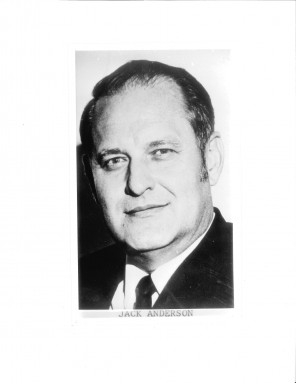
Jack Anderson, who worked for Drew Pearson as an investigative reporter and took over the Merry-Go-Round column upon his mentor's death in 1969, is read by millions of Americans in more than 750 newspapers in this country. He was born October 19, 1922 in Long Beach, California and began his newspaper career as a reporter for the Salt Lake Tribune in 1939. He attended Utah University briefly in 1940-41, but dropped out to work as a Mormon missionary. After service in the Merchant Marine and the Army during and following World War II, he appeared in Pearson's office one day in 1947 and applied for work as an investigative reporter. It marked the beginning of his career in Washington.
Anderson was married on August 10, 1949 to Miss Olivia Farley. They live with their nine children at 7300 Burdette Court, Bethesda, Maryland. The Merry-Go-Round column, distributed for many years by the Bell-McClure Syndicate, now is issued through United Press International.