Frank D. Fackenthal
Biography
By Sean Murphy
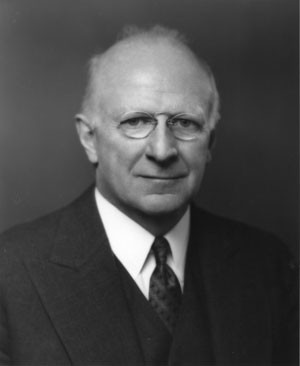
Frank D. Fackenthal was born on February 22, 1883 in Hellertown, PA. He was initially raised in Coplay, PA before the family moved to Roanoke, VA. The family relocated once more to the Crown Heights district of Brooklyn in 1894 when Fackenthal's father Michael (a largely self-educated iron works executive and community leader active in Freemasonry and Congregationalism) was appointed general manager of the Peter Cooper Glue Factory. Fackenthal attended Brooklyn public schools for the remainder of his primary and secondary education; at the prestigious Boys High School, he took the standard college preparatory course of Greek and Latin.
He matriculated at Columbia College in 1902 and received the A.B. in 1906. As an undergraduate, Fackenthal exemplified the fin de siècle ideal of the well-rounded collegiate gentleman of the upper middle class. "I didn't gain any great glory in college," he recalled in a 1957 oral history taken by the University. "On the whole I was probably just an 'able C man.' I chugged along on whatever was to be done, and spent much time on campus activities." These included the Daily Spectator (where he served on the editorial board and eventually as business manager), the Mandolin Club, the Players Club, the Varsity Show and the Barnard Literary Society.
It was not long before University President Nicholas Murray Butler became cognizant of Fackenthal's prodigious administrative abilities, culminating in his appointment as secretary of the University Employment Committee (charged with administrating student workers) in early 1906, months before Fackenthal received his sheepskin. In October of that year, he was appointed chief clerk of the University.
A lifelong bachelor, Fackenthal commuted from Brooklyn to Morningside Heights for his entire career. For some of that time, he resided with his older brother Joseph (a prominent lawyer and fellow Columbia alumnus who served as vice president of the New York City Board of Education under Fiorello LaGuardia) and his family at 35 Prospect Park West in Park Slope. As of 1940, he lived at his parents' house at 930 St. Marks Avenue in Crown Heights.
From 1910 to 1937, Fackenthal served as University secretary; in this capacity, he was the principal liaison between President Butler and the University trustees. As delineated by John Hohenberg in his eponymous history of the Pulitzer Prizes, administration of the program—and particularly the letters, drama and music awards—essentially fell to Fackenthal by proxy as "an unlooked for addition to his regular responsibilities" during this period.
With the Advisory Board only convening once a year to pass their selections on to the trustees for final approval, it was left to Fackenthal and a coterie of trusted associates (most notably longtime administrative assistants Vera Southard and Philip Hayden) to enjoin jurors to serve, disburse entries to the juries, ensure the timely filing of their reports and oversee the annual announcement of the awards in conjunction with the University press office.
In the spring of 1929, Fackenthal received both an honorary LL.D. from Franklin & Marshall College (a small liberal arts institution in Pennsylvania that was the frequent recipient of Fackenthal familial philanthropy) and an honorary Litt.D. from Columbia. Although he never completed an earned graduate degree, he was frequently characterized in the press thereafter as "Dr. Fackenthal." He later received additional honorary doctorates from Syracuse, Rutgers, NYU and Union College.
Fackenthal's ascendancy to the provostship in 1937 was highly atypical, a result of Butler's unwillingness to cultivate a new academic successor after longtime protégé Dixon Ryan Fox assumed the presidency of Union College. As Robert McCaughey observed in his history of the University, Stand, Columbia, "Fackenthal was not an academic and held no advanced degrees; for twenty-seven years his job had been to execute the president's orders. There was no reason to expect him to depart from this pattern as provost."
Although he had served faithfully in the Butler administration for over thirty years, the relationship between Butler and Fackenthal was not as convivial as one would expect, perhaps accounting for Fackenthal's continued residence in Brooklyn. Indeed, Butler went so far as to publicly deprecate his colleague at times, characterizing the provost as "my clerk" on at least one occasion. Nevertheless, as both men were codependent in their professional lives, it is hardly coincidental that Fackenthal stepped in as provost—and as the New York Times would ultimately concede, "deputy president"—while Butler's health and faculties were in abject decline. During World War II, Fackenthal served on the University's war research committee that initially oversaw the incipient Manhattan Project.
Following Butler's retirement in October 1945, Fackenthal was appointed acting president by the trustees during the long search for a successor, a process complicated by the ailing Butler's status as a trustee. When no viable internal candidate manifested a year into what fellow lifelong Columbian Jacques Barzun deemed "the long interregnum," rumors circulated that some trustees nearly capitulated to reason and proposed Fackenthal's permanent appointment; however, this was swiftly forestalled by Butler. Butler also castigated trustee chair Frederick Coykendall when Fackenthal was elected to that board in 1946, as tradition stipulated that only a permanent president could serve as a trustee.
According to McCaughey, Fackenthal was an "institutional caretaker." He mainly developed a long-term plan for Columbia's continued growth (largely eschewed by his successors) and oversaw the evolution of the University's Extension division (including the University Undergraduates program that circumvented Columbia College's ethnic quotas) into the School of General Studies, a propitious step toward inclusivity in higher education. Fackenthal also oversaw the coalescence of such robust Cold War initiatives as the School of International Affairs and the Russian Institute, the latter under the aegis of the Rockefeller Foundation.
After the trustees elected General Dwight D. Eisenhower to replace Butler in the spring of 1947, Fackenthal remained in his position for another year until Eisenhower was released from his military obligations just prior to the 1948 commencement. He had now served as an officer of administration at his alma mater for 42 years. In January 1948, he received the Alexander Hamilton Medal—the University's highest honor—at a special dinner including 1,300 students, faculty and staff.
Three months later, he received a Special Citation on a scroll from the Pulitzer Prize Advisory Board, an achievement that reverberates today in the commemorative scrolls given to each outgoing chair of the Pulitzer Prize Board. It read:
To Dr. Frank Diehl Fackenthal, greetings and felicitations.
You have been associated with the historical development of the Pulitzer Prizes from the beginning.
You were the author of the report which bridged the years between experiment and fulfillment of Joseph Pulitzer's dreams.
You initiated the jury system, communicated with, advised, and at times even consoled juries.
As secretary, provost, and acting president of the university, you were the personal tie between the Advisory Board and the Trustees.
To you, on this occasion, the members of the Advisory Board award the Pulitzer Prize of our friendship in perpetuity.
Thereafter, Fackenthal served as educational consultant for the Carnegie Foundation of New York from 1948 to 1952 and president of Columbia University Press from 1953 to 1958. He also served as president and director of the Bushwick Savings Bank (where his father had also served on the board of directors) and as a director at Tayler, Stiles, & Company, a financial services firm. In addition, he remained a trustee of a variety of institutions, including Columbia University, Barnard College, Franklin and Marshall College, the Riverdale Country School and International House. Columbia University Press published The Greater Power, a collection of 18 speeches from his presidency, in 1949; none totaled more than 500 words, a testament to Fackenthal's laconic elan.
In December 1965, Fackenthal was critically injured when his car collided with a tractor-trailer in White Township, NJ, roughly fifty minutes south of his country home in Buck Hill Falls, PA. He remained infirm thereafter and was forced to eventually relocate from Brooklyn to Buck Hill Falls. In 1967, he relinquished his duties as a trustee of Columbia and became trustee emeritus. Fackenthal succumbed to his injuries and old age at Monroe County General Hospital in East Stroudsburg, PA on September 5, 1968.