Pulitzer-Winning Works to Explore After 'Hamilton'

From a masterwork of American theater to a celebrated biography, discover Lin-Manuel Miranda's fellow Pulitzer winners after watching 'Hamilton'.
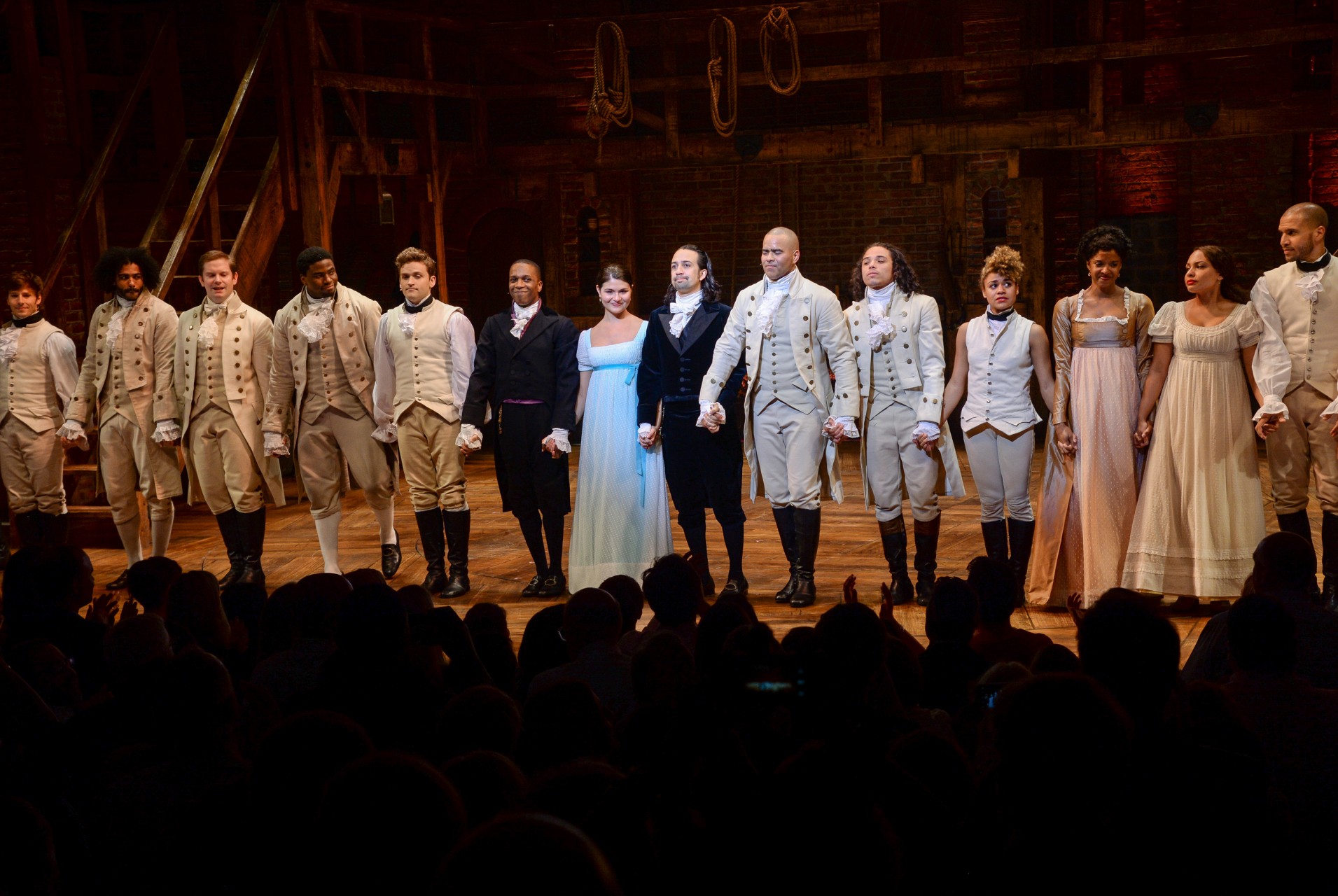
'Hamilton' creator Lin-Manuel Miranda, center, takes his final performance curtain call with cast members (including Leslie Odom Jr., Phillipa Soo, Christopher Jackson, Anthony Ramos, Ariana DeBose and Renée Elise Goldsberry) at the Richard Rogers Theatre on July 9, 2016. (Evan Agostini/Associated Press)

Hailed by the Pulitzer Board as a "landmark American musical" when it was awarded the 2016 Drama Prize, Lin-Manuel Miranda's "Hamilton" melds hip-hop with musical theater and the dichotomous undercurrents of American political history. In 2020, Disney+ premiered a film based on live stage recordings from the original Broadway production of the work. Starring Miranda as Alexander Hamilton, the cast also includes Phillipa Soo as Eliza Hamilton, Leslie Odom Jr. as Aaron Burr, Christopher Jackson as George Washington and Daveed Diggs in a dual role as the Marquis de Lafayette and Thomas Jefferson. Should you wish to explore other Pulitzer-winning work, the following four books and plays interlock with various elements of Hamilton's life and Miranda's approach, from the reappraisal of a political rival to the figure widely regarded as the greatest living composer in American musical theater. Happy reading and viewing!


1.

'Sunday in the Park with George,' by Stephen Sondheim and James Lapine (Drama, 1985)
 

While his influence on popular culture has ebbed and flowed through the decades, 1985 Drama winner Stephen Sondheim remains a household name to devotees of American theater. A living link to the halcyon era of Rodgers, Hammerstein, Hart, Kaufman, Bernstein and Robbins, Sondheim and longtime collaborator Hal Prince responded to the cultural uprisings of the 1960s by subverting the form of the traditional Broadway musical while retaining its most enduring conventions. Among many highlights, the vignette-oriented "Company" (1970) offered meditations on upper-middle-class Manhattan life in John Lindsay-era New York, while "Pacific Overtures" (1976) refracted the bicentennial spirit through the postcolonial realities of America's engagement with Japan. Following the commercial failure of "Merrily We Roll Along" in 1980, Sondheim initiated a new creative partnership with director-playwright James Lapine that resulted in the Pulitzer-winning "Sunday in the Park with George" as well as "Into the Woods." Decades later, Miranda divulged that he was working on "Hamilton" while completing translations for Sondheim on "West Side Story," and despite a generational stylistic divide, both figures were bound by what Miranda characterized as "subject of surprise, both for the audience and for the playwright" in a 2017 profile of the elder composer in The New York Times Magazine. Added Sondheim: "You shouldn’t feel safe. You should feel, 'I don’t know if I can write this.' That’s what I mean by dangerous, and I think that’s a good thing to do. Sacrifice something safe."

2.

'Main Currents in American Thought,' by Vernon Louis Parrington (History, 1928)

1928 History winner Vernon Louis Parrington enjoyed a brief vogue as one of the nation's foremost public intellectuals. Primarily a literary scholar, the University of Washington-based Parrington embraced the economic-oriented Progressive historiography of contemporaries such as Charles Beard at a time when academic study of literature was deeply rooted in biographical analysis of authors' lives, ensuring that "Main Currents" would be read as an early cultural history in the interdisciplinary field of American Studies. Anticipating the ecumenicism of the Frankfurt School and poststructuralism, Parrington did not shy away from juxtaposing political theorists against polemicists and poets. His Hamilton is startlingly consonant with the complex imperatives of Miranda's character: "His mind hardened early as it matured early, and he never saw cause to challenge the principles which he first espoused. He was what a friendly critic would call a political realist, and an enemy would pronounce a cynic. With the practical man's contempt for theorists and idealists, he took his stand on current fact. [...] Whoever aspires to become a sane political leader must remember that his business is not to construct Utopias, but to govern men." While other elements of his project have been superseded by subsequent scholarship, Parrington's Hamilton remains the foundational modern conception: the headstrong fighter who overcame his baser instincts to forge a nation.

3.

'The Hemingses of Monticello: An American Family,' by Annette Gordon-Reed (History, 2009)
Lee Bollinger and Annette Gordon-Reed
Subordinated only by political rival Aaron Burr among "Hamilton"'s antagonists, Thomas Jefferson emerges as the titular character's ideological foil in "Cabinet Battle #2" before settling into a more ambiguous role in "The Election of 1800," when Hamilton unexpectedly votes for Jefferson (citing "his beliefs/Burr has none") to spite longtime bete noir Adams and the incoming vice president. Yet while Jefferson's polymathic competencies (ranging from architecture to linguistics to industrial design) burnished the young republic's profile in extended assignments as minister to France and secretary of state, as a member of Virginia's landed gentry who ultimately defied the Enlightenment rhetoric of his writings, his name is forever intertwined with the nation's original sin of slavery. In 2009, Harvard Law Professor Annette Gordon-Reed received the History Prize for "The Hemingses of Monticello," which chronicles the history of the Black Hemings family from their enslavement to Jefferson's concubinage of Sally Hemings, a half sister of Jefferson's wife who accompanied Jefferson to Paris at the age of 14 and ultimately gave birth to six of his children. Gordon-Reed's research played a key role in affirming Jefferson's paternity of Hemings' children, with the Thomas Jefferson Foundation of Monticello acknowledging that it was "settled historical matter" in 2018. "White supremacy," Gordon-Reed observes, "does not demand deep conviction. Ruthless self-interest, not sincere belief, is the signature feature of the doctrine. It finds its greatest expression, and most devastating effect, in the determination to state, live by, and act on the basis of ideas one knows are untrue when doing so will yield important benefits and privileges that one does not care to relinquish."

4.

'John Adams,' by David McCullough (Biography, 2002)
George Rupp and David McCullough
Nearly two centuries before the advent of social media bluster, there was John Adams. Although popular works such as "1776" tend to depict a tri-cornered, idealistic curmudgeon somehow redolent of both Atticus Finch and Larry David's eponymous character on "Curb Your Enthusiasm," the historical Adams oversaw unprecedented abrogations of civil liberties and press freedom while serving as president during the Quasi-War with France. Moreover, he was not one for patriotic comity, once characterizing Benjamin Franklin as a "continued insult to good manners and to decency," Hamilton as the "bastard brat of a Scotch peddler" (alluded to by Miranda in "The Adams Administration") and George Washington as "too illiterate, unlearned [and] unread for his station." (Indeed, "Hamilton" arguably marks the popular Adams' inevitable descent into minor villain status.) Yet as two-time Pulitzer winner David McCullough discovered when he set out to research a study of the lifelong rivalry between Adams and Thomas Jefferson, the second president's latter-day public misanthropy was offset by a rising activist's commitment to the rule of law and a unique literary perspective of the Revolutionary era, particularly in his extensive correspondence with his wife, Abigail. Refined into a biography of Adams that would earn McCullough his second Pulitzer, it is this Adams who served as the ideological lynchpin of the Revolution; the person who, "more than anyone [...] had made it happen"; the defeated, contradictory force who miraculously convened a decisive diplomatic mission to France at the height of his surprisingly autocratic presidency. 

5.

'Washington: A Life,' by Ron Chernow (Biography, 2011)
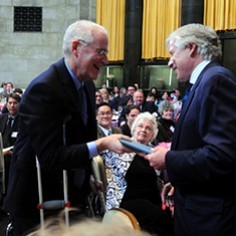
Lee Bollinger and Ron Chernow
The life of George Washington was a key locus of 19th century American culture, bridging the chasms and schisms of the national experiment. Indeed, by the second decade of the 20th century, the original Pulitzer Prize Plan of Award explicitly prohibited works on Washington and Abraham Lincoln in the Biography category as being "too obvious" in demonstrating the initial criterion of "teaching patriotic and unselfish services to the people [as] illustrated by an eminent example." The restriction was lifted on the cusp of World War II, and Douglas Southall Freeman's meticulous seven-volume account (completed by Alexander Carroll and Mary Wells Ashworth following his death in 1953) was awarded the 1958 Biography Prize. Less than two decades later, prolific New York-based autodidact James Thomas Flexner received a Special Citation in 1973 for his popular four-volume account, the basis of a mass-market abridgment ("Washington: The Indispensable Man") familiar to any library-goer who came of age in the following generation. Although these encyclopedic works tempered interest in chronicling the first president's life, Brooklyn-based writer Ron Chernow — known for a 2005 biography of Alexander Hamilton that served as the primary source for Miranda's musical — took on the challenge in "Washington: A Life," which the 2011 Biography Prize. The work was a direct outgrowth of his Hamilton project; echoing Parrington's long-ago sentiments, Chernow observed that "Hamilton is the protagonist of ["Alexander Hamilton"] but Washington is the hero of the book," a key undercurrent in "Hamilton." As decades had elapsed since the previous biographies, Chernow was able to incorporate hitherto neglected archival sources, notably the letters, maps and minutiae collected by The Washington Papers at the University of Virginia. Ultimately, the Washington that unfurls in Chernow's opus is a contemporary pragmatist with a dash of the antiheroic, the antithesis of the "seemingly dull, phlegmatic man" he professed to encounter in past accounts — a "different kind of general fighting a different kind of war" whose "military prowess cannot be judged by the usual scorecard of battles won and lost"; an "exceedingly smart man with a quick ability to grasp"; and, most importantly, a person who managed the vicissitudes of his life "with such consummate skill that they often seemed to happen accidentally." 

Learn More

Pulitzer winner 'Hamilton' takes home Tony for Best Musical

After winning the Pulitzer Prize in Drama, 24 shows have gone on to win the Tony for Best Play or Best Musical. Watch video highlights of the double honorees, with writers like Arthur Miller, performers like Daniel Radcliffe and James Earl Jones, and Broadway classics like 'A Chorus Line.'