Five Poetry Winners to Read This Summer
In the second installment of an occasional series, discover Pulitzer-winning poets who help to define the season.
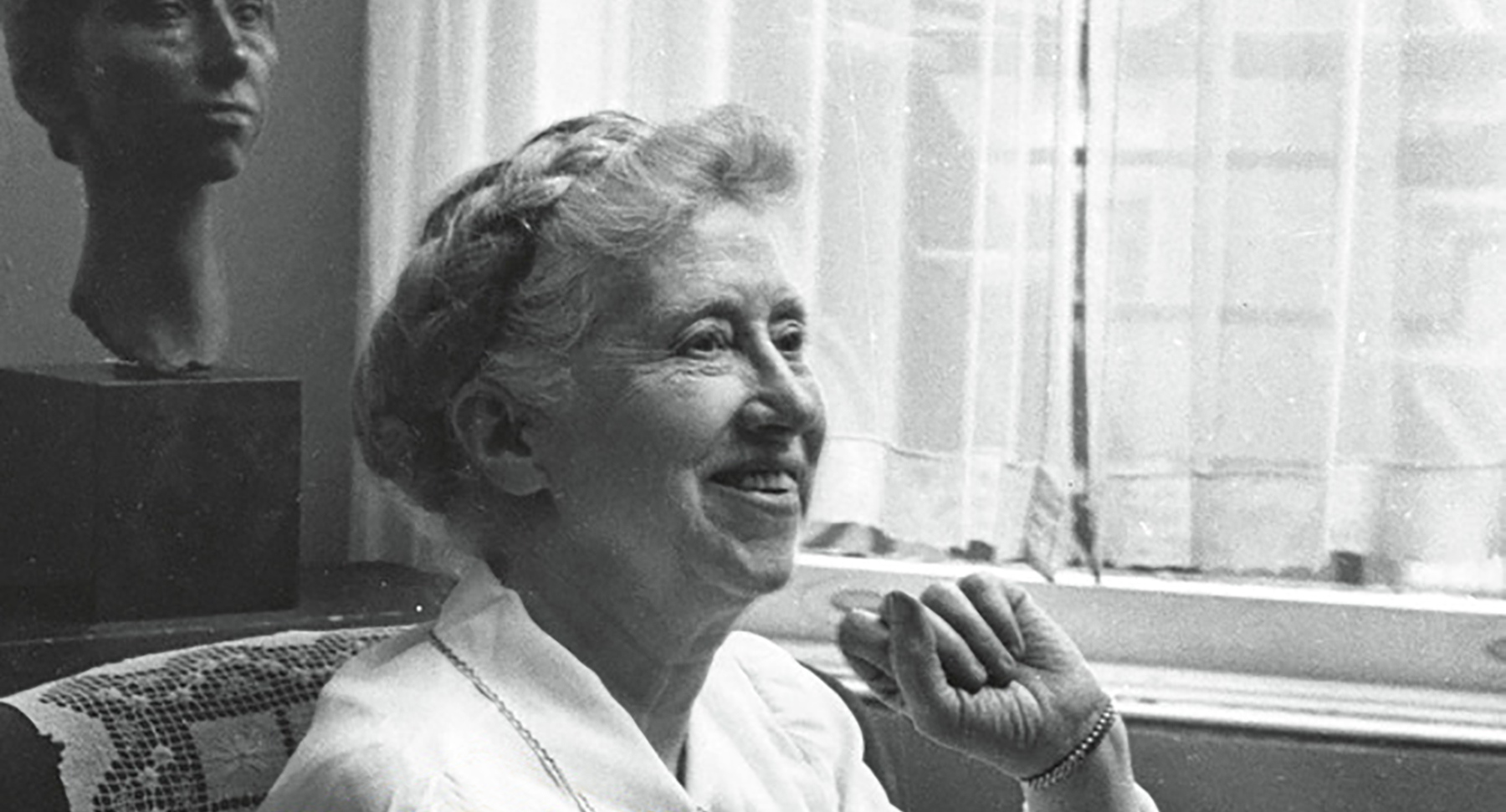
Marianne Moore in what is believed to be her Fort Greene, Brooklyn apartment (FSG).
Summer brings opportunities to discover new books and revisit favorite literary works, particularly in the vast realm of American poetry. As the season progresses, the Pulitzers are highlighting a range of Prize-winning books and dramas primed for your beach blanket or e-reader queue. We welcome recommendations for further installments at [email protected] or on our Twitter, Facebook and Instagram pages. Happy reading!
1.
"Collected Poems" by Robert Frost
Though born and initially raised in San Francisco at the apex of "manifest destiny," the death of Robert Frost's news editor father forced him to move to Lawrence, Mass. when he was 10. Aside from a teaching post at the University of Michigan, the four-time Pulitzer winner remained an inveterate Yankee for the rest of his life, ultimately dividing his time between a house in Cambridge, Mass. and a cabin near the Middlebury Pass in Ripton, Vt., where he was an annual faculty member at Middlebury College's storied Bread Loaf Writers' Conference for 40 years. Frost straddled the complexities of Victorianism and modernism without neatly conforming to either ideology. While he was an early adopter of everyday diction (setting the stage for the likes of fellow Prize winners Ernest Hemingway and William Carlos Williams), his work hearkened back to the past with shorter forms and traditional prosody, best exemplified by his penchant for rhyming couplets. Vermont and New Hampshire summers inspired works such as "Fireflies from the Garden," wherein Frost he rhapsodizes the "emulating flies" — and mainstays of any New England backyard — who "achieve at times a very star-like start." "The Bear" offers an early glimpse into his forays in the Green Mountains, where the famished creatures briefly skitter down to the foothills and lakes after the mud season of late spring abates: "The world has room to make a bear feel free/The universe seems cramped to you and me."
2.
"Turtle Island" by Gary Snyder
As he approaches his tenth decade, 1975 Poetry winner Gary Snyder remains a popular figure in literary studies — two monographs on his oeuvre have been published since 2010. Yet the Snyder of 1974 was better known as an ancillary member of the Beat Generation demimonde, immortalized by Jack Kerouac in "The Dharma Bums" (1958) as Japhy Ryder, the prodigious Buddhist and seasonal fire lookout who spurned the era's prevailing ethos by "prowling in the wilderness to hear the voice crying in the wilderness." Paralleling the tribulations of his closest friend in the original Beat circle, 1995 Poetry finalist Allen Ginsberg, Snyder was unable to secure regular employment in the post-McCarthy era. He devoted much of the 1960s to an itinerant life of Zen practice, writing and independent study. Supported by various fellowships from the Guggenheim Foundation and other organizations, he purchased a tract of land in the Sierra Nevada foothills in 1966; there, he built his permanent home, Kitkitdizze, and began a family with his second wife, the Osaka, Japan-born Masa Uehara. Although the foundations for his later career as an academic and essayist began to come into place amid the Vietnam War and the insurgent environmental movement, many of the poems in "Turtle Island" (a widespread indigenous name for North America) reflect the hardscrabble nature of rural communal life and the possibilities therein: "At fifty below/Fuel oil won't flow/And propane stays in the tank," Snyder reflects in "As for Poets." "Fire Poets/Burn at absolute zero/Fossil love pumped back up." Although the familial intimacy of the California poems spans the seasons, the collection's emotional centerpiece, "Mother Earth: Her Whales," was written on the summer solstice in Stockholm in 1970. An expansive condemnation of political mendacity, deforestation and human trafficking that anticipates Snyder's later contributions to ecological theory, it casts prophetic visions — "The robots argue how to parcel out our Mother Earth/To last a little longer/Like vultures flying" — against the endurance of whales who "turn and glisten/plunge and/Sound, and rise again/Flowing like breathing planets."
3.
"Collected Poems" by Wallace Stevens
During much of the first half of the 20th century, Wallace Stevens had one of the most inimitable careers in American letters. As a vice president at the Hartford Accident and Indemnity Company (still extant as the Hartford Financial Services Group, a Fortune 500 corporation), he became the contemporary equivalent of a millionaire — and in his spare time, Stevens became an imaginative poet. With poetics shaped by such transitional philosophical figures as George Santayana and Henri Bergson, not to mention the specter of James Joyce (his edition of "Ulysses" has inspired scholarly articles), Stevens' aesthetics are markedly different from the "well-wrought urns" of contemporaries such as T. S. Eliot and Ezra Pound. Offering an escape from the drudgery of the insurance office, summer occupies recurring and hallowed ground in many of Stevens' poems. As he observes in "Credence of Summer," containing his most sustained and autobiographical divagations on the season, "The personae of summer play the characters/Of an inhuman author, who meditates/With the gold bugs, in blue meadows, late at night [...] Free, for a moment, from malice and sudden cry/Completed in a completed scene, speaking/Their parts as in a youthful happiness." A similar theme suffuses "The Idea of Order at Key West," where Stevens vacationed for years and was often embroiled in drunken altercations with fellow Pulitzer winners Ernest Hemingway and Robert Frost: "As the night descended, tilting in the air/Mastered the night and portioned out the sea,/Fixing emblazoned zones and fiery poles/Arranging, deepening, enchanting night."
4.
"Collected Poems" by Marianne Moore
One of the greatest writers of the 20th century, Marianne Moore's contributions to poetic modernism were overshadowed in her final years by an eccentric media personality centered around her life in Brooklyn and love of sports, including boxing and baseball. Her work also was affected by her caregiving duties to her mother. Moore oversaw two major revisions of her collected work, further enfeebling her earliest poems after her first "Collected Poems" received the 1952 Poetry Prize. However, the 2010s have seen the release of a meticulous "New Collected Poems" that emphasizes the original iterations of her work while including the revisions as addenda. Moore did not particularly relish the summer, relating her dreams of "several hours of frost every midsummer night" in "An Octopus" and offering to "answer the question/as to 'why I like winter better than summer'" in "Bowls." In contrast to her male counterparts, however, she did not bombard the reader with recherché catalogs of scholarly provenance or images that were so ethereal as to be intangible. Reading Moore remains a direct, inviting and engaging experience nearly a century after her project commenced. In "Pedantic Literalist," she subtly lampoons Pound's descent into what would eventually come to be seen as fascist apologetics: "A Little/'palm tree of turned wood'/Informs your once spontaneous core in/Its/Immutable production." This theme also informs the contemporaneous "Critics and Connoisseurs": "What is/there in being able/to say that once has dominated the/stream in an attitude of self-defense,/in proving that one has had the/experience/of carrying a stick?"
5.
"American Primitive" by Mary Oliver
Openly lesbian at a time when it could have imperiled her career, Mary Oliver was ensconced as one of the country's most popular and enduring poets when she died in 2019. In an era when the idiom had become defined by an innumerable array of often-divisive subcultures, she was a rare unifying force, as likely to earn plaudits from The New Yorker as she was from local book clubs. Residing for much of her adult life in the coastal bohemian enclave of Provincetown, Mass. (where she and her life partner, Molly Malone Cook, were close with seasonal denizen and Pulitzer winner Norman Mailer), Oliver offered a recombinant poetics of postmodern uncertainty built upon the regionalist legacy of Robert Frost, the pastoralism of Walt Whitman and a variety of traditional preoccupations (as she would quip, "Nature, beauty and, worst of all, God"). As she wrote in "August," a key work in her Pulitzer-winning collection, "I spend/all day among the high/branches, reaching/my ripped arms, thinking/of nothing, cramming the black honey of summer/into my mouth." This immersive physicality is also foregrounded in "The Roses": "[T]here is no end,/believe me! to the inventions of summer, to the happiness your body/is willing to bear."