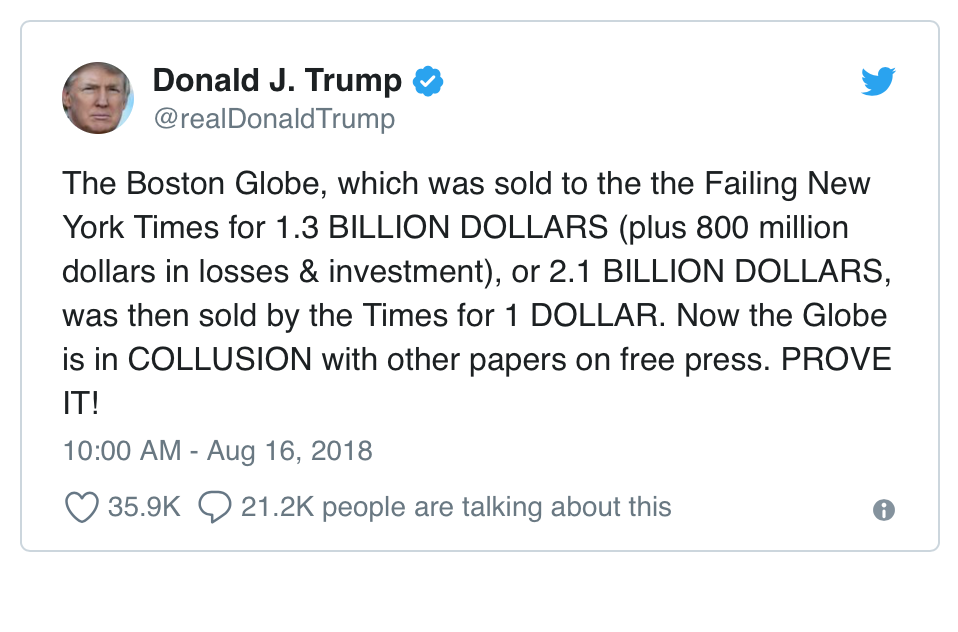
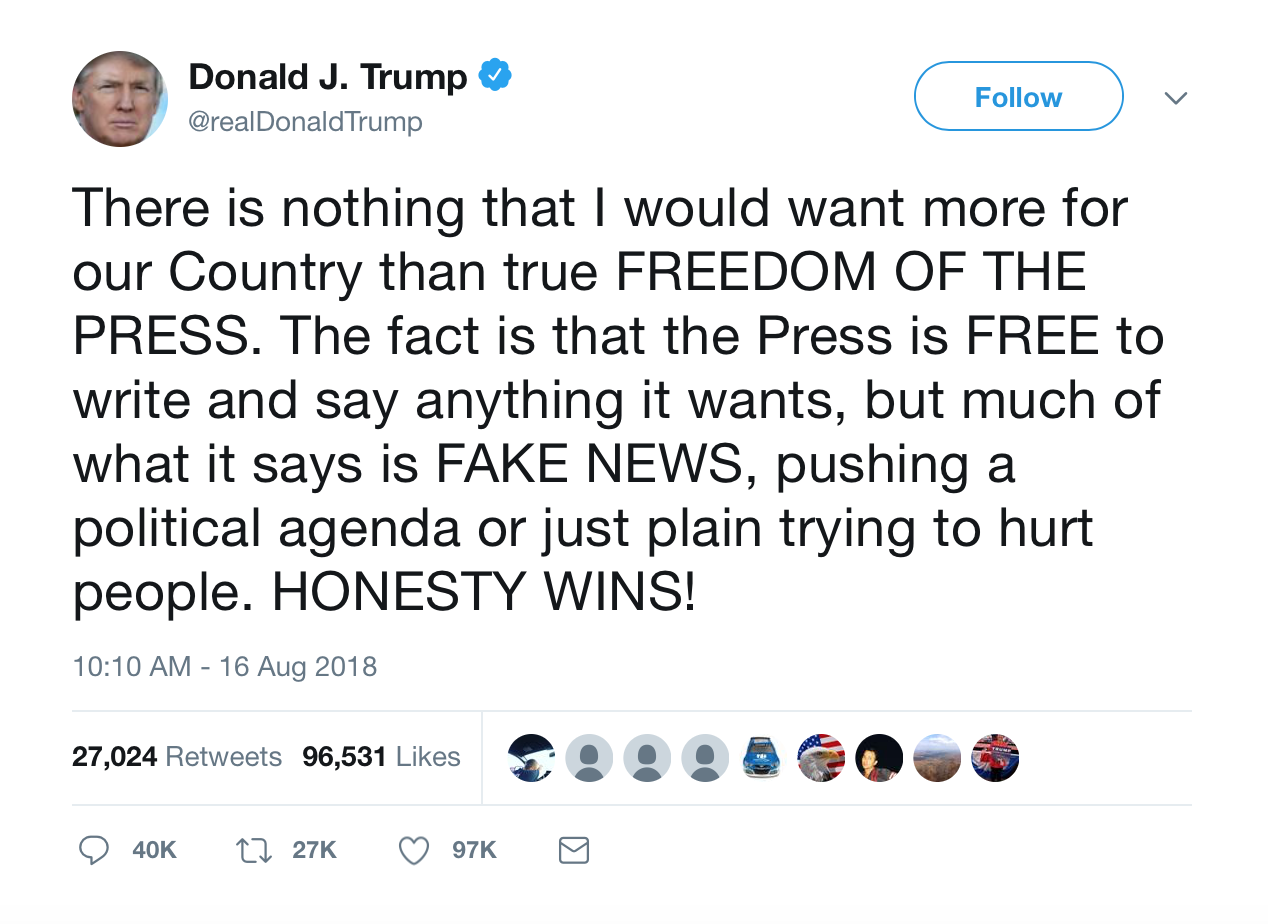
Each news organization that participated in today's free press editorial campaign opted in for their own reasons — and more than 350 outlets chose to participate.
As Boston Globe Deputy Editorial Page Editor Marjorie Pritchard, who initiated the nationwide effort, said in the lead-up to the event, "The impact of Trump's assault on journalism looks different in Boise than it does in Boston. Our words will differ. But at least we can agree that such attacks are alarming."
Below are a variety of responses from across the United States.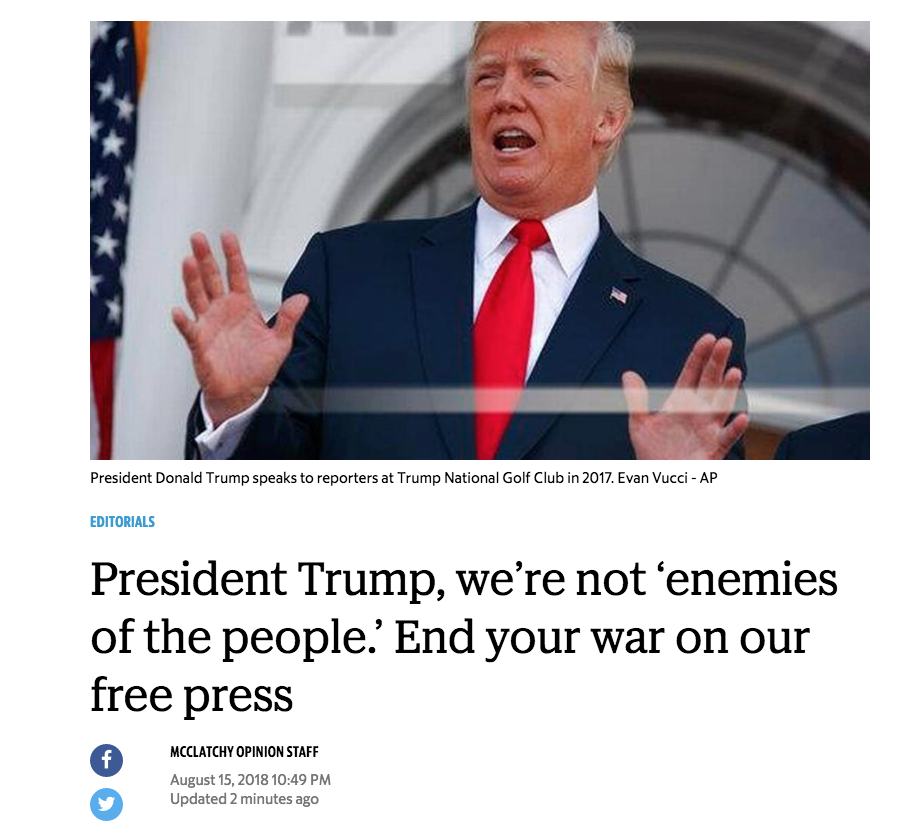
In a piece run by McClatchy Company newspapers (including the Miami Herald and The Sacramento Bee), the group's opinion staff wrote:
We know, too, that Trump’s references to us as the 'enemy of the American People' are no less dangerous because they happen to be strategic. That is what Nazis called Jews. It’s how Joseph Stalin’s critics were marked for execution.
[...]
No American president, or any city council member, for that matter, has ever unreservedly delighted in the way he or she was presented in the press. "I so appreciate the accuracy of their reporting on my perceived flaws!" said no official ever. "And good for them for holding me accountable." But President Donald Trump has veered into unfamiliar and perilous territory with his unceasing all-out assault on the free press and the First Amendment. Of course, the irony of Trump’s attacks on the "SICK!" and "very dishonest people" in "the fake media" he accuses of purveying, yes, "fake news" is that he himself is a product of the New York tabloids. He’s as savvy about manipulating his coverage as he is adept in undermining it.
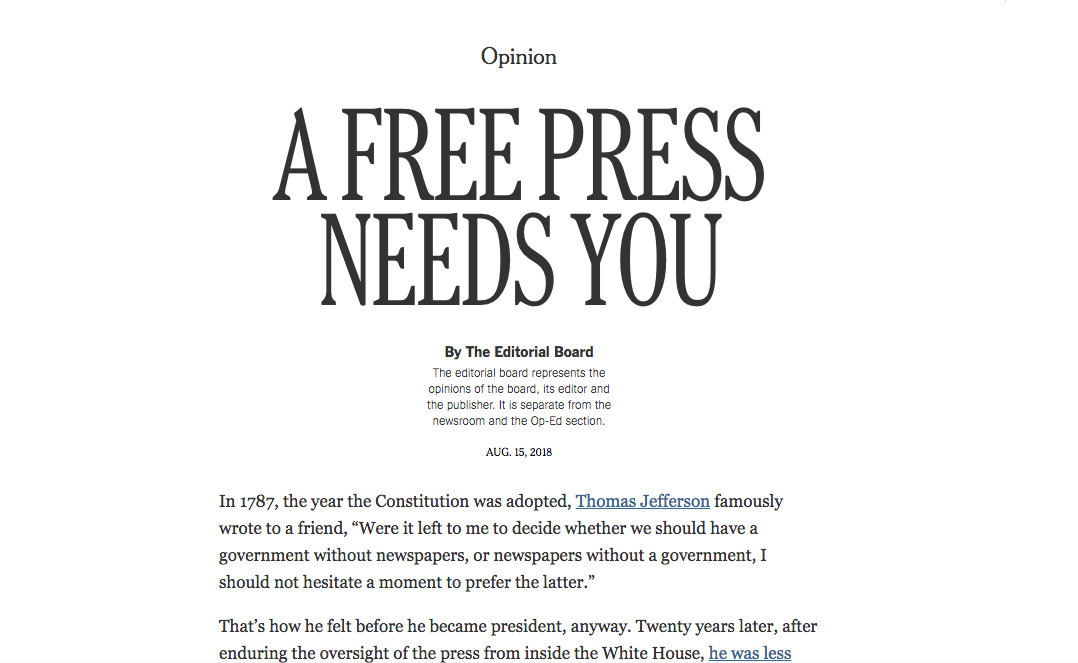
According to The New York Times Editorial Board:
Criticizing the news media — for underplaying or overplaying stories, for getting something wrong — is entirely right. News reporters and editors are human, and make mistakes. Correcting them is core to our job. But insisting that truths you don’t like are "fake news" is dangerous to the lifeblood of democracy. And calling journalists the "enemy of the people" is dangerous, period.
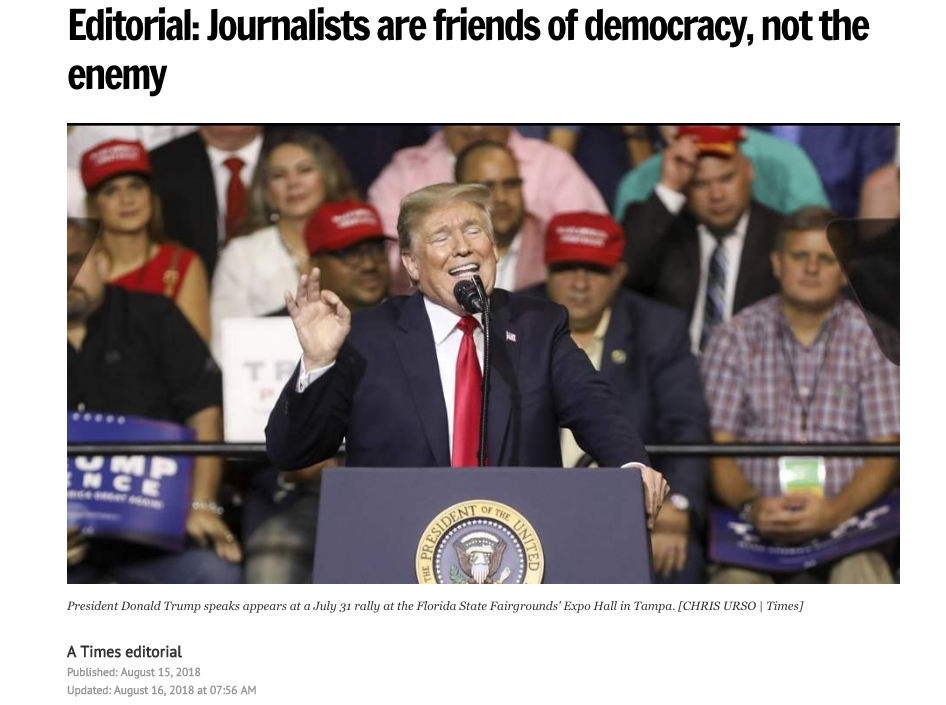
The Tampa Bay Times tied its participation to the vital and often unheralded reportage that enhances local quality of life:
It is real news that the Hillsborough County School District said this week it will accelerate testing for lead in drinking water and release the results after the Tampa Bay Times reported testing would take years and that until we asked families weren’t told about lead levels that already had been discovered.
It is real news that Habitat for Humanity of Hillsborough County announced this week it would try to buy back a dozen mortgages, a day after the Times reported the mortgages were sold to a Tampa company with a history of flipping foreclosed houses.
It is real news that the Clearwater man who shot and killed a father in a dispute over parking in a handicap-reserved space has a history of road rage, a history the Times first reported and law enforcement cited as the shooter was charged with manslaughter this week in a stand your ground case that has attracted national attention.
Yet from Washington, President Donald Trump attacks the media that provides fact-based, independent journalism and holds the powerful to account in communities around the nation.
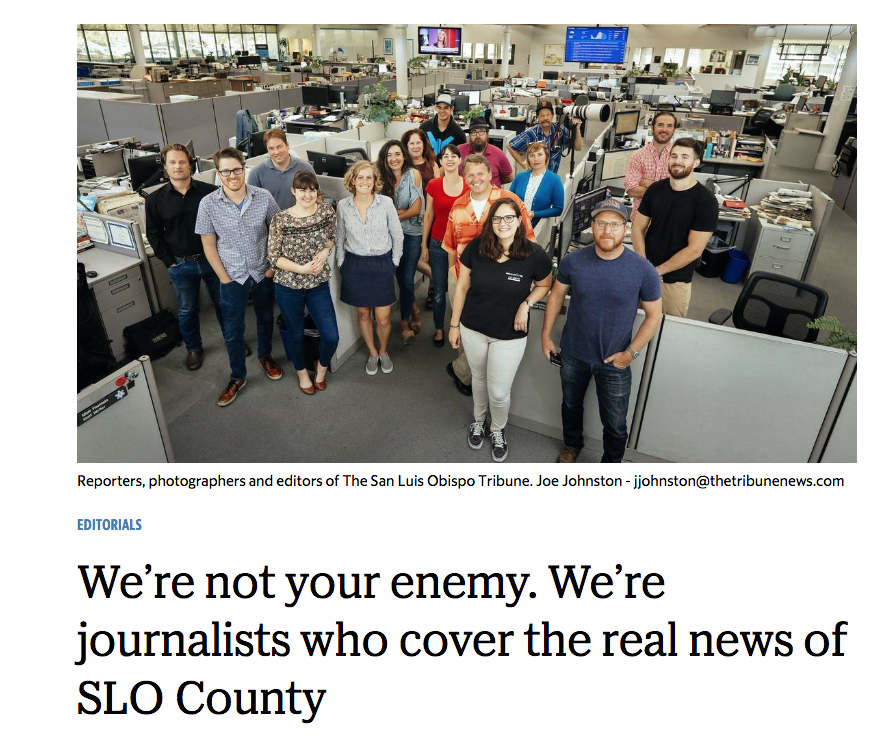
This approach was echoed by The Tribune of San Luis Obispo, Calif.:
Like other small and mid-size newspapers far from the beltway, we fly under the president’s radar.
Yet we, too, have been undermined by Trump’s campaign to demonize journalists. Today, we join more than 200 newspapers across the country in calling out the president’s "fake news" narrative for what it is: a lie.
First, let’s get something straight: Fake news does exist, and it can be unspeakably vile.
One odious example: Denying that young children died in the Sandy Hook shooting.
That’s the type of fake news we should all be trolling. Yet when the president and his supporters lash out at the "fake news media," they are not referring to provocateurs peddling obvious lies, but to the journalists who deliver news they don’t want to hear — as if branding it "fake" can somehow make it go away.
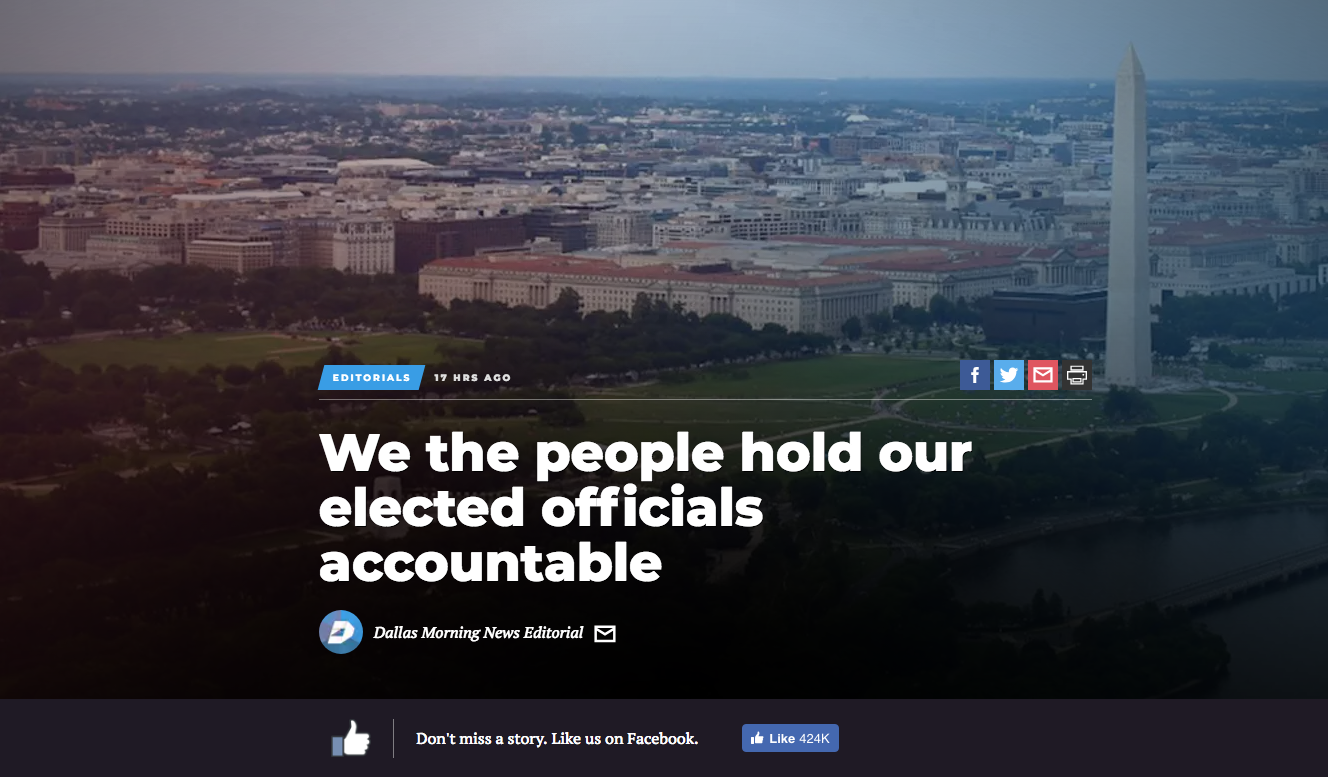
The Dallas Morning News looked back to the origins of the First Amendment and New York Times Co. vs. United States, a pivotal press freedom case that adjudicated the publication of the Pentagon Papers:
Our Founding Fathers well understood that one effective way to squelch our liberty would be to silence those who — through handbills, printing presses and now digital media — work to hold the powerful accountable by opening to public scrutiny facts about how our society is governed.
As a result, they gave us the First Amendment with the expectation that a free press would arm citizens with facts and that the media would be held accountable by readers (and now a viewing public).
It is no coincidence that this newspaper's best work since its founding in 1885 has been produced by journalists who dared, in one way or another, to shine a light on societal injustices, corruption, the ravages of war, poverty and natural disasters while adhering to bedrock principles of truth and fairness.
As Supreme Court Justice Hugo Black wrote in his concurring opinion in the landmark 1971 Pentagon Papers case, New York Times Co. vs. United States, "In the First Amendment, the Founding Fathers gave the free press the protection it must have to fulfill its essential role in our democracy. The press was to serve the governed, not the governors."
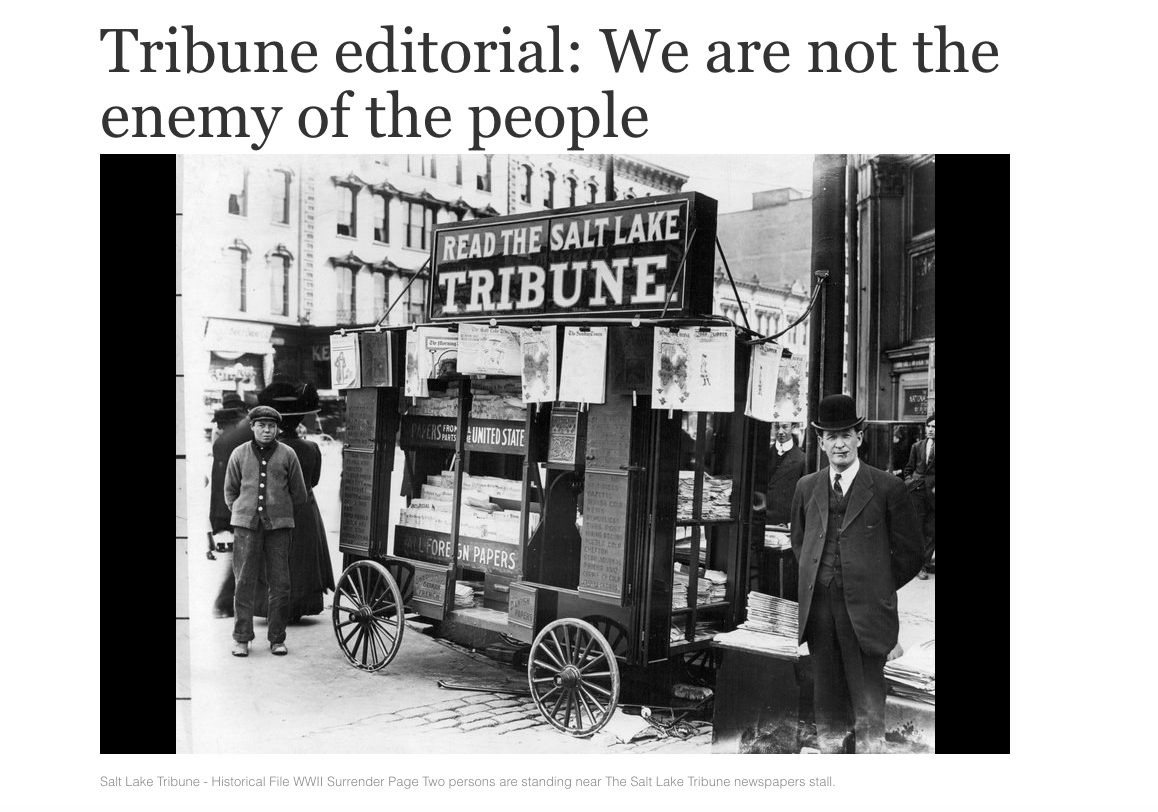
The Salt Lake Tribune invoked a Chico Marx gag from "Duck Soup" and earlier historical precedents:
It is not at all unusual for presidents to have had their fill of the press.
Thomas Jefferson, who once said he would rather live in a country with newspapers and no government over government and no newspapers, was later heard to lament that people who don’t read newspapers are smarter than those who do, because knowing nothing is preferable to knowing things that aren’t true. Richard Nixon temporarily blocked the publication of the Pentagon Papers by The New York Times and threatened to cancel the licenses of TV stations owned by The Washington Post.
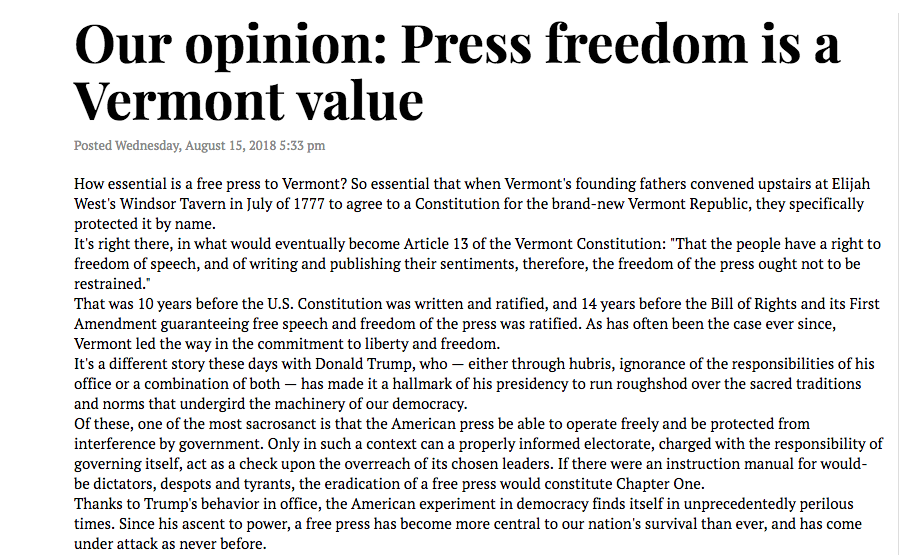
Likewise, Vermont's Manchester Journal took readers back to 1777 and the origins of the now-defunct Vermont Republic:
How essential is a free press to Vermont? So essential that when Vermont's founding fathers convened upstairs at Elijah West's Windsor Tavern in July of 1777 to agree to a Constitution for the brand-new Vermont Republic, they specifically protected it by name.
It's right there, in what would eventually become Article 13 of the Vermont Constitution: "That the people have a right to freedom of speech, and of writing and publishing their sentiments, therefore, the freedom of the press ought not to be restrained."
That was 10 years before the U.S. Constitution was written and ratified, and 14 years before the Bill of Rights and its First Amendment guaranteeing free speech and freedom of the press was ratified. As has often been the case ever since, Vermont led the way in the commitment to liberty and freedom.
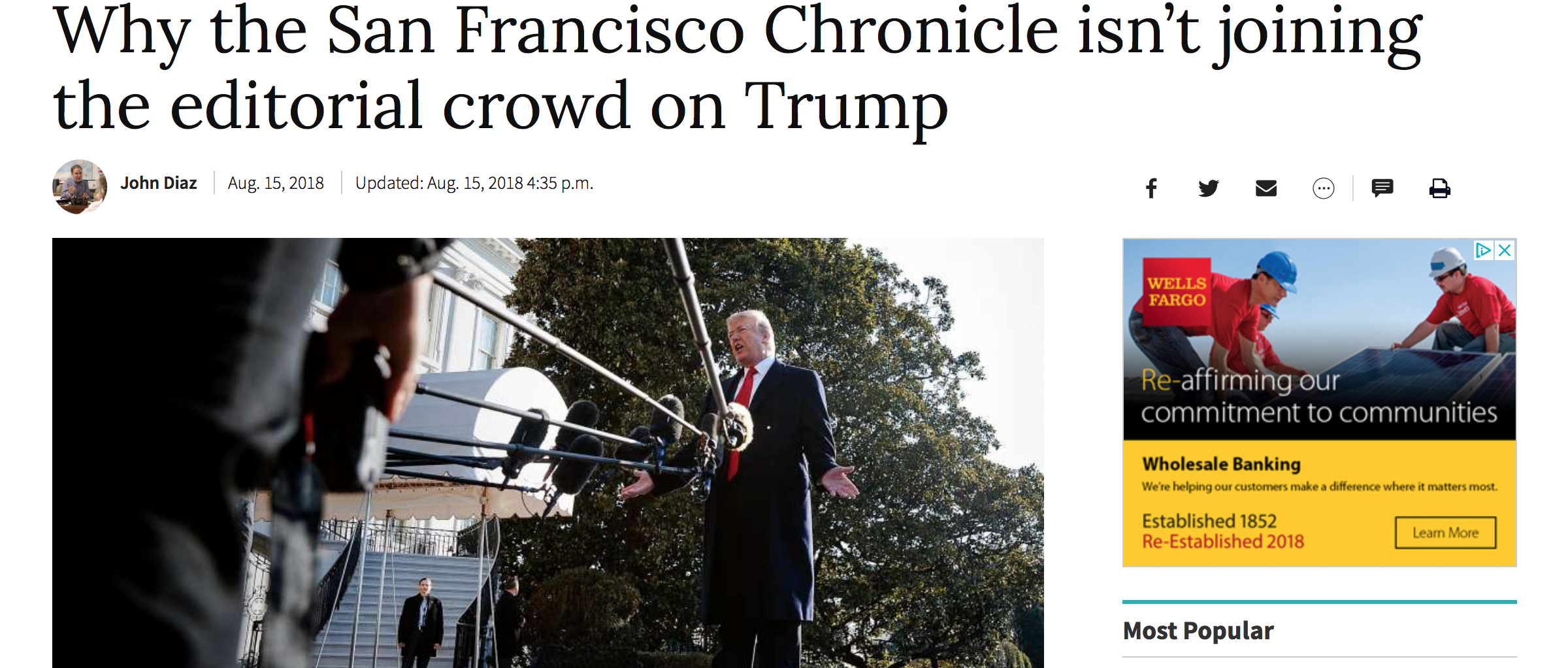
However, some news organizations elected not to participate in the campaign. Foremost among them was the San Francisco Chronicle, led by Editorial Page Editor and former Pulitzer juror John Diaz:
Here is our board’s thinking:
One of our most essential values is independence. The Globe’s argument is that having a united front on the issue — with voices from Boise to Boston taking a stand for the First Amendment, each in a newspaper’s own words — makes a powerful statement. However, I would counter that answering a call to join the crowd, no matter how worthy the cause, is not the same as an institution deciding on its own to raise a matter.
[...]
This brings me to my other concern of the Globe-led campaign: It plays into Trump’s narrative that the media are aligned against him. I can just anticipate his Thursday morning tweets accusing the "FAKE NEWS MEDIA" of "COLLUSION!" and "BIAS!" He surely will attempt to cite this day of editorials to discredit critical and factual news stories in the future, even though no one involved in those pieces had anything to do with this campaign.
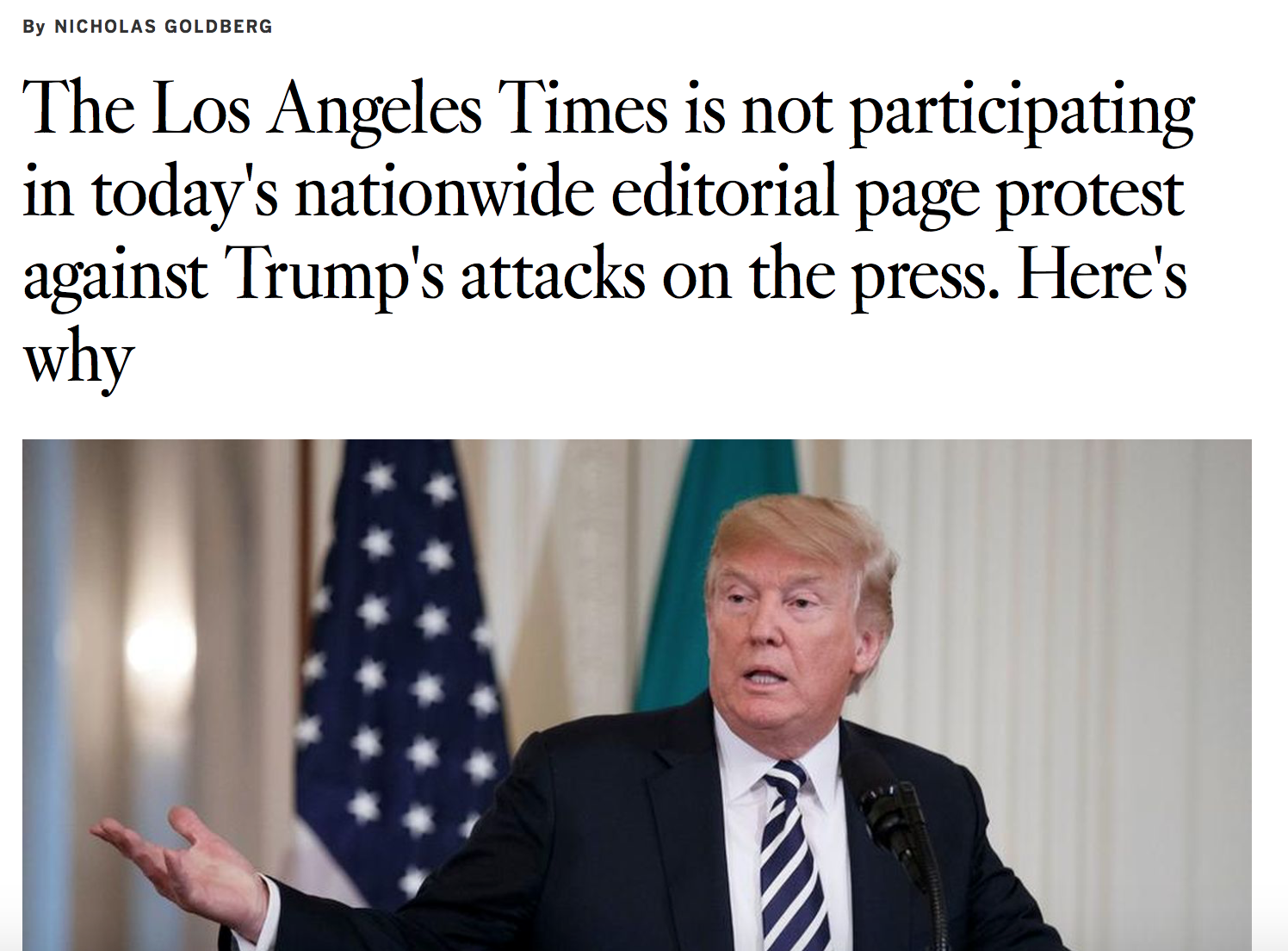
The Los Angeles Times also declined to participate in the campaign. According to Editorial Page Editor Nicholas Goldberg:
The Los Angeles Times editorial board does not speak for the New York Times or for the Boston Globe or the Chicago Tribune or the Denver Post. We share certain opinions with those newspapers; we disagree on other things. Even when we do agree with another editorial page — on the death penalty or climate change or war in Afghanistan, say — we reach our own decisions and positions after careful consultation and deliberation among ourselves, and then we write our own editorials. We would not want to leave the impression that we take our lead from others, or that we engage in groupthink.
[...]
We mean no disrespect to those who have decided to write on this important subject today. But we will continue to write about the issue on our own schedule.
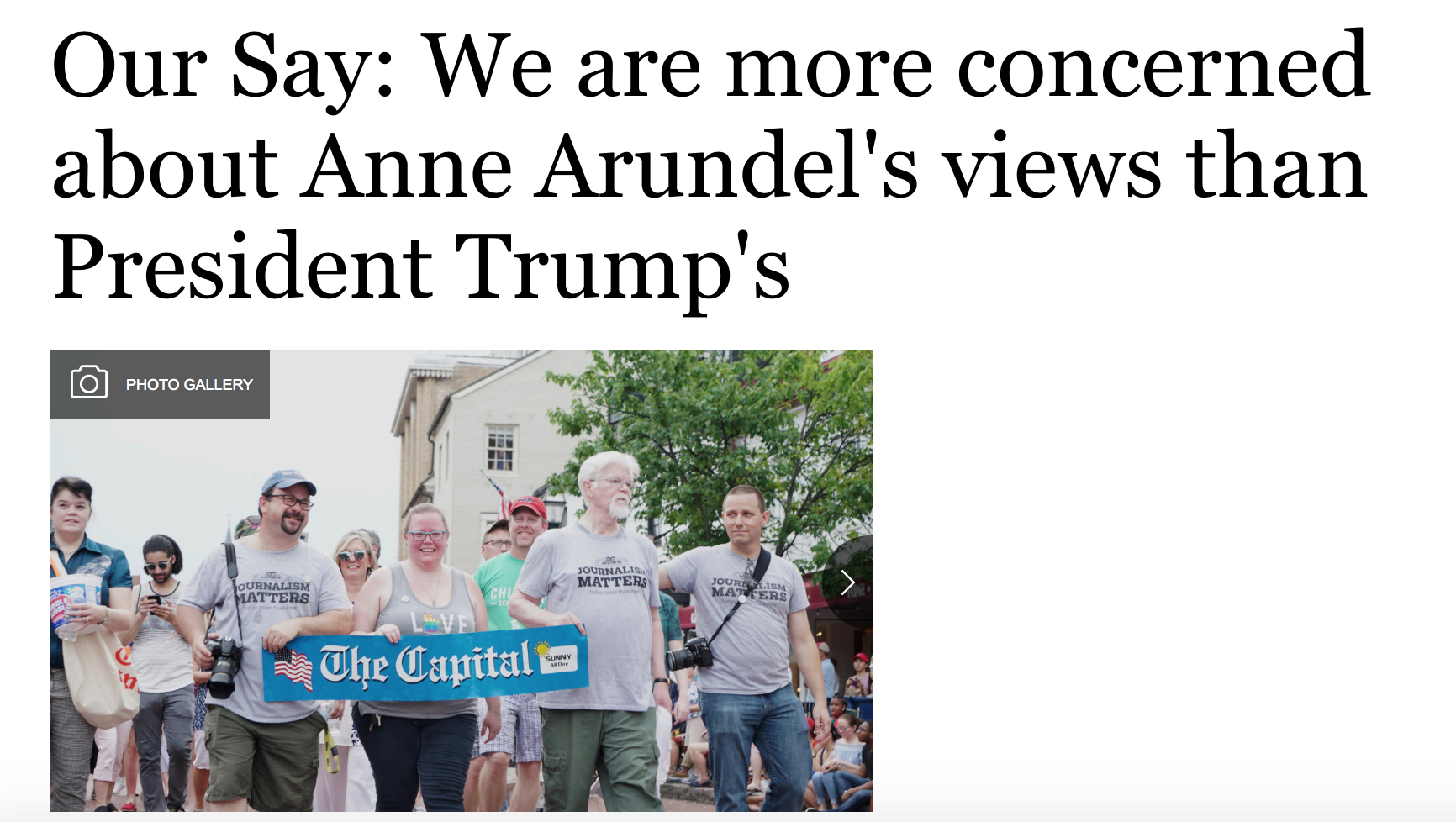
Along similar lines, the Capital Gazette declared that it is "more concerned about Anne Arundel's views than President Trump's":
We don’t feel coordinating with other news organizations will change the president’s appreciation of that.
Even if it did, you won’t suddenly find President Trump on the front page or at the top of our website most days. We tend to seek news here. There are exceptions, of course.
We have called on the president to honor one of our colleagues, Wendi Winters, with the Presidential Medal of Freedom. Members of Congress have written to the White House recommending this posthumous honor.
The president could use the occasion of presenting the medal to Wendi’s family as a moment of change in his approach toward those whose job is to question his presidency. He could honor her work by expressing his belief in the importance of journalism to our country — even when he feels unfairly treated.
On that day, we guarantee, the president would be on the front page.
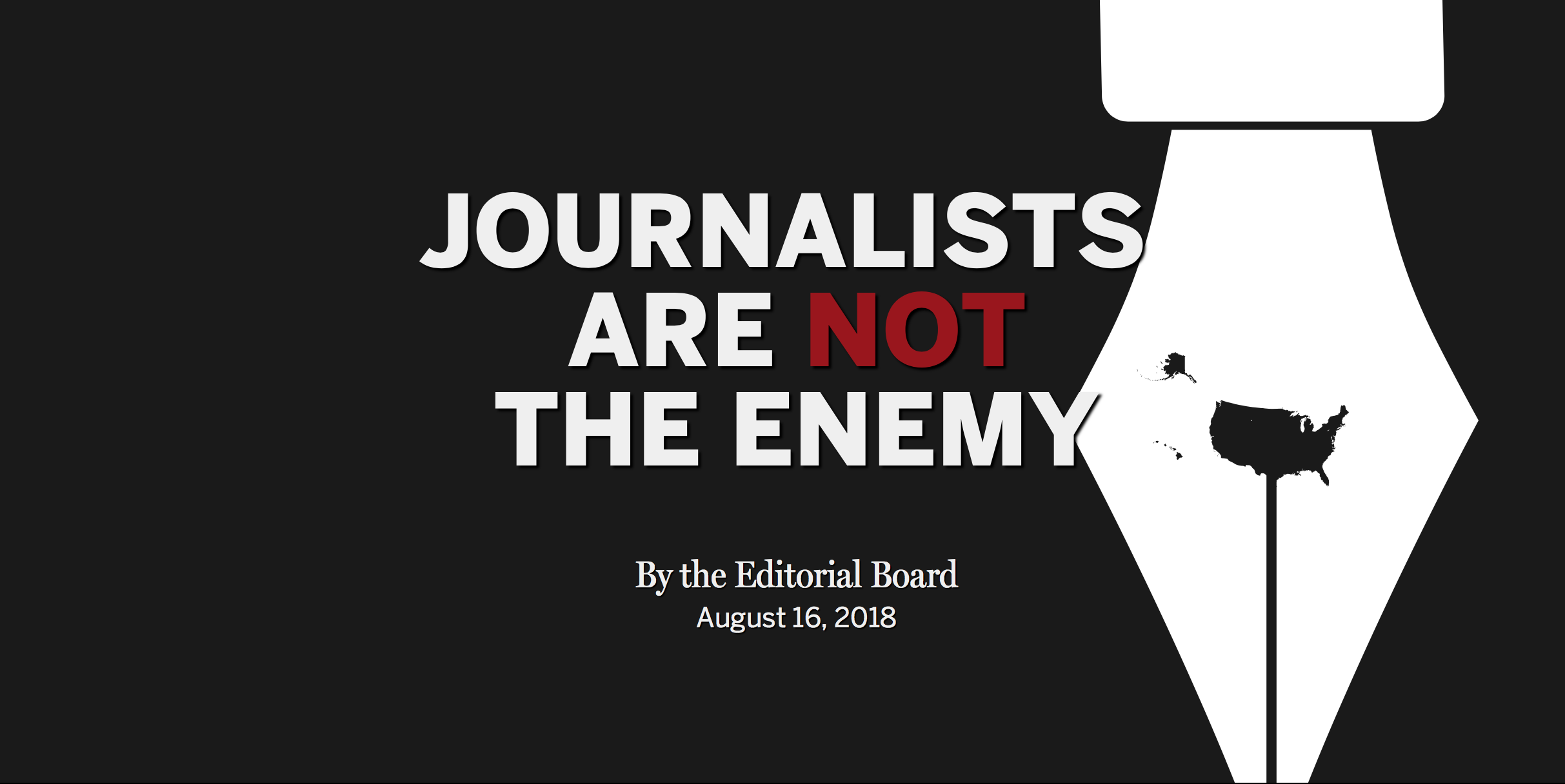
In closing, the Boston Globe Editorial Board cautioned:
Replacing a free media with a state-run media has always been a first order of business for any corrupt regime taking over a country. Today in the United States we have a president who has created a mantra that members of the media who do not blatantly support the policies of the current U.S. administration are the "enemy of the people." This is one of the many lies that have been thrown out by this president much like an old-time charlatan threw out "magic" dust or water on a hopeful crowd.
"The liberty of the press is essential to the security of freedom," wrote John Adams.
For more than two centuries, this foundational American principle has protected journalists at home and served as a model for free nations abroad. Today it is under serious threat. And it sends an alarming signal to despots, from Ankara to Moscow, Beijing to Baghdad, that journalists can be treated as a domestic enemy.
President Trump tweeted the following in response to the campaign: