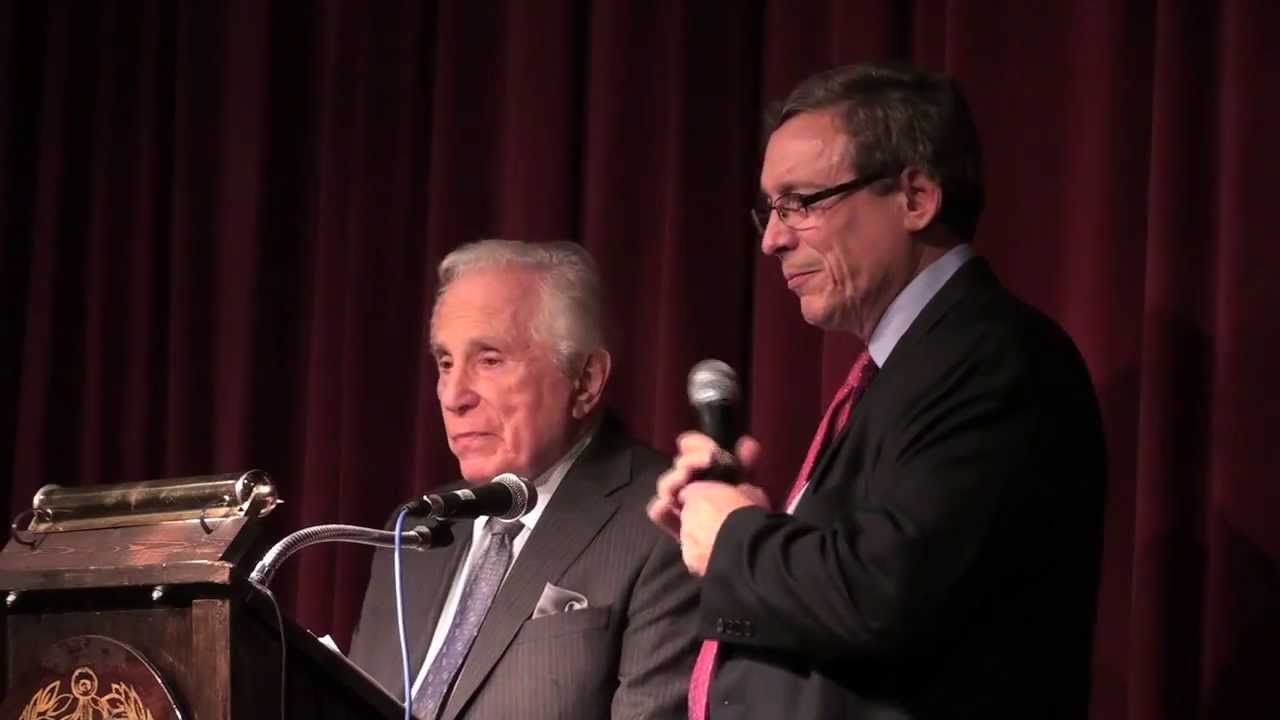
Seymour Topping accepts the Society of the Silurians Lifetime Achievement Award in November 2015. (File)
By Sean Murphy
Former Pulitzer Prize Administrator Seymour Topping died Sunday in White Plains, N.Y. He was 98. His death followed complications from a stroke last month.
"Topping was one of the best of the generation of journalists that defined for the modern world our ideal of what the free press can and should be," said Columbia University President Lee Bollinger. "He played an historic role in the development of the Pulitzer Prizes at Columbia University. I admired him tremendously."
"Top," as he was also known to generations of friends and colleagues, was born in Harlem and grew up in the burgeoning middle-class enclaves of the Bronx and Queens. As a teenager, he "dreamed of becoming a correspondent in China" after "devouring" "Red Star Over China," Edgar Snow's 1937 account of the incipient Chinese Communist movement.
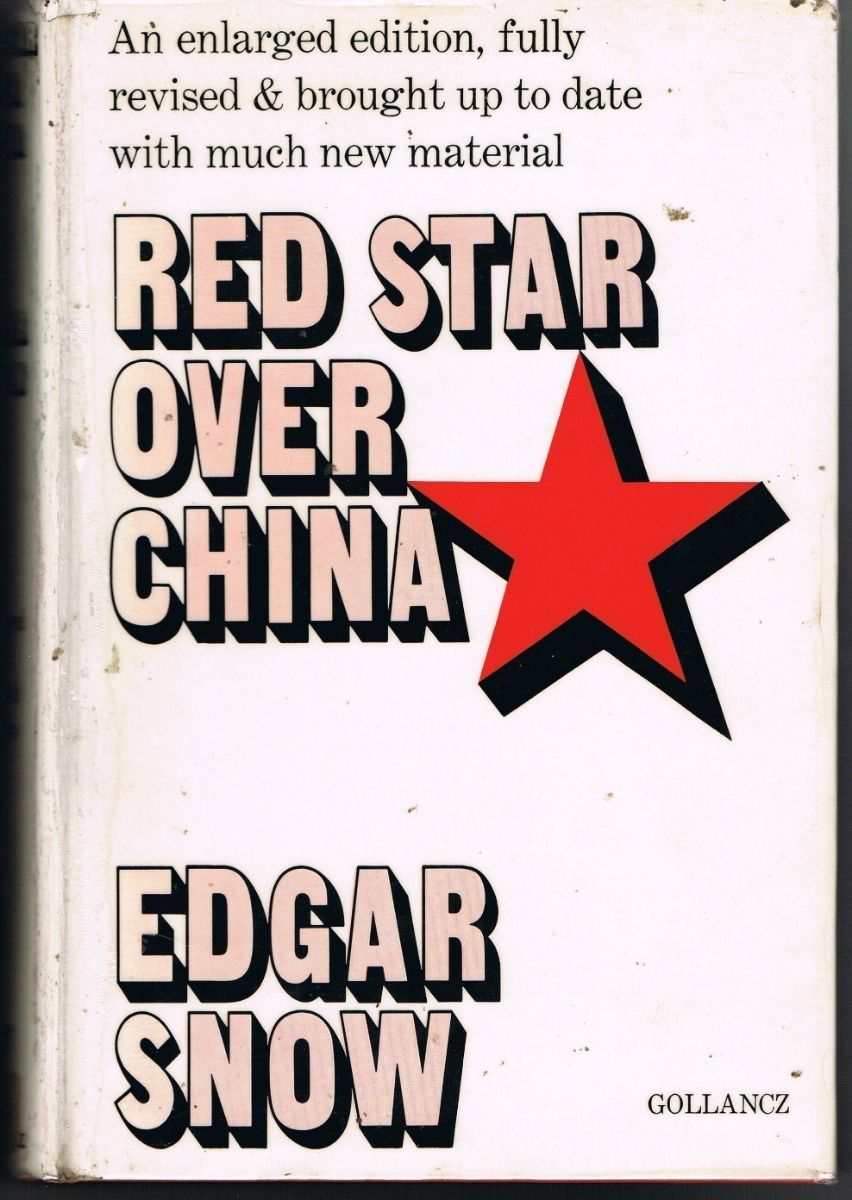
A revised and updated edition of Edgar Snow's "Red Star Over China." (File)
This fascination would take him from the outer boroughs to the University of Missouri's School of Journalism. He elaborated upon his unusual choice in a 2012 interview with his alma mater: "[Walter] Williams had traveled extensively to China and was instrumental in the establishment of schools of journalism in Shanghai at St. John’s and at Yenching University in Peking. Also, there were quite a number of correspondents working in Asia who were graduates of Missouri’s School of Journalism."
During his studies, Topping cultivated an interest in polo (he was required to learn horsemanship as an ROTC cadet) while honing his reportorial acumen on the MU-affiliated Columbia Missourian.
Graduating a semester early in 1943, he entered the Army as an infantry officer. His study of Japanese and a chance encounter with the former MU polo captain at an officers' club ensured a plum assignment to the summer Filipino capital of Baguio as liaison officer to the local American base. While there, he began to cultivate Manila media contacts in anticipation of his postwar career.
After returning to civilian life, Topping was assigned to Beijing (then romanized as Peking) in November 1946 as the International News Service's "chief correspondent for North China and Manchuria," a title that he came to regard as "pretentious." Following his transfer to the American-supported Nationalist capital of Nanjing (then romanized as Nanking), he became a correspondent for the Associated Press.
In short order, he married Audrey Ronning (the daughter of Canadian diplomat Chester Ronning) and scored his "greatest beat" as the first correspondent to cover the fall of Nanjing to the Communists in 1949. An acclaimed photojournalist, Ronning Topping frequently collaborated with her husband over the course of their long careers.
After six months in the People's Republic of China prior to the termination of consular relations with the United States, Topping opened AP's Saigon bureau in February 1950, becoming the first American correspondent to be stationed in French Indochina since the end of World War II. Before leaving for London to become British diplomatic correspondent in 1952, Topping offered a frank assessment of the First Indochina War to Massachusetts Rep. John F. Kennedy, then touring the colony on a fact-finding mission.
According to John Shaw, "Topping told the senator [sic] that France was losing the war in Indochina and was unlikely to reverse its fortunes. Ho Chi Minh had captured the leadership of the nationalist movement, and his forces controlled the mountain passes to China [...] [which] was supplying the Vietminh with weapons and training. Topping said the United States was resented by many Vietnamese who viewed the Americans as supporters of France's war effort and as representing another wave of Western colonialism."
After serving as AP's Berlin bureau chief amid mounting tensions in bifurcated Germany from 1956 to 1959, Topping joined The New York Times. Upon completing a mandatory metropolitan reporting requirement, he covered the Cold War as Moscow (1960-1963) and Hong Kong (1963-1966) bureau chief, including such developments as the 1960 U-2 incident, the growing ideological rift between China and the Soviet Union, the Cuban Missile Crisis, the Partial Test Ban Treaty and the Vostok space program.
In the latter capacity, he also supervised The Times's critical coverage of the escalating Vietnam War, exemplified by the outspoken dispatches of Pulitzer winners Harrison Salisbury, Neil Sheehan and David Halberstam.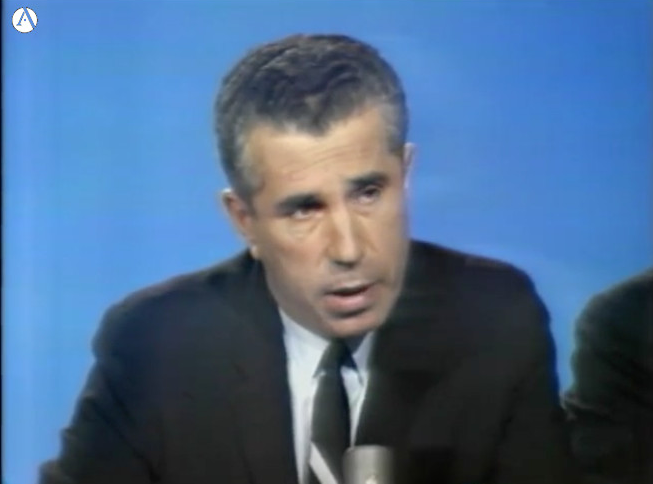
While serving as The Times' foreign editor in 1967, Topping appeared alongside Ellsworth Bunker (U.S. Ambassador to South Vietnam; 1967-1973) and Gen. William Westmoreland (Commander, Military Assistance Command Vietnam; 1964-1968) on a special edition of NBC's "Meet The Press" devoted to the Vietnam War. He was forthright in his interactions with the American leadership: "It seems to me I've heard just the same thing from [Bunker's] predecessors, going back until, I would say the year about 1955 and before that I recall from '51 to '53, at a time when it was French Indochina." View the full show here.
In September 1966, Topping returned to New York as the Times' foreign editor, supervising all of the newspaper's international coverage. The Topping family (which came to include five daughters) settled in a home in suburban Scarsdale that became his final permanent residence. According to longtime Pulitzer Prize Deputy Administrator Bud Kliment, Topping was the first New York-based Times employee to reside outside of the city limits after a residency requirement was lifted.
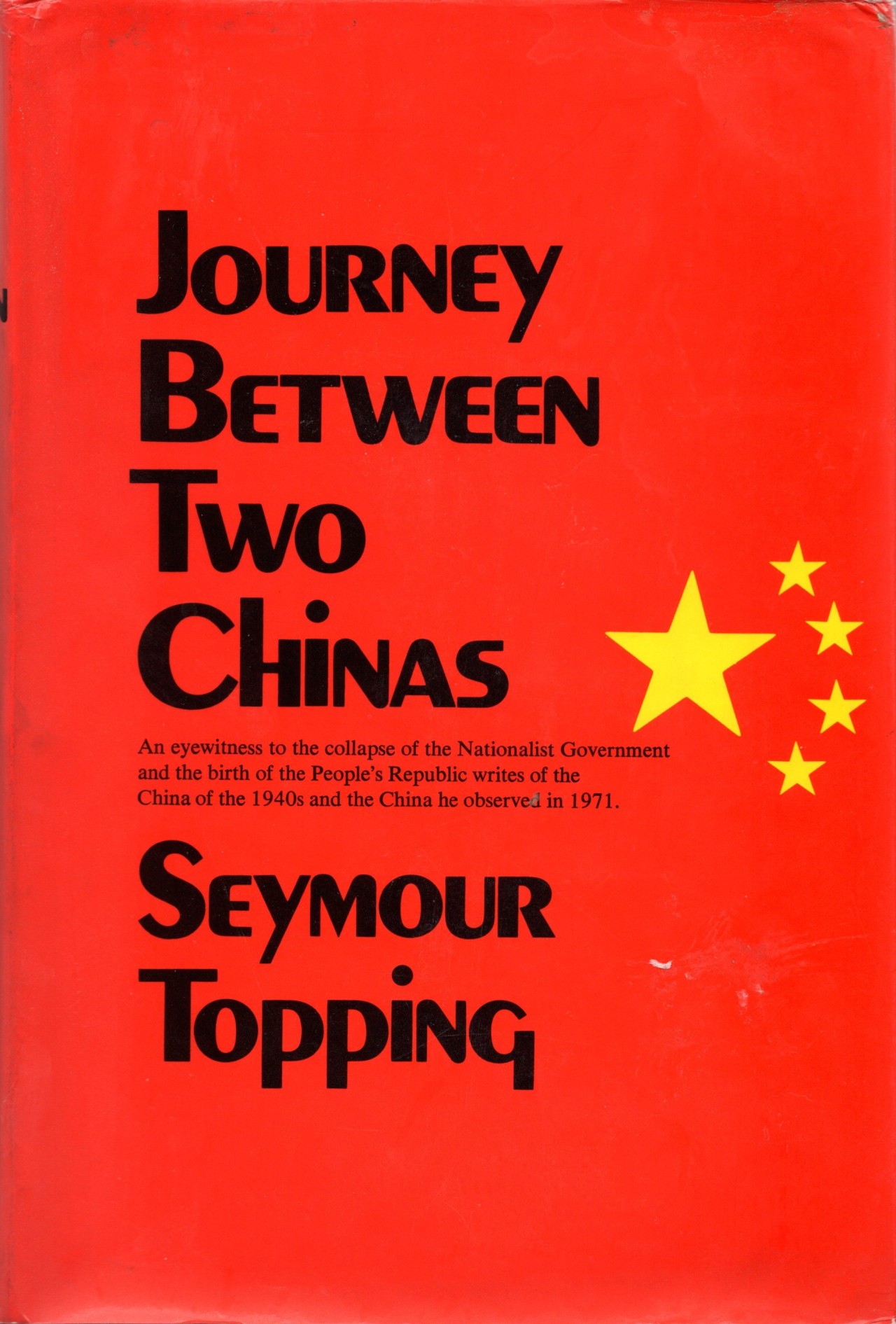
A memoir of Topping's Chinese Civil War coverage and his 1971 tour, "Journey Between Two Chinas" was published by Harper & Row in 1972. Like many Times reporters and editors of the era, Topping was not granted book leave and wrote the book during his free evenings.
Following the editorship of Washington press corps dean Scotty Reston, Topping and Eugene O'Neill biographer Arthur Gelb became the top two lieutenants of Abe Rosenthal, the 1960 International Reporting winner who emerged as the newspaper's de facto editor in 1969.
Under his aegis, Topping served as an assistant managing editor (1969-1976) and deputy managing editor (1976) before being named managing editor (coinciding with Rosenthal's long-deferred appointment as executive editor) on January 1, 1977.
Although he was now a senior executive, Topping continued to report on a regular basis, undertaking lengthy tours of mainland China (1971), the Middle East (1974), South Africa and Zimbabwe (1977), the Soviet sphere of influence (1978), Pakistan and China (1979), the Soviet Union and Mongolia (1981), Canada (1982), Central America and Cuba (1983) and New Zealand and Australia (1985). Many of these tours resulted in lengthy Times Magazine pieces that were illustrated by his wife's photography. During these trips, he interviewed and profiled a litany of world leaders, such as Zhou Enlai (encompassing his first statements to the Western press prior to the 1972 Sino-American thaw), Mohammad Reza Pahlavi, Fidel Castro, Daniel Ortega and Pierre Trudeau.
Topping was succeeded by Gelb when Rosenthal stepped down to become a columnist in 1986. For the next seven years, he served as director of editorial development for The New York Times Company's regional newspapers. During this period, he served as the president of the American Society of Newspaper Editors (1992-1993) and remained active in professional initiatives undertaken by a variety of organizations, including New Directions for News (which he chaired from 1990 to 1991), the Freedom Forum and the Council on Foreign Relations, of which he and his wife were life members.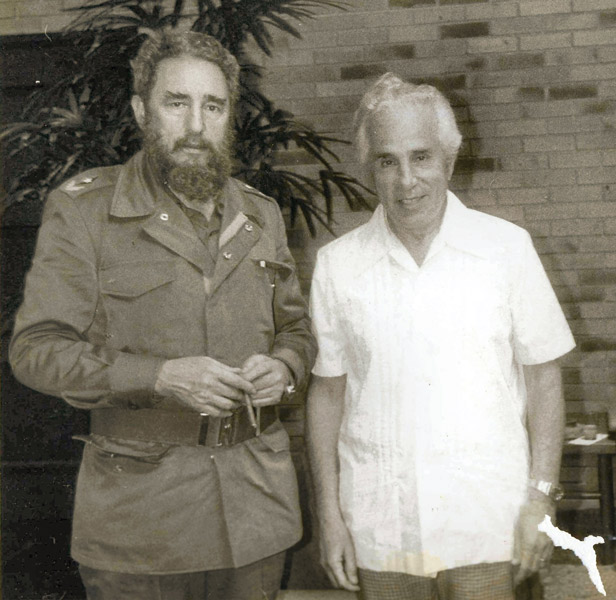
Topping with Fidel Castro in 1983. (Cuban Government/WAG)
In February 1993, Topping was named Pulitzer Prize administrator after a long search that commenced following the death of Robert Christopher in June 1992. Before formally joining the staff in November, he transitioned into the role throughout the year as he concluded his Times duties. He also became the first administrator since John Hohenberg to concurrently hold an active tenured faculty post at the Columbia Journalism School as the San Paolo Professor of International Journalism.
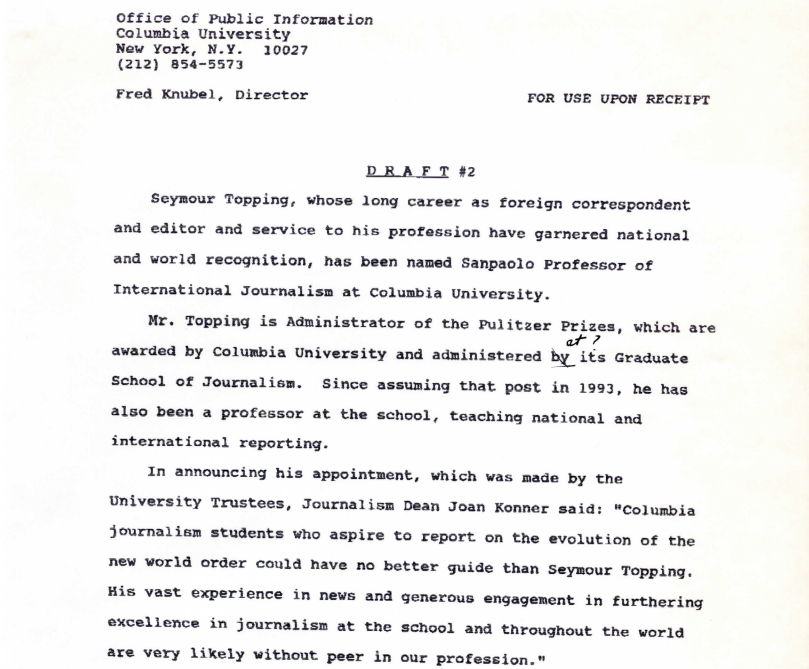
Topping received the endowed San Paolo chair (considered to be the highest mark of academic distinction at Columbia University before University Professorships) in 1995.
Largely quiescent on the domestic front until the dramatic events of September 11, 2001, Topping's nine-year tenure coincided with the apotheosis of the long-simmering digital revolution and a new understanding of popular culture.
Under his leadership, the program established its initial web presence in 1994 and began to accept online-only elements in 1998, paving the way for today's full eligibility of magazines and online news organizations. Topping was computer literate, often filing away relevant information for the Board's first digital committee and remarking in one memo that he planned to regularly check his email at his vacation home in Colorado.
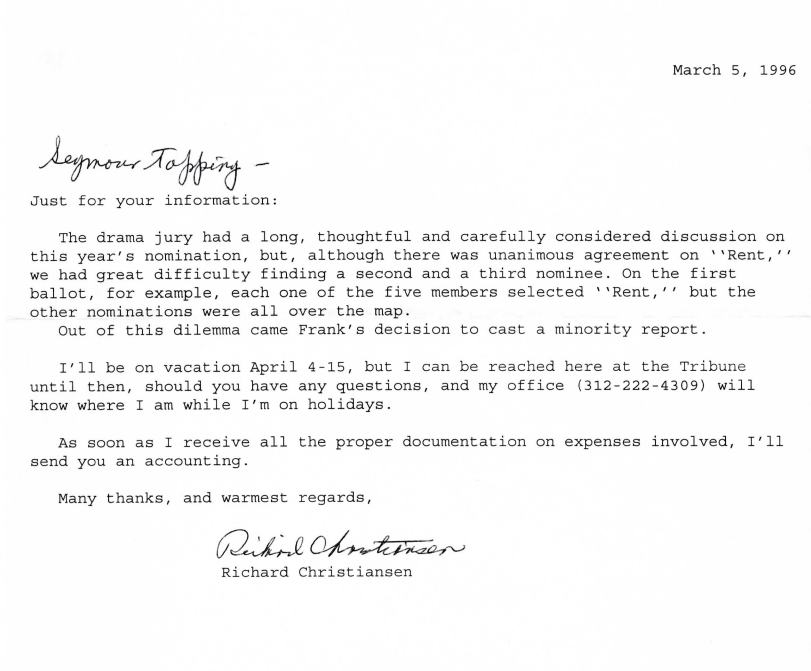
The epochal "Rent" so galvanized the 1997 Drama jury that longtime Chicago Tribune drama critic Richard Christiansen (who served as chair) wrote to Topping about their inability to find additional finalists. Ultimately, Jon Robin Baitz's "A Fair Country" and Jon Marans's "Old Wicked Songs" were named in the final report.
During Topping's, in 1996, George Walker became the first African American to receive the Music Prize and Jonathan Larson posthumously received the Drama Prize for his rock musical "Rent." A year later, Wynton Marsalis became the first jazz musician to receive the Music Prize. George Gershwin and Duke Ellington (infamously denied a proposed 1965 Special Citation) received posthumous Special Citations in 1998 and 1999, setting the stage for such notable winners as Ornette Coleman, Lin-Manuel Miranda and Kendrick Lamar.
The period saw a number of classic journalism entries, including future Pulitzer Prize Board member Katherine Boo's Public Service Prize-winning indictment of Washington group homes, David Moats's defense of same-sex civil unions in Vermont, Eric Newhouse's sociological exploration of alcoholism in small-town Montana and Thomas French's gripping "Angels & Demons."
Following his retirement from Columbia in 2002, Topping published "Fatal Crossroads" (2005), a novel set in the Vietnam of 1945. A memoir based on his journals (appropriately titled "On the Front Lines of the Cold War") was published by Louisiana State University Press in 2010. He also served as president of Emeritus Professors in Columbia. In his twilight years, he seldom missed the annual Pulitzer luncheon ceremony while remaining a fixture at the Overseas Press Club and the Century Association.