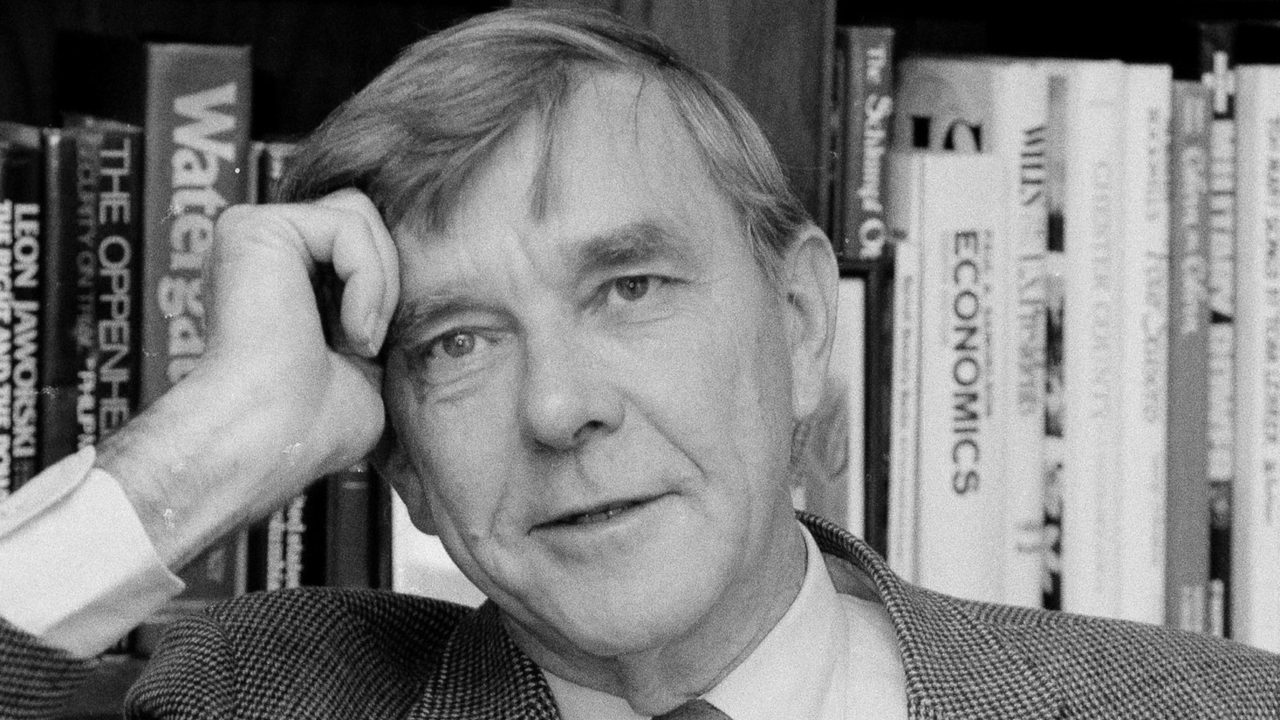
Russell Baker during his Pulitzer Board service. (File)
By Sean Murphy
1979 Commentary winner, 1983 Biography winner and former Pulitzer Prize Board member Russell Baker died Monday at his home in Leesburg, Va. He was 93. The cause of death was complications from a fall.
"Russell Baker was one of the first American writers to win Pulitzer Prizes in both Journalism and Letters," said Pulitzer Prize Administrator Dana Canedy. "He was a distinguished member of the Pulitzer Prize Board, who served as its chairman in 1994, and who delivered the keynote address at the Prizes's 75th Anniversary Celebration in 1991. We join the rest of the country in recalling and celebrating his life, characterized by wit, charm and erudition."
Raised in then-rural Loudoun County, Va., Newark, N.J. and Baltimore under tumultuous circumstances during the Great Depression (experiences which would inform "Growing Up," his Prize-winning memoir), Baker found his métier at a high school in the latter city.
He briefly attended Johns Hopkins on scholarship in 1942 before joining the Navy a year later. After completing pilot training during a domestic tour, he returned to the university, ultimately earning a B.A. in English in 1947.
With Hemingwayesque literary ambitions, he commenced his journalistic career that year in the smoky offices of The Baltimore Sun, where he helped to unionize the staff and worked in such disparate positions as night police reporter and rewriter. By 1952, he had become the newspaper's London correspondent.
In 1954, Baker was poached from the Sun by two-time Pulitzer winner and venerable New York Times Washington bureau chief Scotty Reston. Although he emerged as a sardonic observer of the legislative process and the 1960 campaign trail, it was not until a 1962 offer to return to the Sun prompted a counteroffer to join the Times's opinion pages that Baker's halcyon period began in earnest.
Over the next 36 years, hundreds of his selected satirical columns — ranging from eviscerations of military contractors to an early pronouncement of the "silliness" of Studio 54 — would be collected in several collections, bridging the gap between the Northeastern megalopolis and the pragmatism of Main Street. In Baker, America found a more measured Mencken for an era characterized by postmodern fragmentation, a vital center who could effortlessly defuse the growing divisions in national discourse with perspicacity and charm.
Already one of America's most recognizable journalists, Baker's Pulitzer wins ballasted his national profile, culminating in a nine-year stint (1993-2004) as host of PBS's "Masterpiece Theatre." But he retained a unique devotion to the profession, as evinced by his Board service and in his previously unpublished keynote address at the 75th Anniversary celebration. We are proud to publish it for the first time on Pulitzer.org.
Related: Read Baker's Commentary portfolio here.
"A Member of the Board"
By Russell Baker
It’s a macabre experience to look out over this large assembly and realize that I already know how the obituaries of at least half of you will begin.
They will start with a descriptive three-word phrase beloved by all obituary writers. That phrase, of course, is "Pulitzer Prize-winning," as in "Pulitzer Prize-winning novelist Ernest Poole," or "Pulitzer Prize-winning playwright Zona Gale," or "Pulitzer Prize-winning poet Audrey Wurdemann," to cite three Pulitzer winners who have since presented themselves in paradise bearing the supreme accolade.
Why are obituary winners so devoted to opening their work with the words "Pulitzer Prize-winning"?
For the good and simple reason, ladies and gentlemen, that it instantly tells the public why you, the Pulitzer Prize-winning deceased, were superior to the ordinary run of mortals and therefore deserve an obituary.
Some of you – a few – not too many, I hope, may feel that this is too boastful, too arrogant a view of what the Pulitzer Prize means. You probably think that good taste compels you to show a little humility.
You are wrong.
Humility went out with Joe Palooka and the Nash Rambler. Get bogged down in it and you’re going to miss out on the orgies of self-admiration which are now the commonplace of American life.
This is the age of the blowhard.
Humility will get you nowhere.
So I urge you to drop the "Aw shucks… anybody could have done it" style and join the rest of life’s winners by stepping up to the full-length mirror, thumping yourself on the chest, and shouting "I am the greatest!"
It's only fitting what we be fashionably immodest here today.
We are celebrating a 75th anniversary, and what’s an anniversary for if not to revel in the delights of self-congratulation?
Now, before proceeding I want to apologize on behalf of the Pulitzer Advisory Board for not having a first-class speaker to make this speech. A speaker worthy of this historic occasion.
Mingling with the crowd earlier, I overheard several people say, "Well… they might at least have gotten President Bush to make the speech…"
(Parenthetically, I must say these are obviously people who’ve never heard President Bush make a speech.)
The truth, however, is that the Pulitzer Board is a nonpartisan outfit. If President Bush gave a speech, we’d have to get a big-time Democrat to make an equal speech.
And we couldn’t get one.
We tried. We tried Mario Cuomo. We tried the Senate leader, George Mitchell. We tried the House leader, Congressman Gephardt. We tried Senator Albert Gore. We tried Senator Jay Rockefeller.
None of them could come. They all said they were going to be busy today having Sunday dinner with their mothers.
But if we planned to hold a 79th anniversary celebration four years from now, they’d be glad to speak to that.
Somebody pointed out that such an important occasion would justify the board dipping into capital to pay a lecture fee and get one of the country’s great oratorical stars.
We approached Henry Kissinger, and told him what we were prepared to pay, and he said he had a prior commitment to have Sunday dinner with his mother.
So we approached Art Buchwald, and told him we were prepared to pay, and he said he had a longstanding commitment to spend today working on his biography. It’s titled "Fifty Years of Shame, or, I Never Had Sunday Dinner with My Mother."
I’m not going to tell you what we were prepared to pay, but as most of you know, the Pulitzer Board is composed of people who still think three thousand dollars is real money – until a few years ago, as many of you may remember, we thought one thousand dollars was real money.
It was obvious that the only speaker we could afford would have to be a member of the Board, somebody who would have to speak free to avoid a conflict of interest.
I was out of the room when they finally chose the speaker. But they later told me I became the unanimous choice after somebody remembered I’d recently published a book which opens with the words, "My mother, dead now to this world…"
I also want to apologize to the creative artists and scholars among us for the Board’s presumption in afflicting them with a speech by a newspaperman. The insolence of it must seem insupportable.
Most of the creative and scholarly people I know agree wholeheartedly with the fellow who defined a journalist as "a man with nothing on his mind, and the power to express it."
And yet presumption – breathtakingly insolent presumption – lies at the very foundation of this Pulitzer process we celebrate.
What could be more presumptuous than journalists setting themselves up as the arbiters of excellence in fiction, history, drama, music and – Lord help us – even poetry?
And yet over the past 75 years poets, composers, novelists, historians, biographers, and even a few playwrights have come to respect Mr. Pulitzer’s Prize and to cherish the notoriety and public esteem with which it rewards them.
Respect for the Pulitzers, however, let’s admit it, is not, and never has been, universal.
Everybody remembers Sinclair Lewis sending back his thousand-dollar check and denouncing "all prizes" as dangerous but especially Mr. Pulitzer’s, because, he said, it would influence writers to become "safe, polite, obedient and sterile."
Four years later the danger of prizes had abated sufficiently to allow Lewis to accept a Nobel Prize for Literature carrying a check for $46,350 – which he did not send back.
Like some of you perhaps, my own view of the Pulitzers was even lower than Sinclair Lewis’s.
Truth is, for the longest time I had nothing but contempt for the Pulitzer Prize and admired Sinclair Lewis profoundly for returning the thousand dollars.
I knew, and was always ready to tell anybody who asked me that the Pulitzer operation was run by thick-headed illiterates who were not only out of touch with the modern world but also hopelessly corrupt.
Whenever I heard of someone who had won a Pulitzer, I told everybody I felt sorry for the poor devil and hoped nothing like that would ever happen to me because winning such a tainted award could destroy a man’s reputation.
Then one day when time had had its way with me, and I had begun to thicken in the waist and gray around the ears, and wonder why in the world sensible men would pay good money for a copy of Playboy magazine, I was granted a rare and beautiful epiphany.
In a great blaze of light, such as I imagine Paul must have seen on the road to Damascus, I perceived how wrong I had been about the Pulitzers. How unjust, childish and mean-spirited my criticisms had been.
I still remember the instant of that remarkable enlightenment.
My phone had just rung. It was a friend of mine, and he was saying, "You’ve just won the Pulitzer Prize."
At that very moment, the scales fell from my eyes, and I saw what a remarkable thing Joseph Pulitzer had created. How wondrously efficient the Pulitzer Prize-giving system was. How learned, perspicacious and sophisticated its judges [were].
At that instant, I lost all respect for Sinclair Lewis.
Since this is a solemn celebratory occasion, and since no American feels satisfied by solemn celebratory occasions until he has been scourged with a solemn celebratory speech, I propose to speak for a few minutes in the solemn celebratory vein.
My text starts with:
Joseph Pulitzer, who created the Prize, as well as the Columbia School of Journalism…
And ends with:
John O’Hara, the author, who never won one of Mr. Pulitzer’s awards.
Pulitzer was one of those expansive nineteenth century swashbucklers steeped in the pre-Darwinian optimism of that century, adventurous beyond the imagining of today’s corporate bean counters and golden-parachute babies. They were a breed not yet so enervated by 20th Century fatigue and cynicism that they couldn’t dream up ideas for advancing the world toward the millennium. They even felt a moral duty to do so.
Pulitzer’s idea was comparatively modest. He proposed only to promote “public service, public morals, American literature and the advancement of education.” (I’m quoting from his will.)
To do so he funded the Journalism School here at Columbia and endowed awards for excellence in journalism and letters, the first of which were given in 1917.
1917 was a banner year for expansive 19th Century men launching world-improvement projects. That was the year Woodrow Wilson’s program to make the world safe for democracy got under way. It began by rescuing the British and French colonial empires, proceeded by imprisoning Eugene Debs for dissenting in the time of war and ended twenty years later with most of Europe imprisoned under Hitler’s totalitarian dictatorship.
I917 was also the year Vladimir Ilyich Ulyanov, also known as Lenin, launched his project to create a communal utopia. You know how that one came out. The 75th anniversary of Lenin’s great idea, originally scheduled for this fall, has been canceled.
Obviously, Pulitzer had the better idea.
This of course simply confirms what journalists have always known: When the world needs improving, a journalist will beat a politician. Every time.
Only four Prizes were given when the first Pulitzers were awarded in 1917, two for Journalism, one for History, one for Biography.
The gold medal for Public Service in journalism was not awarded that year. The Prizes available for the Novel and Drama weren’t awarded either, which was an appropriate beginning for two Prize categories that have since given the Board little but pain and suffering.
Twentieth century law requires that everything from government to football players must get bigger and bigger and bigger. Obedient to this command, those first four Prizes given in 1917 have swelled into the twenty-one awarded this year.
You will be happy to hear that I am not going to recite the entire history of the award’s seventy-five years, and for this relief you can thank the ghost of H.L. Mencken.
After laboring to compose a splendid historical roundup, I paused to read the thing to see how it would sound to an audience.
In the deep slumber that quickly ensued, the infamous Mencken appeared before me and spoke a line from one of his essays about journalism, one in which he talks about managing editors. He starts by describing the kind of intelligence it takes to make a managing editor, then starts listing the sort of knowledge that fills a managing editor’s head, but stops abruptly in disgust.
To recite it, says Mencken, would make a barber beg for mercy.
Mencken would be disappointed to hear he’d saved you from hours of suffering, for he had no use for the Pulitzer Prize and once described the awards as "imbecilities repeated annually."
The Prize has always provoked a gratifying, entertaining and healthy volume of such abuse… and a good thing, too.
As John Hohenberg writes in his history of its first fifty years: "A prize that creates no excitement is seldom held in high regard."
By the excitement test, the Pulitzer must rank as the most desirable of all the prizes with which America tries to compensate its achievers for not having a House of Lords, knighthoods, and gaudy royal gewgaws; robes and titles.
It’s a bleak year that fails to produce intense vituperation against at least one of the awards. The Pulitzers bring out the best in the nation’s vituperators.
It’s good to see that this year has been no exception, and that Juries and Board are once again being widely libeled as oafs, knuckleheads and vile backscratchers.
It’s easy for us, who are winners, to smile tolerantly at these sour and sulky critics.
There’s nothing like being a winner to promote one’s sense of living in the best of all possible worlds.
Before busting our buttons, however, it might be good for our souls to pause a moment and salute a few of the people – now gone to the grave – who were passed over when the Pulitzers were being distributed in their lifetimes.
I’ve a small list of my own – an honor roll as it were – of non-Pulitzer-Prize-winning authors and playwrights and composers to keep me from feeling excessively superior.
You can probably make a similar list of your own to help keep your own achievements in perspective, by reminding you that, good as you are, there’s always someone out there who can take you.
My own list includes in no particular order: Theodore Dreiser, Scott Fitzgerald, Duke Ellington, James Baldwin, John Dos Passos, George Gershwin, Lillian Hellman, Richard Wright, James Thurber, Clifford Odets and Thomas Wolfe.
I won’t reveal my list of deplorable omissions in journalism. As a newspaperman, I find it easy to pass judgment on music, theater and literature, but it’s hard to make sound judgments about something as complex as journalism.
It will surely seem strange to cultural historians, however, that the Pulitzer was never extended to Mencken, one of the century’s authentic journalistic giants. Perhaps it was because the Board knew if it was extended, Mencken would surely bite the hand that extended it, and preferred not to arouse the greatest vituperator of them all.
It’s tempting to say that critics have taken the Pulitzer Prize too seriously; that all prizes are silly and the Pulitzer is no exception, and that its silliness is proven by lists we make of people who were overlooked.
I think the case is more complicated.
I think our kind of society – aggressively money-driven; dominated by a corporate mentality – needs something like the Pulitzer Prizes.
Yes, the errors and foolishness inevitable in this kind of process do damage their reputation.
They neglect the human fallibility of jurors and Board who too often fail to recognize pioneering achievement. The problem with pioneering achievement is that it is not always so self-evident the moment it occurs.
Vincent van Gogh’s achievement, for instance, was so little recognized in his lifetime that your great-grandmother could have one of his thirty-million dollar paintings for four dollars and ninety-nine cents.
It is more interesting to look at failures as reflections of the country’s cultural and political history.
What child who has recently been to a PG-rated movie, for example, what great-grandmother who watches the afternoon soap operas, can fail to laugh when reminded that Ernest Hemingway’s "For Whom the Bell Tolls" was denied a Pulitzer Prize because Nicholas Murray Butler, then the president of Columbia, thought it was "lascivious"?
The fierce internal quarrel in 1967 about giving a prize for Harrison Salisbury’s war reporting from inside North Vietnam records a turning point in the way Americans look at their government, crystallizing as it did, the debate set off by those other Pulitzer winners – Malcolm Brown, David Halberstam and Neil Sheehan – about whether the country could tolerate a press that refused to function as a government mouthpiece in wartime. Salisbury, who had pushed to the ultimate question by reporting from the enemy side, lost his Pulitzer by a narrow vote on the Board. But the closeness of the vote signaled the emergence of a new philosophy about what the public was entitled to know in wartime and how far the press should go in challenging the government’s honesty.
The natural culmination of all this was The Washington Post’s Prize-winning coverage of the Watergate affair.
To appreciate what an extraordinary tidal change had occurred, you should recall that no one in American journalism screamed when Douglas Cater in the 1950s published a book on the press titled "The Fourth Branch of Government."
Today the suggestion that the press is doing the government’s work would produce [?] of denunciation from journalists and sarcastic jeers from every certified-loyal-by-the-FBI government agent in Washington.
On the race issue the Pulitzer has had its trials.
[That one of the prime Pentagon goals in the next three wars has been to isolate and silence the reporters.]
That Duke Ellington was denied a Pulitzer in 1965 speaks partly of the lingering of an age when America simply refused to believe anyone could be both black and a cultural treasure. Perhaps more importantly, however, the fact that Ellington was proposed for the Prize marked the arrival of a more inclusive spirit in the world of so called "serious music."
After hearing that he’d been proposed for a special Pulitzer citation and then rejected, Ellington, who was then 66 years old, said, “Fate’s being kind to me. Fate doesn’t want me to be too famous too young.”
John O’Hara, another rejectee, did not take it so graciously.
O’Hara wanted the Pulitzer, I think it’s fair to say – desperately wanted it – but never got it.
If he were alive O’Hara would probably punch me in the nose for dragging him into this ceremony, for by all accounts he was a testy fellow with no tolerance whatsoever for fools.
His letters, however, contain a lot of grumbling about the Prize being given to writers he considered his inferiors, and speculation from year to year about his chances of winning for his latest novel, as well fairly frank admission that he very much wanted it.
In 1959 he wrote a friend, "The awards are generally gutless, but the term 'Pulitzer Prize' has a prestige that the National Book Award never had and never will. 'Pulitzer Prize,' including the common mispronunciation of old Joe’s name, is in the language, like Beech-Nut and Chevrolet and New York Yankees. It’s a brand name."
O’Hara wanted it, came close several times, and always lost.
There is a story that a friend finally asked him why he took the losses so hard.
O’Hara, the friend pointed out, had achieved the kind of success most writers could only dream of.
His books were always automatic bestsellers, yet were also esteemed by many literary people. They had made him one of the richest writers in America. He lived the elegant life of a Princeton country squire, complete with Rolls Royce, estate house, and Scotland’s finest tweeds.
What should he want one thing more?
What in the world did he need with something like a Pulitzer Prize?
To which O’Hara replied: "Goddamn, I want the medals."
Most of us, I suspect, want the medals, and it speaks well of us as it speaks well of O’Hara.
Wanting the medals is an instinctive acknowledgement that life’s report card is not money.
This is an almost subversive idea nowadays, when the marketplace is exalted as the supreme test of excellence, and the ultimate measure of success.
I love this O’Hara story – though it may be only apocryphal – because apocryphal or not, it speaks of a healthy suspicion of mercantile morality.
It speaks of a suspicion that while money may possibly measure the height of our excellence, it may just as easily measure the depths of our meretriciousness.
There is a hunger in us for something more than the money standard, for some assurance that our lives have been not merely successful, but valuable; that we have accomplished something grander than just another well-heeled, loudly publicized journey from the diaper to the shroud; in short, that our lives have been consequential.
That they made a difference.
American society has contrived many medals to gratify this yearning. Some of them are more gratifying than others.
But none of them is more comforting to the spirit than the Pulitzer Prize.
This may be because over the years, for all their lapses and foolishness, we recognize that the jurors and the Board got it right a lot more often than they got it wrong.
No, of course it’s not an absolute guarantee that we did something worth doing while we were here. But still, it speaks well for the success of Mr. Pulitzer’s idea that those of us who have his Prize still feel a little diminished about the good ones, the Ellingtons, the Gershwins, the Fitzgeralds, the Dreisers, who were missed along the way, whose company – alas – we are not allowed to share.