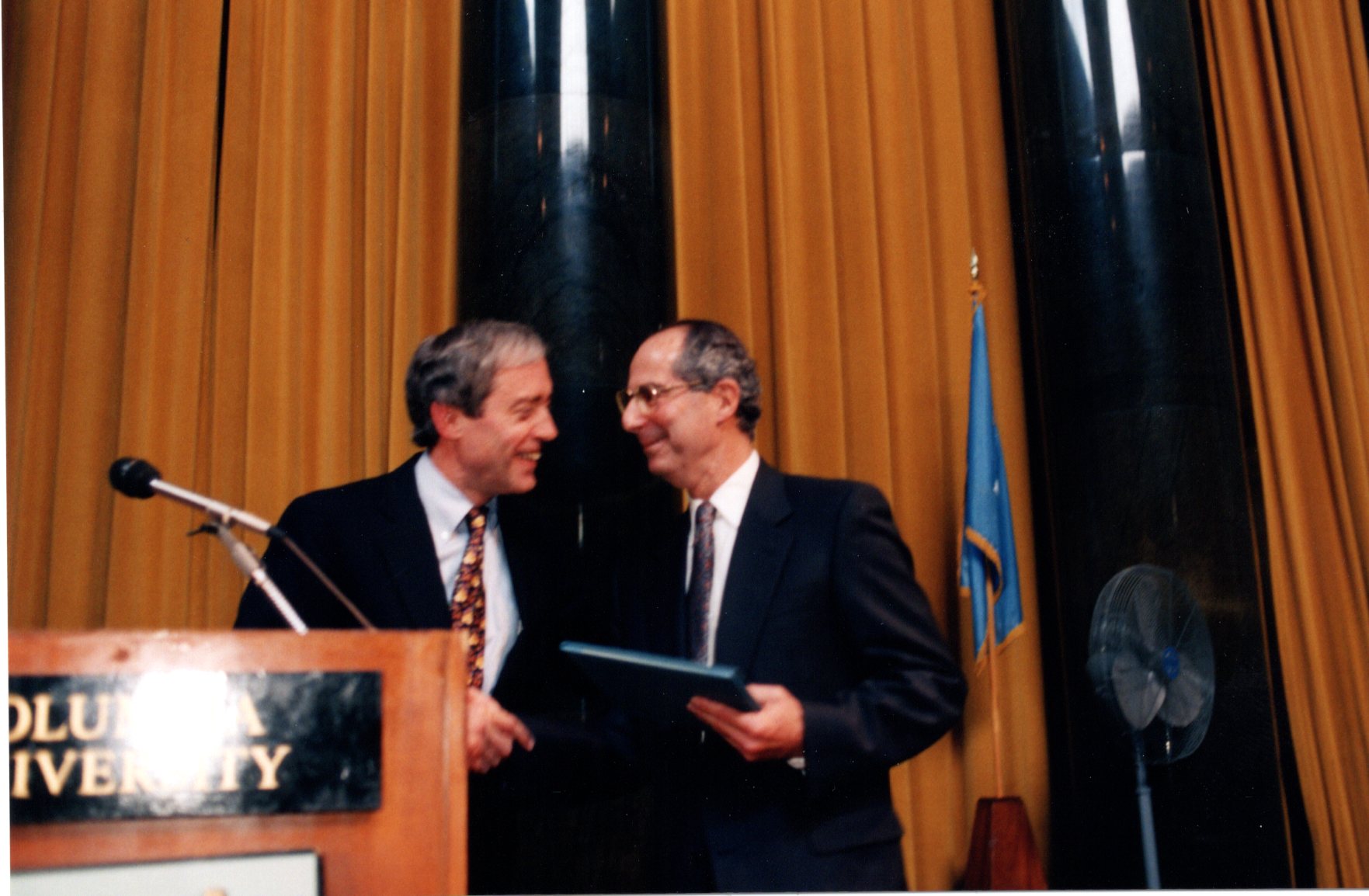
Roth accepts the Fiction Prize from Columbia President George Rupp. (File)
1998 Fiction winner Philip Roth died at a Manhattan hospital of congestive heart failure on May 22. He was 85. In honor of his life, we are publishing the jury report for the Prize-winning "American Pastoral" for the first time on pulitzer.org. Read it here.
Born and raised in a middle-class enclave of Newark, N.J., Roth was a Phi Beta Kappa graduate of Bucknell University. While pursuing an M.A. in English at the University of Chicago in the mid-1950s, he began publishing stories and essays in the Chicago Review and other periodicals.
Over the following six decades, he enjoyed a singular literary career, repeatedly exploring such themes as Jewish-American identity; the banalities and vicissitudes of academic life (Roth taught literature full-time until 1991, most notably at the University of Pennsylvania); liberal anticommunism (he was active in PEN and harbored a special predilection for Czechoslovakia); and the male gaze in the context of the sexual revolution.
Although the ribaldry of "Portnoy's Complaint" (1969) would define Roth's oeuvre in the eyes of many readers, he was a writer of startling range: the McCarthyite baseball fantasia of "The Great American Novel" (1973) echoed innovative work by Don DeLillo ("End Zone") and Philip K. Dick ("The Man in the High Castle"), while "Our Gang" (1971) was a searing critique of the Nixon administration framed as a closet drama.
Throughout his career, the Fiction Prize remained elusive for Roth. "Portnoy's" was mentioned in passing in the 1970 jury report, but he first attained the finalist distinction for "The Ghost Writer" (1979), which marked the debut of longstanding alter ego Nathan Zuckerman. Many years later, the polemical spy novel "Operation Shylock" (1993) and "Sabbath's Theater" (1995) would again take him to the shortlist.
But it was the climactic "American Pastoral" (1997) — an exposition of Roth's enduring themes in the cultural minefield of '60s America — that ultimately would win him the Prize. According to the jury (chaired by 2001 Criticism winner and frequent juror Gail Caldwell), "[The novel] delivers the promises and myths of a postwar America, then watches with helpless compassion as the dream discharges."
Roth unexpectedly retired from writing in 2012 to enjoy a life of leisure on the Upper West Side and at his Connecticut country home. In reading accounts of the final years of his life, one is reminded of Thomas Caryle's beatific evocation of Coleridge's twilight years: "He sat on the brow of Highgate Hill, in those years, looking down on London and its smoke-tumult, like a sage escaped from the inanity of life's battle ... The practical intellects of the world did not much heed him, or carelessly reckoned him a metaphysical dreamer: but to the rising spirits of the young generation he had this dusky sublime character."
For even as American fiction declined as a cultural force (much to his vocal chagrin), Roth's influence continued to endure in a vital arena: the mimetic maelstrom of the Golden Age of Television. In a fitting testament to his legacy, few were surprised when "Portnoy's" inevitably appeared on Don Draper's reading list in 2014.
Related:
Read Michiko Kakutani's review of "American Pastoral" from her Prize-winning entry here.