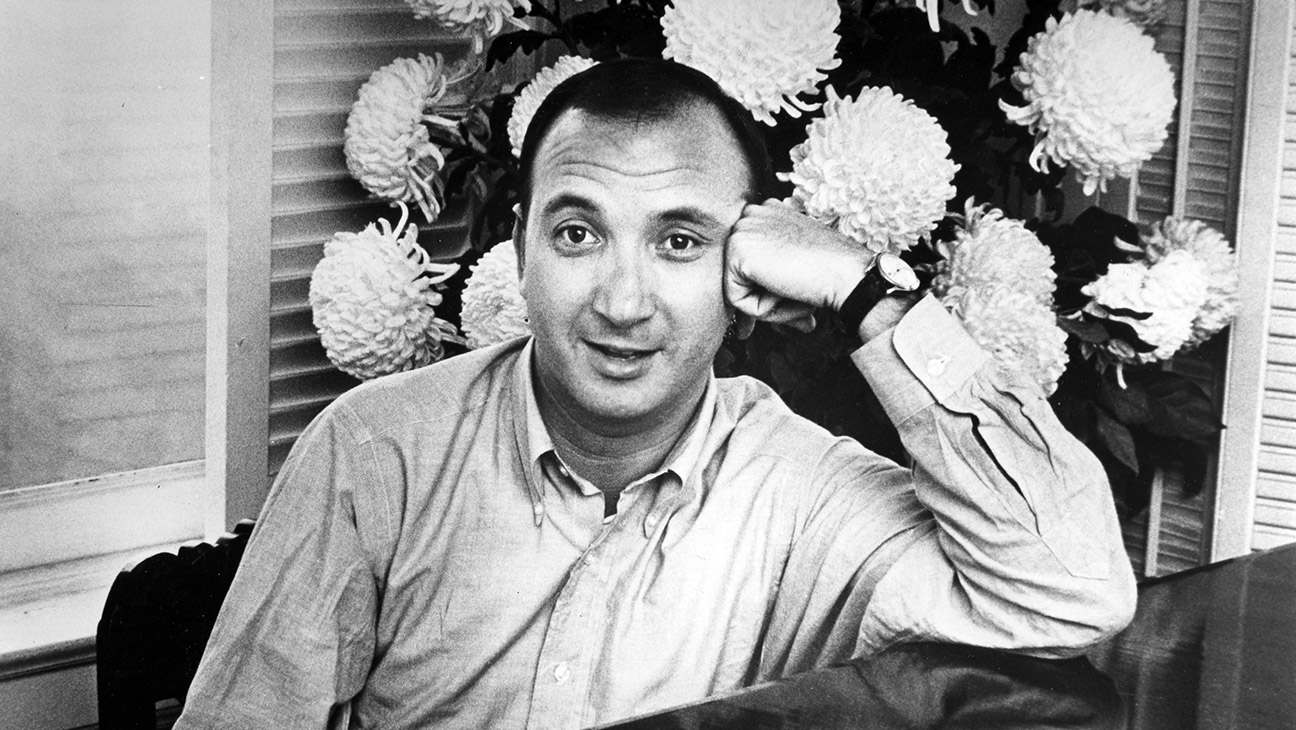
Neil Simon in the 1960s. (Photofest)
1991 Drama winner Neil Simon died from complications of pneumonia, renal failure and Alzheimer's disease in Manhattan on Sunday. He was 91.
An unabashed populist who also refused to pander, Simon enjoyed a three-decade reign as the United States' leading comedic dramatist. In addition to his Pulitzer, he earned four Tony Awards (including a special award for his body of work to 1975), six Writer's Guild of America awards (including the Screen Laurel Award for lifetime achievement), the New York Drama Critics' Circle Award, the Drama Desk Award and the Mark Twain Prize for American Humor.
Tutored by elder brother Danny Simon and radio legend Goodman Ace, Simon honed his talents in the golden age of television as a writer on Sid Caesar and Imogene Coca's "Your Show of Shows" (1950-1954) and the ensuing "Caesar's Hour" (1954-1957). The writing staff assembled by Caesar (including such luminaries as Mel Tolkin, Mel Brooks, Carl Reiner, Selma Diamond, Larry Gelbart and Woody Allen) is widely credited with originating the sketch comedy and sitcom formats.
Even though Simon would continue to work in film (and indirectly, television) for most of his career, ultimately earning four Academy Award nominations, he soon realized that "there is no tradition of the screenwriter, unless he is also the director, which makes him an auteur. So I really feel that I'm writing for posterity with plays, which have been around since the Greek times."
After three years of intermittent work, Simon's first play, "Come Blow Your Horn," was staged on Broadway in 1961. It ran for 678 performances and led to an unparalleled string of commercial successes throughout the decade, including the Caesar vehicle "Little Me" (1962), "Barefoot in the Park" (1963), the franchise-spawning "Odd Couple" (1965), "Sweet Charity" (1966) and "Plaza Suite" (1968).
During the 1966 season, Simon had four plays running on Broadway — a remarkable achievement in a period when New York's Broadway theaters were being repurposed for exploitation films.
Despite decades of bankability, Simon's plays often received mixed reviews; prior to the special award, his lone Tony of the era was for "The Odd Couple." This marginalization was largely informed by what critic Walter Kerr, who maintained that Simon was "one of the finest writers of comedy in American literary history," would characterize as the American tendency "to underrate writers who make them laugh."
In retrospect, another factor may have also been at play. The urban environment (usually, but not always, New York) of Simon's early works was a kind of fantasia perfectly calibrated to the tastes and experiences of its projected audience: New York theatergoers who eschewed the little boxes of Levittown in favor of the edgier prewar glamour exemplified by Oscar Madison and Felix Ungar's "large eight-room affair [...] on Riverside Drive in the upper eighties."
Though not without its own influence in the similarly cloistered '90s New York of Larry David and Jerry Seinfeld, Simon's relegation of the era's social issues to background noise was conspicuous, particularly when considered against the fare of onetime colleague Brooks and 1985 Drama winner Stephen Sondheim. Simon seldom wrote meaningful parts for actors of color and refrained from directly commenting on the counterculture after "The Star-Spangled Girl" (1966) received some of the worst reviews of his career.
While this social diffidence would prove to be an enduring weakness in Simon's oeuvre, it was offset by the increasingly personal and confessional nature of his work. Inspired by and written for Maureen Stapleton, "The Gingerbread Lady" (1970) is a frank exploration of alcoholism and agency in the theater world, while "The Prisoner of Second Avenue" (1971) portrayed the unflinching reality of long-term unemployment during America's first postwar recession. The semi-autobiographical "Chapter Two" (1977) saw Simon dramatize the traumatic 1973 death of his first wife, Joan Baim, and the specter it cast over his tumultuous second marriage to actress Marsha Mason.
By the 1980s, the New York of "Barefoot in the Park," "The Odd Couple" and "Sweet Charity" had taken its place in history alongside the contemporaneous evocations of John Cheever, James Baldwin and Hubert Selby, Jr.
Continuing to write what he knew — with the exception of "The Slugger's Wife" (1985), an unusual film that blended Simon's acutely verbal style with director Hal Ashby's intensely visual acumen in a banal, baseball player-meets-rock singer plot — Simon reached new critical heights with the semi-autobiographical Eugene Trilogy. Set between 1937 and the late 1940s, it traced Eugene Morris Jerome's transformation from awkward Brighton Beach teenager to successful radio comedy writer alongside the dissolution of his family.
"Broadway Bound" (1986), the final work in the trilogy, was Simon's first play to be named as a Pulitzer Prize finalist following the formal designation of the distinction in 1980. Although he had received his third Tony in 1985 for "Biloxi Blues" (1985), the Drama Prize remained unusually elusive.
Simon had first been cited by the 1969 Drama Prize jury in conjunction with "Promises, Promises" (1968), a Burt Bacharach/Hal David-scored musical adapted from Billy Wilder's "The Apartment" (1960); however, Howard Sackler's "The Great White Hope" was recommended unanimously by the jury and received the Prize.
In 1970, "Last of the Red Hot Lovers" (a 1969 après-"Company" farce about a seafood salesman's failed extramarital affairs, unknowingly conducted at his mother's Kips Bay apartment) came in second behind Charles Gordone's winning "No Place to be Somebody." As his uncredited "doctoring" to "A Chorus Line" (1975) was not listed on the book or entry, he did not share in the 1976 Drama Prize.
A year later, "Chapter Two" was invoked as an auxiliary possibility alongside works by future winners David Mamet, Sam Shepard and Wendy Wasserstein — with an unusual caveat.
"There was some feeling that Neil Simon is sooner or later due for recognition," veteran juror and New Yorker critic Brendan Gill wrote in the report. "[B]ut the members did not feel that 'Chapter Two' was the right place for it."
"The right place" finally manifested with "Lost in Yonkers" (1990), which was unanimously recommended for and received the 1991 Drama Prize. Set in 1942, the comic drama chronicles the odyssey of two young teenagers who, by virtue of their mother's recent death and their father's new job as a traveling salesman, are increasingly enmeshed in the taxing dynamics of their family and its imperious matriarch, Grandma Kurnitz. As with many of Simon's works, the play was adapted into a 1993 film.
Simon enjoyed his last original theatrical success with "The Dinner Party" (2000), a one-act comedy about three divorced couples who unknowingly RSVP to the meal in Paris. Even though his influence waned in tandem with his health, his creations have endured in school productions and community theaters across the country, while a revived "Odd Couple" television series ran on CBS from 2015 to 2017.
As New York Times Co-Chief Theater Critic Jesse Green wrote in response to Simon's death, "I like those early works [...] because even though they are comedies, they are coherent as drama. The trick was structure: Mr. Simon’s sense of the situations he devised was so clear he could write boffo gags that did not seem to come from him, but rather from the character and conflict. [...] Sometimes, in the way that can happen when writers momentarily grab the tail of the zeitgeist, the laughs were even prescient."