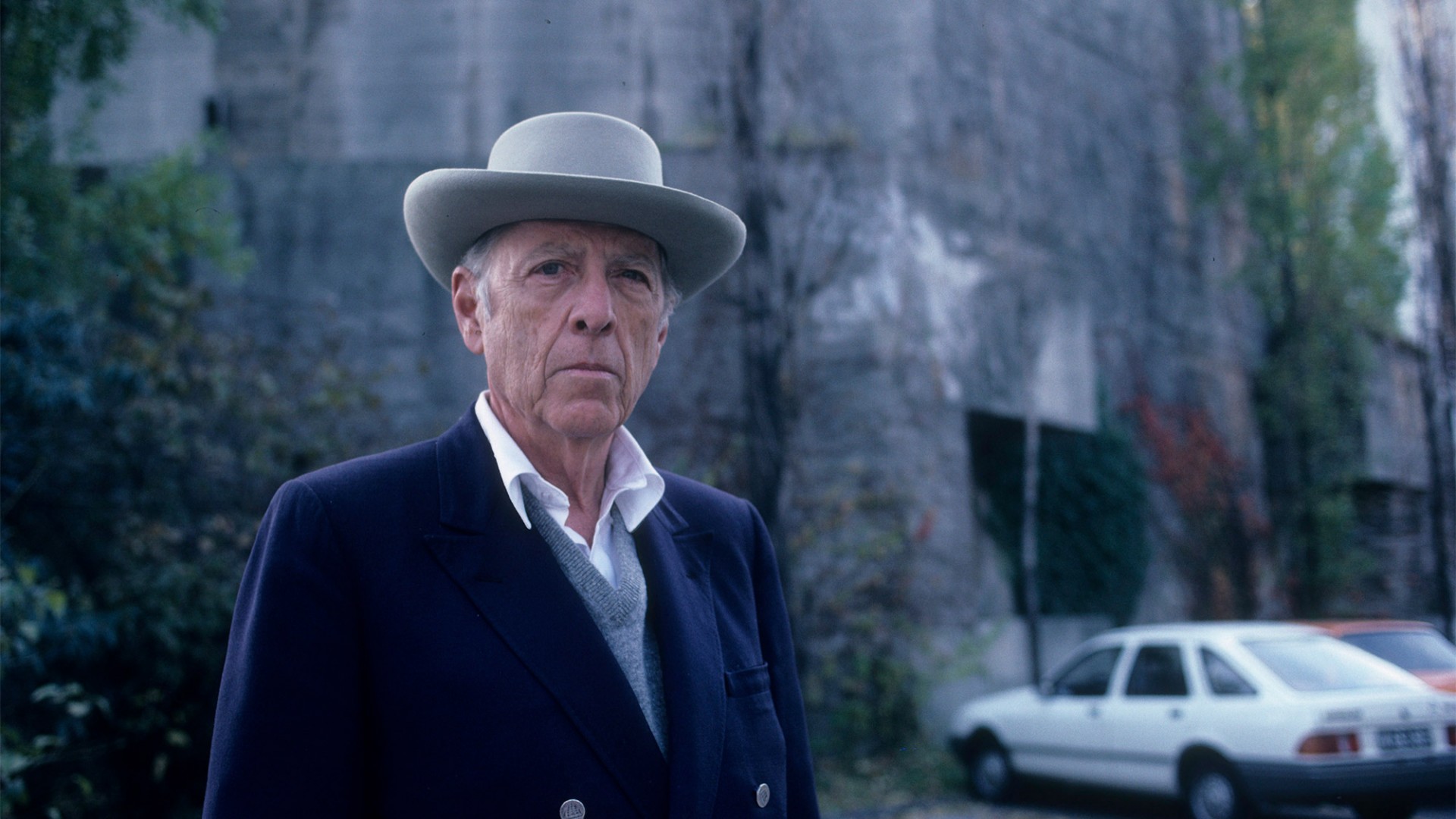
Herman Wouk, c. 1980s. (ABC/Getty Images)
By Sean Murphy
1952 Fiction winner Herman Wouk died in his sleep, his family and literary agent announced Friday. He was 103 and had resided in Palm Springs, Calif. since 1990, following long residencies in Washington, D.C. and the U.S. Virgin Islands. Wouk would have turned 104 on May 27 and was working on a book, said Amy Rennert, his agent.
Over a prolific career that spanned nine decades, Wouk guarded his personal privacy (he seldom gave interviews, leading Ken Ringle of The Washington Post to dub him "the reclusive dean of American historical novelists" on the occasion of his 80th birthday in 1995) and remained devoted both to his family and Modern Orthodox Judaism.
His work translated well to other media: "The Caine Mutiny," Wouk's Pulitzer-winning work, was adapted into a classic 1954 film (starring Humphrey Bogart and Van Johnson) by Edward Dmytryk, while his Tolstoy-and-Thucydides-inspired World War II epic — envisaged as a single work before being released as "The Winds of War" (1971) and "War and Remembrance" (1978) — defined the miniseries vogue of broadcast American television in the 1970s and 1980s. Wouk scripted both adaptations, which starred Robert Mitchum as Navy captain and Franklin Roosevelt confidante Victor "Pug" Henry.
Wouk was born in 1915 in Manhattan. Raised by immigrants from present-day Belarus in the Bronx, his intellectual life largely was shaped by his grandfather, a rabbi from Minsk who introduced him to the Talmud as a teenager.
He found inspiration in American literature as well. "My greatest literary influence, without question, was Mark Twain," he recalled. "My mother bought his complete works from a door-to-door salesman and I'd read them all by the time I was 12."
By the time he was 17, the Wouks — who had started a successful laundry service — could afford to move to Manhattan's Upper West Side, then home to the city's most prosperous Jewish community. Having graduated early from Townsend Harris High School, he enrolled at Columbia University, where he received his degree with honors at age 19, in 1934.
Although he was a diligent student and cultivated lifelong friendships with faculty luminaries Irwin Edman and Jacques Barzun, he remained apolitical throughout the Depression. "My heart was [...] on the third floor of John Jay [Hall], where I served on Spectator, edited Jester [a humor magazine] and watched rehearsals of my Varsity Shows," he told Columbia College Today.
His involvement in campus activities led to post-graduate radio script work with humorist Fred Allen, a leading light of the Golden Age of Radio whose legacy permeated the work of Johnny Carson and David Letterman. As many Americans struggled through the Depression, Wouk "[made] a very good living as a feckless young man [...] seeing shows [...] traveling to Hollywood," where onetime Algonquin Round Table habitués (such as fellow Columbian Herman Mankiewicz) found easy money and mores. He aspired to write a hit Broadway comedy and follow their path.
However, the beginning of World War II and Wouk's first visit to Europe in July 1939 irrevocably altered his life. He already had read "Mein Kampf" in full and donated to anti-Nazi causes — "That was part of being a thoughtful person in those days," he said — but the announcement of the Nazi/Soviet nonagression pact forced him and a fellow Fred Allen writer to curtail their working vacation and take a circuitous path from Cannes to Rotterdam to New York with U-boats on the trails of their ship.
His initial attempts to join the Navy as an officer were unsuccessful; in the prewar climate, an engineering background was still preferred. Pearl Harbor changed that, and he was soon accepted as a midshipman. Wouk ultimately attained the rank of full lieutenant and served on two minesweeper destroyers in the South Pacific, the USS Zane and USS Southard. He served as executive officer of the latter.
"I was the only Jew aboard. I was commanding Americans from all over the country of a sort I had never met [...] living with them, fighting battles with them [...] betting my life on them and having them bet their lives on me," he would later write. It was the defining experience of his life.
Inevitably exhausting his book supply during a long detail, Wouk restocked during shore leave in Auckland with what was available: "Dickens, Thackeray, the Brontes [...] Fielding, Richardson." Soon, the descriptions in his notebooks began to outweigh the dialogue, and the aspiring playwright declared himself a novelist.
As the morally ambiguous modernism of future Pulitzer winners Ernest Hemingway and William Faulkner began to shape a permissiveness in the wartime generation of Norman Mailer, Gore Vidal and Jack Kerouac, Wouk took a different path. The motif of duty recurs throughout his work: extrajudicial duty (in "The Caine Mutiny"), duty to one's faith ("Marjorie Morningstar," an early exploration of Jewish life in America that was subsequently adapted by Irving Rapper with Natalie Wood in the title role) and duty to one's vocation ("Youngblood Hawke," inspired by the seismic rise and early death of Thomas Wolfe).
With a hand from Edman, the contract for Wouk's first novel, "Aurora Dawn" (1947), was relayed to the author while he was stationed off Okinawa. Although it was a Book of the Month Club main selection, his second novel, the Dickensian buildingsroman "City Boy" (1948), was overshadowed by the mammoth success of Mailer's "The Naked and the Dead."
In "The Caine Mutiny," Wouk cast a classic naval trope against the vivid backdrop of World War II, finally earning critical and commercial success. It polarized the 1952 Pulitzer jury — Dartmouth professor Eric Kelly ranked it fourth of fifth among the recommended works, while it was University of Michigan professor Roy Cowden's preference, with the caveat that "I do not find among these books [...] any one that seems to be a really great novel."
Nevertheless, Kelly, who had just turned 68 and did not serve in the conflict, intuitively grasped the visceral appeal of the work despite his reservations: "[E]xcellently written, [it] does seem to possess the pent up feeling of the average American drafted into service in any of the armed forces, a feeling that seldom gets a chance for expression until some creation such as Mr. Wouk's does the job for us." After ratification by the then-Advisory Board and Columbia's trustees, Wouk earned the Pulitzer.
Wouk met his wife, Betty Sarah Brown, a Phi Beta Kappa graduate of the University of Southern California and Navy personnel specialist, while the Zane was undergoing repairs in Los Angeles. "I wrote nothing that was of the slightest consequence before I met Sarah," Wouk said after her death in 2011. "[J]okes work for what they are but they're ephemeral. They just disappear. And that was the kind of thing I did up until the time that I met Sarah and we married. And I would say my literary career and my mature life both began with her."
Following her conversion to Judaism, they married in December 1945 and had three children. His first, Abraham, drowned in a swimming pool in Mexico shortly before his fifth birthday.
Although Wouk arguably never enjoyed critical success on par with "The Caine Mutiny" or commercial success that rivaled his World War II franchise (a fixture of drugstore paperback racks), he remained an active writer, actively enmeshed in the mysteries of his faith ("This Is My God," his 1959 layperson's guide to Judaism, was revised in 1973 and has remained continuously in print) and the implications of cutting-edge science.
One of his later works, "A Hole in Texas" (2004), explored the implications of the discovery of the Higgs boson nearly a decade before its existence was confirmed. Wouk's most influential scientific interlocutor was Manhattan Project veteran and Nobel laureate Richard Feynman, who encouraged the writer to learn calculus and riffed with him on a panoply of subjects during a brief, intense friendship that peaked during a 1973 meeting at the Aspen Institute. He memorialized their meetings in a memoir-meditation titled, "The Language God Talks: On Science and Religion" (2010).
Shortly after the release of his final book, the memoir "Sailor and Fiddler" (2015), Wouk granted rare interviews to several outlets, including CBS News and NPR. "I was very pleased when a book worked and to some extent they've all worked to my satisfaction," he told the latter organization. "In that I'm a very happy gent of 100."